
Table of Contents
(State or other jurisdiction of incorporation or organization) |
(Primary Standard Industrial Classification Code Number) |
(I.R.S. Employer Identification Number) |
| Large accelerated filer | ☐ | Accelerated filer | ☐ | |||
| ☒ | Smaller reporting company | |||||
| Emerging growth company | ||||||
Table of Contents
The information in this prospectus is not complete and may be changed. We may not sell these securities until the registration statement filed with the Securities and Exchange Commission is effective. This prospectus is not an offer to sell these securities and we are not soliciting an offer to buy these securities in any jurisdiction where the offer or sale is not permitted.
SUBJECT TO COMPLETION, DATED NOVEMBER 20, 2026
PRELIMINARY PROSPECTUS

ContextLogic Holdings Inc.
Subscription Rights to Purchase Up to $650,000,000 in Shares of Common Stock, representing 72,222,222 Shares of ContextLogic Common Stock in the Aggregate
We are conducting a rights offering pursuant to which we are distributing to the holders of ContextLogic Holdings Inc. (“ContextLogic” or the “Company”) common stock, par value $0.0001 per share (“ContextLogic common stock” or “our common stock”), subscription rights to purchase up to 72,222,222 shares of ContextLogic common stock (the “Rights Offering”). Holders of ContextLogic common stock will receive a subscription right at no charge for each share of ContextLogic common stock owned at 5:00 p.m. in New York City, on , 2026 (the “Effective Date”). The subscription rights are not separable from the ContextLogic common stock to which they are attached and prior to their exercise will only be transferable to the extent that the shares of ContextLogic common stock to which they are attached are transferred from and after the Effective Date. Subscription rights attach to the ContextLogic common stock in respect of which they are issued and will not be separately transferable. ContextLogic common stock is traded on the OTCQB Venture Market on the OTC Markets (“OTCQB”) under the symbol “LOGC.” On November 19, 2026, the last reported sale price of ContextLogic common stock on OTCQB was $13.00 per share.
Each subscription right will entitle the holder to purchase 1.57849 shares of ContextLogic common stock at an exercise price of $9.00 per share. Holders who exercise their subscription rights in full may over-subscribe for additional shares, to the extent shares are available, subject to certain limitations described herein for a stockholder who would become a 4.9% or greater holder of ContextLogic common stock as a result of such subscription (or any existing 4.9% or greater stockholder increasing its percentage ownership of ContextLogic common stock). If all of the subscription rights are exercised in this Rights Offering, the total purchase price for the ContextLogic common stock sold in the Rights Offering will be $650 million.
This Rights Offering is being conducted in connection with the pending acquisition of EagleTree-Gaylord Holdings Corp., a Delaware corporation, and its subsidiaries (“gChem” and such transaction, the “gChem Acquisition”), by GCH Buyer, Inc., a Delaware corporation (the “Buyer”) and an indirect, wholly owned subsidiary of ContextLogic Holdings, LLC (“Holdings”), a subsidiary of the Company in which the Company currently directly and indirectly holds approximately 44% of the fully-diluted outstanding equity and conducts its operations. Certain institutional investors, including investment funds advised by BC Partners Advisors LP (“BC Partners”) and investment funds being advised by Abrams Capital Management, L.P. (“Abrams Capital”), are investors in Holdings. Pursuant to the Stock Purchase Agreement, dated August 4, 2026, as amended on October 22, 2026 (the “Purchase Agreement”), the Buyer will acquire gChem for $850 million at closing, which will occur no later than the contractual outside date of May 1, 2027 (the “Outside Date”). We expect the consideration for the gChem Acquisition to come from the financings described herein, including this Rights Offering, and cash on hand. This Rights Offering will close prior to the closing of the gChem Acquisition. However, this Rights Offering is not contingent upon the other financings described herein. There can be no assurance that the gChem Acquisition or such financings will be consummated on the terms described herein, or at all. See “The gChem Acquisition, Backstop Agreements and Financing Arrangements.” We reserve the right to cancel this Rights Offering at any time. If this Rights Offering is canceled or if the gChem Acquisition is not consummated, the exercise price will be promptly returned by wire to exercising holders, without interest or deduction. If the Rights Offering is canceled, the subscription rights will not be exercisable and will have no value. Delivery of purchased shares will take place as soon as practicable after the closing of the Rights Offering.
Table of Contents
In connection with its entry into the Purchase Agreement, (i) Holdings entered into equity financing commitments with certain investors for an aggregate of $870 million (the “Backstop Agreements”) and (ii) Buyer obtained a debt financing commitment arranged by Blackstone Alternative Credit Advisors LP and Blackstone Holdings Finance Co. L.L.C. (together with Blackstone Alternative Credit Advisors LP, “Blackstone”) and Wells Fargo Securities, LLC, comprising a $250 million term loan (the “Term Facility”) and a $25 million revolving credit facility (the “Revolving Facility” and, together with the Term Facility, the “Facilities” or “Financing”). The Backstop Agreements will be reduced by both (i) the proceeds from the Term Facility and (ii) amounts raised in the Rights Offering used to finance all or a portion of the consideration due under the Purchase Agreement and related fees and expenses, subject to complying with the Backstop Agreements’ guaranteed minimum issuance amounts. In addition to issuances pursuant to the Backstop Agreements, Holdings may issue Class A convertible preferred units (“Class A Units”) to certain other of Holdings’ existing institutional holders or their affiliates for cash at a price of $9.00 per Class A Unit. If both the Rights Offering is subscribed in full and Holdings makes all contemplated guaranteed minimum issuances under the Backstop Agreements and to other existing investors, it could result in a total equity raise by Holdings of up to $850 million for use in both the gChem transaction and other corporate purposes.
The subscription rights are exercisable beginning on the date of this prospectus and will expire if they are not exercised by 5:00 p.m. in New York City, on , 2026 (the “Expiration Time”), unless extended by us from time to time in our sole discretion. Subscription rights that are not exercised by the Expiration Time of the Rights Offering will expire and will have no value.
During the period of the Rights Offering (i.e., following the Effective Date and until the Expiration Time (the “Rights Offering Period”)), the subscription rights will remain attached to and trade along with the associated ContextLogic common stock. To indicate that the ContextLogic common stock is trading with the associated subscription rights attached, the ContextLogic common stock is expected to trade under the symbol “LOGCD” for the duration of the Rights Offering Period. Therefore, if a holder transfers shares of ContextLogic common stock during the period of the Rights Offering, the subscription rights associated with those shares of ContextLogic common stock will transfer along with the shares of ContextLogic common stock. Upon submission of a holder’s ContextLogic common stock for exercise of subscription rights, the ContextLogic common stock will be held in a suspense account and will cease to trade. Since stock trades may take a business day to settle, trades made by holders on the last day of the Rights Offering Period would settle following the Expiration Time and therefore would not settle with the subscription right (and as a result would not participate in the Rights Offering). The rights are not separately tradable or transferable from the shares of ContextLogic common stock. At consummation of the Rights Offering, the ContextLogic common stock to be issued pursuant to validly exercised subscription rights will be issued, and the associated ContextLogic common stock will be released from the suspense account and returned to the holders who exercised such subscription rights. Upon submission of a holder’s exercise of subscription rights, such holder’s ContextLogic common stock may be held in the suspense account until no later than three business days after the earlier of the (i) Expiration Time or (ii) cancellation of the Rights Offering, and in no event later than May 5, 2027, the third business day following the Outside Date under the Purchase Agreement. From and after the Expiration Time, the ContextLogic common stock will again trade under the symbol “LOGC”.
Holders who exercise their subscription rights will not be entitled to revoke their exercise. Holders who do not exercise their subscription rights will relinquish any value inherent in the subscription rights and their relative percentage ownership level of outstanding ContextLogic common stock will decrease as a result of the increase in outstanding ContextLogic common stock resulting from this Rights Offering.
In order to preserve certain of our tax attributes, ContextLogic’s Second Amended and Restated Certificate of Incorporation (as amended from time to time, the “Certificate of Incorporation”) contains restrictions on transfer to prohibit any person, entity or group from becoming a holder of 4.9% or greater of ContextLogic common stock, the increase in ownership of any existing stockholder who owns 4.9% or greater of ContextLogic common stock and certain transfers by a stockholder holding 4.9% or more of outstanding shares of ContextLogic common stock. As a result, there are limitations on the exercise of the subscription rights, including the over-subscription rights, as described in this prospectus if, as a result of
Table of Contents
such subscription a stockholder would become (or otherwise be) a 4.9% or greater holder of ContextLogic common stock upon completion of the Rights Offering without the approval of our Board.
We are a smaller reporting company as defined in Rule 12b-2 promulgated under the Securities Exchange Act of 1934, as amended (the “Exchange Act”). As such, we have elected to rely on certain reduced public company disclosure requirements.
We are not requiring a minimum individual or overall subscription to complete this Rights Offering. In connection with this Rights Offering, we have engaged Kroll Restructuring Administration LLC d/b/a Kroll Issuer Services (US) (“Kroll”) to serve as the rights agent and information agent. The rights agent will hold in escrow the funds we receive from subscribers until we complete or cancel the Rights Offering.
This prospectus is not an offer to sell or a solicitation of an offer to buy any securities other than those being offered in this Rights Offering.
This prospectus is not an offer to sell and we are not soliciting an offer to buy in any state or other jurisdiction in which the offer or sale is not permitted, see “Plan of Distribution” in this prospectus.
Neither the Securities and Exchange Commission (the “SEC”) nor any state securities commission has approved or disapproved of these securities or passed upon the adequacy or accuracy of this prospectus. Any representation to the contrary is a criminal offense.
Investing in our securities involves risks. You should carefully review and consider the information contained in this prospectus, including the risk factors beginning on page 32 of this prospectus, as well as the risk factors and other information contained in any documents we incorporate by reference into this prospectus before exercising your subscription rights. See “Where You Can Find More Information”. Neither the Securities and Exchange Commission nor any state securities regulators have approved or disapproved of these securities or determined if this prospectus is truthful or complete. Any representation to the contrary is a criminal offense.
The date of this prospectus is , 2026.
3
Table of Contents
TABLE OF CONTENTS
| Page | ||||
| 1 | ||||
| 2 | ||||
| 3 | ||||
| 4 | ||||
| 5 | ||||
| 6 | ||||
| 14 | ||||
| 21 | ||||
| 29 | ||||
| 32 | ||||
| 72 | ||||
| 73 | ||||
| 74 | ||||
| 76 | ||||
| THE GCHEM ACQUISITION, BACKSTOP AGREEMENTS AND FINANCING ARRANGEMENTS |
77 | |||
| 78 | ||||
| UNAUDITED PRO FORMA CONDENSED COMBINED FINANCIAL INFORMATION |
89 | |||
| MANAGEMENT’S DISCUSSION AND ANALYSIS OF FINANCIAL CONDITION AND RESULTS OF OPERATIONS |
120 | |||
| 137 | ||||
| 165 | ||||
| 169 | ||||
| 183 | ||||
| 184 | ||||
| 185 | ||||
| 190 | ||||
| 196 | ||||
| SECURITY OWNERSHIP OF CERTAIN BENEFICIAL OWNERS AND MANAGEMENT |
200 | |||
| 202 | ||||
| 203 | ||||
| 204 | ||||
i
Table of Contents
ABOUT THIS PROSPECTUS
This prospectus is part of a registration statement that we have filed with the SEC. The exhibits to the registration statement contain the full text of certain contracts and other important documents we have summarized in this prospectus. Since these summaries may not contain all the information that you may find important in deciding whether to purchase our securities, you should review the full text of these documents. The registration statement and the exhibits can be obtained from the SEC as indicated under the section entitled “Where You Can Find More Information.”
You should rely only on the information contained in this prospectus with respect to this Rights Offering. No one has been authorized to provide you with information that is different from that contained in this prospectus with respect to the Rights Offering. This prospectus is dated as of the date set forth on the cover hereof. You should not assume that the information contained in this prospectus is accurate as of any date other than that date.
The distribution of this prospectus and this Rights Offering and the sale of our securities in certain jurisdictions may be restricted by law. No action has been taken in any jurisdiction outside the United States to permit an offering of our securities or possession or distribution of this prospectus in that jurisdiction. The securities offered by this prospectus may not be offered or sold, directly or indirectly, nor may this prospectus or any other offering material or advertisements in connection with the offer, issue and sale of any such securities be distributed or published in any jurisdiction, except under circumstances that will result in compliance with the applicable rules and regulations of that jurisdiction. Persons into whose possession this prospectus comes are advised to inform themselves about and to observe any restrictions relating to the offering and the distribution of this prospectus.
We have not authorized anyone to provide any information other than that contained in this prospectus or in any free writing prospectus prepared by or on behalf of us or to which we have referred you. We take no responsibility for, and can provide no assurance as to the reliability of, any other information that others may give you. You should assume that the information appearing in this prospectus is accurate only as of the date on its cover page. Our business, financial condition, results of operations and prospects may have changed since those dates.
1
Table of Contents
INDUSTRY AND MARKET DATA
The industry and market data and other statistical information used throughout this prospectus are based on independent industry publications, government publications, reports by market research firms or other published independent sources. Some data is also based on our good faith estimates. Although we believe these sources are reliable, we have not independently verified the information and cannot guarantee its accuracy and completeness.
Some information in this prospectus concerning processing volumes, market demand and other industry information, including general expectations concerning dimethyl sulfoxide (“DMSO”) and related specialty chemicals, are based on estimates prepared by gChem using certain assumptions and their knowledge of these industries as well as data from third party sources. Additionally, some information in this prospectus concerning processing volumes, market demand and other industry information, including general expectations concerning evaporated salt, salt manufacturing and other salt products, are based on estimates prepared by US Salt Parent Holdings, LLC, a Delaware limited liability company (“US Salt”) using certain assumptions and their knowledge of these industries as well as data from third party sources. These estimates, in particular as they relate to our general expectations concerning the salt industry and DMSO industry, involve risks and uncertainties and are subject to changes based on various factors, including those discussed under “Risk Factors” in this prospectus.
2
Table of Contents
TRADEMARKS
This prospectus contains references to our trademarks and service marks and to those belonging to other entities. Solely for convenience, trademarks and trade names referred to in this Rights Offering circular may appear without the ® or TM symbols, but such references are not intended to indicate, in any way, that we will not assert, to the fullest extent under applicable law, our rights or the rights of the applicable licensor to these trademarks and trade names. We do not intend our use or display of other companies’ trade names, trademarks or service marks to imply a relationship with, or endorsement or sponsorship of us by, any other companies.
3
Table of Contents
NON-GAAP FINANCIAL INFORMATION
This prospectus includes certain non-GAAP financial measures that are not prepared in accordance with accounting principles generally accepted in the United States (“GAAP”) including, among others, EBITDA, Adjusted EBITDA and free cash flow, and that may be different from non-GAAP financial measures used by other companies. The Company believes that the use of these non-GAAP financial measures provides an additional tool for investors and potential investors to use in evaluating its ongoing operating results and trends. These non-GAAP measures should not be considered in isolation from, or as an alternative to, financial measures determined in accordance with GAAP. To the extent that forward-looking non-GAAP financial measures are provided, they are presented on a non-GAAP basis without reconciliations of such forward-looking non-GAAP measures due to the inherent difficulty in forecasting and quantifying certain amounts that are necessary for such reconciliation.
Our calculation of EBITDA, Adjusted EBITDA and Free Cash Flow may be different from the calculation used by other companies for non-GAAP financial measures having the same or similar names; therefore, they may not be comparable to other companies. See “Management’s Discussion and Analysis of Financial Conditions and Results of Operations - Non-GAAP Financial Measures” for reconciliations of EBITDA, Adjusted EBITDA and free cash flow to the most comparable GAAP measure for each.
4
Table of Contents
PRESENTATION OF ACQUIRED COMPANY FINANCIAL INFORMATION
The financial information included in this Registration Statement with respect to the gChem Acquisition is financial information of EagleTree-Gaylord Holdings Corp. and subsidiaries.
The financial information included in this Registration Statement with respect to the acquisition of US Salt (the “US Salt Acquisition”) is financial information of US Salt Parent Holdings, LLC and subsidiaries.
Additionally, financial information included in this Registration Statement with respect to the Company after the date of the US Salt Acquisition, the period from February 27, 2026 through September 30, 2026 (Successor), include the Company’s consolidation of US Salt into ContextLogic, reflecting US Salt on a new basis in accordance with application of acquisition accounting. The Company is presenting US Salt as the predecessor to the post-acquisition consolidated ContextLogic entity and as a result has presented activity of stand-alone US Salt in periods prior to February 26, 2026 (Predecessor Periods). To provide meaningful and comparable information, the Company is also presenting Combined results-a non-GAAP measure that adds the period from January 1, 2026 through February 26, 2026 (Predecessor) and the period from February 27 through September 30, 2026 (Successor)-to compare against the nine months ended September 30, 2025 (Predecessor).
5
Table of Contents
QUESTIONS AND ANSWERS ABOUT THIS RIGHTS OFFERING
The following are examples of what we anticipate will be common questions about the Rights Offering. The answers are based on selected information included elsewhere in this prospectus. The following questions and answers do not contain all of the information that may be important to you and may not address all of the questions that you may have about the Rights Offering. This prospectus contains more detailed descriptions of the terms and conditions of the Rights Offering and provide additional information about us and about our business, including potential risks related to the Rights Offering, our common stock and our business. Exercising the subscription rights and investing in our securities involve a high degree of risk. We urge you to carefully read the “Risk Factors” section of this prospectus and all other information included in this prospectus in its entirety before you decide whether to exercise your subscription rights.
| Q: | What are we offering in this prospectus? |
| A: | We are conducting a rights offering. We issued a subscription right with respect to each share of ContextLogic common stock outstanding as of the close of business on the Effective Date at no charge to our stockholders. Through this prospectus, we are offering the shares of ContextLogic common stock that holders of subscription rights may purchase upon exercise of their subscription rights. |
| Q: | Who may participate in this Rights Offering? |
| A: | We distributed subscription rights to the holders of ContextLogic common stock as of the close of business on the Effective Date. Since the subscription rights attach to these shares of ContextLogic common stock and trade with them until they are exercised or the Expiration Time, any purchaser or other transferee of these shares of ContextLogic common stock after the Effective Date and prior to the expiration or termination of this Rights Offering will be permitted to exercise the subscription rights attached – or “stapled” – to such shares of ContextLogic common stock. |
| Q: | What is the basic subscription right each subscription right gives me the right to purchase? |
| A: | Each subscription right issued under this Rights Offering entitles you to purchase 1.57849 shares of ContextLogic common stock at an exercise price of $9.00 per share. You may exercise any number of your subscription rights, or you may choose not to exercise any of the subscription rights issued to you. We will not distribute any fractional shares, but instead will round fractional shares down to the nearest whole share of ContextLogic common stock. |
| Q: | What is the over-subscription right? |
| A: | We do not expect all of our stockholders to exercise all of their basic subscription rights. The over-subscription right provides stockholders who are not currently 4.9% or greater stockholders that exercise all of their basic subscription rights the opportunity to subscribe for additional shares of our common stock at the same exercise price, if any shares are not purchased by other holders of subscription rights who are similarly not currently 4.9% or greater stockholders under the basic subscription rights as of the Expiration Time. If an insufficient number of shares are available to fully satisfy all over-subscription right requests, the available shares will be distributed proportionately among such rights holders who exercise their over-subscription right based on the number of shares each such rights holder subscribed for under the basic subscription right, subject to the limitations described herein regarding the exercise of some or all of a holder’s subscription rights in this Rights Offering to the extent that such exercise may result in such holder becoming a 4.9% or greater stockholder. Holders that are currently 4.9% or greater stockholders will not be permitted to exercise over-subscription rights. The subscription agent will return any excess payments by wire without interest or deduction promptly after the expiration of the subscription period. |
6
Table of Contents
| Q: | How long will the subscription period last? |
| A: | You will be able to exercise your subscription rights only until the Expiration Time, which is by 5:00 p.m. in New York City, on , 2026. If you do not exercise your subscription rights before the Expiration Time, your subscription rights will expire and be of no further value. We may, in our sole discretion, as described below decide to extend this Rights Offering until some later time or may choose to terminate the Rights Offering. If we extend the expiration time, we will give oral or written notice to the rights agent on or before the Expiration Time, followed by a press release no later than 5:00 p.m., New York City time, on the next business day after the previously scheduled Expiration Time. If we elect to extend the Rights Offering for a period of more than 30 days, then holders who have subscribed for rights may cancel their subscriptions and receive a refund of all money submitted to date. |
| Q: | Is there any limit on how long the subscription period will last? |
| A: | Although the Rights Offering is scheduled to remain open until the Expiration Time, we retain the ability to extend the Rights Offering for as long or as many times as our Board determines is necessary to consummate the Rights Offering or otherwise in our best interests. |
| Q: | Am I required to participate in this Rights Offering? |
| A: | No. |
| Q: | What happens if I choose not to exercise my subscription rights? |
| A: | You will retain your current number of shares of ContextLogic common stock even if you do not exercise your subscription rights. If you choose not to exercise your subscription rights, then the percentage of ContextLogic common stock that you own is expected to decrease upon closing of this Rights Offering. The magnitude of the reduction of your percentage ownership will depend upon the extent to which you and the other stockholders exercise their rights. See “Risk Factors – Risks Related to The Rights Offering – Holders who do not fully exercise their subscription rights will have their interests diluted” for more information regarding the amount of potential dilution. |
| Q: | How do I exercise my subscription rights? |
| A: | If you are a holder of ContextLogic common stock, you may exercise your subscription rights by taking the following steps and ensuring the exercise is fully completed in the manner described below at or prior to the Expiration Time: |
Procedure for holders of record of ContextLogic common stock:
If you are a holder of record and you hold your shares of ContextLogic common stock in book-entry form, you must provide the following to the rights agent at the address set forth below so they are received at or prior to the Expiration Time:
| • | your properly completed election submission with any required signature guarantees or other supplemental documentation; |
| • | an attestation that the new shares will be received by, or held on account of, the same beneficial owner of the shares to which the subscription rights were attached; and |
| • | your full exercise price payment for each share of ContextLogic common stock subscribed for based upon your basic subscription rights and over-subscription rights, if applicable. |
All of the above must be RECEIVED by the rights agent by the Expiration Time via the E-Form available at the following address: https://deals.is.kroll.com/contextlogic.
7
Table of Contents
Holders of record of ContextLogic common stock who exercise their subscription rights will be deemed to have surrendered the shares of ContextLogic common stock stapled to such subscription rights, and such shares will be frozen from transfer from the time of subscription until the earlier of (i) delivery of any shares received pursuant to the exercise of subscription rights or (ii) cancellation of this Rights Offering. Any attempted transfer of such shares prior to the conclusion of the rights offering will result in the cancellation of the holder’s subscription election and the return of their payment, without interest, as soon as practicable thereafter.
Procedure for holders of ContextLogic common stock through a broker, bank or other nominee:
If you are a holder and you hold shares of ContextLogic common stock through the Depository Trust Company (“DTC”), you must arrange to have your broker, bank or other nominee effect all required steps on your behalf by the requisite deadlines so that DTC may convey your subscription exercise to the rights agent at or prior to the Expiration Time.
| • | you must provide your instructions to your broker, bank, or other nominee (in the format requested by your nominee) to instruct DTC to transfer your shares of ContextLogic common stock associated with the subscription rights to be exercised to a suspense account at DTC on behalf of the rights agent, to be held in escrow for you until after the Expiration Time; |
| • | you must also provide instructions to your broker, bank, or other nominee (in the format requested by them) of the number of shares of ContextLogic common stock for which you wish to have your nominee exercise the associated subscription rights on your behalf at the exercise price; |
| • | you must make any necessary payment arrangements with your broker, bank, or other nominee; |
| • | you must follow any special instructions provided to you by your broker, bank, or other nominee (in the format requested by your nominee) with respect to the exercise of your subscription rights, including attesting that the new shares will be received by, or held on account of, the same beneficial owner of the shares to which the subscription rights were attached; and |
| • | upon submission of your exercise of subscription rights, your shares of ContextLogic common stock will be held in a suspense account until after the Expiration Time, at which time your shares will be returned to your nominee on your behalf. See “The Rights Offering – Rights Agent; Delivery of Subscription Materials and Payment.” |
DO NOT SEND ANY INSTRUCTIONS TO US OR THE RIGHTS AGENT. YOUR INSTRUCTIONS MUST BE PROVIDED TO YOUR BROKER, BANK, OR OTHER NOMINEE (IN THE FORMAT REQUESTED BY YOUR NOMINEE).
Upon submission of your ContextLogic common stock for exercise of subscription rights, the ContextLogic common stock will be held in a suspense account and will cease to trade. Since stock trades may take a business day to settle, trades made by holders on the last day of the Rights Offering Period would settle following the Expiration Time and therefore would not settle with the subscription right (and as a result would not participate in the Rights Offering). The rights are not separately tradable or transferable from the shares of ContextLogic common stock. At consummation of the Rights Offering, the ContextLogic common stock to be issued pursuant to your validly exercised subscription rights will be issued, and the associated ContextLogic common stock will be released from the suspense account and returned to you.
The rights agent will not deliver any certificates to, or make book-entry transfers on behalf of, any holder in California, or any other state where qualification is required, unless and until the offer and sale of the subscription rights and ContextLogic common stock have been qualified in that state.
The Company may choose to qualify its ContextLogic common stock in Arizona, rely on the limited offering exemption which requires a $500,000 cap, or rely on a self-executing exemption. The aggregate amount of ContextLogic common stock we are offering to Arizona residents pursuant to this Rights Offering is limited to
8
Table of Contents
$500,000, and we will not issue more than this amount of ContextLogic common stock to holders of subscription rights residing in Arizona upon exercise of their subscription rights. Therefore, unless we choose to qualify the offering in Arizona or can rely on a separate exemption for any subscription, if the rights agent receives exercise documentation that otherwise would require us to issue to Arizona residents more than $500,000 (or approximately 55,556 shares assuming an offering price of $9.00 per share) of ContextLogic common stock, we will issue to all such exercising holders their pro rata portion of such amount of ContextLogic common stock and return the excess payment amount, if any, to such stockholders, without interest, as soon as practicable after the Expiration Time.
| Q: | What should I do if I want to exercise my subscription rights but my shares are held in the name of my broker, custodian bank or other nominee? |
| A: | If you hold shares of ContextLogic common stock through a broker, custodian bank or other nominee, we will ask your broker, custodian bank or other nominee to notify you of this Rights Offering. If you wish to exercise your subscription rights, you will need to have your broker, custodian bank or other nominee act for you. To indicate your decision, you should complete and return to your broker, custodian bank or other nominee the forms provided by them. You should receive this form from your broker, custodian bank or other nominee with the other offering materials. You should contact your broker, custodian bank or other nominee if you believe you are entitled to participate in this Rights Offering but you have not received this form. |
| Q: | What restrictions may there be on my right to exercise my subscription rights? |
| A: | Our ability to utilize net operating losses (“NOLs”) could be greatly reduced if we were to undergo an “ownership change” as that term is defined under federal income tax regulations. In order to preserve certain of our tax attributes, the Certificate of Incorporation and the Rights Offering contain restrictions on transfer to prohibit, absent written approval of the board of directors of the Company (the “Board”) or a committee thereof, any person, entity or group from becoming a holder of 4.9% or greater of ContextLogic common stock, the increase in ownership of any existing stockholder who owns 4.9% or greater of ContextLogic common stock, or certain transfers by a stockholder holding 4.9% or more of outstanding shares of ContextLogic common stock. As a result, there are limitations on the exercise of the subscription rights as described in this prospectus. Without the approval of our Board, no holder will be issued shares as a result of such subscriptions if the holder will hold 4.9% or greater of outstanding ContextLogic common stock following completion of the Rights Offering, which if this Rights Offering is fully subscribed, will be 5,780,821 shares. Therefore, in order to comply with the transfer restriction mechanics of the Certificate of Incorporation and this Rights Offering, and avoid an “ownership change” as a result of this Rights Offering: (1) by exercising subscription rights, each holder will represent to us that such holder was not an owner, directly or indirectly (as described in this prospectus and the transfer restrictions), of 4.9% or more of outstanding shares of ContextLogic common stock or 2,241,933 shares based on 45,753,716 shares of ContextLogic common stock outstanding as of September 30, 2026 (unless such holder has previously obtained an applicable waiver from the Board); (2) if such exercise would result in such holder owning, directly or indirectly, more than 2,241,933 shares of ContextLogic common stock, such holder must notify the information agent at the email address set forth under “The Rights Offering – Information Agent; Questions about Exercising Subscription Rights”; (3) if requested, each holder will provide us with additional information regarding the amount of ContextLogic common stock that the holder owns; (4) we may instruct the rights agent to hold any subscription payments separately pending our determination of any ownership issues; and (5) we will have the right to instruct the rights agent to refuse to honor such holder’s exercise to the extent such exercise of subscription rights, including over-subscription rights, might, in our sole and absolute discretion, result in such holder owning 4.9% or more of ContextLogic common stock. By exercising subscription rights in this Rights Offering, you agree that the transfer restriction mechanics in the Certificate of Incorporation and this Rights Offering are valid, binding and enforceable against you. See “The Rights Offering – Transfer Restrictions” for a discussion on the transfer restrictions. |
9
Table of Contents
| Q: | What should I do if I want to exercise my subscription rights and I am a stockholder in a foreign country or in the Armed Services? |
| A: | The rights agent will not mail any Rights Offering materials to you if you are a holder of subscription rights whose address is outside the United States or if you have an Army Post Office or a Fleet Post Office address. To exercise your rights, you must notify the rights agent on or prior to 5:00 p.m., New York City time, on , 2026, and take all other steps which are necessary to exercise your rights, on or prior to that time. If you do not follow these procedures prior to the Expiration Time, your rights will expire. |
| Q: | Will I be charged a sales commission or a fee if I exercise my subscription rights? |
| A: | No. We will not charge a brokerage commission or a fee to rights holders for exercising their subscription rights. However, if you exercise your subscription rights through a broker or nominee, you will be responsible for any fees charged by your broker or nominee. |
| Q: | What are the United States federal income tax consequences of exercising my subscription rights as a holder of ContextLogic common stock? |
| A: | A holder of ContextLogic common stock generally will not recognize income or loss for federal income tax purposes in connection with the receipt or exercise of subscription rights in this Rights Offering. We urge you to consult your own tax advisor with respect to the particular tax consequences of this Rights Offering to you. See “Material U.S. Federal Income Tax Consequences” for more information on the tax consequences of this Rights Offering. |
| Q: | When will I receive the shares purchased in this Rights Offering? |
| A: | The transfer agent will make the necessary book-entry issuances representing shares purchased in this Rights Offering to you or to the DTC on your behalf, as the case may be, as soon as reasonably practicable after the completion of the Rights Offering, which is expected to occur immediately prior to the closing of the gChem Acquisition and will follow the Expiration Time. |
| Q: | If this Rights Offering is not completed, will my subscription payment be refunded and my shares of ContextLogic common stock be returned to me? |
| A: | Yes. The rights agent will hold all funds it receives and shares of ContextLogic common stock in escrow until completion of this Rights Offering. If this Rights Offering is not completed, the rights agent will return promptly, without interest, all subscription payments and shares of ContextLogic common stock. |
| Q: | Are there risks in exercising my subscription rights? |
| A: | Yes. The exercise of your rights involves risks. Exercising your rights means buying additional shares of ContextLogic common stock and should be considered as carefully as you would consider any other equity investment in our company. Among other things, you should carefully consider the risks described under the heading “Risk Factors,” in this prospectus. |
| Q: | After I exercise my subscription rights, can I change my mind and cancel my purchase? |
| A: | No. Once you submit your election submission, shares of ContextLogic common stock and payment, you will not be able to revoke the exercise of your subscription rights even if you later learn information about us that you consider to be unfavorable and even if the market price of ContextLogic common stock is below the exercise price. You should not exercise your subscription rights unless you are certain that you wish to purchase additional shares of ContextLogic common stock at the exercise price. |
10
Table of Contents
| Q: | May I transfer my subscription rights if I do not want to purchase any shares? |
| A: | No. The subscription rights attach to shares of ContextLogic common stock and are not separately transferable. Transfer of ownership of a share of ContextLogic common stock, however, after the Effective Date and before the earlier of the Expiration Time or any subscription right associated with such share is exercised will also transfer ownership of the subscription right issued with respect to such share. If you choose to exercise your subscription rights, you will not be able to transfer your shares of ContextLogic common stock that are “stapled” to such subscription rights until the Rights Offering is completed or canceled. |
| Q: | Can I sell my shares after I have exercised my subscription rights? |
| A: | No. In order to subscribe for the rights issued to you as a holder of ContextLogic common stock, you must submit your shares of ContextLogic common stock, with your election submission and payment of the exercise price. The shares of ContextLogic common stock submitted as part of the subscription process will not be transferable until they are returned to you upon completion or cancellation of the Rights Offering. |
| Q: | If I purchase shares after the Rights Offering has commenced, will I be able to participate in the Rights Offering? |
| A: | Yes, upon commencement of the Rights Offering and distribution of the subscription rights to holders, the shares of ContextLogic common stock and the subscription rights that are “stapled” to the ContextLogic common stock. Since stock trades may take a business day to settle, please note that if you purchase shares late in the Rights Offering period, you may not receive your shares in time to exercise the attached subscription rights. We are under no obligation, and have no intention, to adjust our procedures to accommodate holders who acquire shares after the Rights Offering has commenced. Additionally, since stock trades may take a business day to settle, trades made by holders on the last day of the Rights Offering Period would settle following the Expiration Time and therefore would not settle with the subscription right (and as a result would not participate in the Rights Offering). Holders should submit their trades before the last day of the Rights Offering Period. We are under no obligation, and have no intention, to adjust our procedures to accommodate holders who acquire shares of ContextLogic common stock after the Rights Offering has expired. |
| Q: | Why is ContextLogic engaging in this Rights Offering? |
| A: | We are making this Rights Offering in order to raise up to $650 million, before expenses, in new capital to be used to pay a portion of the $850 million in aggregate cash and equity consideration we have agreed to pay in the gChem Acquisition and for general corporate purposes. This Rights Offering is conditioned upon, and will not close unless, the conditions to closing of the gChem Acquisition have been met. |
| Q: | How will the Company’s percentage ownership in Holdings be affected by the Rights Offering? |
| A: | The Company currently directly and indirectly holds approximately 44% of the fully-diluted outstanding equity of Holdings. Certain of the investors who are parties to the Backstop Agreements also hold shares of common stock of the Company and their equity commitments to Holdings may be offset to the extent those investors are able to exercise their subscription rights. The proceeds from the exercise of subscription rights will be used by the Company to purchase additional membership interests in Holdings. If the Rights Offering is subscribed in full, the Company’s percentage ownership of Holdings will increase. If the Rights Offering is not subscribed in full, the Company’s percentage ownership of Holdings may decrease in certain circumstances. |
| Q: | How were the terms of the Rights Offering and the exercise price established? |
| A: | The exercise price for the Rights Offering was based on the determination of our management and the Board. |
11
Table of Contents
| Q: | What is the Board’s recommendation regarding this Rights Offering? |
| A: | The Board is not making any recommendation as to whether you should exercise your subscription rights. You should make your decision based on your own assessment of this Rights Offering and our company. |
| Q: | How many shares of ContextLogic common stock will be outstanding after this Rights Offering? |
| A: | As of September 30, 2026, we had 45,753,716 shares of ContextLogic common stock issued and outstanding, and there were 47 holders of record of ContextLogic common stock. After the closing of the gChem Acquisition and this Rights Offering, we anticipate that we will have approximately 117,975,938 shares of ContextLogic common stock outstanding, assuming all the subscription rights that are issued pursuant to the Rights Offering are exercised in full. |
| Q: | Will the new shares be traded on OTCQB and treated like other shares? |
| A: | Yes. ContextLogic common stock is traded on OTCQB. During the Rights Offering Period, the subscription rights will remain attached to and trade along with the associated ContextLogic common stock. Therefore, if a holder transfers shares of ContextLogic common stock during the period of the Rights Offering, the subscription rights associated with those shares of ContextLogic common stock will transfer along with the shares of ContextLogic common stock. Upon submission of a holder’s ContextLogic common stock for exercise of subscription rights, the ContextLogic common stock will be held in a suspense account and will cease to trade. Since stock trades may take a business day to settle, trades made by holders on the last day of the Rights Offering Period would settle following the Expiration Time and therefore would not settle with the subscription right (and as a result would not participate in the Rights Offering). The rights are not separately tradable or transferable from the shares of ContextLogic common stock. At consummation of the Rights Offering, the ContextLogic common stock to be issued pursuant to validly exercised subscription rights will be issued, and the associated ContextLogic common stock will be released from the suspense account and returned to the holders who exercised such subscription rights. |
| Q: | What is the maximum duration a holder’s ContextLogic common stock may be held in the suspense account? |
| A: | Upon submission of a holder’s exercise of subscription rights, such holder’s ContextLogic common stock may be held in the suspense account until no later than three business days after the earlier of the (i) Expiration Time or (ii) cancellation of the Rights Offering, and in no event later than May 5, 2027, the third business day following the Outside Date under the Purchase Agreement. |
| Q: | Can the Board amend or withdraw this Rights Offering? |
| A: | Yes. We reserve the right to cancel the Rights Offering at any time. If canceled, the subscription funds and any underlying shares will be promptly returned to exercising holders of the subscription right, without interest or deduction. If this Rights Offering is canceled, the subscription rights will not be exercisable and will have no value. We also reserve the right to extend the Expiration Time and to amend the terms or conditions of the Rights Offering. If this Rights Offering is extended, the rights agent will hold your election submission, shares and subscription funds. |
Further, if we make any fundamental changes to the terms set forth in this prospectus, including a change in the exercise price or number of shares of ContextLogic common stock purchasable upon exercise of a subscription right, we expect to file a revised prospectus, offer potential purchasers who have subscribed for rights the opportunity to cancel such subscriptions, issue a refund of any money advanced by such stockholder and recirculate an updated prospectus after the post-effective amendment is declared effective with the SEC. In addition, upon such event, we may extend the Expiration Time of this Rights Offering to allow holders of rights ample time to make new investment decisions and for us to recirculate updated
12
Table of Contents
documentation. Promptly following any such occurrence, we will issue a press release announcing any changes with respect to this Rights Offering and the new Expiration Time. The terms of the Rights Offering cannot be modified or amended after the Expiration Time.
| Q: | Are there limitations on where these subscription rights may be distributed and where subscription rights may be exercised? |
| A: | This prospectus is not an offer to sell and we are not soliciting an offer to buy our ContextLogic common stock in any state or other jurisdiction in which the offer or sale is not permitted. We have applied for qualification of this Rights Offering with certain state securities commissions, including California. We have the discretion to delay or to refuse to distribute any shares any holder may elect to purchase through the exercise of subscription rights if we deem it necessary to comply with applicable securities laws, including state securities and blue sky laws. |
Our application for qualification with the Department of Business Oversight of the State of California related to this Rights Offering was not effective as of the date of this prospectus. Unless our application becomes effective prior to the Expiration Time, we will not be permitted to offer or sell the subscription rights or ContextLogic common stock in the State of California or communicate to a stockholder located in the State of California that we are accepting their subscription to purchase shares in this Rights Offering.
The Company may choose to qualify its ContextLogic common stock in Arizona, rely on the limited offering exemption which requires a $500,000 cap, or rely on a self-executing exemption. The aggregate amount of ContextLogic common stock we are offering to Arizona residents pursuant to this Rights Offering is limited to $500,000, and we will not issue more than this amount of ContextLogic common stock to holders of subscription rights residing in Arizona upon exercise of their subscription rights. Therefore, unless we choose to qualify the offering in Arizona or can rely on a separate exemption for any subscription, if the rights agent receives exercise documentation that otherwise would require us to issue to Arizona residents more than $500,000 (or approximately 55,556 shares assuming an offering price of $9.00 per share) of ContextLogic common stock, we will issue to all such exercising holders their pro rata portion of such amount of ContextLogic common stock and return the excess payment amount, if any, to such stockholders, without interest, as soon as practicable after the Expiration Time.
| Q: | What should I do if I have other questions or need assistance? |
| A: | We have appointed Kroll Restructuring Administration LLC d/b/a Kroll Issuer Services as information agent for the Rights Offering. Any questions or requests for additional copies of this prospectus or any ancillary documents may be directed to the information agent at the following address, telephone number and email: |
Kroll Restructuring Administration LLC d/b/a Kroll Issuer Services Phone (Local): (844) 408-3269
Phone (International): (646) 706-7496
Email: contextlogic@is.kroll.com
For a more complete description of this Rights Offering, see “The Rights Offering.”
13
Table of Contents
PROSPECTUS SUMMARY
This summary description about us, our business and the Rights Offering highlights selected information contained elsewhere in this prospectus. This summary does not contain all of the information you should consider before investing in ContextLogic common stock. You should carefully read this entire prospectus before making an investment decision.
Company Overview
We are a business ownership platform designed from first principles to combine the structural advantages of permanent public capital with the operating discipline, alignment, and long-term orientation typically associated with private ownership. Our mission is to build a portfolio of high-quality, niche, and competitively advantaged businesses that generate sustainable, growing free cash flow that can be reinvested over long time horizons.
Origins and Evolution of the Platform
Our origins trace to the former Wish.com business, which was divested following a multi-year decline driven by structural challenges in its underlying business model, leaving us with balance sheet liquidity of $161.6 million. Prior to the divestiture, the Company preserved approximately $2.9 billion of federal NOLs and other tax attributes.
ContextLogic, through its subsidiary, Holdings, operates a platform based on aligned ownership, decentralized operations, and disciplined capital deployment.
On February 26, 2026, ContextLogic and Holdings closed a series of transactions that resulted in the acquisition of US Salt, pursuant to a purchase agreement dated December 8, 2025. US Salt is a leading producer, packager, and distributor of evaporated and specialty salt products originally founded in 1893. The acquisition of US Salt represented our anchor acquisition and launched our new strategy as a business ownership platform.
Our Business Model
Our decentralized structure means each operating subsidiary is independently managed by its leadership team with responsibility for day-to-day operations, commercial strategy, and long-term planning. Our corporate functions are intentionally limited in scope. Corporate leadership – led by our President – supports public company reporting, capital allocation, and mergers and acquisitions execution. Our operating businesses will each have chief executive officers with primary authority and accountability for their businesses.
Under this model, each operating subsidiary is overseen by a dedicated business oversight committee consisting of directors who work directly with management, review budgets, assess performance, and make compensation decisions, and some of whom are also representatives from the Company’s and Holdings’ largest equityholders. Capital allocation across the platform is overseen by an investment committee. We believe this governance structure will keep decision-making close to owners, enhance accountability, and ensure capital is deployed with discipline.
Acquisition Strategy
Our acquisition approach focuses on identifying and acquiring businesses that meet three core criteria:
| 1. | Niche market positioning. Businesses operating in markets that are sufficiently attractive to support long-term growth but are typically too specialized to attract substantial new competition. |
14
Table of Contents
| 2. | Durable competitive advantages. Businesses with tangible and demonstrable structural advantages – such as cost position, technical capability, regulatory or qualification hurdles, or geographic advantages. |
| 3. | Long-duration relevance. Companies with business models and end markets that we expect to remain essential for decades, allowing us to own and operate them without a predetermined exit timeline. |
We intend to add new businesses gradually over time, emphasizing quality, resilience, and attractive cash flow characteristics rather than volume or pace of deployment. In addition to strategic acquisitions, we may also pursue value-enhancing opportunities such as share repurchases or structured investments when we believe such opportunities are attractive to stockholders.
Recent Developments
On August 4, 2026, GCH Buyer, Inc., a Delaware corporation and indirect, wholly owned subsidiary of Holdings, entered into the Purchase Agreement, as amended on October 22, 2026, with EagleTree-Gaylord Management Investment, L.P., a Delaware limited partnership, gChem and, solely for limited purposes, Holdings, to acquire all of the issued and outstanding capital stock of gChem (other than certain rollover shares) for $850 million, following satisfaction or waiver of certain conditions and subject to customary purchase price adjustments. gChem manufactures dimethyl sulfide, dimethyl sulfoxide, dinitrogen tetroxide and is the originator and exclusive producer of PROCIPIENT® (Dimethyl Sulfoxide USP, PhEur).
gChem Business
Overview
gChem (formerly Gaylord Chemical Company, LLC) is a vertically integrated manufacturer of DMSO and related specialty chemicals. gChem was originally founded in 1962 and is headquartered in Covington, Louisiana.
DMSO is a high-performance solvent within the class of polar aprotic solvents, which are characterized by their capacity to dissolve an unusually broad range of organic and inorganic substances without participating in the reactions they mediate. That property makes polar aprotic solvents the enabling reaction medium for processes that are difficult or uneconomic to conduct by other means. Principal applications for DMSO include the synthesis and formulation of peptide-based therapeutics and other pharmaceutical products, the formulation of crop protection products, photoresist stripping and post-etch cleaning in semiconductor fabrication, and the production of polyacrylonitrile-based carbon fiber. In the majority of these applications, DMSO represents a modest share of the customer’s aggregate input cost while remaining critical to process performance and end-product quality.
DMSO is differentiated from certain other polar aprotic solvents by two characteristics. The first is purity: DMSO can be manufactured to specifications under which trace impurities are controlled at parts-per-billion levels, a requirement in applications such as semiconductor fabrication and pharmaceutical manufacturing in which minor contamination may compromise yield or batch integrity. The second is its toxicity and biodegradability profile, which compares favorably to that of certain legacy solvents performing comparable functions, including NMP and DMF. Such solvents have been subject to increasingly restrictive regulation in the United States and the European Union in recent years, and the Company believes DMSO’s profile supports its continued substitution for those solvents across a wide range of applications.
gChem manufactures DMSO through a proprietary, integrated chemical process. A hydrogen sulfide byproduct sourced from an unaffiliated refining company that operates an adjacent facility in Tuscaloosa, Alabama is converted into DMS using process technology developed by gChem. The resulting DMS is then oxidized using NTO, which gChem also manufactures on-site, to produce high-purity DMSO.
15
Table of Contents
gChem’s production facility in Tuscaloosa, Alabama is one of a small number of facilities worldwide that manufacture DMSO at scale, and the Company believes it is the only such facility in the Western Hemisphere. The Company believes gChem is one of a limited number of on-purpose producers of DMSO and NTO globally.
gChem manufactures four principal product lines – DMSO, PROCIPIENT® (a high-purity, U.S. Food and Drug Administration- (“FDA”) regulated active pharmaceutical ingredient DMSO product), DMS, and NTO – sold into pharmaceutical, agricultural, semiconductor, industrial, and aerospace and defense end markets. A number of gChem’s products play a critical role in a customer’s manufacturing process or are referenced in customer regulatory filings, reflecting the importance of DMSO in products and processes, and the rigor customers apply when selecting a DMSO supplier.
Competitive Strengths
| • | Premier Process Know-How and Integrated Domestic Supply Chain – economically viable DMSO production is limited by a combination of factors, including consistent feedstock access, proprietary process technology protected primarily by trade secrets, customer requirements related to safety and regulatory track record and substantial upfront capital investment. gChem’s long-term supply arrangement with a facility-adjacent refinery partner gives it control over the quality and availability of its own inputs and avoids transporting hazardous intermediates over long distances. The Company is further differentiated by its commercial strategy, which pairs disciplined, value-based pricing with a high-touch technical service model; by its consistently high customer satisfaction, reflected in top-tier Net Promoter Scores; and by its product quality and purity that meet the exacting specifications required for pharmaceutical and other regulated applications. |
| • | Mission-Critical Products – many of gChem’s products play a critical role in customer manufacturing processes and, for certain higher-value grades, are referenced in customer regulatory filings, reflecting the importance of DMSO in end products and processes. |
| • | Leading, Defensible Market Position – the Company believes gChem’s position as the only producer of DMSO and NTO in the Western Hemisphere affords significant transportation and reliability advantages for customers in North American and Western Europe, which for DMSO is of heightened importance given the specified nature of its DMSO products. Furthermore, it is the only producer of active-pharmaceutical-ingredient-grade DMSO, regulated by the FDA, which it markets under the PROCIPIENT® brand. |
| • | Resilient End-Market Exposure – gChem’s products serve end markets that the Company believes are characterized by limited substitution risk and low cyclicality, and that benefit from several durable secular trends, including a shift away from certain legacy solvents, growth in peptide-based therapeutics, and increased semiconductor and aerospace and defense application development. |
| • | Deep Regulatory Support – gChem maintains a Type II Drug Master File with the U.S. FDA and Health Canada, a Certificate of Suitability with the European Directorate for the Quality of Medicines & Healthcare, a Good Manufacturing Practice certification with Japan’s Pharmaceuticals and Medical Devices Agency, and compliance with the European Union’s Registration, Evaluation, Authorization and Restriction of Chemicals and comparable chemical regulatory frameworks in other jurisdictions. The Company believes this regulatory support and filing, which in some cases takes years to establish, is a meaningful differentiator relative to certain market players. |
Business Strategy
gChem’s strategy is organized around four principal areas: pursuing growth aligned with secular trends in its end markets, maintaining value-based pricing strategy, developing new products and markets, and continuing to improve operating efficiency at its existing production facility.
16
Table of Contents
Growth Aligned with End-Market Trends
gChem is a beneficiary of the continued shift by certain customers away from legacy solvents toward alternatives such as DMSO, a trend the Company believes is reinforced by evolving solvent-related regulation in the United States and European Union. gChem has also expanded its supply relationship with a global pharmaceutical customer in connection with growing demand for peptide-based therapeutics and continues to pursue growth opportunities in cell and gene therapy, semiconductor manufacturing, and aerospace and defense applications.
Value-Based Pricing
The majority of gChem’s DMSO revenue is under multi-year contracts with built-in pricing escalators. gChem intends to continue pricing for the value it provides in market segments where customers select suppliers based on quality, regulatory compliance, and supply reliability, while participating only selectively and opportunistically in the more commoditized industrial DMSO market, particularly in Asia.
New Markets and Products
gChem believes they have the in-house technical personnel and product know-how to continue to grow its core markets over time by expanding its core product suite to technical, high-value applications. gChem has developed aerospace-grade NTO product for satellite and space-propulsion applications and is pursuing qualifications of this product with certain aerospace customers. gChem is also extending its pharmaceutical product line targeting cell and gene therapy applications.
Operational Efficiency
gChem has made capital investments to expand and further automate the Tuscaloosa facility, including the addition of DMSO production capacity, in-house NTO production, and an in-house PROCIPIENT® packaging line. As a result, the Company believes gChem can support continued volume growth with limited incremental capital investment, and gChem continues to pursue further automation of certain production and material handling tasks.
gChem’s Operations
gChem’s DMSO and NTO are produced at a single, vertically integrated, highly automated facility in Tuscaloosa, Alabama, brought online in 2010 to replace an earlier facility in Bogalusa, Louisiana. Certain key feedstocks are supplied under a long-term arrangement with its facility-adjacent refinery partner, and gChem’s DMS is produced by gChem’s refinery partner under certain licenses of gChem. This arrangement includes, in the case of termination, multi-year advance notice and equipment buyout provisions, reciprocal supply, technology-license, and land-use provisions that the Company believes provide long-term security of feedstock supply and support the facility’s integrated operations. The arrangement extends for a multi-year term, with renewal provisions customary for agreements of this type. Since initial construction, the site has been expanded through the addition of further DMSO production capacity and a dedicated NTO production facility. The plant generally operates on a continuous basis, other than planned maintenance shutdowns.
gChem’s principal manufacturing inputs – methanol, ammonia, and oxygen – are readily available, low relative cost commodities sourced domestically from multiple established suppliers, and gChem does not consider itself dependent on any single source for these inputs. gChem’s facility also requires a reliable supply of energy, including electricity and natural gas, which it purchases from regional utility and pipeline providers serving its Alabama location.
gChem’s world-leading property insurer has ranked the Tuscaloosa facility in the top quartile of chemical industry peers on its underwriting risk assessment. The facility has a strong operational and safety track record.
17
Table of Contents
gChem also leases a smaller administrative office supporting sales, finance, and other corporate functions, separate from the Tuscaloosa production site.
gChem’s Products and Sales
gChem manufactures and sells four principal product lines:
| • | DMSO – gChem’s flagship, high-purity polar aprotic solvent, used as a reaction solvent and in applications including peptide synthesis, crop protection, semiconductor processing, and polymer processing. |
| • | PROCIPIENT® – gChem’s FDA-regulated product, supported by a Type II FDA Drug Master File and used in a number of approved drug products for parenteral, topical, and cryopreservation applications. |
| • | DMS – an intermediate and feedstock used internally to produce DMSO, with certain surplus volumes sold to third parties as a reactant and processing aid. |
| • | NTO – an oxidizer used in propellant formulations and aerospace applications, for which the Company believes it is one of a small number of on-purpose producers in the Western Hemisphere. |
gChem sells mostly direct to end customers in certain end markets, primarily North America, and indirectly through distribution and channel partners in others, primarily in EMEA and Asia. gChem maintains a diversified customer base across geographies and end markets.
Competition
Competition in the specialty solvents industry is based on product purity and documentation, technical and regulatory support, supply reliability, and price. gChem competes against a small number of other global and regional producers of DMSO and related specialty ingredients, as well as distributors and channel partners that also supply competing products into certain of gChem’s end markets.
More broadly, DMSO represents a small share of the total polar aprotic solvent market and competes against other established specialty solvents, including NMP and DMF, on the basis of polarity, toxicity, purity, and price. DMSO’s more favorable toxicity profile has supported its displacement of these legacy solvents in certain applications.
gChem’s regulatory support, product purity, and long qualification history support its position in certain higher-value, more regulated market segments, while other segments of the markets in which gChem participates are more price-competitive. gChem seeks to compete principally on the basis of product quality and consistency, technical and regulatory support, and reliable supply.
Intellectual Property
gChem protects its intellectual property primarily through trade secrets and proprietary process know-how relating to its production and purification technology, supplemented by trademark registrations, confidentiality and non-disclosure agreements with employees and business partners, and other contractual protections. gChem’s registered and pending trademarks include PROCIPIENT® and AGXALT®, among others.
PROCIPIENT® is gChem’s branded, higher-purity grade of DMSO manufactured to pharmaceutical-grade specifications for use as an excipient and active pharmaceutical ingredient, and the Company believes the PROCIPIENT® brand is well recognized among its pharmaceutical customers as denoting a consistent, regulatory-grade product. AGXALT® is gChem’s branded product line serving agricultural input applications. The Company believes these brands support customer retention and differentiate its products from non-branded, commodity-grade DMSO offered by competitors, particularly in specification-driven end markets where customers value a consistent, traceable supply source.
18
Table of Contents
As stated above, gChem holds several regulatory registrations across many jurisdictions. The Tuscaloosa facility is also ISO 9001:2015-certified and registered with the FDA. The Company believes these registrations, certain of which take years to obtain, represent competitive differentiation for prospective new competitors seeking to serve regulated pharmaceutical, nutraceutical, or agricultural end markets.
Under gChem’s arrangement with its facility-adjacent refinery partner, gChem retains rights to the process technology used to produce DMS, and licenses this technology to the partner solely in connection with its manufacturing activities under the arrangement.
Summary Discussion of gChem Results of Operations
We have included this summary of historical financial data and related disclosures of EagleTree-Gaylord Holdings Corp.’s and its subsidiaries’ operating results and cash flows and to further explain the variations and trends that impact the financial results of the business.
The historical results are not necessarily indicative of operating results to be expected for any future period. Additionally, this financial data should be read in conjunction with the EagleTree-Gaylord Holdings Corp. audited consolidated financial statements for the years ended December 31, 2025 and 2024 included herein.
Select GAAP Financial Data:
EagleTree-Gaylord Holdings Corp. and Subsidiaries
Income from operations
(amounts in millions)
| Year ended December 31, 2025 Audited |
Year ended December 31, 2024 Audited |
Nine Months Ended September 30, 2026 Unaudited |
Nine Months Ended September 30, 2025 Unaudited |
|||||||||||||
| Revenue, net |
$ | 106.8 | $ | 114.8 | $ | 74.5 | $ | 78.3 | ||||||||
| Cost of sales |
38.3 | 36.6 | 27.0 | 29.2 | ||||||||||||
|
|
|
|
|
|
|
|
|
|||||||||
| Gross Profit |
68.5 | 78.2 | 47.5 | 49.1 | ||||||||||||
| Selling, general and administrative expenses |
15.5 | 15.0 | 12.5 | 11.2 | ||||||||||||
| Amortization of intangibles |
6.7 | 6.7 | 5.0 | 5.0 | ||||||||||||
| Income from operations |
$ | 46.3 | $ | 56.5 | $ | 30.0 | $ | 32.9 | ||||||||
|
|
|
|
|
|
|
|
|
|||||||||
Revenue, Net:
gChem’s net revenue is impacted by the underlying sales volumes of the customers it serves, as well as the natural stocking and destocking trends at these customers. For pharmaceutical customers, the driving factors can include underlying sales of drugs in which DMSO or Procipient is used in the production process or end product. For agroscience and industrial customers, demand reflects product sales campaigns, the timing of which varies with the underlying market dynamics for each customer. In addition to these factors, a small portion of the net revenue, predominantly in Asia, is sold at spot prices, which can fluctuate.
Net revenue decreased $8.0 million, or 7.0%, to $106.8 million for the year ended December 31, 2025 from $114.8 million for the year ended December 31, 2024, and decreased $3.8 million, or 4.9%, to $74.5 million for the nine months ended September 30, 2026 from $78.3 million for the nine months ended September 30, 2025. In both periods, the decrease was primarily attributable to lower sales volumes resulting from the customer purchasing patterns described above and, to a lesser extent, lower spot prices in Asia.
19
Table of Contents
The comparison between 2025 and 2024 is also affected by a large customer pulling orders forward in 2024 to build inventory due to concerns about international shipping constraints. We view these variations as normal course and evaluate the business operations and financial results on a multi-year basis.
In September 2026, the Defense Logistics Agency (DLA) Energy awarded gChem a ten-year contract to supply NTO for use in aerospace propellant. We anticipate recurring sales under this contract will start in mid-2027.
Income from Operations: Income from operations decreased $10.2 million, or 18.1%, to $46.3 million for the year ended December 31, 2025 from $56.5 million for the year ended December 31, 2024, and decreased $2.9 million, or 8.8%, to $30.0 million for the nine months ended September 30, 2026 from $32.9 million for the nine months ended September 30, 2025. The decrease in sales volumes described above was the primary driver in both periods. Income from operations in both periods was also affected by a change in product mix compared to the prior-year periods. Income from Operations for the nine months ended September 30, 2026 was further impacted by a lag between the timing of input cost increases and the related price pass-throughs under customer contracts. Because these contracts provide for the pass-through of input cost changes, gChem expects this timing difference to reverse in subsequent periods.
EagleTree-Gaylord Holdings Corp. and Subsidiaries
Cash Flows Summary
(amounts in millions)
| Year ended December 31, 2025 Audited |
Year ended December 31, 2024 Audited |
Nine Months Ended September 30, 2026 Unaudited |
Nine Months Ended September 30, 2025 Unaudited |
|||||||||||||
| Net cash (used in) provided by: |
||||||||||||||||
| Operating activities |
$ | 7.6 | $ | 24.1 | $ | (0.8 | ) | $ | 7.2 | |||||||
| Investing activities |
$ | (2.5 | ) | $ | (3.3 | ) | $ | (1.3 | ) | $ | (1.1 | ) | ||||
| Financing activities |
$ | (2.5 | ) | $ | (23.4 | ) | $ | (0.7 | ) | $ | (4.8 | ) | ||||
| Supplemental Cash Flow Information |
||||||||||||||||
| Cash Interest Paid |
43.7 | 40.5 | 31.5 | 32.9 | ||||||||||||
| Cash Taxes Paid |
3.8 | 5.6 | 2.0 | 3.8 | ||||||||||||
Operating Activities: Operating cash flows are principally driven by income from operations, adjusted for non-cash depreciation and amortization of intangibles, less cash paid for interest and income taxes, and changes in working capital. The historical periods include substantial cash interest payments ($43.7 million and $40.5 million for the years ended December 31, 2025 and 2024, and $31.5 million and $32.9 million for the nine months ended September 30, 2026 and 2025, respectively), which reflect gChem’s capital structure prior to the acquisition.
Operating cash flows for the nine months ended September 30, 2026 also include approximately $4 million of spending on a planned turnaround of the DMS plant. A turnaround is a scheduled shutdown of the plant for major inspection, maintenance and overhaul. It is not part of gChem’s routine annual maintenance: a turnaround of the DMS plant typically occurs only once every three to five years and requires significant spending in the period in which it occurs.
Investing Activities: Investing cash flows are principally driven by maintenance and periodic growth capital expenditures. Maintenance capital expenditures have historically been less than 1% of revenue. gChem invested in discrete growth projects during 2024 and 2025, which included capacity expansion projects and the installation of a new packaging line at the Tuscaloosa facility.
Financing Activities: Financing activities for the year ended December 31, 2025 and for the nine months ended September 30, 2025 and 2026 primarily represent a net paydown of debt facilities. The year ended December 31, 2024 financing activities included distributions to members, partially offset by net borrowings.
20
Table of Contents
TERMS OF THE RIGHTS OFFERING
| Issuer |
ContextLogic Holdings Inc. (OTCQB: LOGC) |
| Securities to be issued |
We are issuing, at no charge, a subscription right with respect to each share of ContextLogic common stock outstanding as of 5:00 p.m. in New York City, on the Effective Date. |
| Total Offering Size |
The aggregate number of shares of ContextLogic common stock that may be purchased upon exercise of subscription rights in this Rights Offering is 72,222,222 shares, or 157.8% of ContextLogic common stock outstanding as of October 31, 2026: |
| ContextLogic common stock outstanding before |
45,753,716 shares |
| ContextLogic common stock outstanding after |
117,975,938 shares, assuming the Rights Offering is fully subscribed |
| Effective Date |
The subscription rights will be issued to holders of ContextLogic common stock as of 5:00 p.m. New York City time, , 2026. |
| Transferability of subscription rights |
The subscription rights are not transferable separately from the underlying shares of ContextLogic common stock. Subscription rights will attach to and trade along with the associated ContextLogic common stock after the Effective Date until the Expiration Time. |
| Basic Subscription Right; Exercise Price |
Holders of subscription rights will be entitled to purchase 1.57849 shares of ContextLogic common stock for every subscription right held, at an exercise price of $9.00 per share, in immediately available funds. |
| Over-Subscription Right |
Holders who are not currently 4.9% or greater stockholders who exercise their basic subscription right in full may also subscribe for additional shares of our common stock at the same exercise price per share if any shares are not purchased by other holders of subscription rights who are similarly not currently 4.9% or greater stockholders under the basic subscription rights as of the Expiration Time. If there are insufficient shares available to fully satisfy all over-subscription right requests, the available shares will be distributed proportionately among rights holders who exercise their over-subscription right based on the number of shares each rights holder subscribed for under the basic subscription right. The rights agent will return any excess payments by wire without interest or deduction promptly after the expiration of the subscription period. |
21
Table of Contents
| Conditions |
The closing of this Rights Offering is subject to conditions, including the confirmation that the conditions to closing of the gChem Acquisition have been met or are capable of being met at closing. See “The Rights Offering – Conditions to The Rights Offering” for more details. The right to exercise subscription rights is subject to, among other things, ownership restrictions imposed by the Certificate of Incorporation, including the transfer restrictions described herein. In addition, we are not offering or selling any subscription rights or ContextLogic common stock in any state or jurisdiction where the offer or sale is not permitted, see “Plan of Distribution.” |
| NOL Preservation Strategy |
As of December 31, 2025, we had federal NOLs available to reduce future taxable income, if any, of $886 million that begin to expire in 2030 and continue to expire through 2037 and $2.1 billion that have an unlimited carryover period. As of December 31, 2025, we had state NOLs available to reduce future taxable income, if any, of $4.0 billion that begin to expire in 2026 and continue to expire through 2045 and $4.1 billion that have an unlimited carryover period. If we were to experience an “ownership change” as determined under Section 382 of the Internal Revenue Code of 1986, as amended (the “Tax Code”), it could significantly impair the value of these tax assets. |
| To preserve the availability of our tax assets, the Certificate of Incorporation imposes certain transfer restrictions on the transfer of ContextLogic common stock and other equity securities. These transfer restrictions impose trading restrictions on any persons who own, or as a result of a transaction would own, 4.9% or more of ContextLogic common stock. The purpose of the transfer restrictions is to reduce the risk that any change in ownership might occur under Section 382 of the Tax Code and thereby suffer limitations on our future ability to utilize our tax attributes. Nevertheless, it is possible that we could undergo a future ownership change, either by events within or outside of our control. For more information on the transfer restrictions, see the section entitled The Rights Offering – the Transfer Restrictions”. |
| We reserve the right to limit or reject any exercise of subscription rights, in whole or in part, to the extent that the exercise of some or all of a holder’s subscription rights, including over-subscription rights, in this Rights Offering may result in a holder becoming a 4.9% or greater stockholder, any existing 4.9% stockholder increasing its ownership of ContextLogic, or certain transfers of any shares by any stockholder owning 4.9% or more of ContextLogic common stock. If this Rights Offering is fully subscribed, 4.9% of outstanding ContextLogic common stock is 5,780,821 shares, however, we cannot be assured of the actual number of shares for which we will receive subscription requests. Therefore, in order to avoid an “ownership change” for federal income tax purposes as a result of this Rights Offering, we refer to the following transfer restrictions: (1) by exercising subscription rights, each holder will represent to us that |
22
Table of Contents
| such holder was not an owner, directly or indirectly (as described in this prospectus and the transfer restrictions), of 4.9% or more of outstanding shares of ContextLogic common stock, or 2,241,933 shares based on 45,753,716 shares of ContextLogic common stock outstanding as of September 30, 2026 (unless such holder has previously obtained an applicable waiver from the Board); (2) if such exercise would result in such holder owning, directly or indirectly, more than 2,241,933 shares of ContextLogic common stock, such holder must notify the information agent at the email address set forth under “The Rights Offering – Information Agent; Questions about Exercising Subscription Rights”; (3) if requested, each holder will provide us with additional information regarding the amount of ContextLogic common stock that the holder owns; (4) we may instruct the rights agent to hold any subscription payments separately pending our determination of any ownership issues; and (5) we shall have the right to instruct the rights agent to refuse to honor such holder’s exercise to the extent such exercise of subscription rights, including over-subscription rights, might, in our sole and absolute discretion, result in such holder owning 4.9% or more of ContextLogic common stock. By exercising subscription rights in this Rights Offering, you agree that the transfer restrictions are valid, binding and enforceable against you. See “The Rights Offering – the Transfer Restrictions.” |
| Procedure for Exercising Subscription Rights |
If you are a holder of ContextLogic common stock, you may exercise your subscription rights by taking the following steps and ensuring the exercise is fully completed in the manner described below at or prior to 5:00 p.m., New York City time, on the Expiration Time: |
| Procedure for holders of record of ContextLogic common stock: |
| If you are a holder of record and you hold your shares of ContextLogic common stock in book-entry form on the books of the transfer agent, you must provide the following to the rights agent at the address set forth below so they are received at or prior to the Expiration Time: |
| • | your properly completed election submission with any required signature guarantees or other supplemental documentation; |
| • | an attestation that the new shares will be received by, or held on account of, the same beneficial owner of the shares to which the subscription rights were attached; and |
| • | your full exercise price payment for each share of ContextLogic common stock subscribed for based upon your basic subscription rights and your over-subscription rights, if applicable, which is to be remitted to the rights agent via wire. |
| All of the above must be RECEIVED by the rights agent by the Expiration Time via the E-Form available at the following address: https://deals.is.kroll.com/contextlogic. |
23
Table of Contents
| Holders of record of ContextLogic common stock who exercise their subscription rights will be deemed to have surrendered the shares of ContextLogic common stock stapled to such subscription rights, and such shares will be frozen from transfer from the time of subscription until the earlier of (i) delivery of any shares received pursuant to the exercise of subscription rights or (ii) cancellation of this Rights Offering. Any attempted transfer of such shares prior to the conclusion of the rights offering will result in the cancellation of the holder’s subscription election and the return of their payment, without interest, as soon as practicable thereafter. |
| Procedure for holders of ContextLogic common stock through a broker, bank, or other nominee: |
| If you are a holder and you hold shares of ContextLogic common stock through DTC, you must arrange to have your broker, bank, or other nominee effect all required steps on your behalf by the requisite deadlines so that DTC may convey your subscription exercise to the rights agent at or prior to the Expiration Time. |
| • | you must provide your instructions to your broker, bank, or other nominee (in the format requested by them) to instruct DTC to transfer your shares of ContextLogic common stock and the subscription rights to be exercised to a suspense account at DTC on behalf of the rights agent, to be held in escrow for you until after the Expiration Time; |
| • | you must also provide instructions to your broker, bank, or other nominee (in the format requested by them) of the number of shares of ContextLogic common stock for which you wish to have your nominee exercise the associated subscription rights on your behalf at the exercise price; |
| • | you must make any necessary payment arrangements with your broker, bank, or other nominee; |
| • | you must follow any special instructions provided to you by your broker, bank, or other nominee (in the format requested by them) with respect to the exercise of your subscription rights; and |
| • | upon submission of your exercise of subscription rights, your shares of ContextLogic common stock will be held in a suspense account until after the Expiration Time, at which time your shares will be returned to your nominee on your behalf. See “The Rights Offering – Rights Agent; Delivery of Subscription Materials and Payment.” |
| DO NOT SEND ANY INSTRUCTIONS TO US OR THE RIGHTS AGENT. YOUR INSTRUCTIONS MUST BE PROVIDED TO YOUR BROKER, BANK, OR OTHER NOMINEE (IN THE FORMAT REQUESTED BY YOUR NOMINEE). |
| Upon submission of your ContextLogic common stock for exercise of subscription rights, the ContextLogic common stock will be held in a |
24
Table of Contents
| suspense account and will cease to trade. Since stock trades may take a business day to settle, trades made by holders on the last day of the Rights Offering Period would settle following the Expiration Time and therefore would not settle with the subscription right (and as a result would not participate in the Rights Offering). The rights are not separately tradable or transferable from the shares of ContextLogic common stock. At consummation of the Rights Offering, the ContextLogic common stock to be issued pursuant to your validly exercised subscription rights will be issued, and the associated ContextLogic common stock will be released from the suspense account and returned to you. |
| Once you have exercised the subscription rights, your shares of ContextLogic common stock will be held in a suspense account and will cease to trade until the earlier of (i) the Expiration Time or (ii) the cancellation of this Rights Offering, and none of your shares of ContextLogic common stock or subscription rights may be transferred until following the Expiration Time. Upon submission of your exercise of subscription rights, your ContextLogic common stock may be held in the suspense account until no later than three business days after the earlier of the (i) Expiration Time or (ii) cancellation of the Rights Offering, and in no event later than May 5, 2027, the third business day following the Outside Date under the Purchase Agreement. Your exercise may not be revoked in whole or in part at any time before or after the Expiration Time. |
| The rights agent will not deliver any certificates to, or make book-entry transfers on behalf of, any holder in California, or any other state where qualification is required, unless and until the offer and sale of the subscription rights and ContextLogic common stock have been qualified in that state. |
| The Company may choose to qualify its ContextLogic common stock in Arizona, rely on the limited offering exemption which requires a $500,000 cap, or rely on a self-executing exemption. The aggregate amount of ContextLogic common stock we are offering to Arizona residents pursuant to this Rights Offering is limited to $500,000, and we will not issue more than this amount of ContextLogic common stock to holders of subscription rights residing in Arizona upon exercise of their subscription rights. Therefore, unless we choose to qualify the offering in Arizona or can rely on a separate exemption for any subscription, if the rights agent receives exercise documentation that otherwise would require us to issue to Arizona residents more than $500,000 (or approximately 55,556 shares assuming an offering price of $9.00 per share) of ContextLogic common stock, we will issue to all such exercising holders their pro rata portion of such amount of ContextLogic common stock and return the excess payment amount, if any, to such stockholders, without interest, as soon as practicable after the Expiration Time. |
25
Table of Contents
| Issuance of ContextLogic common stock |
The transfer agent will make the necessary book-entry issuances representing shares purchased in this Rights Offering as soon as reasonably practicable after the Expiration Time. All exercises of subscription rights will be effective on the closing of this Rights Offering, which is conditioned on and will not close unless, the conditions to closing of the gChem Acquisition have been met. |
| No Revocation |
Each exercise of subscription rights is irrevocable. If we amend this Rights Offering to allow for an extension of this Rights Offering for a period of more than 30 days or make a fundamental change to the terms set forth in this prospectus, holders may cancel their subscription and receive a refund of any money previously advanced. Holders should not exercise subscription rights unless they are certain that they wish to purchase additional shares of ContextLogic common stock at an exercise price of $9.00 per full share. |
| Extension, Cancellation and Amendment |
We have the option to extend this Rights Offering and the period for exercising subscription rights for a period not to exceed 30 days, although we do not presently intend to do so. If we elect to extend the expiration of the Rights Offering, we will issue a press release announcing such extension no later than 5:00 p.m. in New York City, on the next business day after the most recently announced Expiration Time of the Rights Offering. We will extend the duration of the Rights Offering as required by applicable law or regulation, and may choose to extend it if we decide to give investors more time to exercise their subscription rights in this Rights Offering. If we elect to extend the Rights Offering for a period of more than 30 days, then holders who have subscribed for rights may cancel their subscriptions and receive a refund of all money advanced. |
| The Board may cancel the Rights Offering at any time prior to the expiration of the Rights Offering for any reason, including failure to close the gChem Acquisition, in which case the rights will terminate without value. In the event that this Rights Offering is cancelled, we will issue a press release notifying stockholders of the cancellation, and all subscription payments received by the rights agent will be returned, without interest or penalty, as soon as practicable. |
| The Board also reserves the right to amend or modify the terms of the Rights Offering. If we make any fundamental changes to the terms set forth in this prospectus, including a change in the exercise price or number of shares of ContextLogic common stock purchasable upon the exercise of a subscription right, we will file an updated prospectus to offer potential purchasers who have subscribed for rights the opportunity to cancel such subscriptions and issue a refund of any money advanced by such stockholder and recirculate an updated prospectus after the post-effective amendment is declared effective with the SEC. In addition, upon such event, we may extend the |
26
Table of Contents
| Expiration Time of this Rights Offering to allow holders of rights ample time to make new investment decisions and for us to recirculate updated documentation. Promptly following any such occurrence, we will issue a press release announcing any changes with respect to this Rights Offering and the new Expiration Time. The terms of the Rights Offering cannot be modified or amended after the Expiration Time of the Rights Offering. Although we do not presently intend to do so, we may choose to amend or modify the terms of the Rights Offering for any reason, including, without limitation, in order to increase participation in the Rights Offering. |
| United States Federal Income Tax |
For United States federal income tax purposes, the receipt of subscription rights in this Rights Offering and the exercise of such rights by holders of ContextLogic common stock should generally not be a taxable event. See “Material U.S. Federal Income Tax Consequences.” |
| Use of Proceeds |
We will use the net proceeds from this Rights Offering, together with the net proceeds from the financings described herein, as payment by Holdings and its applicable subsidiaries for the purchase price of the gChem Acquisition, related transaction fees and expenses and for general corporate purposes. This Rights Offering is conditioned on the confirmation that the conditions to closing of the gChem Acquisition have been met. See “Use of Proceeds.” |
| Quotation |
ContextLogic common stock is traded on the OTCQB under the symbol “LOGC.” During the Rights Offering Period, the subscription rights will remain attached to and trade along with the associated ContextLogic common stock, and will not be traded separately from the shares of ContextLogic common stock. |
| The last reported sale price of ContextLogic common stock on November 19, 2026 was $13.00. |
| Dividend Policy |
None. |
| No Board Recommendation: Participation |
The Board is not making any recommendation as to whether holders should exercise their subscription rights. Each holder should decide whether to exercise subscription rights based upon such holder’s assessment of its own best interests. |
| Procedures for Exercising Subscription Rights |
To exercise subscription rights, holders must complete the election submission and deliver it to the rights agent together with full payment for all the subscription rights holders elect to exercise under the basic subscription right. |
| Rights Agent and Information Agent |
Kroll Restructuring Administration LLC d/b/a Kroll Issuer Services (US) |
27
Table of Contents
| Fees and Expenses |
We will pay the fees and expenses related to this Rights Offering. |
| Risk Factors |
Investing in ContextLogic common stock involves a high degree of risk. See “Risk Factors” in this prospectus. |
For additional information concerning the Rights Offering, see “The Rights Offering” section of this prospectus. The information set forth in this prospectus is based on 45,753,716 shares of common stock outstanding as of the Effective Date, and assumes that no options are exercised, restricted stock awards vest, or new options are issued under our equity incentive plans or we otherwise issue additional shares of common stock prior to consummation of the Rights Offering.
28
Table of Contents
SUMMARY OF RISK FACTORS
Participating in this offering involves significant risks. You should carefully consider all of the information in this prospectus before making an investment in our common stock. Below please find a summary of the principal risks we face, organized under relevant headings.
Risks Related to the Rights Offering
| • | The closing of the rights offering is conditioned on the satisfaction of conditions to closing of the gChem acquisition. If those conditions are not met, the rights offering will not close and subscribing holders will not be issued additional shares nor paid interest or penalty fees on their subscription amounts; |
| • | Once a holder exercises subscription rights, the exercise is generally irrevocable. Stockholders who exercise their rights must deliver their shares of ContextLogic common stock “stapled” to the subscription rights into a suspense account, rendering those shares untradeable until the rights offering is completed or terminated – regardless of market conditions or company actions; |
| • | There is no assurance that the market price of ContextLogic common stock will not decline after a holder exercises subscription rights. Holders could commit to purchasing shares at a price greater than the then-current market price, resulting in an immediate unrealized loss; and |
| • | If the rights offering is fully subscribed, it will result in significant share issuance. Holders who do not fully exercise their subscription rights will have their relative ownership interest diluted. Holders of derivative securities (options, restricted stock, restricted stock units (“RSUs”)) will also be diluted to the extent they do not exercise those securities prior to the Effective Date. |
Risks Related to gChem’s Business
| • | gChem operates from a single manufacturing facility in Tuscaloosa, Alabama, with no alternate or backup production capacity. The facility is vulnerable to equipment failures, natural disasters, chemical releases, cyberattacks, and labor disputes, any of which could cause prolonged outages and material adverse effects; |
| • | gChem depends on a single third-party refinery for its supply of hydrogen sulfide and conversion of feedstock into DMS. Disruption to the refinery’s operations, renegotiation of contractual terms, or deterioration of the business relationship could materially impair gChem’s production; |
| • | gChem’s manufacturing processes involve highly hazardous and reactive chemicals (hydrogen sulfide, dimethyl sulfide, dinitrogen tetroxide). A serious safety incident could result in injury, loss of life, regulatory action, litigation, reputational harm, and prolonged operational shutdown; |
| • | gChem’s operating model relies on a small, specialized workforce. The loss of key employees – particularly during the post-acquisition integration period – or inability to recruit and retain qualified operators, technicians, and scientists could adversely affect operations; |
| • | gChem’s business can be capital intensive, requiring significant investments in specialized equipment with long lead times. Delays, cost overruns, or unavailability of specialized equipment could impede growth and profitability; |
| • | gChem and its pharmaceutical-grade products are subject to extensive FDA and comparable international regulation, and failure to maintain applicable registrations or quality standards could result in product rejection, recalls, reputational harm or loss of business to gChem; and |
| • | gChem may not successfully implement its growth strategy, and even if implemented, gChem may not realize the expected benefits. |
29
Table of Contents
Risks Related to the gChem Acquisition, Backstop Agreements and Financing Arrangements
| • | The gChem acquisition is subject to customary closing conditions, and there can be no assurance that the company will be able to raise the necessary funds or that the acquisition will be consummated on the described terms, or at all; |
| • | Integration of gChem into ContextLogic could be a lengthy, costly process requiring substantial management attention and resources. Challenges include integration into accounting and reporting systems, development of operating support systems, loss of key employees, disruption to customer and supplier relationships, and inconsistencies in controls and procedures. Failure to integrate successfully could prevent realization of anticipated strategic, operational, and financial benefits; |
| • | In addition to the $850 million purchase price, the company will incur significant transaction costs, including legal, accounting, diligence, and financing fees. Delays in closing will increase these costs; and |
| • | Upon completion, ContextLogic will operate in an industry and locations in which it does not currently operate, subject to additional regulations, risks, and uncertainties that may exceed expectations and negatively impact financial results. |
Risks Related to Our Business
| • | We continue to incur the expense of complying with public company reporting requirements; and |
| • | We have been, and may in the future be, involved in litigation matters or other legal proceedings that are expensive and time consuming; and |
| • | We depend upon our subsidiary, Holdings, for our cash flows, and we may not have sufficient cash flows or cash on hand to satisfy our obligations. |
Risks Related to US Salt
| • | US Salt conducts all production at a single facility in Watkins Glen, New York, and does not operate additional plants, so any disruption at that facility could significantly impair its ability to manufacture and distribute products and materially adversely affect our business and results of operations. |
| • | US Salt’s production processes rely heavily on natural gas, its largest variable input cost, and its current fixed-price supply contract expires at the end of 2027. Unrecovered increases in natural gas prices or supply interruptions could materially adversely affect US Salt’s business and results of operations. |
Risks Related to our NOLs and Other Tax Attributes
| • | Transfer restrictions may cause the market price of our common stock to decline; |
| • | An “ownership change,” a challenge by a taxing authority, or a change in law could result in the inability to realize benefits from the Company’s tax attributes; and |
| • | We may not be able to make use of the existing tax attributes of the NOLs without taxable income of ContextLogic, which may not include taxable income incurred by its subsidiaries, including gChem. |
Risks Related to our Business Plan, Future Operations and Internal Controls
| • | We may face difficulties or delays or be unsuccessful in a search to acquire additional operating businesses or assets, and we may expend significant time and capital on a prospective business or asset acquisition that is not ultimately consummated; |
30
Table of Contents
| • | Our business could suffer if we are unsuccessful in making, integrating, and maintaining any future acquisitions and investments; and |
| • | The success of our business will depend, in part, on the continued services of certain key personnel and our ability to attract and retain qualified personnel. |
Risks Related to Our Common Stock
| • | Because ContextLogic common stock is traded on the OTC Markets, our stockholders’ ability to sell their shares in the secondary trading market may be limited. |
31
Table of Contents
RISK FACTORS
Investing in our securities involves a high degree of risk. In addition to the other information included in this prospectus, you should carefully consider the risks described below, before making an investment decision. The following risks are presented as of the date of this prospectus and we expect that these will be updated from time to time in our periodic and current reports filed with the SEC. Please refer to these subsequent reports for additional information relating to the risks associated with investing in our securities.
The risks and uncertainties described therein and below could materially adversely affect our business, operating results and financial condition, as well as cause the value of our securities to decline. You may lose all or part of your investment as a result. You should also refer to the other information contained in this prospectus, including our financial statements and the notes to those statements, and the information set forth under the caption “Special Note Regarding Forward-Looking Statements.” Our actual results could differ materially from those anticipated in these forward-looking statements as a result of certain factors, including the risks mentioned below. Forward-looking statements included in this prospectus are based on information available to us on the date hereof. We disclaim any intent to update any forward-looking statements. The risks described are not the only ones that we face. Additional risks not presently known to us or that we currently deem immaterial may also adversely affect our business operations.
Risks Related to the Rights Offering
The closing of this Rights Offering is conditioned on and will not close unless, the conditions to closing of the gChem Acquisition have been met. The gChem Acquisition may not be consummated in a timely manner or at all.
The closing of the gChem Acquisition is subject to certain customary closing conditions, including, among other things: (a) (i) each of the Fundamental Representations (as defined in the Purchase Agreement) and Buyer Fundamental Representations (as defined in the Purchase Agreement) shall be true and correct in all but de minimis respects as of the Closing Date (as defined in the Purchase Agreement) of the Purchase Agreement and (ii) all of the other representations and warranties of the Buyer Parties (as defined in the Purchase Agreement) and Seller Parties (as defined in the Purchase Agreement) under the Purchase Agreement (disregarding all “materiality” or “Material Adverse Effect” (as defined in the Purchase Agreement) qualifications set forth therein) shall be true and correct as of the Closing Date of the Purchase Agreement (except for any such representations and warranties that are made as of a specific date, which representations and warranties shall have been so true and correct as of such specific date), except where the failure of the representations and warranties pursuant to this clause (ii) to be so true and correct, individually or in the aggregate, has not had, and would not reasonably be expected to have, a Material Adverse Effect (as defined in the Purchase Agreement). In connection with its entry into the Purchase Agreement, (i) Holdings entered into the Backstop Agreements and (ii) Buyer obtained a debt financing commitment arranged by Blackstone and Wells Fargo Securities, LLC, comprising the Term Facility and the Revolving Facility, which will be used to finance the consideration due under the Purchase Agreement and related fees and expenses, subject to the terms and conditions set forth in the respective equity and debt commitment letters. A portion of the equity financing is expected to be provided by, and the equity financing commitments may be offset by, this Rights Offering. However, we may fail to meet the conditions of the necessary Financing.
This Rights Offering is conditioned on and will not close unless, the conditions to closing of the gChem Acquisition have been met. If the conditions to closing of the gChem Acquisition are not met for any reason, this Rights Offering will not close, and subscribing holders will not be issued additional shares and will not be paid interest or penalty fees on such holders’ subscription amounts.
32
Table of Contents
Stockholders who exercise their subscription rights will be unable to sell or otherwise transfer their shares of ContextLogic common stock associated with the subscription rights until the Rights Offering is completed or terminated, regardless of market conditions or other events, including actions taken, or not taken, by ContextLogic.
Stockholders who exercise their subscription rights in the Rights Offering and are current stockholders are required to deliver to the rights agent their shares of ContextLogic common stock “stapled” to such subscription rights, to be held in a suspense account until after the Expiration Time. Therefore, for the exercised subscription rights, you will be unable to sell or otherwise transfer the shares of ContextLogic common stock “stapled” to such subscription rights during the Rights Offering, even if you are only exercising a portion of the subscription rights attached to such shares. Upon submission of a holder’s exercise of subscription rights, such holder’s ContextLogic common stock may be held in the suspense account until no later than three business days after the earlier of the (i) Expiration Time or (ii) cancellation of the Rights Offering, and in no event later than May 5, 2027, the third business day following the Outside Date under the Purchase Agreement. The shares of ContextLogic common stock issuable upon exercise of the subscription rights to purchase shares of ContextLogic common stock in the Rights Offering are not transferable until the Rights Offering is completed or terminated. If you exercise your subscription rights, you may not be able to resell shares of ContextLogic common stock purchased by exercising your subscription rights, regardless of market conditions or other events, including actions taken, or not taken, by ContextLogic until you, or your custodian bank, broker, dealer, or other nominee, if applicable, have received those shares.
Moreover, you will have no rights as a stockholder in respect of the shares you purchased in the Rights Offering until we issue the shares to you. Although we will endeavor to issue the shares as soon as practicable after completion of the Rights Offering, including after all necessary calculations have been completed, there may be a delay between the Expiration Time of the Rights Offering and the time that the shares are issued. As a result, the market price of ContextLogic common stock could decline while your ability to exit your position is constrained, and you could lose some or all of your investment in the Company.
If a holder participates in this Rights Offering, its subscription will be generally irrevocable.
Factors that could affect our stock price include operational issues, general market trends, business interruptions, changes in investor perception of the gChem Acquisition, the Financing or the Company generally, any delays or changes in connection with the gChem Acquisition or the Financing, unanticipated financial results or defaults on indebtedness.
This Rights Offering is conditioned upon, and will not close unless, the conditions to closing of the gChem Acquisition have been met, and holders who participate in the Rights Offering must subscribe in a timely manner prior to the Expiration Time. Further, any exercise of subscription rights is irrevocable, except in the limited instance in which we extend the expiration of the Rights Offering by more than 30 days or if we make a fundamental change to the terms of the Rights Offering. We will not pay interest on funds delivered to the rights agent pursuant to the exercise of subscription rights.
There can be no assurance that the market price of ContextLogic common stock will not decline after a subscribing holder elects to exercise its subscription rights. If that occurs, such holder may have committed to buy shares of ContextLogic common stock in this Rights Offering at a price greater than the then-current market price, and such holder could have an immediate unrealized loss. Moreover, there can be no assurance that following the exercise of a holder’s subscription rights, such holder will be able to sell its ContextLogic common stock at a price equal to or greater than the exercise price. Until shares are delivered upon the expiration of the Rights Offering, no subscribing holder will be able to sell the shares of ContextLogic common stock that he, she or it subscribes for in the Rights Offering.
33
Table of Contents
Holders who do not fully exercise subscription rights will have their ownership interests in the Company diluted.
If this Rights Offering is fully subscribed, this Rights Offering will result in our issuance of approximately 72,222,222 shares, or 157.8% of ContextLogic common stock as of September 30, 2026. Any holder who chooses not to fully exercise subscription rights prior to the Expiration Time of the Rights Offering will have its relative ownership interest in the Company diluted. In addition, the potential relative ownership interest of any holder of currently convertible, exercisable, or other derivative securities, including stock options, restricted stock or restricted stock units will be diluted to the extent such holder does not exercise those securities prior to the Effective Date. Further, a holder of subscription rights who does not exercise the subscription rights prior to the Expiration Time will lose any value in the subscription rights. Additionally, the Company currently directly and indirectly holds approximately 44% of the fully-diluted outstanding equity of Holdings. In connection with its entry into the Purchase Agreement, Holdings entered into the Backstop Agreements with certain investors for an aggregate of $870 million, pursuant to which each investor committed to purchase Class A Units for cash at a price per Class A Unit equal to $9.00. The Backstop Agreements will be reduced by both (i) the proceeds from the Term Facility and (ii) amounts raised in the Rights Offering used to finance all or a portion of the consideration due under the Purchase Agreement and related fees and expenses, subject to complying with the Backstop Agreements’ guaranteed minimum issuance amounts. In addition to issuances pursuant to the Backstop Agreements, Holdings may issue Class A Units to certain other of Holdings’ existing institutional holders or their affiliates for cash at a price of $9.00 per Class A Unit. If both the Rights Offering is subscribed in full and Holdings makes all contemplated guaranteed minimum issuances under the Backstop Agreements and to other existing investors, it could result in a total equity raise by Holdings of up to $850 million for use in both the gChem transaction and other corporate purposes. As a result, our ownership interest in Holdings may be reduced. There can be no assurance that we will continue to own the same percentage of Holdings.
Holders in California and other states will not be able to exercise subscription rights unless we are able to qualify the offer and sale of the subscription rights and ContextLogic common stock in those states.
We have applied for qualification of this Rights Offering with certain state securities commissions, including the State of California. There is no assurance that we will be able to qualify the offer and sale of the subscription rights and ContextLogic common stock in those states. If we are unable to obtain qualification prior to the Expiration Time, holders located in those states will not be able to exercise their subscription rights in this Rights Offering or may be otherwise restricted in their participation. Even if we obtain qualification, we may be unable to do so sufficiently in advance of the Expiration Time so that all required documents and payment are received by the rights agent prior to the Expiration Time. Holders who are unable to exercise their subscription rights will not have any value in the subscription rights and will have their relative ownership interest in the Company diluted.
The exercise price determined for this Rights Offering is not an indication of the fair value of ContextLogic common stock.
The exercise price for the Rights Offering was determined based on determination of our management and the Board, as assisted by our financial advisors, which provided that the exercise price equal $9.00 per share. Therefore, the exercise price is not necessarily related to our book value, net worth, or any other established criteria of value, and may or may not be considered the fair value of ContextLogic common stock to be offered in the Rights Offering. The Company cannot give any assurance that ContextLogic common stock will trade at or above the exercise price in any given time period. After the date of this prospectus, ContextLogic common stock may trade at prices above or below the exercise price.
This Rights Offering may cause the price of ContextLogic common stock to decrease.
The announcement of this Rights Offering and its terms, including the exercise price, together with the number of shares of ContextLogic common stock we could issue if the Rights Offering is completed, may have
34
Table of Contents
prompted, and may continue to result in, a decrease in the trading price of ContextLogic common stock. This decrease may continue after the completion of the Rights Offering. If that occurs, any purchase of shares of ContextLogic common stock in the Rights Offering may be at a price greater than the prevailing trading price. Further, if a substantial number of subscription rights are exercised and the holders of the shares received upon exercise of those subscription rights choose to sell some or all of those shares, the resulting sales could depress the market price of ContextLogic common stock.
We may cancel, amend or modify this Rights Offering at any time prior to the Expiration Time in our sole discretion. Upon a cancellation, neither we nor the rights agent will have any obligation to any holder except to return exercise payments.
We may, in our sole discretion, decide not to continue with the Rights Offering or cancel the Rights Offering prior to the Expiration Time. If the Rights Offering is cancelled, we will issue a press release notifying stockholders of the cancellation and all subscription payments received by the rights agent will be returned, without interest, as soon as practicable.
Further, although we do not presently intend to do so, we reserve the right to amend or modify the terms of this Rights Offering in our sole discretion for any reason, including, without limitation, in order to increase participation in the Rights Offering. If we should make any fundamental changes to the terms set forth in this prospectus, including a change in the exercise price or number of shares of ContextLogic common stock purchasable by a subscription right, we will file a revised prospectus, offer potential purchasers who have subscribed for rights the opportunity to cancel such subscriptions, and issue a refund of any money advanced by such stockholder and recirculate an updated prospectus after the post-effective amendment is declared effective with the SEC. In addition, upon such event, we may extend the Expiration Time of this Rights Offering to allow holders of rights ample time to make new investment decisions and for us to recirculate updated documentation. Promptly following any such occurrence, we will issue a press release announcing any changes with respect to this Rights Offering and the new Expiration Time. The terms of the Rights Offering cannot be modified or amended after the Expiration Time.
This Rights Offering does not have a minimum amount of proceeds necessary to close, and there can be no assurance that stockholders will choose to exercise their subscription rights up to the maximum amount of the Rights Offering or at all. As a result, if no holders exercise subscription rights, we will use capital from the Backstop Agreements and the Financing to fund the gChem Acquisition, and the Company’s percentage ownership of Holdings will be reduced.
There can be no assurance that our stockholders will exercise their subscription rights. There is no minimum amount of proceeds required to complete this Rights Offering. The proceeds from the Backstop Agreements and the Financing are sufficient to finance the gChem Acquisition. As a result, if no holders exercise their subscription rights, the Company’s percentage ownership of Holdings will be reduced.
We have the right to limit the exercise of the subscription rights, including over-subscription rights, in this Rights Offering in order to protect our tax attributes.
The Certificate of Incorporation allows us to impose transfer restrictions to prohibit any person from owning, as a result of a transaction or otherwise, 4.9% or more of ContextLogic common stock, and, for any person who already owns 4.9% or more of ContextLogic common stock (as a result of a previously obtained applicable waiver from the Board), from further increases in ownership. We reserve the right to limit or reject any exercise of subscription rights, including over-subscription rights, in whole or in part, to the extent that the exercise of some or all of a holder’s subscription in this Rights Offering may result in a holder becoming a 4.9% or greater stockholder, any existing 4.9% stockholder increasing its ownership of ContextLogic, or certain transfers of any shares by any stockholder owning 4.9% or more of ContextLogic common stock. In addition, holders may be required to provide certain information concerning their share ownership in order to help us enforce these restrictions.
35
Table of Contents
If holders of ContextLogic common stock do not act promptly and follow the subscription instructions, their exercise of subscription rights will be rejected.
Holders of ContextLogic common stock that desire to purchase shares in this Rights Offering must act promptly to ensure that all required forms and payments are actually received by the rights agent prior to the Expiration Time. Any beneficial owner of shares must act promptly to ensure that its broker, dealer, custodian bank or other nominee acts for such holder and that all required forms and payments are actually received by the rights agent prior to the Expiration Time. We are not responsible if a holder’s broker, custodian or nominee fails to ensure that all required forms and payments are actually received by the rights agent prior to the Expiration Time. If a holder fails to complete and sign the required subscription forms, sends an incorrect payment amount or otherwise fails to follow the subscription procedures that apply to an exercise in the Rights Offering prior to the Expiration Time, the rights agent will reject such subscription or accept it only to the extent of the payment received. Neither we nor our rights agent undertakes to contact any holder concerning an incomplete or incorrect subscription form or payment, nor are we under any obligation to correct such forms or payment. We have the sole discretion to determine whether a subscription exercise properly complies with the subscription procedures.
We may invest or spend the proceeds in this Rights Offering in our discretion, which may include ways with which holders may not agree and in ways that may not earn a profit.
We intend to use the net proceeds from this Rights Offering and the Financing as partial payment by Holdings for the purchase price of the gChem Acquisition, related transaction fees and expenses and for general corporate purposes. However, we will retain discretion over the use of the net proceeds from this Rights Offering, and, in the event that we raise amounts in excess of the amount necessary to pay expenses incurred in connection with the gChem Acquisition and pay the purchase price under the Purchase Agreement, we may use such proceeds for financing future acquisition opportunities, working capital and capital expenditures. Stockholders may not agree with the ways we decide to use these proceeds, and our use of the proceeds may not yield any profits.
Holders may not receive all of the shares they subscribe for pursuant to over-subscription rights.
If an insufficient number of shares is available to fully satisfy all over-subscription right requests, the available shares will be distributed proportionately among stockholders who exercised their over-subscription rights based on the number of shares each stockholder subscribed for under their basic subscription rights, subject to certain limitations described herein for a stockholder who would become a 4.9% or greater holder of ContextLogic common stock as a result of such subscription (or any existing 4.9% or greater stockholder increasing its percentage ownership of ContextLogic common stock).
Risks Related to gChem’s Business
gChem manufactures its products at a single facility, and an unplanned disruption at that facility may negatively impact gChem’s production and operations.
gChem’s production is concentrated at a single manufacturing facility. gChem does not currently maintain any alternate or backup production capacity, nor does it have contractual arrangements with third-party manufacturers to produce its products in the event of a disruption. As a result, gChem’s operations are vulnerable to a wide range of events that could cause an unplanned outage at the facility, including equipment failures, utility interruptions, supply chain disruptions, fires, explosions, chemical releases, natural disasters (including floods, hurricanes, earthquakes, and severe weather events), public health emergencies, acts of terrorism, cyberattacks on operational technology systems, and labor disputes.
Any significant unplanned outage could prevent gChem from fulfilling customer orders, lead to a loss of revenue, and result in contractual penalties or the loss of customer relationships. Depending on the nature and severity of the disruption, the facility may require extensive repairs or re-commissioning, which could be costly and time-consuming. gChem’s insurance coverage may not be sufficient to compensate for losses arising from a
36
Table of Contents
disruption, including lost revenue, remediation costs, and third-party claims. A prolonged outage could also impair gChem’s ability to maintain its market position, as customers may seek alternative suppliers during the period of disruption. There can be no assurance that production will continue without disruption, and any prolonged or recurring outage could have a material adverse effect on gChem’s business, financial condition, and results of operations.
gChem’s operations also depend upon critical equipment, such as specialized reactors. Certain components and repairs require specialized contractors or long-lead equipment; shortages or delays could extend an outage and increase costs. Although gChem employs preventive maintenance programs, holds select critical spare parts, stages inventory at third-party warehouse locations, and maintains disaster-recovery, contingent business-interruption insurance and business-interruption insurance, these measures may not fully offset or prevent the effects of a disruption. If gChem is unable to promptly restore production following a disruption, gChem’s business, financial condition, and results of operations could be adversely affected.
gChem depends on a third-party refinery for its supply of hydrogen sulfide and conversion of feedstock into DMS. If the third-party’s operations are disrupted, or gChem’s relationship with the third-party is disrupted, gChem’s operations may be negatively impacted.
gChem’s operations are dependent on hydrogen sulfide supplied through a long-term supply arrangement with a facility-adjacent refinery partner. The third-party refinery that gChem contracts with converts hydrogen sulfide into DMS, which gChem uses as critical feedstocks in its manufacturing processes. gChem does not own or control the refinery and currently has no alternative source of feedstock at comparable cost, quality, or scale.
gChem’s supply arrangement with the third-party refinery is subject to a number of risks, including the refinery’s own operational, financial, and regulatory risks, over which gChem has limited visibility or control. If the refinery were to experience an extended outage – whether due to equipment failure, regulatory action, environmental incidents, labor disputes, or financial distress – gChem may be unable to obtain the feedstock necessary to continue its production. gChem may also be unable to secure an alternative supply of hydrogen sulfide or DMS conversion services on commercially reasonable terms, or at all, within a timeframe sufficient to avoid disruption to its own operations.
In addition, gChem’s relationship with the third-party refinery is subject to contractual terms that may be subject to renegotiation, non-renewal, or termination. Any material change in the pricing, volume, or other terms of gChem’s supply arrangement could increase gChem’s production costs or reduce its access to feedstock. Disputes with the refinery operator, changes in ownership or management of the refinery, or deterioration of the business relationship for any reason could also jeopardize gChem’s supply. If gChem’s supply of feedstock is materially reduced or interrupted, or if gChem is unable to maintain its relationship with the refinery on acceptable terms, gChem’s operations, financial condition, and results of operations could be materially and adversely affected.
gChem’s production processes involve hazardous and reactive materials, and a serious safety incident could result in injury, loss of life, regulatory action, litigation, reputational harm, or a prolonged shutdown of its operations.
Risks of environmental liabilities are inherent in gChem’s operations. The use, handling, disposal and remediation of hazardous substances currently or formerly used by gChem, or the liabilities arising from past releases of, or exposure to, hazardous substances may result in future expenditures that could materially and adversely affect gChem’s financial results, cash flows or financial condition. gChem’s manufacturing processes involve the handling, storage, processing, and transportation of hazardous and highly reactive chemicals, including hydrogen sulfide, dimethyl sulfide, and dinitrogen tetroxide. Each of these substances presents significant safety and environmental risks. Hydrogen sulfide is acutely toxic and flammable, dimethyl sulfide is highly flammable and volatile, and dinitrogen tetroxide is a powerful
37
Table of Contents
oxidizer that can react violently with organic materials. The use of these materials requires specialized engineering controls, containment systems, and operating procedures.
Although gChem maintains process safety management programs, automated safety interlocks, continuous gas detection and monitoring systems, and emergency response plans, and conducts regular safety audits and employee training, these measures may not be sufficient to prevent all incidents. A safety incident – such as a chemical release, explosion, fire, or toxic exposure event – could result in serious injury or loss of life among gChem’s employees, contractors, or members of the surrounding community.
Such an incident could also trigger regulatory investigations and enforcement actions by federal, state, or local authorities, including the Occupational Safety and Health Administration, the Environmental Protection Agency, and state environmental and workplace safety agencies. gChem could be subject to fines, penalties, mandatory corrective actions, consent orders, or revocation or suspension of permits necessary for its operations. In addition, an incident could give rise to significant litigation, including personal injury and wrongful death claims, class actions, property damage claims, and environmental remediation obligations, any of which could result in substantial monetary damages or settlements.
A serious incident could also lead to increased scrutiny from regulators, insurers, and the public, resulting in higher insurance premiums, loss of coverage, more stringent operating requirements, or difficulty obtaining necessary permits for future operations. Reputational harm from a safety incident could adversely affect gChem’s relationships with customers, suppliers, and the communities in which it operates. Any of these outcomes, individually or in combination, could have a material adverse effect on gChem’s business, reputation, financial condition, and results of operations.
gChem’s operating model depends on a small number of specialized personnel, and the loss of key employees or an inability to recruit and retain qualified operators, technicians, and scientists could adversely affect its business, results of operations and financial condition.
gChem employs a small workforce and requires a relatively small number of plant operators at its manufacturing facility during operation. This operating model magnifies the importance of each employee, several of whom have long tenure and facility-specific knowledge that would be difficult to replace quickly. The loss of personnel, or the temporary absence of staff during key production stages, could disrupt operations and adversely affect product quality and timelines. gChem may also encounter difficulty recruiting a sufficient number of personnel at acceptable wage and benefit levels due to the competitive labor markets for skilled chemical operators or the loss of several experienced employees over a short period, which could impair gChem’s ability to safely and efficiently operate the facility. If gChem is unable to attract, develop and retain the personnel necessary for the efficient operation of its business, this could result in higher costs and decreased productivity and efficiency, which may have a material adverse effect on gChem’s performance.
gChem’s business is also dependent on the ability to attract, develop and retain highly skilled personnel. An inability to attract, develop and retain personnel with the necessary skills and experience could result in decreased productivity and efficiency, higher costs, the use of less-qualified personnel and reputational harm, which may have a material adverse effect on gChem’s performance.
gChem’s business can be capital intensive, and the inability to fund necessary capital expenditures, or delays or cost overruns on capital projects, could adversely affect gChem’s growth and profitability.
gChem could require a significant amount of capital to operate its business and fund capital expenditures. Any expansion of gChem’s business and investment in specialized manufacturing equipment, which is supplied by a limited number of fabricators and often requires long lead times to produce after gChem places an order, would require gChem to make significant investments into its business. Delays, cost overruns, or unavailability of
38
Table of Contents
specialized equipment or contractors could delay anticipated growth or cause gChem to lose committed volumes or contractual milestones negatively impacting its business, financial condition and results of operations.
Increases in the cost of energy, feedstocks, and other inputs could adversely affect gChem’s margins if gChem is unable to pass such heightened costs through to its customers.
gChem’s production requires natural gas and electricity and is feedstock-intensive, and rising costs for natural gas, electricity, and other manufacturing inputs could increase gChem’s cost of production. While a substantial majority of gChem’s DMSO revenue is generated under multi-year contracts with pricing escalators, gChem’s ability to recover cost increases may be limited by contract structure, competitive dynamics, or the timing of contract renewals, which could adversely affect gChem’s financial position.
gChem’s products are transported by truck, rail, and, for certain international customers, ISO containers, as hazardous or regulated materials, and disruptions in transportation, logistics capacity, or compliance with applicable regulations could adversely affect gChem’s business.
gChem ships its products by truck, rail, and, for certain international customers, ISO containers, and is subject to regulations governing the transportation of hazardous and regulated materials. Disruptions in rail or trucking capacity, increased freight costs, transportation incidents, or regulatory changes could delay product deliveries, increase costs, or result in liability or reputational harm to gChem.
gChem is dependent upon a small number of customers for a significant portion of its revenue, and the loss of, or significant reduction in, sales to these customers would adversely affect its results of operations.
A significant portion of gChem’s sales is concentrated among a few customers and channel partners. As of September 30, 2026, one channel partner represented 22% of gChem’s revenue, and gChem’s top ten customers, including channel partners and direct end customers, represented approximately 72% of gChem’s revenue for the nine months ended September 30, 2026. The loss of any large customer or channel partner, a significant reduction in sales we make to them, any cancellation of orders they have made with gChem, or any failure to pay for the products gChem has shipped to them could adversely affect gChem’s results of operations.
gChem’s business is concentrated in a narrow range of related solvent and oxidizer products, which limits diversification and increases gChem’s exposure to end-market, technological, or regulatory developments affecting these products specifically.
A significant portion of gChem’s revenue is derived from a small family of related chemical products to manufacture DMSO, PROCIPIENT® (a high-purity, FDA-regulated active pharma ingredient DMSO product), DMS, and NTO. Adverse developments specific to these products or their underlying chemistry could adversely affect gChem’s results.
gChem’s business is exposed to currency exchange rate fluctuations, particularly in Europe and Asia.
gChem generates a substantial portion of its revenue from operations in Europe and Asia, and its business activities in these regions expose the Company to significant fluctuations in foreign currency exchange rates, including the euro, British pound, Japanese yen, Chinese renminbi, and other regional currencies. Movements in these exchange rates relative to the U.S. dollar could adversely affect gChem’s reported revenue, cost of goods sold, and operating margins. In particular, a strengthening of the U.S. dollar against European and Asian currencies could reduce the translated value of gChem’s international earnings, while a weakening of the U.S. dollar could increase the cost of locally sourced materials and services. Because gChem conducts a substantial amount of business in these regions, even modest currency fluctuations could have a material impact on gChem’s consolidated financial results.
39
Table of Contents
gChem is exposed to counterparty risk under minimum-volume contract structures, and a customer’s failure to meet contracted volumes, or gChem’s failure to collect associated shortfall payments, could adversely affect results of operations.
A portion of gChem’s contracts include minimum-volume commitments with associated shortfall payments. These contract structures could expose gChem to the credit and business risk of individual counterparties and to the risk that a customer disputes or is unable to pay amounts owed which could negatively affect gChem’s business.
A portion of gChem’s revenue is tied to spot market prices, predominately in Asia, which are inherently volatile and subject to factors beyond its control.
Although the majority of gChem’s revenue is derived from long-term contracts with customers, a portion of its revenue is generated from sales priced at prevailing spot market rates, with this spot-price exposure concentrated in Asian markets. Spot prices for chemical products in Asia are inherently volatile and difficult to predict, and have historically been, and may in the future be, subject to significant fluctuations due to a variety of factors largely beyond gChem’s control, including changes in regional and global macroeconomic conditions, shifts in supply and demand dynamics within Asian chemical markets, capacity additions or reductions by competitors, changes in foreign currency exchange rates, geopolitical developments and armed conflicts, natural disasters, pandemics and other public health emergencies, and seasonal or cyclical trends affecting end-market demand. Unlike gChem’s long-term contract revenue, sales made at spot market prices do not benefit from the pricing stability, volume commitments or cost pass-through mechanisms that may be available under long-term customer arrangements, and gChem therefore has limited contractual protection against adverse price movements with respect to this portion of its revenue.
Competition, Sales and Pricing Risks
gChem faces competition from other scaled DMSO producers and from new or expanding entrants, particularly in Asia.
Global on-purpose DMSO supply is concentrated among a limited number of scaled producers. Smaller producers have entered the market, primarily in Asia, and gChem cannot assure that these entrants will not make further inroads into its core markets. gChem’s competitors may have greater financial resources or develop competing technology, which could negatively impact gChem’s market share.
Competition in gChem’s product lines is based on product quality, purity, regulatory support, technical service, reliability of supply, and price, and gChem may need to increase investment in these areas to remain competitive.
If gChem does not invest in production quality, regulatory registrations, technical support, and reliability of supply, it may not have sufficient resources to remain competitive at the pace required which could adversely affect gChem’s business, reputation and results of operations. In addition, changes in competitors’ strategy could require gChem to adjust its own pricing or commercial approach, some of whom may have a lower cost structure than gChem’s. In order to effectively compete in the future, gChem may be required to offer promotions and other incentives to customers and distributors, which may result in lower operating margins and in turn adversely affect gChem’s results of operations. gChem also faces a significant challenge from its competitors forming alliances with each other. These relationships may enable competitors to negotiate better pricing and better terms from suppliers by aggregating the demand for products and negotiating volume discounts, which could be a competitive disadvantage to gChem.
40
Table of Contents
Although gChem’s products play a critical role in customer end products and processes that support customer retention, winning new business or displacing incumbent solvents can require a lengthy and uncertain qualification and regulatory-approval process and any disruption or delay could adversely impact its business, results of operations and financial condition.
gChem’s products are frequently tailored to a customer’s manufacturing process or regulatory filing, such that switching suppliers requires costly requalification by the customer. This dynamic supports gChem’s competitive differentiation with existing customers, however winning new business or qualifying new products for existing customers can require lengthy technical and regulatory review, extending gChem’s sales cycle and adversely impacting its business.
DMSO could lose market share to other polar aprotic solvents.
DMSO competes with other polar aprotic solvents, including legacy solvents it has been displacing, on the basis of toxicity, purity, performance, and price. A competing solvent that matches or improves on DMSO’s profile in any of these respects could displace DMSO in existing or prospective applications, which could adversely affect gChem’s business.
Inflation could result in higher costs and decreased profitability.
gChem’s business can be affected by inflation, including increases in feedstock expenses, freight rates, prices for energy and other costs. Sustained inflation could result in higher costs for transportation, energy, materials, supplies and labor. gChem’s efforts to recover inflation-based cost increases from gChem’s customers may be hampered as a result of the structure of gChem’s contracts and the contract bidding process as well as the competitive industries, economic conditions and countries in which gChem operates. Accordingly, substantial inflation may result in a material adverse impact on gChem’s costs, profitability and financial results.
Legal, Regulatory and Compliance Risks
gChem and its pharmaceutical-grade products are subject to extensive FDA and comparable international regulation, and failure to maintain applicable registrations or quality standards could result in product rejection, recalls, reputational harm or loss of business to gChem.
gChem’s pharmaceutical-grade products must be manufactured in compliance with FDA Current Good Manufacturing Practices (“CGMPs”) and applicable United States Pharmacopeia standards, and gChem’s ability to sell into regulated markets depends on maintaining its drug master file and comparable international registrations. Failure to maintain compliance could result in product rejection, recalls, regulatory enforcement, reputational harm or loss of certifications.
gChem is subject to costs and risk associated with a complex regulatory, compliance and legal environment, and gChem may be adversely affected by changes in laws, industry standards and regulatory requirements.
gChem’s global business is subject to complex requirements of federal, state, local and foreign laws, regulations, treaties and regulatory authorities as well as industry standard-setting authorities. These requirements are subject to change. Changes in the standards and requirements imposed by these laws, regulations, treaties and authorities or adoption of any new laws, regulations or treaties could negatively affect gChem’s ability to serve gChem’s customers or gChem’s business. In the event that gChem is unable to meet any existing, new or modified standards when adopted, gChem’s business could be adversely affected. Some of the federal, state, local and foreign laws and regulations that affect gChem include those relating to environmental, health and safety matters; taxes; antitrust and anti-competition laws; data protection and privacy; advertisement and marketing; labor and employment; import, export and anti-corruption; product liability; CGMPs and import and export requirements for pharmaceutical, agricultural, semiconductor and aerospace and defense products; export requirements in jurisdictions outside of the United States where gChem markets its products; facility registrations; product
41
Table of Contents
registrations and labeling requirements; and intellectual property. gChem could be adversely affected by the adoption of global minimum taxes as countries implement the Organization for Economic Co-operation and Development’s Pillar II regime.
gChem’s operations are subject to extensive environmental, health, and safety laws and regulations, and changes in law or enforcement practice, or an environmental or safety incident, could increase gChem’s compliance costs or otherwise adversely affect its business.
gChem’s facility operates under permits and programs addressing air emissions, wastewater treatment, and process safety, and its operations are subject to federal and state environmental and occupational safety laws. Future rulemaking, permit modifications, more stringent enforcement, or an operational upset could require additional capital expenditure or result in fines or operating restrictions. gChem cannot predict how these or other laws or their interpretation, administration and enforcement will change over time. There can be no assurance that gChem’s employees, contractors, agents, distributors, customers, payment parties or third-parties working on gChem’s behalf will not take actions in violation of these laws. Any violations of these laws could subject gChem to civil or criminal penalties and could also materially damage gChem’s reputation, brand, business and operating results.
gChem could incur significant environmental liabilities with respect to gChem’s current facility, adjacent or nearby third-party facilities or off-site disposal locations.
Risks of environmental liabilities are inherent in gChem’s operations. The use, handling, disposal and remediation of hazardous substances currently or formerly used by gChem, or the liabilities arising from past releases of, or exposure to, hazardous substances may result in future expenditures that could materially and adversely affect gChem’s financial results, cash flows or financial condition. gChem’s facility is also subject to laws and regulations which require gChem to monitor and detect potential environmental hazards and damages. gChem’s procedures and controls may not be sufficient to timely identify and protect against potential environmental damages and related costs.
Compliance with import and export requirements, the Foreign Corrupt Practices Act and other applicable anticorruption laws may increase the cost of doing business.
gChem’s operations and activities inside and outside the U.S., as well as the shipment of gChem’s products across international borders, require gChem to comply with a number of federal, state, local and foreign laws and regulations, which are complex and increase gChem’s cost of doing business. These laws and regulations include import and export requirements, economic sanctions laws, customs laws, tax laws and anti-corruption laws, such as the Foreign Corrupt Practices Act and the Canadian Corruption of Foreign Public Officials Act. gChem cannot predict how these or other laws or their interpretation, administration and enforcement will change over time. There can be no assurance that gChem’s employees, contractors, agents, distributors, customers, payment parties or third parties working on gChem’s behalf will not take actions in violation of these laws. Any violations of these laws could subject gChem to civil or criminal penalties, including fines or prohibitions on gChem’s ability to offer gChem’s products in one or more countries debarment from government contracts (and termination of existing contracts) and could also materially damage gChem’s reputation, brand, international expansion efforts, business and operating results. In addition, changes to trade or anticorruption laws and regulations could affect gChem’s operating practices or impose liability on gChem in a manner that could materially and adversely affect gChem’s business, financial condition and results of operations.
gChem’s NTO products are used in aerospace and defense-related applications and may be subject to export-control and trade-compliance requirements that could restrict or complicate gChem’s ability to sell to certain customers or in certain jurisdictions.
Certain of gChem’s products may be subject to export-control regulations given their end use, in addition to standard customs requirements applicable to gChem’s international sales. Changes in export-control
42
Table of Contents
classification, licensing requirements, or trade policy could restrict gChem’s ability to serve certain customers or geographies and increase competitive pressure from lower-cost foreign producers. Any violations of these laws could subject gChem to civil or criminal penalties, including fines or prohibitions on gChem’s ability to offer gChem’s products in one or more countries, debarment from government contracts (and termination of existing contracts) which may result in damage gChem’s reputation, brand, business and financial position.
gChem may face product liability claims and recalls, which could harm gChem’s business and reputation.
Given the use of gChem’s products in pharmaceutical, agricultural, and other sensitive applications where quality, safety, purity and chemical standards are exacting, gChem faces exposure to product liability and related claims. Quality deviations, foreign material contamination, mislabeling, adulteration, or failure to meet specifications or certifications could result in rejections, recalls, regulatory actions, customer claims, reputational damage and loss of business. gChem faces exposure to product liability and other claims if its products cause harm, are alleged to have caused harm or have the potential to cause harm to consumers or their property. In addition, gChem’s products or products manufactured by its customers using gChem’s products could be subject to a product recall as a result or product contamination, gChem’s failure to meet product specifications or other causes. Claims associated with downstream products that incorporate gChem’s products, particularly in pharmaceutical applications, could subject gChem to product liability claims or indemnity obligations.
A product recall due to contamination, other adulteration, or mislabeling of products that gChem provided could result in significant losses due to the costs of a recall, the destruction of product inventory and production delays to investigate, identify, and address the underlying cause of the recall. gChem could be held liable for costs related to gChem’s customers’ product recall if gChem’s products cause the recall or other product liability claims if gChem’s products cause harm to gChem’s customers or their property. Additionally, a significant product liability case, product recall or failure to meet product specifications could result in adverse publicity, harm to gChem’s brand and reputation and significant costs, which could have a material adverse effect on gChem’s business and financial performance. Even with quality systems and certifications, gChem may face costs and liabilities in excess of insurance coverage or retention levels.
gChem is, and may in the future be, subject to litigation and other legal proceedings arising in the ordinary course of business, the outcome of which is inherently uncertain.
gChem is subject to litigation and other claims in the ordinary course of business, some of which could be material. An unfavorable resolution of one or more such matters could affect gChem’s results of operations and cash flows in a particular period.
Strategic and Other Business Risks
gChem may not successfully implement its growth strategy, and even if implemented, gChem may not realize the expected benefits.
gChem’s growth strategy depends on successful execution across several initiatives, including new supply relationships, new public and private contracts, new product launches, and continued value-based pricing realization under new and existing contracts. gChem cannot assure that it will successfully execute these initiatives or that they will generate the revenue or profitability benefits management currently projects.
gChem’s business depends on the continued services of its Chief Executive Officer (“CEO”) and other key members of management, the loss of whom could adversely affect gChem’s operations and strategic execution.
gChem’s recent operating and financial performance has been closely associated with its current management team. The loss of gChem’s CEO or other senior leaders, particularly during the integration period following the gChem Acquisition, could disrupt gChem’s operations and execution of its growth initiatives.
43
Table of Contents
The Company may not successfully integrate gChem’s operations following the acquisition, and integration could divert management attention, disrupt existing operations, or fail to realize anticipated benefits.
The gChem Acquisition will be the Company’s second operating-business acquisition. Integrating gChem could divert management attention from core operations, and the Company may not realize the anticipated benefits of owning gChem on the timeline, or to the extent, currently expected.
gChem’s intellectual property is protected primarily through trade secrets and process know-how, rather than patents, and gChem’s intellectual property may be misappropriated or subject to claims of infringement.
Intellectual property rights, including patents, trademarks, and trade secrets, are a valuable aspect of gChem’s business. gChem attempts to protect its intellectual property, including its proprietary production and purification technology, primarily through a combination of trade secrets and contractual protections, rather than patents. Any patent rights that gChem does obtain may not provide meaningful protection to prevent others from selling competitive products or using similar production processes. Pending patent applications may not result in an issued patent. If gChem does receive an issued patent, gChem cannot guarantee that its patent rights will not be challenged, invalidated, circumvented, or rendered unenforceable.
Although gChem occasionally enters into confidentiality agreements with its employees, third-party consultants and advisors to protect gChem’s trade secrets, gChem cannot guarantee that these agreements provide meaningful protection or that adequate remedies will be available in the event of an unauthorized use or disclosure of gChem’s trade secrets.
gChem’s brand names and the goodwill associated therewith are an important part of gChem’s business. gChem seeks to register its brand names as trademarks where it makes business sense. gChem’s trademark registrations may not prevent its competitors from using similar brand names. Many of gChem’s brand names are registered as trademarks in the U.S. The laws in certain foreign countries in which gChem may do business do not protect trademark rights to the same extent as U.S. law. As a result, these factors could weaken gChem’s competitive advantage with respect to its products, services and brands in foreign jurisdictions, which could adversely affect gChem’s financial performance.
gChem’s intellectual property rights may not be upheld if challenged. Such claims, if proven, could materially and adversely affect gChem’s business and may lead to the impairment of the amounts recorded for goodwill and other intangible assets. If gChem is unable to maintain the proprietary nature of its technologies, gChem may lose any competitive advantage provided by gChem’s intellectual property. In addition, although any such claims may ultimately prove to be without merit, the necessary management attention to and legal costs associated with defending gChem’s intellectual property rights could be significant. gChem cannot assure that its confidentiality measures will prevent misappropriation or that a competitor will not independently develop comparable technology over time.
If gChem’s computer systems, information technology or operations technology are disrupted or compromised, gChem’s ability to conduct its business will be adversely impacted.
gChem relies on computer systems, information technology and operations technology to conduct its business, including cash management, order entry, invoicing, plant operations, vendor payments, employee salaries and recordkeeping, inventory and asset management, shipping of products, and communication with employees and customers. gChem also uses its systems to analyze and communicate its operating results and other data to internal and external recipients. While gChem maintains some of its critical computer and information technology systems, gChem is also dependent on third parties to provide important computer and information technology services. Cybersecurity incidents, ransomware attacks, phishing, third-party system compromises, and other data security events could disrupt operations, delay shipments, compromise confidential or personal information, trigger legal and regulatory obligations, and result in material costs. gChem continues to make
44
Table of Contents
updates and improvements to its enterprise resource planning system, network and other core applications, which could impact substantially all of gChem key processes. Any implementation issues could have adverse effects on gChem’s ability to properly capture, process and report financial transactions, distribute its products, invoice and collect from its customers and pay its vendors and could lead to increased expenditures or operational disruptions.
gChem is susceptible to cyber-attacks, computer viruses and other technological disruptions, which generally continue to increase due to evolving threats and gChem’s expanding information technology footprint. gChem has experienced attempts by unauthorized agents to gain access to gChem’s computer systems through the internet, e-mail and other access points. To date, none have resulted in any material adverse impact to gChem’s business or operations. While gChem has programs, policies and procedures in place to identify, prevent and detect any unauthorized access, this does not guarantee that gChem will be able to detect or prevent unauthorized access to gChem’s computer systems. In addition, remote work arrangements for gChem’s employees could strain gChem’s technology resources and introduce operational risks, including heightened cybersecurity risk. Remote working environments may be less secure and more susceptible to hacking attacks, including phishing and other social engineering attempts. These risks may in the future impact the third parties on which gChem relies, and security measures employed by these third parties may also prove to be ineffective at countering threats.
A material failure or interruption of access to gChem’s computer systems for an extended period of time or the loss of confidential or proprietary data could adversely affect gChem’s operations, reputation and regulatory compliance. While gChem has mitigation and data recovery plans in place, it is possible that significant expenditures, capital investments and time may be required to correct any of these issues. Additional capital investment and expenditures needed to address, prevent, correct or respond to any of these issues may negatively impact gChem’s business, financial condition and results of operations.
gChem is subject to tax liabilities which could adversely impact gChem’s (and the Company’s) profitability, cash flows and liquidity.
gChem is subject to income tax in the U.S. and other jurisdictions. Because gChem is a corporation that will be owned through Holdings following the consummation of the gChem Acquisition, the Company’s tax attributes are not currently expected to be available to offset taxable income of gChem. In addition, gChem’s effective tax rate could be adversely affected by changes in tax laws and gChem could be subject to tax audits (and corresponding liabilities) in various jurisdictions. gChem’s tax liabilities could adversely impact gChem’s (and the Company’s) profitability, cash flows and liquidity.
Risks Related to the gChem Acquisition, Backstop Agreements, and Financing Arrangements
If we consummate the gChem Acquisition, gChem will be integrated into the Company. As a result, we will be subject to the following additional risks and uncertainties relating to gChem. The risks described below are not the only ones facing gChem. Any risk or uncertainty that could have a material adverse effect on gChem’s business, operations and financial condition could also have a material adverse effect on the Company’s business, operations and financial condition. Additional risks and uncertainties not currently known to gChem or that gChem currently deems to be immaterial may also materially and adversely affect gChem’s business, financial condition or results of operations.
If we consummate the gChem Acquisition, we and gChem may incur significant cost, time, effort and attention on integration and the development of necessary support. These may hinder our ability to realize the expected benefits of the gChem Acquisition.
gChem maintains its own sales, marketing, product development, manufacturing and other administrative teams, legal, purchasing, information technology (“IT”), tax and certain other financial and operating services such as
45
Table of Contents
human resources (“HR”), insurance and treasury. gChem will continue to operate independently from ContextLogic until closing of the gChem Acquisition.
While we intend to operate gChem predominantly as a stand-alone business with substantially the same organizational structure, operations, management team, employees and locations as are presently used in gChem, the success of the gChem Acquisition will substantially depend on our ability to incorporate gChem into the Company and support its business needs, as well as to effectively manage this business. Such challenges include (i) the integration of gChem into our accounting reporting system and functions, (ii) the development, adaptation and maintenance of the operating and administrative support systems historically provided by gChem on which gChem has relied, including legal, purchasing, IT, tax, HR, insurance and treasury, and (iii) the ability of gChem and management to adapt to our policies, procedures and support systems.
If the gChem Acquisition is consummated, incorporation of, and development of the necessary support for, gChem could be a lengthy process, requiring substantial expenditures by the Company, as well as significant time, effort and attention from the management teams and key employees of both the Company and gChem. Such demands could divert needed resources from both businesses. Further, these challenges could result in the loss of key employees, disruption of the ongoing businesses and relationships with customers, suppliers and other third parties, diversion of management and corporate attention to integration issues, tax costs and inefficiencies, and inconsistencies in standards, controls, IT systems, accounting systems, procedures, policies, Sarbanes-Oxley controls and other administrative systems. If any of these factors limit our ability to integrate gChem successfully or on a timely basis, we may not achieve the strategic, operational, financial and other benefits anticipated to result from the gChem Acquisition to the fullest extent, on a timely basis or at all.
Beyond the purchase price and the cost of our diligence and preparation associated with the gChem Acquisition, we will incur significant transaction and integration costs in connection with the gChem Acquisition and significant fees in connection with any delays in closing.
In addition to the purchase price, we will incur significant transaction costs in connection with the gChem Acquisition and the Financing. Among these costs are fees or reimbursement of expenses under the Financing, including, notably, commitment, funding, duration, agency, and administration fees to the parties providing the Financing. Significant costs have been incurred and are expected to be incurred prior to the closing of the gChem Acquisition, including related to legal, accounting, diligence and other transaction fees and expenses.
There can be no assurance that the conditions to closing set forth in the Purchase Agreement or the Financing will be met or waived on the applicable timelines, or at all. As a result, we or our affiliates may incur significant costs or interest associated with any delays. Further, any delay in the closing of the gChem Acquisition will increase the related transaction costs. The substantial majority of these costs will be nonrecurring expenses related to the gChem Acquisition.
While we satisfy the closing conditions and pursue the Financing for the gChem Acquisition, we and gChem will be subject to business uncertainties that could adversely affect our and their businesses. Delays in closing the gChem Acquisition could exacerbate these uncertainties and adverse effects.
Uncertainty about the effect of the gChem Acquisition on the employees and customers of both the Company and gChem may have an adverse effect on us and gChem and, consequently, on the combined company. Although we and gChem intend to take actions to reduce any adverse effects during the time period before closing, these uncertainties may impair our and their ability to attract, retain and motivate key personnel until the gChem Acquisition is completed and for a period of time thereafter. These uncertainties could cause customers, suppliers and others that deal with gChem, and to a lesser degree, our business, to seek to change existing business relationships with the two companies. Alternately, it could cause third parties who are considering doing business with us or gChem to delay taking action until the outcome of the gChem Acquisition or the Financing is known. Employee retention could be reduced during the pendency of the gChem Acquisition, as employees of the
46
Table of Contents
Company or gChem may experience uncertainty about their future roles with the combined company. If, despite retention and business partner management efforts, we or gChem lose key employees or customer/supplier relationships because of concerns relating to the uncertainty and difficulty of the integration process or a desire not to remain with the combined company, the business, operations, prospects and financial results of the combined company could be harmed.
If the gChem Acquisition is completed, as owner, we will operate a large entity in an industry and locations in which we do not currently operate, subject to additional regulations, risks and uncertainties that we have not previously faced. These could exceed our expectations and have a negative impact on our financial condition and results of operations.
If the gChem Acquisition is consummated, the size of the Company and our operating segments following the transaction will change compared with our current operations. As a result, any risk or uncertainty that is significant to gChem will also be significant to us and have a negative effect on our financial condition and results of operations.
If gChem is unable to maintain compliance with U.S. federal, state and non-U.S. regulatory requirements, we could incur substantial costs, including fines, civil penalties and criminal sanctions, or costs associated with upgrades to improve facilities or changes in manufacturing processes in order to achieve and maintain regulatory compliance. While we intend to operate gChem largely as a stand-alone business, our results of operations, financial condition and stock price will depend on how gChem can handle its business risks and uncertainties. These risks and uncertainties may exceed our expectations, and it may take time for us to mitigate them.
The market price of ContextLogic Common Stock after the gChem Acquisition may be affected by factors different from those affecting our shares currently.
Our current business differs from gChem in several ways, including industry, geographic area, and applicable regulations. As a result, if the gChem Acquisition is consummated, the results of operations of the combined company and the market price of shares of ContextLogic Common Stock may be affected by factors different from those currently affecting our results of operations.
The gChem Acquisition may not be accretive to earnings, and, if not accretive, may cause dilution to our earnings per share.
We currently anticipate that the gChem Acquisition will be accretive to our adjusted earnings per share in the first complete fiscal year following its consummation. This expectation is based on our preliminary estimates, which may change materially. We may encounter additional or unforeseen transaction and integration-related costs, or we may fail to realize all of the anticipated benefits of the gChem Acquisition. Any of these factors could cause a decrease in our adjusted earnings per share or decrease or delay the expected accretive effect of the gChem Acquisition and contribute to a decrease in the price of ContextLogic Common Stock.
Our acquisition of gChem may expose us to unknown or contingent liabilities for which we may not be adequately indemnified.
The entities that we will acquire in the gChem Acquisition may have unknown or contingent liabilities, including liabilities for failure to comply with environmental and other laws and regulations, and for litigation or other claims. Buyer’s sole recourse for any breach of Seller’s or gChem’s representations and warranties generally will be to a buyer-side representation and warranties policy, and Seller and gChem will not be obligated to indemnify us other than in limited circumstances specifically provided for in the Purchase Agreement. As a result, we may incur material liabilities for the past activities of gChem. Such liabilities and related legal or other costs and/or resulting reputational damage could negatively impact our business, financial condition and results of operations.
47
Table of Contents
The proposed Financing in connection with the gChem Acquisition and future debt financing arrangements that we or our subsidiaries may enter into otherwise, may contain various covenants that limit our ability to take certain actions and also require us to meet financial maintenance tests. Failure to comply with these limits or requirements could have a material adverse effect on our operations, business and financial results.
The proposed Financing is intended to finance a portion of the gChem Acquisition. Interest costs related to this indebtedness will be substantial. The facilities pursuant to the Financing and the instruments governing our other future indebtedness contain, or will contain, certain customary restrictions, covenants, provisions for mandatory repayment upon the occurrence of certain events, and provisions for events of default that will require us or gChem to satisfy certain financial tests and maintain certain financial ratios, restrict our or gChem’s ability to engage in specified types of transactions, and otherwise limit the distributions of funds from gChem to us. This overall leverage and the terms of our financing arrangements could:
| • | limit the ability to pay dividends; |
| • | make it more difficult to satisfy obligations under the terms of this indebtedness; |
| • | limit the ability to refinance this indebtedness on terms acceptable to the Company, or at all; |
| • | limit the flexibility to plan for and adjust to changing business and market conditions in the industries in which we or gChem operate and increase the vulnerability to general adverse economic and industry conditions; |
| • | require the dedication of a substantial portion of cash flow to make interest and principal payments on such debt, thereby limiting the availability of cash flow to distribute to us or to fund future acquisitions, working capital, business activities, and other general corporate requirements; |
| • | restrict sales of key assets; |
| • | limit the ability to substantially change our business or enter into new lines of business; |
| • | limit the ability to obtain additional financing for working capital, to fund growth or acquisitions or for general corporate purposes, even when necessary to maintain adequate liquidity, particularly if any ratings assigned to our debt securities by rating organizations were revised downward; or |
| • | subject us to higher levels of indebtedness than our competitors, which may cause a competitive disadvantage and may reduce our flexibility in responding to increased competition. |
In addition, the restrictive covenants pertaining to the Facilities and certain other indebtedness would or could require us to maintain specified financial ratios and satisfy other financial conditions and tests. Our ability to meet those financial ratios, conditions and tests will depend on our ongoing financial and operating performance, which, in turn, will be subject to economic conditions and to financial, market, and competitive factors, many of which are beyond our control. A breach of any of these covenants could result in a default under the instruments governing our indebtedness.
With respect to the gChem Acquisition, if consummated, challenges with integration, the industry, operations and other business, market and acquisition-related risks, as well as various uncertainties and events beyond our control, could affect our ability to comply with such restrictions and covenants. Failure to comply with any of the restrictions and covenants in our existing or future financing arrangements could result in a default under those arrangements and under other arrangements containing cross-default provisions.
Upon the occurrence of an event of default under any such financing arrangement, the relevant lenders could assess increased interest rates, accelerate the maturity of the debt or foreclose upon any collateral securing the debt. In this event, we may lack sufficient funds or other resources to satisfy all of our obligations. In addition, any limitations imposed by financing agreements on our ability to incur additional debt or to take other actions could significantly impair our ability to obtain other financing.
48
Table of Contents
The Financing associated with the gChem Acquisition will increase Holdings’ consolidated leverage, and debt service obligations could limit gChem’s and the Company’s financial flexibility.
The gChem Acquisition is expected to be funded in part with new first-lien debt, in addition to debt already outstanding at US Salt, a subsidiary of Holdings. This increased leverage will require the combined business to dedicate a portion of its cash flow to debt service, which could limit the Company’s and gChem’s financial flexibility, and could make them more vulnerable to adverse economic conditions or a shortfall in projected EBITDA.
We do not currently control gChem, and Holdings and the Company will not control gChem until the completion of the gChem Acquisition.
The Company, as the managing member of Holdings, will not control gChem unless and until the gChem Acquisition is completed. The Purchase Agreement imposes certain customary limitations on how gChem may be managed while the gChem Acquisition is pending, but there can be no assurance that gChem will be operated in the same way as it would be under our control.
Our ownership interest in Holdings may be diluted depending on the extent to which the subscription rights in the contemplated rights offering are not fully exercised as well as through additional issuances of Class A Units of Holdings.
The Company currently directly and indirectly holds approximately 44% of the fully-diluted outstanding equity of Holdings. In connection with its entry into the Purchase Agreement, Holdings entered into equity financing commitments with certain investors for an aggregate of $870 million. The Backstop Agreements will be reduced by both (i) the proceeds from the Term Facility and (ii) amounts raised in the Rights Offering used to finance all or a portion of the consideration due under the Purchase Agreement and related fees and expenses, subject to complying with the Backstop Agreements’ guaranteed minimum issuance amounts. In addition to issuances pursuant to the Backstop Agreements, Holdings may issue Class A Units to certain other of Holdings’ existing holders or their affiliates for cash at a price of $9.00 per Class A Unit. If both the Rights Offering is subscribed in full and Holdings makes all contemplated guaranteed minimum issuances under the Backstop Agreements and to other existing investors, it could result in a total equity raise by Holdings of up to $850 million for use in both the gChem transaction and other corporate purposes. As a result, our ownership interest in Holdings may be reduced. There can be no assurance that we will continue to own the same percentage of Holdings.
Impairment of intangible assets acquired as a result of the gChem Acquisition could result in significant charges that could adversely impact our future operating results.
In connection with the completion of the gChem Acquisition, the Company expects to acquire significant intangible assets, including goodwill, which are susceptible to impairment charges as a result of changes in various factors or conditions. As has been our past practice with our other operating subsidiaries, we will assess the potential impairment of goodwill and indefinite-lived intangible assets on an annual basis, as well as whenever events or changes in circumstances indicate that the carrying value may exceed fair value. We will assess finite-lived intangible assets whenever events or changes in circumstances indicate that the carrying value may exceed fair value. Adverse changes in the operations of our businesses or other unforeseeable factors could result in an impairment charge in future periods that could adversely impact our results of operations and financial position in that period.
Risks Related to Our Business
We continue to incur the expense of complying with public company reporting requirements.
As a public company, we incur substantial legal, accounting, and other expenses to comply with the reporting requirements of the Exchange Act. For example, we are subject to the reporting requirements of the Exchange Act, the applicable requirements of the Sarbanes-Oxley Act of 2002 (the “Sarbanes-Oxley Act”), the Dodd-Frank Wall Street Reform and Consumer Protection Act and the rules and regulations of the SEC.
49
Table of Contents
In addition, as a public company, our management and other key personnel must divert attention from other business matters to devote substantial time to the reporting and other requirements of being a public company. In particular, we incur significant expense and devote substantial management effort to complying with the requirements of Section 404 of the Sarbanes-Oxley Act.
As a result of our obligations as a public company, we may be subject to threatened or actual litigation, including by stockholders and competitors. If such claims are successful, our business and operating results could be adversely affected, and even if the claims do not result in litigation or are resolved in our favor, these claims, and the time and resources necessary to resolve them, could divert the resources of our management and adversely affect our business and operating results.
We have been, and may in the future be, involved in litigation matters or other legal proceedings that are expensive and time consuming.
We have been, and may in the future be, involved in litigation matters, including class action lawsuits. Any lawsuit to which we are a party, with or without merit, may result in an unfavorable judgment. We also may decide to settle lawsuits on unfavorable terms. Any such negative outcome could result in payments of substantial damages or fines, damage to our reputation, loss of rights, or adverse changes to our offerings or business practices. Any of these results could adversely affect our business. In addition, defending claims is costly and can impose a significant burden on our management.
Additionally, the market price of ContextLogic common stock has been and may continue to be volatile. As a result, we have been named in lawsuits, and may be subject to both ongoing litigation and other requests related to our stock price/performance and/or performance and independence of our Board.
The Company, its directors, certain of its officers and the underwriters named in its initial public offering (“IPO”) registration statement were named as defendants in a consolidated class action complaint pursuant to Sections 11 and 15 of the Securities Act first filed in May 2021. In May 2026, the Company entered into an agreement to settle these matters for $3.5 million in cash, without admission of liability or wrongdoing. Under the agreement, an initial $1.8 million of the settlement was placed in an interest-bearing escrow account after June 30, 2026. A hearing for the preliminary approval of the class action settlement has been set for March 18, 2027. The Company expects to use these escrowed funds and existing cash on hand to fund the settlement payment when it becomes due. Upon acceptance by the Court and payout of the settlement amount, this matter will be fully resolved.
In addition, in August 2021, a shareholder derivative action purportedly brought on behalf of the Company, Patel v. Szulczewski, was filed in the U.S. federal court alleging that the Company’s directors and officers made or caused the Company to make false and/or misleading statements about the Company’s business operations and financial prospects in various public filings. This matter is stayed pending certain motion practice in the IPO Case.
We cannot predict the outcome of these cases at this time and we may continue to be the target of securities litigations, and/or may receive other civil and regulator inquiries and requests, in the future. Securities litigation or inquiries or investigations against us could result in substantial costs and divert our management’s attention from other business concerns, which could adversely affect our business, results of operation, and/or reputation.
We depend upon our subsidiary, ContextLogic Holdings, LLC, for our cash flows, and we may not have sufficient cash flows or cash on hand to satisfy our obligations, or we may not be able to effectively manage our business.
In connection with the up to $150 million investment in our subsidiary, Holdings, in March 2025, we contributed $142 million to Holdings (the “Parent Cash Contribution”) in exchange for common units in Holdings and committed to contribute an aggregate additional $5 million, which was all contributed by August 2025.
50
Table of Contents
Following the Parent Cash Contribution, almost all of our cash is held by Holdings. Consequently, our cash flows and our ability to meet our obligations, including our expenses as a publicly traded company, depend upon the cash flows of Holdings and the payment of funds by Holdings to us in the form of distributions or otherwise. Any failure to receive distributions from Holdings when needed could have a material adverse effect on our business, results of operations or financial condition.
Our subsidiary, Holdings, is subject to certain restrictions under the Second Amended and Restated Limited Liability Agreement of Holdings, dated February 26, 2026 (as such agreement may be amended, “A&R LLCA”), which could affect our ability to execute our operational and strategic objectives.
Legal and contractual restrictions in the agreements governing Holdings, such as the A&R LLCA, as well as its financial condition and operating requirements, may limit the ability of Holdings to make distributions to the Company. Holdings is and will be a separate legal entity, and although it is controlled by us, it has no obligation to make any funds available to us, whether in the form of loans, distributions or otherwise, except as set forth in the A&R LLCA. The ability of Holdings to distribute cash to us will also be subject to, among other things, restrictions that are contained in the A&R LLCA, availability of sufficient funds and applicable state laws and regulatory restrictions. With certain exceptions, holders of Class A Units have priority as to the distribution of cash and assets of Holdings over our claims. To the extent the ability of Holdings to make distributions or other payments to us could be limited in any way, this could materially limit our ability to fund and conduct our business or fund dividends, redemptions or repurchases.
The holders of the Class A Units have rights, preferences and privileges in Holdings that are not held by, and are preferential to, the rights of the Company. These rights include priority in distributions and on liquidation, and the requirement that distributions on the Class A Units be paid in cash. Such rights could adversely affect the amount of cash available to the Company and our liquidity and financial condition.
Certain holders of the Class A Units have approval rights over, among other things, the operation of Holdings, acquisitions and dispositions of assets, distributions and repurchases of equity, affiliate transactions, the incurrence of indebtedness and the issuance of securities or other instruments. These approval rights could limit Holdings’ ability to implement future strategic objectives. The preferential rights could also result in divergent interests between us, as a holder of common units in Holdings, and the holders of the Class A Units.
Risks Related to US Salt
As a result of the US Salt Acquisition, we are subject to the following additional risks and uncertainties relating to US Salt. The risks described below are not the only ones facing US Salt. Any risk or uncertainty that could have a material adverse effect on US Salt’s business, operations and financial condition could also have a material adverse effect on the Company’s business, operations and financial condition. Additional risks and uncertainties not currently known to US Salt or that US Salt currently deems to be immaterial may also materially and adversely affect our business, financial condition or results of operations.
Operational Risks
Native geological conditions could adversely affect results of US Salt’s operations.
Geological environments always carry uncertainties due to scale and natural occurrence. These uncertainties are particularly true for solution mining, where unexpected challenges encountered in the geological setting cannot be addressed by direct human interaction. The extensive successful mining history of US Salt’s Watkins Glen brinefield provides some reassurance that the geological setting is tolerant of a wide variety of solution-mining outcomes without negatively impacting the surface or underground sources of drinking water. This history, along with the success of the collocated gas storage facility, generally indicates a sound geological setting. However, US Salt cannot ensure that the geological environment will remain consistent in the years to come.
51
Table of Contents
The main risk focus with respect to the brinefield involves maintaining roof salt and hydraulic integrity across all caverns in active galleries. Maintaining a salt roof between the top of the cavern and top of the formation provides structural and fluid integrity, thus taking advantage of salt’s high impermeability. A salt roof provides a primary barrier against cavern fluid migration upward toward the underground sources of drinking water. Contamination of the underground sources of drinking water is a highly unlikely risk, but the impact could be significant and, depending on circumstances, could lead to injection permit revocation and loss of both brinefields. Proper spacing and mining control of current and future caverns reduces the risk of losing hydraulic integrity within the salt formation. While a loss of integrity between separate galleries in the salt has a less deleterious effect, it can remove the affected gallery from service. US Salt employs attentive cavern monitoring and operational flexibility to help reduce these risks.
Limited availability or increased cost of trucking and other transportation services could adversely affect US Salt’s ability to deliver products to customers and its results of operations.
US Salt depends on third-party carriers to deliver products from its facility in Watkins Glen, New York to customers across the country. A significant portion of US Salt’s products are shipped by truck. US Salt does not own or operate a material transportation fleet and relies on a limited number of carriers and freight brokers serving its facility. Salt is a high-volume, relatively low-value product, so transportation costs are a significant part of the delivered cost to customers. As a result, US Salt’s competitiveness depends on timely, cost-effective freight.
The trucking industry has periodically faced driver shortages, high driver turnover, equipment constraints, and capacity tightness. These conditions may be made worse by regulatory requirements. Carrier capacity may also be redirected to higher-margin freight or other regions during periods of strong demand. US Salt’s location in rural upstate New York may limit the number of carriers willing to serve its facility at commercially reasonable rates. Severe winter weather in the region may also disrupt shipments, often during periods of elevated seasonal demand for certain of US Salt’s products.
If US Salt is unable to obtain enough transportation capacity on acceptable terms, it may be unable to fulfill customer orders on time or at all. This could result in lost sales, contractual penalties or other remedies under customer agreements, damage to customer relationships, and loss of market share to competitors with more favorable logistics. In addition, increases in freight rates, fuel prices, fuel surcharges, insurance costs, or carrier compliance costs could raise US Salt’s operating expenses or reduce the competitiveness of its delivered pricing. US Salt may not be able to pass these increases on to customers in full or on a timely basis. Constrained shipments could also cause inventory to build up at the facility, which could limit storage capacity and require US Salt to curtail production. Any of these factors could have a material adverse effect on US Salt’s business, financial condition, and results of operations.
US Salt’s concentration in salt products limits diversification and amplifies exposure to end-market, regulatory and competitive risks.
US Salt focuses exclusively on salt products. As a result, adverse developments specific to the salt industry, including new environmental restrictions, regulatory developments, changes in food or pharmaceutical specifications, or increased import competition among other risks, could disproportionately impact US Salt. US Salt lacks the product diversification that could otherwise mitigate the volatility of a single commodity-driven business.
US Salt is subject to customer concentration, with a limited number of customers accounting for a portion of US Salt’s revenues.
A portion of US Salt’s sales may be concentrated among larger customers. The loss of or reduction in purchases by significant customers or failure to deliver during peak periods to certain customers could negatively affect sales and margins.
52
Table of Contents
US Salt’s operations are concentrated at a single, integrated facility, and US Salt is also dependent on critical equipment.
US Salt conducts all production at a single, integrated solution-mining and mechanical-evaporation facility in Watkins Glen, New York, supplemented by third-party co-packers and warehouses. A disruption at US Salt’s Watkins Glen facility could significantly affect production of US Salt’s products or distribution of US Salt’s products, which could damage US Salt’s customer relationships. Because US Salt does not operate additional plants, US Salt’s ability to replace lost production is limited. Insurance may not cover all resulting losses, and prolonged or repeated disruptions could lead to penalties, loss of customer awards, or non-renewals.
US Salt’s operations depend upon critical equipment, such as brine wells, brine conveyance, vacuum pans, crystallizers, boilers, steam distribution, dryers, conveyors, and packaging lines. Certain components and repairs require specialized contractors or long-lead equipment; shortages or delays could extend an outage and increase costs. Although US Salt employs preventive maintenance programs, holds select critical spare parts, stages inventory at third-party warehouse locations, and maintains disaster-recovery, contingent business-interruption insurance and business-interruption insurance, these measures may not fully offset or prevent the effects of a disruption. If US Salt is unable to maintain operations at Watkins Glen or promptly restore production following a disruption, US Salt’s business, financial condition, and results of operations could be adversely affected.
US Salt’s business can be capital intensive, and the inability to fund necessary capital expenditures or successfully complete US Salt’s capital projects could have an adverse effect on US Salt’s growth and profitability.
In recent years, US Salt has made significant expenditures on large capital projects. In addition, maintaining US Salt’s existing facilities requires significant capital expenditures, which may fluctuate materially. US Salt also may make significant capital expenditures in the future to expand or modify US Salt’s existing operations, including projects to expand or improve US Salt’s facilities or equipment and projects to improve US Salt’s computer systems, information technology and operations technology. These activities or other capital improvement projects may require the temporary suspension of production at US Salt’s facilities, which could have a material adverse effect on the results of US Salt’s operations.
Any capital project US Salt undertakes involves risks, including cost overruns, delays and performance uncertainties, and could interrupt US Salt’s ongoing operations. The expected benefits from any of US Salt’s capital projects may not be realized in accordance with US Salt’s projections. US Salt’s capital projects may also result in other unanticipated adverse consequences, such as the diversion of management’s attention from other operational matters or significant disruptions to US Salt’s ongoing operations.
Although US Salt currently finances most of US Salt’s capital expenditures through cash provided by operations, US Salt also may depend on increased borrowing or other financing arrangements to fund future capital expenditures. If US Salt is unable to obtain suitable financing on favorable terms or at all, US Salt may not be able to complete future capital projects and US Salt’s ability to maintain or expand US Salt’s operations may be limited. The occurrence of these events could have a material adverse effect on US Salt’s business, financial condition and results of operations.
Strikes, other forms of work stoppage or slowdown and other union activities could disrupt US Salt’s business and negatively impact US Salt’s financial results.
The majority of US Salt’s workforce is represented by a collective bargaining agreement (“CBA”). There can be no assurance that labor disruptions by such employees will not occur in the future. The current CBA is scheduled to expire in November 2026 and, as a result, US Salt expects to negotiate a new CBA in 2026.
Unsuccessful contract negotiations, adverse labor relations at any of US Salt’s locations or other factors could in the future, result in strikes, work stoppages, work slowdowns, dissatisfied employees or other actions, which
53
Table of Contents
could disrupt US Salt’s business and operations. These disruptions could negatively impact US Salt’s business, US Salt’s operations, US Salt’s ability to produce or sell US Salt’s products, US Salt’s ability to service US Salt’s customers and US Salt’s ability to recruit and retain personnel and could result in significant additional costs as well as adversely affect US Salt’s reputation, financial condition and operating results.
Financial Risks
US Salt’s indebtedness and any potential inability due to outside factors to pay US Salt’s indebtedness could adversely affect US Salt’s business and financial condition.
US Salt has a significant amount of indebtedness and may incur additional debt in the future. US Salt pays significant interest on US Salt’s indebtedness, with variable interest on US Salt’s borrowing under US Salt’s senior secured credit facilities based on prevailing interest rates. Significant increases in interest rates will increase the interest US Salt pays on US Salt’s debt. US Salt’s indebtedness could:
| • | require US Salt to agree to less favorable terms, including higher interest rates, in order to incur additional debt, and otherwise limit US Salt’s ability to borrow additional money to fund US Salt’s working capital, capital expenditures and debt service requirements; |
| • | impact US Salt’s ability to implement US Salt’s business strategy and limit US Salt’s flexibility in planning for, or reacting to, changes in US Salt’s business as well as changes to economic, regulatory or other competitive conditions; |
| • | place US Salt at a competitive disadvantage compared to US Salt’s competitors with greater financial resources; |
| • | make US Salt more vulnerable to a downturn in US Salt’s business or the economy; |
| • | require US Salt to dedicate a substantial portion of US Salt’s cash flow from operations to the repayment of US Salt’s indebtedness, thereby reducing the availability of US Salt’s cash flow for other purposes; |
| • | restrict US Salt from making strategic acquisitions or cause US Salt to make non-strategic divestitures; and |
| • | materially and adversely affect US Salt’s business and financial condition if US Salt is unable to meet US Salt’s debt service requirements or obtain additional financing. |
In the future, US Salt may incur additional indebtedness or refinance US Salt’s existing indebtedness. If US Salt incurs additional indebtedness or refinance, the risks that US Salt faces as a result of US Salt’s leverage could increase. Financing may not be available when needed or, if available, may not be available on commercially reasonable or satisfactory terms. Any downgrades from credit rating agencies such as Moody’s or Standard & Poor’s may adversely impact US Salt’s ability to obtain financing or the terms of such financing.
US Salt’s ability to make payments on US Salt’s indebtedness, refinance US Salt’s indebtedness and fund planned capital expenditures will depend on US Salt’s ability to generate future cash flows from operations. This, to a certain extent, is subject to general economic, financial, competitive, legislative, regulatory and other factors that are beyond US Salt’s control. There can be no assurance that US Salt’s business will generate sufficient cash flows from operations or that future borrowings will be available to US Salt under US Salt’s revolving credit facility in an amount sufficient to enable US Salt to make payments with respect to US Salt’s indebtedness or to fund US Salt’s other liquidity needs. If this were the case, US Salt might need to refinance all or a portion of US Salt’s indebtedness on or before maturity, sell assets, reduce or delay capital expenditures or seek additional equity financing. US Salt’s inability to obtain needed financing or generate sufficient cash flows from operations may require US Salt to abandon or curtail capital projects, strategic initiatives or other investments, cause US Salt to divest US Salt’s business or impair US Salt’s ability to make acquisitions, enter into joint ventures or engage in other activities, which could materially impact US Salt’s business.
54
Table of Contents
US Salt and its owners may be subject to tax liabilities which could adversely impact their profitability, cash flow and liquidity.
Because US Salt is pass-through for U.S. federal income tax purposes, its income and loss is generally recognized by its owners (including ContextLogic) for U.S. federal income tax purposes. US Salt’s (and its owners’, including ContextLogic’s) effective tax rate, tax expense and cash flows could be adversely affected by changes in tax laws. US Salt may be subject to audits in various jurisdictions and US Salt and its owners (including ContextLogic) may be assessed additional taxes as a consequence of an audit. In the ordinary course of US Salt’s business, there are many transactions and calculations that could be challenged by taxing authorities. The final determination of any tax audits and litigation may take several years and, if additional taxes are assessed as a result of an audit, assessment or litigation, there could be a material adverse effect on US Salt’s (or its owners’, including ContextLogic’s) financial condition, income tax provision and net income in the affected periods as well as future profitability, cash flows and ability to make distributions and service debt.
Competition, Sales and Pricing Risks
US Salt’s products face strong competition and if US Salt fails to successfully attract and retain customers and invest in capital improvements, productivity, quality improvements and product development, sales of US Salt’s products could be adversely affected.
The market price for the product mix and competing cost of goods sold, especially labor and materials expenses, are challenges to US Salt’s operations and remain a risk through the foreseeable future. US Salt encounters strong competition in many areas of US Salt’s business and US Salt’s competitors may have significantly more financial resources than US Salt does. Competition in US Salt’s product lines is based on a number of factors, including product quality and performance, logistics, brand reputation, price and quality of customer service and support. To remain competitive, US Salt needs to invest in manufacturing, productivity, product innovation, marketing, customer service and support and US Salt’s distribution networks. US Salt may not have sufficient resources to continue to make such investments or maintain US Salt’s competitive position. US Salt may have to adjust US Salt’s prices, strategy, product innovation, distribution or marketing efforts to stay competitive.
Changes in competitors’ production, geographic or marketing focus could have a material impact on US Salt’s business. US Salt faces global competition from new and existing competitors who have entered or may enter the markets in which US Salt sells, particularly in the specialty salt categories. Some of US Salt’s competitors may have greater financial and other resources than US Salt does or are more diversified, making them less vulnerable to industry downturns and better positioned to pursue new expansion and development opportunities. US Salt’s competitive position could suffer if US Salt is unable to expand US Salt’s operations through investments in new or existing operations or through acquisitions, joint ventures or partnerships.
Inflation could result in higher costs and decreased profitability.
US Salt’s business can be affected by inflation, including increases in freight rates, prices for energy and other costs. Sustained inflation could result in higher costs for transportation, energy, materials, supplies and labor. US Salt’s efforts to recover inflation-based cost increases from US Salt’s customers may be hampered as a result of the structure of US Salt’s contracts and the contract bidding process as well as the competitive industries, economic conditions and countries in which US Salt operates. Accordingly, substantial inflation may result in a material adverse impact on US Salt’s costs, profitability and financial results.
Increasing costs or a lack of availability of transportation services could have an adverse effect on US Salt’s ability to deliver products at competitive prices.
Transportation and handling costs are a significant component of US Salt’s total delivered salt cost. The high relative cost of transportation favors producers whose mines or facilities are located near the customers they serve. US Salt contracts (directly and, from time to time, through third parties) trucking and rail services to move
55
Table of Contents
US Salt’s products from US Salt’s production facilities to third-party warehouses and customers. A reduction in the dependability or availability of transportation services, a significant increase in transportation service rates, and adverse weather could impair US Salt’s ability to deliver US Salt’s products economically to US Salt’s customers or expand US Salt’s markets. Disruptions caused by driver shortages, rail service constraints, extreme weather, labor disruptions at carriers or terminals, or diesel price spikes can delay shipments, increase costs, strain customer relationships and trigger contractual penalties. Limited availability of equipment during peak seasons may require use of premium carriers or expedited options, reducing margin.
In addition, diesel fuel is a significant component of US Salt’s transportation costs. Some of US Salt’s customer contracts allow for full or partial recovery of changes in diesel fuel costs through an adjustment to the selling price. However, a significant increase in the price of diesel fuel that is not passed through to US Salt’s customers could materially increase US Salt’s costs and adversely affect US Salt’s financial results.
Significant transportation costs relative to the cost of US Salt’s products may limit US Salt’s ability to increase US Salt’s market share or serve new markets.
Legal, Regulatory and Compliance Risks
US Salt relies solely on its own on-site power generation to power its manufacturing operations and any disruption or failure in its power system could adversely impact its business, results of operations and financial condition.
US Salt’s plant is not connected to the electricity grid. Instead, US Salt operates its own proprietary on-site power generation through combined heat and power systems that generate the electricity required for US Salt’s operations and captures waste heat for use in the evaporation process. US Salt relies exclusively on two 5 MW and 3 MW on-site gas-fired generators for its manufacturing operations, which primarily run on byproducts from US Salt’s facility, for the majority of its electricity needs. While this off-grid configuration provides certain cost stability and reduced exposure to regional power-market volatility. It also concentrates US Salt’s operational risk in US Salt’s own energy infrastructure.
Historically, US Salt has experienced occasional power disruptions, primarily due to isolated boiler shutdowns and generator failures. Any boiler or generator failure caused by mechanical malfunction, extreme weather, or other unforeseen events could negatively affect US Salt’s business, results of operations and financial condition. Because US Salt’s plant is not interconnected with the local power grid, resuming full operations depends on US Salt’s ability to repair the affected equipment or secure substitute electricity, such as through rented backup generators, either of which could involve significant expense and delay. In 2025, US Salt installed a 2.5 MW backup black-start generator to help mitigate these risks and support the restoration of power; however, it may not prevent extended outages or fully maintain production. Extended outages or other issues with US Salt’s energy infrastructure could result in lost production, particularly during the drying stage of the salt production process, as well as damage to customer relationships and to US Salt’s reputation. Any such events could have a material adverse effect on US Salt’s business, financial condition, and results of operations.
In July 2019, New York enacted the Climate Leadership and Community Protection Act (“CLPCA”). The CLPCA sets statewide goals for reducing greenhouse gas emissions and requires the New York State Department of Environmental Conservation (“NYSDEC”) to promulgate regulations which will achieve these goals. NYSDEC currently is required to issue regulations implementing the CLPCA no later than December 31, 2028. Any regulation NYSDEC passes to comply with the CLPCA could impact how US Salt’s energy system operates, and US Salt may be required to reduce greenhouse gas emissions in accordance with CLPCA limits, which could have a material adverse effect on US Salt’s business, results of operations and financial condition.
56
Table of Contents
US Salt’s operations heavily rely on natural gas and are therefore exposed to changes in the price and availability of natural gas.
US Salt’s operations are energy intensive, and production processes rely on the consumption of natural gas. Natural gas is a primary energy source used in the mechanically evaporated salt production process. A significant interruption in the supply or an increase in the price of natural gas could adversely affect US Salt’s business, results of operations and financial condition. Energy costs represent a substantial part of US Salt’s total production costs and natural gas is its largest variable input cost. US Salt’s profitability is impacted by the price and availability of natural gas that US Salt purchases from third parties. Generally, US Salt will enter into fixed-price supply contracts that limit pricing volatility during the period of the contract. While future market pricing cannot be predicted with certainty, natural-gas cost variability may affect its production costs if market rates materially differ from the terms of any expiring contract.
A significant increase in the price of natural gas that is not recovered through an increase in the price of US Salt’s products or covered through US Salt’s contract arrangements, or an extended interruption in the supply of natural gas to US Salt’s production facilities, could have a material adverse effect on US Salt’s business, financial condition and results of operations.
US Salt’s operations depend on US Salt’s rights and governmental authorizations to mine and operate US Salt’s properties.
US Salt holds numerous environmental and mineral extraction permits, water withdrawal permits, and other permits, licenses and approvals from governmental authorities authorizing operations at US Salt’s facility. These permits are typically issued at the discretion of the relevant governmental authority and require periodic and timely renewal in the ordinary course of business. Changes in legislation, standards or enforcement – at federal, state or local levels – may result in permit modifications mandating additional controls, abatement equipment, monitoring, reporting or operational modifications, including for air emissions, wastewater, stormwater and waste management. Enhanced stormwater management requirements at third-party warehouses could increase US Salt’s distribution costs or limit depot availability. A decision by a governmental agency to revoke, substantially modify, deny or delay renewal of or apply conditions to an existing permit, license or approval could have a material adverse effect on US Salt’s ability to continue operations at US Salt’s single salt production facility, increase compliance costs and result in significant costs.
Expansion of US Salt’s existing operations or production capacity, or preservation of existing rights in some cases, is also predicated upon securing any necessary permits, licenses and approvals.
Unanticipated litigation or investigations, or negative developments in pending litigation or investigations or with respect to other contingencies, could adversely affect US Salt.
US Salt may in the future become subject to litigation, arbitration or other legal proceedings with other parties. Any claim that is successfully asserted against US Salt in legal proceedings that could be brought against US Salt in the future, may adversely affect US Salt’s financial condition, results of operations or prospects.
US Salt is subject to Environmental, Health and Safety laws and regulations which could become more stringent and adversely affect US Salt’s business.
US Salt’s operations are subject to an evolving set of federal, state, and local Environmental, Health and Safety laws and regulations. New or proposed Environmental, Health and Safety regulatory programs, as well as future interpretations and enforcement of existing Environmental, Health and Safety laws and regulations, could result in the assessment of fines or penalties, may require modification to US Salt’s facility, require substantial increases in equipment and operating costs, or subject US Salt to adverse decisions regarding the renewal or modification of air emission, underground injection, wastewater discharge, and other environmental permits that are essential for the operation of its single facility, resulting in interruptions, modifications or a termination of operations.
57
Table of Contents
US Salt could incur significant environmental liabilities with respect to US Salt’s current facility, adjacent or nearby third-party facilities or off-site disposal locations.
Risks of environmental liabilities is inherent in US Salt’s operations. The use, handling, disposal and remediation of hazardous substances currently or formerly used by US Salt, or the liabilities arising from past releases of, or exposure to, hazardous substances may result in future expenditures that could materially and adversely affect US Salt’s financial results, cash flows or financial condition. US Salt’s facility is also subject to laws and regulations which require US Salt to monitor and detect potential environmental hazards and damages. US Salt’s procedures and controls may not be sufficient to timely identify and protect against potential environmental damages and related costs.
Groundwater samples historically collected at US Salt’s facility identified chloride at concentrations above standards established by NYSDEC. This data was initially reported to NYSDEC several decades ago. While NYSDEC has not required that US Salt further investigate or take other action in response to these conditions, it could do so in the future and any required mitigation efforts could have a material adverse effect on US Salt’s business, results of operations and financial condition.
US Salt records accruals for contingent environmental liabilities when US Salt believes it is probable that US Salt will be responsible, in whole or in part, for environmental investigation, asset retirement obligation or remediation activities and the expenditures for these activities are reasonably estimable. However, the extent and costs of any environmental investigation, asset retirement obligation or remediation activities are inherently uncertain and difficult to estimate and could exceed US Salt’s expectations, which could materially affect US Salt’s financial condition and operating results.
Compliance with import and export requirements, the Foreign Corrupt Practices Act and other applicable anti-corruption laws may increase the cost of doing business.
US Salt’s operations and activities inside and outside the U.S., as well as the shipment of US Salt’s products across international borders, require US Salt to comply with a number of federal, state, local and foreign laws and regulations, which are complex and increase US Salt’s cost of doing business. These laws and regulations include import and export requirements, economic sanctions laws, customs laws, tax laws and anti-corruption laws, such as the Foreign Corrupt Practices Act, as well as the Canadian Corruption of Foreign Public Officials Act despite US Salt’s sales to Canada and Mexico accounting for less than 5% of total revenue. US Salt cannot predict how these or other laws or their interpretation, administration and enforcement will change over time. There can be no assurance that US Salt’s employees, contractors, agents, distributors, customers, payment parties or third parties working on US Salt’s behalf will not take actions in violation of these laws. Any violations of these laws could subject US Salt to civil or criminal penalties, including fines or prohibitions on US Salt’s ability to offer US Salt’s products in one or more countries, debarment from government contracts (and termination of existing contracts) and could also materially damage US Salt’s reputation, brand, international expansion efforts, business and operating results. In addition, changes to trade or anticorruption laws and regulations could affect US Salt’s operating practices or impose liability on US Salt in a manner that could materially and adversely affect US Salt’s business, financial condition and results of operations.
US Salt is subject to costs and risk associated with a complex regulatory, compliance and legal environment, and US Salt may be adversely affected by changes in laws, industry standards and regulatory requirements.
US Salt’s global business is subject to complex requirements of federal, state, local and foreign laws, regulations, treaties and regulatory authorities as well as industry standard-setting authorities. These requirements are subject to change. Changes in the standards and requirements imposed by these laws, regulations, treaties and authorities or adoption of any new laws, regulations or treaties could negatively affect US Salt’s ability to serve US Salt’s customers or US Salt’s business. In the event that US Salt is unable to meet any existing, new or modified standards when adopted, US Salt’s business could be adversely affected. Some of the federal, state, local and
58
Table of Contents
foreign laws and regulations that affect US Salt include those relating to Environmental, Health and Safety matters; taxes; antitrust and anti-competition laws; data protection and privacy; advertisement and marketing; labor and employment; import, export and anti-corruption; product liability; FDA Current Good Manufacturing Practices and import and export requirements for food and pharmaceutical products; export requirements in jurisdictions outside of the United States where US Salt markets its food and pharmaceutical grade products; facility registrations; product registrations and labeling requirements; and intellectual property. US Salt could be adversely affected by the adoption of global minimum taxes as countries implement the Organization for Economic Co-operation and Development’s Pillar II regime.
Certain U.S. states have either enacted or proposed legislation that would provide a preference for their agencies or municipalities to use salt mined in the U.S., their home state or selected states. If such legislation is adopted, it could adversely impact the amount of salt sales contracts awarded to US Salt for salt supplied from US Salt’s Watkins Glen mine in New York.
US Salt may face significant product liability claims and product recalls, which could harm US Salt’s business and reputation.
US Salt supplies food-grade and USP sodium chloride for human consumption and pharmaceutical, medical and dialysis applications, where quality, safety, purity and traceability standards are exacting. US Salt also supplies high-purity salt for industrial, textile and dye applications and water conditioning products. Quality deviations, foreign material contamination, mislabeling, adulteration, or failure to meet specifications or certifications could result in rejections, recalls, regulatory actions, customer claims, reputational damage and loss of business. US Salt faces exposure to product liability and other claims if US Salt’s products cause harm, are alleged to have caused harm or have the potential to cause harm to consumers or their property. In addition, US Salt’s products or products manufactured by US Salt’s customers using US Salt’s products could be subject to a product recall as a result of product contamination, US Salt’s failure to meet product specifications or other causes. Claims associated with downstream products that incorporate US Salt’s salt, particularly food items or medical applications, could subject US Salt to product liability claims or indemnity obligations. For example, US Salt’s customers use US Salt’s food-grade salt products in food items they produce, such as cheese and bread, which could be subject to a product recall if US Salt’s products are contaminated or adulterated.
A product recall due to contamination, other adulteration, or mislabeling of salt products that US Salt provided could result in significant losses due to the costs of a recall, the destruction of product inventory and production delays to investigate, identify, and address the underlying cause of the recall. US Salt could be held liable for costs related to US Salt’s customers’ product recall if US Salt’s products cause the recall or other product liability claims if US Salt’s products cause harm to US Salt’s customers or their property. Additionally, a significant product liability case, product recall or failure to meet product specifications could result in adverse publicity, harm to US Salt’s brand and reputation and significant costs, which could have a material adverse effect on US Salt’s business and financial performance. Even with quality systems and certifications, US Salt may face costs and liabilities in excess of insurance coverage or retention levels.
US Salt’s intellectual property may be misappropriated or subject to claims of infringement.
Intellectual property rights, including patents, trademarks, and trade secrets, are a valuable aspect of US Salt’s business. US Salt attempts to protect US Salt’s intellectual property rights primarily through a combination of patent, trademark, and trade secret protection. The patent rights that US Salt obtains may not provide meaningful protection to prevent others from selling competitive products or using similar production processes. Pending patent applications may not result in an issued patent. If US Salt does receive an issued patent, US Salt cannot guarantee that US Salt’s patent rights will not be challenged, invalidated, circumvented, or rendered unenforceable.
Although US Salt occasionally enters into confidentiality agreements with US Salt’s employees, third-party consultants and advisors to protect US Salt’s trade secrets, US Salt cannot guarantee that these agreements
59
Table of Contents
provide meaningful protection or that adequate remedies will be available in the event of an unauthorized use or disclosure of US Salt’s trade secrets.
US Salt’s brand names and the goodwill associated therewith are an important part of US Salt’s business. US Salt seeks to register US Salt’s brand names as trademarks where it makes business sense. US Salt’s trademark registrations may not prevent US Salt’s competitors from using similar brand names. Many of US Salt’s brand names are registered as trademarks in the U.S. and in Canada. The laws in certain foreign countries in which US Salt may do business do not protect trademark rights to the same extent as U.S. law. As a result, these factors could weaken US Salt’s competitive advantage with respect to US Salt’s products, services and brands in foreign jurisdictions, which could adversely affect US Salt’s financial performance.
US Salt’s intellectual property rights may not be upheld if challenged. Such claims, if proven, could materially and adversely affect US Salt’s business and may lead to the impairment of the amounts recorded for goodwill and other intangible assets. If US Salt is unable to maintain the proprietary nature of US Salt’s technologies, US Salt may lose any competitive advantage provided by US Salt’s intellectual property. In addition, although any such claims may ultimately prove to be without merit, the necessary management attention to and legal costs associated with defending US Salt’s intellectual property rights could be significant.
Strategic and Other Business Risks
US Salt may not successfully implement its strategies.
US Salt’s success depends, to a significant extent, on successful implementation of US Salt’s business strategies, including US Salt’s cost savings initiatives and continuous improvement initiatives. US Salt cannot assure that US Salt will be able to successfully implement US Salt’s strategies or, if successfully implemented, US Salt may not realize the expected benefits of US Salt’s strategies.
Although US Salt makes investments in product innovation, US Salt cannot be certain that US Salt will be able to develop, obtain or successfully implement new products or technologies on a timely basis or that they will be well-received by US Salt’s customers. Moreover, US Salt’s investments in new products and technologies involve certain risks and uncertainties and could disrupt US Salt’s ongoing business. New investments may not generate sufficient revenue, may incur unanticipated liabilities and may divert US Salt’s limited resources and distract management from US Salt’s current operations. US Salt cannot be certain that US Salt’s ongoing investments in new products and technologies will be successful, will meet US Salt’s expectations and will not adversely affect US Salt’s reputation, financial condition and operating results.
US Salt’s business is dependent upon personnel, including highly skilled personnel. A labor shortage or the loss of key personnel may have a material adverse effect on US Salt’s performance.
US Salt’s business is dependent on US Salt’s ability to attract, develop and retain skilled production, maintenance, quality and logistics personnel. US Salt may encounter difficulty recruiting sufficient numbers of personnel at acceptable wage and benefit levels due to the competitive labor market for skilled workers. If US Salt is unable to attract, develop and retain the personnel necessary for the efficient operation of US Salt’s business, this could result in higher costs and decreased productivity and efficiency, which may have a material adverse effect on US Salt’s performance.
US Salt’s business is also dependent on the ability to attract, develop and retain highly skilled personnel. An inability to attract, develop and retain personnel with the necessary skills and experience could result in decreased productivity and efficiency, higher costs, the use of less-qualified personnel and reputational harm, which may have a material adverse effect on US Salt’s performance.
To help attract, retain and motivate qualified personnel, US Salt uses stock-based incentive awards. If the value of these stock awards does not appreciate, performance conditions in these awards are not met or if the stock-
60
Table of Contents
based compensation otherwise ceases to be viewed as a valuable benefit, US Salt’s ability to attract, retain and motivate personnel could be weakened, which could harm US Salt’s business.
The loss of certain key employees could result in the loss of vital institutional knowledge, experience and expertise, damage critical customer relationships and impact US Salt’s ability to successfully operate US Salt’s business and execute US Salt’s business strategy. US Salt may not be able to find qualified replacements for these key positions and the integration of replacements may be disruptive to US Salt’s business. In addition, the loss of US Salt’s key employees who have in-depth knowledge of US Salt’s mining, manufacturing, engineering or research and development processes could lead to increased competition to the extent that those employees are hired by a competitor and are able to recreate US Salt’s processes or share US Salt’s confidential information.
If US Salt’s computer systems, information technology or operations technology are disrupted or compromised, US Salt’s ability to conduct US Salt’s business will be adversely impacted.
US Salt relies on computer systems, information technology and operations technology to conduct US Salt’s business, including cash management, order entry, invoicing, plant operations, vendor payments, employee salaries and recordkeeping, inventory and asset management, shipping of products, and communication with employees and customers. US Salt also uses US Salt’s systems to analyze and communicate US Salt’s operating results and other data to internal and external recipients. While US Salt maintains some of US Salt’s critical computer and information technology systems, US Salt is also dependent on third parties to provide important computer and information technology services. Cybersecurity incidents, ransomware attacks, phishing, third-party system compromises, and other data security events could disrupt operations, delay shipments, compromise confidential or personal information, trigger legal and regulatory obligations, and result in material costs. US Salt continues to make updates and improvements to US Salt’s enterprise resource planning system, network and other core applications, which could impact substantially all of US Salt’s key processes. Any implementation issues could have adverse effects on US Salt’s ability to properly capture, process and report financial transactions, distribute US Salt’s products, invoice and collect from US Salt’s customers and pay US Salt’s vendors and could lead to increased expenditures or operational disruptions.
US Salt is susceptible to cyber-attacks, computer viruses and other technological disruptions, which generally continue to increase due to evolving threats and US Salt’s expanding information technology footprint. US Salt has experienced attempts by unauthorized agents to gain access to US Salt’s computer systems through the internet, e-mail and other access points. To date, none have resulted in any material adverse impact to US Salt’s business or operations. While US Salt has programs, policies and procedures in place to identify, prevent and detect any unauthorized access, this does not guarantee that US Salt will be able to detect or prevent unauthorized access to US Salt’s computer systems. In addition, remote work arrangements for US Salt’s employees could strain US Salt’s technology resources and introduce operational risks, including heightened cybersecurity risk. Remote working environments may be less secure and more susceptible to hacking attacks, including phishing and other social engineering attempts. These risks may in the future impact the third parties on which US Salt relies, and security measures employed by these third parties may also prove to be ineffective at countering threats.
A material failure or interruption of access to US Salt’s computer systems for an extended period of time or the loss of confidential or proprietary data could adversely affect US Salt’s operations, reputation and regulatory compliance. While US Salt has mitigation and data recovery plans in place, it is possible that significant expenditures, capital investments and time may be required to correct any of these issues. Additional capital investment and expenditures needed to address, prevent, correct or respond to any of these issues may negatively impact US Salt’s business, financial condition and results of operations.
Climate change and related laws and regulations could adversely affect US Salt.
The potential impact of climate change on US Salt’s resources and operations remains uncertain. Scientists have proposed that the impacts of climate change could include changes in rainfall patterns, water shortages, changing
61
Table of Contents
sea levels, changes to the water levels of lakes and other bodies of water, changing storm patterns and intensities and changing temperature levels. Climate change could also lead to disruptions in the production or distribution of US Salt’s products due to major storm events or prolonged adverse conditions, changing temperature levels, lake or river level fluctuations or flooding from sea level changes.
In addition, legislative and regulatory measures to address climate change and greenhouse gas emissions (including carbon or emissions taxes) have been enacted and are also in various phases of consideration at both the state and federal level, as well as internationally. These measures could restrict US Salt’s operations, require US Salt to make capital expenditures to be compliant with these initiatives, increase US Salt’s costs, impact US Salt’s ability to compete or negatively impact U.S. Salt’s efforts to obtain permits, licenses and other approvals for existing and new facilities. These measures could also result in increased cost of fuel and other consumables used in US Salt’s operations or in transporting US Salt’s products. US Salt’s inability to timely respond to the risks posed by climate change and the costs of compliance with climate change laws and regulations could have a material impact on US Salt.
Risks Related to our NOLs and Other Tax Attributes
The transfer restrictions included in the Certificate of Incorporation may cause the market price of ContextLogic common stock to decline.
The shares of ContextLogic common stock are subject to transfer restrictions. It is possible that the transfer restrictions will have an adverse effect on the liquidity and market price of ContextLogic common stock. The transfer restrictions will remain in effect until the earlier of (i) the repeal of Section 382 of the Tax Code or any successor statute if the Board determines that the transfer restrictions are no longer necessary or desirable for the preservation of the tax attributes; (ii) such date as the Board shall fix in its discretion; (iii) the beginning of a tax year of the Company which the Board determines that no attributes may be carried forward; or (iv) July 25, 2028, being the third anniversary of the filing and effectiveness of ContextLogic’s Second Amended and Restated Certificate of Incorporation.
The transfer restrictions may impede or discourage efforts by a third party to acquire us, even if doing so would benefit stockholders.
Although the transfer restrictions are designed as a protective measure to preserve the Company’s tax attributes, the transfer restrictions may have the effect of impeding or discouraging a merger, tender offer or proxy contest, even if such a transaction may be favorable to the interests of some or all of our stockholders. This effect might prevent stockholders from realizing an opportunity to sell all or a portion of their shares of ContextLogic common stock at a premium above market prices. In addition, the transfer restrictions may delay the assumption of control by a holder of a large block of ContextLogic common stock and the removal of incumbent directors and management, even if such removal may be beneficial to some or all of our stockholders.
The transfer restrictions may not be enforceable, and an ownership change may occur with the result that the ability to use the tax attributes could be severely limited.
The transfer restrictions could be challenged, and a court could refuse to enforce them. It is also possible that the IRS and other tax authorities could take the position that the transfer restrictions were not effective and did not protect the Company from an ownership change for tax purposes.
Future legislation may result in us being unable to realize the tax benefits of the Company’s tax attributes.
It is possible that legislation or regulations will be adopted that would limit our ability to use the tax benefits associated with the Company’s tax attributes.
62
Table of Contents
We may not be able to make use of the existing tax attributes of the NOLs because we may not generate taxable income of ContextLogic, which may not include taxable income incurred by its subsidiaries, including gChem.
The use of the NOLs is subject to uncertainty because it is dependent upon the amount of taxable income and capital gains generated by us and our consolidated subsidiaries. There can be no assurance that we will have sufficient taxable income or capital gains in future years to use the NOLs.
The IRS could challenge the amount of the NOLs or claim that we experienced an ownership change including in connection with the US Salt Acquisition or the gChem Acquisition, which could reduce the amount of NOLs that we can use.
The amount of the NOLs has not been audited or otherwise validated by the IRS. The IRS could challenge the amount of the NOLs, which could result in an increase in our income tax liability (including potentially interest and penalties). In addition, calculating whether an ownership change has occurred is subject to uncertainty, both because of the complexity and ambiguity of Section 382 and because of limitations on a publicly traded company’s knowledge as to the ownership of, and transactions in, its securities. Therefore, we cannot assure our investors that a governmental authority will not claim that we experienced an ownership change and attempt to reduce or eliminate the benefit of the NOLs even though ContextLogic common stock is subject to the transfer restrictions. The Company has received from Ernst & Young U.S. LLP (“EY”), an opinion concluding that during the period between January 1, 2018 and September 30, 2025, the Company should not have undergone an “ownership change” within the meaning of Section 382(g) of the Tax Code. EY performed another opinion in connection with the close of the US Salt Acquisition concluding that the Company should not have experienced an “ownership change” upon consummating such transaction. Although the Company expects to receive an opinion that the Company should not undergo an “ownership change” in connection with this Rights Offering, no assurances can be provided that such opinion will be delivered or that the IRS or a court will agree.
We may not be able to utilize a significant portion of our NOLs, and other tax attributes, which could adversely affect the value of our common stock.
As of December 31, 2025, we had federal NOLs available to reduce future taxable income, if any, of $886 million that begin to expire in 2030 and continue to expire through 2037 and $2.1 billion that have an unlimited carryover period. As of December 31, 2025, we had state NOLs available to reduce future taxable income, if any, of $4.0 billion that begin to expire in 2026 and continue to expire through 2045 and $4.1 billion that have an unlimited carryover period. Under legislation enacted in 2017, informally titled the Tax Cuts and Jobs Act (the “Tax Act”), as modified by the Coronavirus Aid, Relief, and Economic Security Act (the “CARES Act”), unused U.S. federal NOLs generated in tax years beginning after December 31, 2017, will not expire and may be carried forward indefinitely, but the deductibility of such federal NOLs in tax years beginning after December 31, 2020, is limited to 80% of taxable income. Additionally, portions of these NOLs could expire unused and be unavailable to offset future income tax liabilities. In addition, at the state level, there may be periods during which the use of NOLs is suspended or otherwise limited. As a result, even if we acquire income producing assets and attain profitability in the future, we may be unable to use a material portion of our NOLs and other tax attributes, which could adversely affect our future cash flows and the value of our common stock.
An “ownership change” could limit the use of our NOLs and our potential to derive a benefit from our NOLs.
The utilization of NOLs and other tax attributes to offset future taxable income or taxes may be subject to limitations under Sections 382 and 383 of the Tax Code, and similar state statutes as a result of ownership changes that could occur in the future. While the Certificate of Incorporation includes a transfer restrictions on ContextLogic common stock, there is no guarantee that we have not undergone an ownership change in the past or that such transfer restrictions will be enforceable and thus prevent us from experiencing an ownership change in the future which would limit our ability to use our NOLs.
63
Table of Contents
In general, an “ownership change” would occur if there is a cumulative change in the ownership of our common stock of more than 50% by one or more “5% stockholders” during a three-year test period.
Risks Related to our Business Plan and Future Operations
We may face difficulties or delays or be unsuccessful in a search to acquire additional operating businesses or assets, and we may expend significant time and capital on a prospective business or asset acquisition that is not ultimately consummated.
Our Board is evaluating strategic alternatives for acquiring additional operating businesses or assets. The investigation of any specific target assets or a business and any subsequent negotiation and drafting of related agreements, SEC disclosure and other documents may require substantial amounts of management’s time and attention and material additional costs in connection with outsourced services from accountants, attorneys and other professionals. We would likely expend significant time and resources searching for, conducting due diligence on, and negotiating transaction terms in connection with a proposed asset or a business acquisition that may not ultimately come to fruition. Unanticipated issues which may be beyond our control or that of the seller of the applicable assets or business may arise that force us to terminate discussions with a target company, such as the target’s failure or inability to provide adequate documentation to assist in our investigation, a party’s failure to obtain required waivers or consents to consummate the transaction as required by the inability to obtain the required audits, applicable laws, charter documents and agreements, the appearance of a competitive bid from another prospective purchaser, or the seller’s inability to maintain its operations for a sufficient time to allow the transaction to close. Such risks are inherent in any search for new assets or a business and investors should be aware of them before investing in an enterprise such as ours and we can provide no assurance that we will be successful in our efforts to acquire assets or a revenue producing business.
We expect to face intense competition in our search for additional operating businesses or assets. Other parties, such as private equity and venture capital firms, larger companies, and other strategic investors, may have greater capital or human resources than we do and/or more experience in a particular industry within which we choose to search. These competitors may have a certain amount of liquid cash available to take advantage of favorable market conditions for a prospective asset or business purchase. Any delay or inability to locate, negotiate and enter into a transaction as a result of any disadvantages we have relative to those other potential purchasers could cause us to lose valuable business opportunities to those other potential purchasers, which would have a material adverse effect on our business plan and results of operations. Moreover, economic factors that are beyond our control, including inflation and higher interest rates and economic uncertainty, as well as geopolitical instability may hinder our ability to locate and obtain assets or a business on terms that are favorable to us.
In addition, we have limited capital, and we may not be able to take advantage of any available business opportunities on favorable terms or at all. There can be no assurance that we will have sufficient capital or be able to raise additional capital to provide us with the necessary funds to successfully acquire assets or a business we deem to be appropriate or necessary to accomplish our objectives, in which case we may be forced to terminate our efforts to acquire assets or a revenue producing business and our investors’ investment in ContextLogic common stock could be materially and adversely impacted. In addition, any debt financing that we may secure in connection with an acquisition, could result in additional operating and financial covenants that would limit or restrict our ability to take certain actions. There is no guarantee that financing would be available to us in amounts or on terms acceptable to us, if at all.
We may attempt to complete an acquisition with a private target company about which little information is available, and such target entity may not generate revenue as expected or otherwise be compatible with us as expected.
In pursuing our search for additional operating businesses or assets, we may seek to complete an acquisition with a privately-held company or acquire assets from a privately-held company. Very little public information
64
Table of Contents
generally exists about private companies, and the only information available to us prior to making a decision may be from documents and information provided directly to us by the target company in connection with the transaction. Such documents or information or the conclusions we draw therefrom could prove to be inaccurate or misleading. As such, we may be required to make our decision on whether to pursue a potential asset or business acquisition based on limited, incomplete or faulty information, which may result in our subsequent operations generating less revenue than expected, which could materially harm our financial condition and results of operations.
When evaluating the desirability of a potential business acquisition, our ability to assess the target business’s management may be limited due to a lack of time, resources or information. Our management’s assessment of the capabilities of the target’s management, therefore, may prove to be incorrect and such management may lack the skills, qualifications or abilities expected. Should the target’s management not possess the skills, qualifications or abilities necessary to manage a public company or assist with their former entity’s merger or combination into ours, the operations and profitability of the post-acquisition business may be negatively impacted, and our stockholders could suffer a reduction in the value of their shares.
Our business could suffer if we are unsuccessful in making, integrating, and maintaining any future acquisitions and investments.
We may acquire assets, businesses or technologies in the future. Integrating an acquired asset, business or technology is difficult and can be risky. These potential and completed transactions create risks such as:
| • | the risks associated with assuming liabilities related to the activities of the acquired business before and after the acquisition, including liabilities for violations of laws and regulations, commercial disputes, cyberattacks, taxes, and other matters; and |
| • | the difficulty of integrating new assets, businesses and technologies into our infrastructure. |
Acquisitions also may require us to spend a substantial portion of our available cash, issue stock, incur debt or other liabilities, amortize expenses related to intangible assets, or incur write-offs of goodwill or other assets. Finally, acquisitions could be viewed negatively by analysts, investors or our users.
The success of our business will depend, in part, on the continued services of certain key personnel and our ability to attract and retain qualified personnel.
The success of our business will depend, in part, on the continued services of certain members of our management. Our inability to attract and retain qualified personnel could significantly disrupt our business. Although we take prudent steps to retain key personnel, we face competition for qualified individuals from numerous professional services and other companies. For example, our competitors may be able to attract and retain more qualified professional and technical personnel by offering more competitive compensation packages. If we are unable to attract new personnel and retain our current personnel, we may not be able execute our business plan.
Our non-officer directors will allocate their time to other businesses, thereby causing potential conflicts of interest in their determination as to how much time to devote to our affairs.
Our non-officer directors are not required to, and will not, commit their full time to our affairs. Some of our directors serve or may in the future serve as officers and board members for other entities. In addition, our directors affiliated with BC Partners or Abrams Capital may have time and attention requirements for other entities that BC Partners or Abrams Capital may sponsor currently and in the future. If our directors’ other business affairs require them to devote substantial amounts of time to such affairs, it could limit their ability to devote time to our affairs which may have a negative impact on our ability to pursue and complete our business strategy.
65
Table of Contents
Certain of our directors are now, and may in the future become, and certain of our officers in the past were, affiliated with entities engaged in business activities similar to ours, and, accordingly, may have conflicts of interest in determining to which entity a particular business opportunity should be presented.
BC Partners and Abrams Capital and their affiliates engage in a broad range of investment and business activities, and may pursue opportunities in industries and sectors in which we currently operate or may operate in the future. Certain of our directors are affiliated, and certain of our officers, including Mark Ward, who is our President and was previously employed by BC Partners while also serving as our President, have in the past been affiliated, with BC Partners or Abrams Capital, and may, in the future, become affiliated with additional entities that are engaged in similar activities. Accordingly, they may have conflicts of interest in determining whether a particular business, strategic, or investment opportunity should be presented to us or to BC Partners or Abrams Capital or one of their affiliates or clients. Investment ideas and opportunities generated within BC Partners or Abrams Capital, or any of their affiliates, and other persons who may make decisions for our company, may be suitable for both us and for BC Partners or Abrams Capital or any of their affiliates, and may be directed initially to BC Partners or Abrams Capital rather than to us. None of our officers and directors, BC Partners, Abrams Capital, or any of their affiliates, have any obligation to present us with any opportunity of which they become aware unless it is offered to them solely in their capacity as our director or officer and after they have satisfied their contractual and fiduciary obligations to other parties, including BC Partners or Abrams Capital. BC Partners or Abrams Capital may offer investment opportunities that fit within the investment program of a BC Partners or Abrams Capital fund to such fund before offering it to us, and may choose to allocate all or part of any such opportunity to any BC Partners or Abrams Capital affiliate or any business in which a BC Partners or Abrams Capital affiliate has invested instead of offering such opportunity to us. If BC Partners or Abrams Capital or any of their affiliates decides to pursue any such opportunity, including opportunities that our company might otherwise have had the ability or desire to pursue, it is acknowledged that we may be precluded from pursuing the same. ContextLogic has renounced any interest or expectancy in, or in being offered an opportunity to participate in, any such opportunity.
Certain of our directors presently have, and any of them in the future may have, and certain of our officers in the past had, additional, fiduciary or contractual obligations to other entities, which may cause conflicts of interest in determining whether to present opportunities to us or to such other entities.
Certain of our directors presently have, and any of them in the future may have, and certain of our officers, including Mark Ward, who is our President and was previously employed by BC Partners while also serving as our President, have in the past had, additional fiduciary or contractual obligations to other entities, including BC Partners or Abrams Capital and their affiliates. As a result, they may be required to present certain opportunities to BC Partners or Abrams Capital instead of to us. These conflicts may not be resolved in our favor, and business, strategic or investment opportunities that could be beneficial to us may be directed to BC Partners or Abrams Capital or their affiliates before being considered by us, if they are considered by us at all.
Risks Related to the Asset Purchase Agreement
We have counterparty risk with the Asset Buyer (as defined below) and its affiliates for certain ongoing obligations under the Asset Purchase Agreement (as defined below) and the failure of the Asset Buyer (as defined below) and its affiliates to perform their obligations could cause us to suffer losses.
On February 10, 2024, the Company entered into an Asset Purchase Agreement (the “Asset Purchase Agreement”) with Qoo10 Inc., a Delaware corporation (“Qoo10 Delaware”), and, for certain specified purposes, Qoo10 Pte. Ltd., a Singapore private limited company and Qoo10 Delaware’s parent company (“Qoo10”), pursuant to which (i) the Company agreed to sell substantially all of the Company’s assets to Qoo10 Delaware or an affiliate designated by Qoo10 Delaware (such designated affiliate, the “Asset Buyer”), other than (A) the Company’s NOLs and certain other tax attributes, (B) the Company’s marketable securities and (C) certain of the Company’s cash and cash equivalents, and (ii) Qoo10 agreed to acquire those assets and assume substantially all of the Company’s liabilities as specified in the Asset Purchase Agreement (the “Asset Sale”).
66
Table of Contents
In connection with the Asset Sale, under the Asset Purchase Agreement, the Asset Buyer agreed to assume any and all third party claims, liabilities, and obligations disclosed by the Seller except for certain agreed upon excluded claims and liabilities including, but not limited to, state and federal tax obligations, liabilities and claims related to international subsidiaries, vendor disputes, etc. However, although the Asset Buyer would be responsible for such liabilities, claims, and obligations under the terms of the Asset Purchase Agreement, we can provide no assurance that we would be successful in obtaining payment or reimbursement from the Asset Buyer or Qoo10 for such losses.
Risks Related to Our Internal Controls
We have previously identified material weaknesses in our internal control over financial reporting and may identify additional material weaknesses in the future or otherwise fail to maintain an effective system of internal controls, which may result in material misstatements of our consolidated financial statements or cause us to fail to meet our periodic reporting obligations.
We have identified material weaknesses in our internal control over financial reporting. A material weakness is a deficiency, or a combination of deficiencies, in internal control over financial reporting such that there is a
reasonable possibility that a material misstatement of our financial statements will not be prevented or detected on a timely basis. In connection with the US Salt Acquisition, in fiscal year 2023, we identified a material weakness in our internal control over financial reporting resulting from our lack of a formalized internal control framework in accordance with the Committee of Sponsoring Organizations of the Treadway Commission, which relates to (a) an insufficient complement of personnel with an appropriate degree of internal controls knowledge, which caused management to be unable to appropriately define responsibilities to create an effective control environment; (b) the lack of a formalized risk assessment process; and (c) selection and development of control activities, including over information technology. In fiscal year 2021, we identified material weaknesses in connection with the former Wish.com business. Following the identification of the fiscal year 2021 material weaknesses, we designed a new control environment with new IT systems, processes, and controls commensurate with our current business operations. Following the effective implementation of the new controls, management concluded that the material weaknesses identified in fiscal year 2021 were remediated as of December 31, 2024. Remediation efforts are ongoing for the material weakness identified in fiscal year 2023. We cannot guarantee that additional material weaknesses in our internal control over financial reporting will not be identified in the future. Our failure to implement and maintain effective internal control over financial reporting could result in errors in our consolidated financial statements that could result in a restatement of our consolidated financial statements and could cause us to fail to meet our reporting obligations, any of which could diminish investor confidence and cause a decline in the price of our common stock.
Our management is required to evaluate the effectiveness of our disclosure controls and internal control over financial reporting. If we are unable to maintain effective disclosure controls and internal control over financial reporting, investors may lose confidence in the accuracy of our financial reports.
As a public company, we are required to maintain internal control over financial reporting and to report any material weaknesses in such internal control. Section 404 of the Sarbanes-Oxley Act requires that we evaluate and determine the effectiveness of our internal control over financial reporting. We expect that the requirements of these rules and regulations will continue to increase our legal, accounting, and financial compliance costs, make some activities more difficult, time-consuming, costly, and place significant strain on our personnel, systems, and resources.
We are continuing to develop and refine our disclosure controls and other procedures that are designed to ensure that information required to be disclosed in the reports that we will file with the SEC is recorded, processed, summarized, and reported within the time periods specified in SEC rules and forms and that information required to be disclosed in reports under the Exchange Act is accumulated and communicated to our principal executive and financial officers. While we have developed a new control environment with new systems, processes and controls commensurate with our ongoing business going forward, and new business processes and controls were
67
Table of Contents
designed and documented in order to improve our internal control over financial reporting through remediation measures. We cannot guarantee that these changes will remediate future deficiencies or that additional material weaknesses in our internal control over financial reporting will not be identified in the future.
In order to maintain and improve the effectiveness of our disclosure controls and procedures and internal control over financial reporting, we have expended, and anticipate that we will continue to expend, significant resources, including accounting-related costs and significant management oversight. If any of these new or improved controls and systems do not perform as expected, we may experience further deficiencies in our controls.
Our current controls and any new controls that we develop may become inadequate because of changes in conditions in our business. Any failure to develop or maintain effective controls or any difficulties encountered in their implementation or improvement could harm our results of operations, cause us to fail to meet our reporting obligations, and adversely affect the results of periodic management evaluations. Ineffective disclosure controls and procedures and internal control over financial reporting could diminish investor confidence and negatively affect the price of our common stock.
Risks Related to Our Common Stock
We transferred the trading of our common stock from The Nasdaq Stock Market to the OTCQB. Because ContextLogic common stock is traded on the OTC Markets, our stockholders’ ability to sell their shares in the secondary trading market may be limited.
On May 30, 2025, we notified Nasdaq of our decision to voluntarily withdraw from the Nasdaq hearings process, which resulted in our common stock being delisted from The Nasdaq Global Market. We filed a Form 25 with the SEC relating to the delisting of our common stock on June 9, 2025, and the delisting of our common stock from Nasdaq became effective on June 19, 2025. On June 3, 2025, our common stock was quoted for trading with the OTCQB. The decision to move our common stock from trading on Nasdaq to the OTC Markets was influenced by several factors, including our evaluation of our ability to continue maximizing the value of our assets while also considering the advantages of remaining traded on Nasdaq versus the regulatory requirements, the time management dedicated to compliance and reporting, and the costs involved in maintaining the listing.
As a result of the transfer of our common stock from Nasdaq to the OTCQB, our stockholders could experience negative consequences related to our securities, including but not limited to: limited availability of market quotations for our securities; a reduced level of trading activity in the secondary trading market for shares of our common stock; a limited amount of analyst coverage; and decreased ability to issue additional securities or obtain additional financing in the future.
Because ContextLogic common stock is traded on the OTCQB market, our stockholders’ ability to sell their shares in the secondary trading market may be limited. Since June 3, 2025, the OTCQB is the only liquidity platform for our common stock. We cannot assure our stockholders that ContextLogic common stock will continue to trade on this liquidity platform, whether broker-dealers will continue to provide public quotes of ContextLogic common stock on this liquidity platform, whether the trading volume of ContextLogic common stock will be sufficient to provide for respective efficient liquidity platforms or whether quotes for our common stock will continue on this liquidity platform in the future, which could result in significantly lower trading volumes and reduced liquidity for investors seeking to buy or sell our common stock. As a result, prices for shares of ContextLogic common stock may be lower than might otherwise prevail if ContextLogic common stock were listed on a national securities exchange.
Our stockholders may not be afforded any opportunity to evaluate or approve an asset or business acquisition as we pursue strategic alternatives.
Our stockholders may not be afforded the opportunity to evaluate and approve a proposed business acquisition. In most cases, asset or business acquisitions do not require stockholder approval under applicable law, and the
68
Table of Contents
Certificate of Incorporation and the Amended and Restated Bylaws of ContextLogic (the “Bylaws”) do not afford our stockholders with the right to approve such a transaction. In order to develop and implement our business plan, we may in the future hire lawyers, accountants, technical experts, appraisers, or other consultants to assist with determining our direction and consummating any transactions contemplated thereby. We may rely on such persons in making difficult decisions in connection with the Company’s future business and prospects. The selection of any such persons will be made by our Board, and any expenses incurred, or decisions made based on any of the foregoing could prove to be adverse to the Company in hindsight, the result of which could be diminished value to our stockholders.
We are a smaller reporting company, and any decision on our part to comply only with reduced reporting and disclosure requirements applicable to such companies could make our common stock less attractive to investors.
As of September 30, 2026, we qualified as a “smaller reporting company,” as defined in the Exchange Act, meaning that we are not an investment company, an asset-backed issuer, or a majority-owned subsidiary of a parent company that is not a “smaller reporting company,” and the market value of shares of ContextLogic common stock held by non-affiliates, or our public float, is less than $250 million. As a “smaller reporting company,” we may choose to take advantage of certain exemptions from various reporting requirements applicable to other public companies that are not smaller reporting companies. This includes reduced disclosure obligations in our SEC filings such as simplified executive compensation disclosures, exemption from the provisions of Section 404(b) of the Sarbanes-Oxley Act requiring that independent registered public accounting firms provide an attestation report on the effectiveness of internal control over financial reporting and only being required to provide two years of audited consolidated financial statements in annual reports. Decreased disclosures in our SEC filings due to our status as a “smaller reporting company” may make it harder for investors to analyze our operating results and financial prospects and investors may find shares of ContextLogic common stock less attractive, which may result in a less active trading market for ContextLogic common stock and greater stock price volatility.
We do not intend to pay dividends on our capital stock, so any returns will be limited to increases in the value of ContextLogic common stock.
We have never declared or paid any cash dividends on our capital stock. We currently anticipate that we will retain future earnings for the operation and expansion of our business. Accordingly, we do not anticipate declaring or paying any cash dividends for the foreseeable future. In addition, any future credit facility or financing we obtain may contain, terms prohibiting or limiting the amount of dividends that may be declared or paid on ContextLogic common stock. Any return to stockholders will therefore be limited to increases in the price of ContextLogic common stock, if any.
We do not expect to pay any cash dividends to the holders of ContextLogic common stock in the foreseeable future and the availability and timing of future cash dividends, if any, is uncertain.
We do not expect to declare or pay any cash dividends on our common stock in the foreseeable future. Our Board will determine the amount and timing of stockholder dividends, if any, that we may pay in future periods. In making this determination, our directors will consider all relevant factors, including the amount of cash available for dividends, capital expenditures, covenants, prohibitions or limitations with respect to dividends, applicable law, general operational requirements and other variables. We cannot predict the amount or timing of any future dividends our stockholders may receive, and if we do commence the payment of dividends, we may be unable to pay, maintain or increase dividends over time. Therefore, our stockholders may not be able to realize any return on their investment in our common stock for an extended period of time, if at all, other than by selling their shares.
69
Table of Contents
The price of ContextLogic common stock has been and continues to be volatile. Declines in the price of ContextLogic common stock have resulted in, and could subject us in the future to, litigation.
The market price of ContextLogic common stock has in the past fluctuated and declined and may in the future fluctuate or decline substantially. The price of ContextLogic common stock could continue to be subject to wide fluctuations for many reasons, many of which are beyond our control, including those described in this “Risk Factors” section and others such as:
| • | failure of analysts to initiate or maintain coverage of our company, changes in their estimates of our operating results or changes in recommendations by analysts that follow our common stock; |
| • | uncertainty among investors relating to the strategic alternatives that we will choose, including any prospective asset or business acquisition and the terms and conditions thereof; |
| • | the operating performance of any business we may acquire, if any, including any failure to achieve material revenues therefrom; |
| • | the performance of our competitors in the marketplace; |
| • | the public’s reaction to our press releases, SEC filings, website content and other public announcements and information; |
| • | changes in earnings estimates of any business that we acquire, if any, or recommendations by any research analysts who may follow us or other companies in the industry of a business that we acquire, if any; |
| • | variations in general economic conditions, including as may be caused by uncontrollable events such as future pandemics, global conflicts and interest rates; |
| • | the public disclosure of the terms of any financing we disclose in the future; |
| • | the number of shares of ContextLogic common stock that are eligible to be publicly traded in the future; |
| • | litigation or claims against us; and |
| • | any other factors discussed in this prospectus. |
Many of these factors are beyond our control and may decrease the market price of ContextLogic common stock, regardless of whether we choose to pursue and consummate an asset or business acquisition and of our current or subsequent operating performance and financial condition. In the past, following periods of volatility in the market price of a company’s securities, securities class action litigation has often been instituted. A securities class action suit against us could result in substantial costs and divert our management’s time and attention, which would otherwise be used to benefit our business.
The Certificate of Incorporation provides that the Court of Chancery of the State of Delaware and the federal district courts of the United States of America are the exclusive forums for substantially all disputes between us and our stockholders, which could limit our stockholders’ ability to obtain a favorable judicial forum for disputes with us or our directors, officers or employees.
The Certificate of Incorporation provides that the Court of Chancery of the State of Delaware and the federal district courts of the United States of America are the exclusive forum for substantially all disputes between us and our stockholders, which could limit our stockholders’ ability to obtain a favorable judicial forum for disputes with us or our directors, officers or employees. The Certificate of Incorporation provides that the Court of Chancery of the State of Delaware is the exclusive forum for: (i) any derivative action or proceeding brought on behalf of us; (ii) any action asserting a claim of breach of a fiduciary duty; (iii) any action arising pursuant to any provision of the DGCL, the Certificate of Incorporation or the Bylaws (as either may be amended from time to time); (iv) any action to interpret, apply, enforce or determine the validity of the Certificate of Incorporation or the Bylaws; or (v) any action asserting a claim against us that is governed by the internal affairs doctrine.
70
Table of Contents
This provision does not apply to suits brought to enforce a duty or liability created by the Exchange Act. Furthermore, Section 22 of the Securities Act creates concurrent jurisdiction for federal and state courts over all such Securities Act actions. Accordingly, both state and federal courts have jurisdiction to entertain such claims. To prevent having to litigate claims in multiple jurisdictions and the threat of inconsistent or contrary rulings by different courts, among other considerations, the Certificate of Incorporation further provides that the U.S. federal district courts are the exclusive forum for resolving any complaint asserting a cause of action arising under the Securities Act. While the Delaware courts have determined that such choice of forum provisions are facially valid, a stockholder may nevertheless seek to bring a claim in a venue other than those designated in the exclusive forum provisions. In such instance, we would expect to vigorously assert the validity and enforceability of the exclusive forum provisions of the Certificate of Incorporation. This may require significant additional costs associated with resolving such action in other jurisdictions and there can be no assurance that the provisions will be enforced by a court in those other jurisdictions.
These exclusive-forum provisions may limit a stockholder’s ability to bring a claim in a judicial forum that it finds favorable for disputes with us or our directors, officers, or other employees. If a court were to find either exclusive forum provision of the Certificate of Incorporation to be inapplicable to or unenforceable in an action, we may incur further significant additional costs associated with resolving the dispute in other jurisdictions, all of which could seriously harm our business.
71
Table of Contents
SPECIAL NOTE REGARDING FORWARD-LOOKING STATEMENTS
This prospectus contains forward-looking statements, which statements involve substantial risks and uncertainties. Forward-looking statements generally relate to future events or future financial or operating performance and include all statements that are not historical facts such as information concerning executive management transitions and integrations, the financial outlook of ContextLogic Holdings Inc., information concerning the gChem Acquisition, information concerning the integration of gChem into the Company’s operations, potential growth strategies and opportunities, and potential resolutions to ongoing litigation and planned capital expenditures. In some cases, forward-looking statements can be identified by terms such as “anticipates,” “assumption,” “believes,” “continue,” “could,” “estimates,” “expects,” “foresees,” “forecasts,” “guidance,” “intends,” “goals,” “judgment,” “may,” “might,” “outlook,” “plans,” “potential,” “predicts,” “projects,” “seeks,” “should,” “targets,” “will,” “would” or similar expressions and the negatives of those terms.
Forward-looking statements involve known and unknown risks, uncertainties and other factors that may cause our actual results, performance or achievements to be materially different from any future results, performance or achievements expressed or implied by the forward-looking statements. Those risks include those described in the section titled “Risk Factors” in this prospectus. The inclusion of forward-looking information should not be regarded as a representation by us, our management or any other person that the future plans, estimates, or expectations contemplated by us will be achieved. Given these uncertainties, you should not place undue reliance on any forward-looking statements in this prospectus.
In addition, statements that “we believe” and similar statements reflect our beliefs and opinions on the relevant subject, including, but not limited to, statements regarding acquisitions, the strategic alternatives considered by the Board, including the decisions taken thereto; future financial performance; future liquidity and operating expenditures; financial condition and results of operations; competitive changes in the marketplace and other characterizations of future events or circumstances. These statements are based on information available to us as of the date of this prospectus. While we believe such information provides a reasonable basis for these statements, such information may be limited or incomplete. Our statements should not be read to indicate that we have conducted an exhaustive inquiry into, or review of, all relevant information. These statements are inherently uncertain, and investors are cautioned not to unduly rely on these statements.
The forward-looking statements made in this prospectus relate only to events as of the date on which the statements are made. We undertake no obligation to update any forward-looking statements made in this prospectus to reflect new information or the occurrence of unanticipated events, except as required by law. We may not actually achieve the plans, intentions, or expectations disclosed in our forward-looking statements, and you should not place undue reliance on our forward-looking statements. Our forward-looking statements do not reflect the potential impact of any future acquisitions, mergers, dispositions, joint ventures, or investments.
In addition to the factors identified herein, certain risks associated with the Company’s business are also discussed from time to time in the reports the Company files with the Commission. The information contained in this prospectus is as of the date indicated above. The Company assumes no obligation to update any forward-looking statements contained in this prospectus as a result of new information or future events or developments, except to the extent required by law.
72
Table of Contents
USE OF PROCEEDS
Assuming that all offered shares of common stock in the Rights Offering are sold at the exercise price to stockholders as of Effective Date, we estimate that the aggregate net proceeds from the sale of the common stock, before deducting estimated offering expenses, will be approximately $650 million.
We intend to use the net proceeds of the Rights Offering, together with the net proceeds from the Financing described herein, as payment by Holdings for the purchase price of the gChem Acquisition, related transaction fees and expenses and for general corporate purposes. We have not determined the amount of net proceeds to be used for any specific purpose other than to complete the gChem Acquisition, and management will retain broad discretion over the allocation of net proceeds. While we have no current agreements, commitments or understandings for any specific acquisitions other than the gChem Acquisition at this time, we may use a portion of the net proceeds for these purposes.
73
Table of Contents
DILUTION
If you do not exercise your rights to subscribe for ContextLogic common stock in the Rights Offering, your ownership interest will be diluted. In addition, if you exercise your rights to subscribe for shares of ContextLogic common stock in the Rights Offering, your ownership interest will be diluted immediately to the extent of the difference between the exercise price per share of ContextLogic common stock and the adjusted net tangible book value per share of ContextLogic common stock after the Rights Offering. The discussion of dilution and the table below should be read in conjunction with the sections entitled “Unaudited Pro Forma Combined Financial Statements” and our consolidated financial statements and notes thereto included herein.
Net tangible book value per share represents the amount of our total tangible assets, excluding intangible assets, less total liabilities and noncontrolling interest divided by the total number of shares outstanding (after giving pro forma effect to the gChem Acquisition and related transactions). Our net tangible book value as of September 30, 2026 would have been approximately $(1,080.50) million, or approximately $(23.62) per share after giving pro forma effect to the gChem Acquisition and related transactions and assuming 100% participation in the Rights Offering.
Dilution per share to purchasers in the Rights Offering represents the difference between the amount per share paid by purchasers for ContextLogic common stock in the Rights Offering and the pro forma net tangible book value per share of ContextLogic common stock immediately following the completion of the Rights Offering.
After giving pro forma effect to the gChem Acquisition and related transactions and effect to the sale of 72,222,222 shares of ContextLogic common stock (assuming 100% participation in the Rights Offering) upon exercise of subscription rights offered by this prospectus at the public offering price of $9.00 per share, after deducting the estimated fees, commissions and our estimated offering expenses, our pro forma net tangible book value as of September 30, 2026 would have been approximately $(430.50) million or approximately $(3.65) per share. This represents an increase in net tangible book value of approximately $19.97 per share to our existing stockholders attributable to the Rights Offering, as illustrated by the following table:
| Tangible book value per share(1) September 30, 2026 |
||||||||||||
| 20% Participation |
50% Participation |
100% Participation |
||||||||||
| Exercise price for one share of ContextLogic common stock |
$ | 9.00 | $ | 9.00 | $ | 9.00 | ||||||
| Historical net tangible book value (deficit) per share as of September 30, 2026 |
$ | (5.26 | ) | $ | (5.26 | ) | $ | (5.26 | ) | |||
| Decrease attributable to the gChem Acquisition and related transactions (0% participation) |
$ | (18.35 | ) | $ | (18.35 | ) | $ | (18.35 | ) | |||
| Pro forma net tangible book value (deficit) per share before the Rights Offering |
$ | (23.62 | ) | $ | (23.62 | ) | $ | (23.62 | ) | |||
| Increase attributable to the Rights Offering |
$ | 7.83 | $ | 14.39 | $ | 19.97 | ||||||
|
|
|
|
|
|
|
|||||||
| Pro forma net tangible book value (deficit) per share as of September 30, 2026 |
$ | (15.79 | ) | $ | (9.23 | ) | $ | (3.65 | ) | |||
|
|
|
|
|
|
|
|||||||
| Dilution per share to purchasers in the Rights Offering |
$ | 24.79 | $ | 18.23 | $ | 12.65 | ||||||
| Percentage of dilution to common stockholder purchasers |
275 | % | 203 | % | 141 | % | ||||||
|
|
|
|
|
|
|
|||||||
| (1) | Noncontrolling interest is excluded from net tangible book value. |
74
Table of Contents
A breakdown of our net tangible book value and shares outstanding after giving pro forma effect to the gChem Acquisition and related transactions and effect to the Rights Offering at various participation rates is illustrated in the following table:
| 20% Participation |
50% Participation |
100% Participation |
||||||||||
| Pro forma net tangible book value (deficit), after the Rights Offering |
(950.50 | ) | (755.50 | ) | (430.50 | ) | ||||||
| Shares outstanding, after the Rights Offering (in millions) |
60.20 | 81.87 | 117.98 | |||||||||
The discussion of dilution, and the table quantifying it, assume no exercise of any outstanding options or other potentially dilutive securities.
75
Table of Contents
DIVIDEND POLICY AND RESTRICTIONS ON DIVIDENDS
Dividend Policy
We have never declared or paid any cash dividends on ContextLogic common stock. We do not anticipate paying any cash dividends to stockholders in the foreseeable future. In addition, any future determination to pay cash dividends will be at the discretion of the Board and will be dependent upon our financial condition, results of operations, capital requirements and such other factors as the Board deems relevant.
76
Table of Contents
THE GCHEM ACQUISITION, BACKSTOP AGREEMENTS AND FINANCING ARRANGEMENTS
The gChem Acquisition
On August 4, 2026, GCH Buyer, Inc., a Delaware corporation and indirect, wholly owned subsidiary of Holdings entered into the Purchase Agreement, as amended on October 22, 2026, with EagleTree-Gaylord Management Investment, L.P., a Delaware limited partnership, gChem and, solely for limited purposes, Holdings, to acquire all of the issued and outstanding capital stock of gChem (other than certain rollover shares) for $850 million, following satisfaction or waiver of certain conditions and subject to customary purchase price adjustments. gChem manufactures dimethyl sulfide, dimethyl sulfoxide, dinitrogen tetroxide and is the originator and exclusive producer of PROCIPIENT® (Dimethyl Sulfoxide USP, PhEur).
The Backstop Agreements
In connection with its entry into the Purchase Agreement, Holdings entered into the Backstop Agreements with certain investors for an aggregate of $870 million, pursuant to which each investor committed to purchase Class A Units for cash at a price per Class A Unit equal to $9.00. The Backstop Agreements will be reduced by both (i) the proceeds from the Term Facility and (ii) amounts raised in the Rights Offering used to finance all or a portion of the consideration due under the Purchase Agreement and related fees and expenses, subject to complying with the Backstop Agreements’ guaranteed minimum issuance amounts. In addition to issuances pursuant to the Backstop Agreements, Holdings may issue Class A Units to certain other of Holdings’ existing institutional holders or their affiliates for cash at a price of $9.00 per Class A Unit. If both the Rights Offering is subscribed in full and Holdings makes all contemplated guaranteed minimum issuances under the Backstop Agreements and to other existing investors, it could result in a total equity raise by Holdings of up to $850 million for use in both the gChem transaction and other corporate purposes.
The Financing Arrangements
In connection with its entry into the Purchase Agreement, Buyer entered into a debt financing commitment led by Blackstone together with Wells Fargo Bank, National Association, and Wells Fargo Securities, LLC, comprising the Term Facility and the Revolving Facility, which will be used to finance a portion of the consideration due under the Purchase Agreement and related fees and expenses, subject to the terms and conditions set forth in the debt commitment letter.
The Company intends to use the proceeds of the Facilities, together with Backstop Agreements and the Rights Offering as payment for the purchase price of the gChem Acquisition, related transaction fees and expenses and for general corporate purposes.
77
Table of Contents
THE RIGHTS OFFERING
The Subscription Rights and Transfer Provisions
In this Rights Offering, we are issuing at no charge a subscription right with respect to each share of ContextLogic common stock outstanding as of the Effective Date. The subscription rights will remain attached to and trade along with the associated ContextLogic common stock. Holders of subscription rights will be entitled to purchase 1.57849 shares of ContextLogic common stock for every subscription right held, at the exercise price of $9.00 per share. Holders who are not currently 4.9% or greater stockholders who exercise their subscription rights in full may over-subscribe for additional shares not purchased by other holders of subscription rights who are similarly not currently 4.9% or greater stockholders under the basic subscription rights as of the Expiration Time, to the extent shares are available, subject to certain limitations described herein for a stockholder who would become a 4.9% or greater holder of ContextLogic common stock as a result of such subscription (or any existing 4.9% or greater stockholder increasing its percentage ownership of ContextLogic common stock). If all of the subscription rights are exercised in this Rights Offering, the aggregate number of shares of ContextLogic common stock issued in the Rights Offering would be 72,222,222 shares and the total purchase price of all of ContextLogic common stock sold in the Rights Offering will be $650 million.
The subscription rights in respect of shares of ContextLogic common stock are exercisable beginning on the Effective Date and will expire if they are not exercised by the Expiration Time, unless extended by us from time to time in our sole discretion or earlier terminated.
In order to subscribe for the rights issued to you as a holder of ContextLogic common stock, you must submit your shares of ContextLogic common stock, with your election submission and payment of the exercise price. The shares of ContextLogic common stock submitted as part of the subscription process will not be transferable until they are returned to you upon completion or cancellation of the Rights Offering.
Holders who exercise their subscription rights will not be entitled to revoke their exercise, unless we amend this Rights Offering to extend the Expiration Time for a period of more than 30 days or make a fundamental change to the terms set forth in this prospectus, in which case we will allow holders to cancel previous subscriptions and receive a refund of amounts previously advanced.
Subscription rights that are not exercised by the Expiration Time will expire on that date and will have no further value. The holders of restricted shares, and, to the extent vested and exercised prior to the Effective Date, options to purchase shares of ContextLogic common stock are eligible to participate in this Rights Offering. Upon such exercise, such shares will be treated in the same manner as the other shares of ContextLogic common stock described in this prospectus.
Holders who do not exercise their subscription rights or who trade the shares to which the subscription rights attach without first exercising the subscription rights will relinquish any value inherent in the subscription rights.
Holders who wish to exercise the subscription rights should note that immediately available funds must be received by the Expiration Time for a subscription to be valid See “–Method and Receipt of Payment.” We reserve the right to limit the exercise of any subscription rights that would result in a risk of any stockholder becoming the owner of 4.9% or more of ContextLogic common stock or, of any person who already owns 4.9% or more of ContextLogic common stock (as a result of previously obtained applicable waiver from the Board) further increasing their ownership. See “Risk Factors – We have the right to limit the exercise of the subscription rights.”
The number of shares that a holder may purchase pursuant to the basic subscription right we are distributing is calculated by multiplying the number of subscription rights owned by 1.57849. For example, if a holder owns
78
Table of Contents
100 subscription rights (based on holding 100 ContextLogic common stock shares), such holder may subscribe for 157 shares (100 subscription rights multiplied by 1.57849 = 157, rounded down to eliminate fractional shares). There is no minimum subscription requirement. We will not issue fractional shares of ContextLogic common stock. Fractional shares of ContextLogic common stock resulting from the exercise of the basic subscription right will be eliminated by rounding down to the nearest whole share, with the total purchase price to be paid by the holder being adjusted accordingly. Any excess subscription payments received by the rights agent will be returned, without interest or penalty, as soon as practicable.
The subscription rights are “stapled” to the ContextLogic common stock. Since stock trades may take a business day to settle, you may not receive your shares in time to exercise the attached subscription rights if you purchase shares late in the Rights Offering Period. Additionally, since stock trades may take a business day to settle, trades made by holders on the last day of the Rights Offering Period would settle following the Expiration Time and therefore would not settle with the subscription right (and as a result would not participate in the Rights Offering). Holders should submit their trades before the last day of the Rights Offering Period. We are under no obligation, and have no intention, to adjust our procedures to accommodate holders who acquire shares after the Rights Offering has expired.
During the Rights Offering Period, the subscription rights will remain attached to and trade along with the associated ContextLogic common stock. Therefore, if a holder transfers shares of ContextLogic common stock during the period of the Rights Offering, the subscription rights associated with those shares of ContextLogic common stock will transfer along with the shares of ContextLogic common stock. Upon submission of a holder’s ContextLogic common stock for exercise of subscription rights, the ContextLogic common stock will be held in a suspense account and will cease to trade. Upon submission of a holder’s exercise of subscription rights, such holder’s ContextLogic common stock may be held in the suspense account until no later than three business days after the earlier of the (i) Expiration Time or (ii) cancellation of the Rights Offering, and in no event later than May 5, 2027, the third business day following the Outside Date under the Purchase Agreement. Since stock trades may take a business day to settle, trades made by holders on the last day of the Rights Offering Period would settle following the Expiration Time and therefore would not settle with the subscription right (and as a result would not participate in the Rights Offering). The rights are not separately tradable or transferable from the shares of ContextLogic common stock. At consummation of the Rights Offering, the ContextLogic common stock to be issued pursuant to validly exercised subscription rights will be issued, and the associated ContextLogic common stock will be released from the suspense account and returned to the holders who exercised such subscription rights.
Purpose of this Rights Offering
The principal purpose of this Rights Offering is to use the net proceeds, together with the net proceeds from the Financing described herein, as payment by Holdings for the purchase price of the gChem Acquisition, related transaction fees and expenses and for general corporate purposes. See “Use of Proceeds.”
Determination of Terms of the Rights Offering
The exercise price and the other terms of the Rights Offering were approved by our Board. Our Board was also advised by our tax and corporate counsel and independent financial advisors who advised the Company in connection with the gChem Acquisition, the Backstop Agreements and the Financing.
After review, the Board determined that the Rights Offering, together with the other transactions discussed in “The gChem Acquisition, Backstop Agreements and Financing Arrangements” below, was necessary in order to help raise the funding to finance the gChem Acquisition. Further, a rights offering gives our stockholders the opportunity to participate in the sale of new equity capital on a pro rata basis at the same price that the backstop providers have committed. The exercise price for this Rights Offering is $9.00 per share and the Board believes that the exercise price for this Rights Offering balances our objective of achieving the maximum net proceeds
79
Table of Contents
obtainable from the Rights Offering, while providing our security holders with an opportunity to make an additional investment in our company and reduce the level of dilution of their ownership position in us. Further, in connection with entering into the Purchase Agreement, the Backstop Agreements and agreements relating to the Financing, to determine that the pricing terms set forth in the respective agreements were fair and reasonable to the Company’s stockholders.
While ContextLogic common stock has traded at prices in excess of the exercise price in this Rights Offering, there can be no assurance that the market price of ContextLogic common stock will not decline during the exercise period to a level equal to or below the exercise price, or that, following the issuance of the subscription rights and of ContextLogic common stock upon exercise of subscription rights, an exercising holder will be able to sell shares purchased in this Rights Offering at a price equal to or greater than the exercise price.
Shares of ContextLogic Common Stock Outstanding after the Rights Offering
If all subscription rights are exercised in this Rights Offering, 72,222,222 new shares of ContextLogic common stock will be issued upon consummation of the Rights Offering. Based on the 45,753,716 shares of ContextLogic common stock issued and outstanding as of October 31, 2026, our issuance of shares in this Rights Offering would result, on a pro forma basis as of October 31, 2026 in an approximate 157.8% increase in the number of outstanding shares of ContextLogic common stock.
Conditions to the Rights Offering
The completion of this Rights Offering is conditioned on the confirmation that the conditions to closing of the gChem Acquisition have been met. However, it is not contingent on the completion of any other backstop or financing. We may terminate the Rights Offering at any time in our sole discretion, including if the gChem Acquisition is terminated or if there is any judgment, order, decree, injunction, statute, law or regulation entered, enacted, amended or held to be applicable to the Rights Offering that in the sole judgment of our Board would or could make the Rights Offering or its completion illegal or materially more burdensome to us or otherwise restrict or prohibit completion of the Rights Offering. Subscription rights are not exercisable in any state or other jurisdiction in which the offer and sale of the subscription rights and ContextLogic common stock is not permitted, see “Plan of Distribution.”
In addition, if we determine that the exercise of the subscription rights would cause an unreasonable risk of a Section 382 ownership change, we may terminate the Rights Offering.
If the conditions to completion of the Rights Offering are not satisfied or we otherwise terminate the Rights Offering, all subscription rights will expire without value and all exercise payments received by the rights agent will be returned promptly, without interest, penalty or deduction.
Expiration of the Rights Offering
Holders may exercise subscription rights at any time before 5:00 p.m. in New York City, on , 2026, the Expiration Time. We may, in our sole discretion, extend the time for exercising the subscription rights. If a holder does not exercise subscription rights before the Expiration Time, such holder’s unexercised subscription rights will be null and void. We will not be obligated to honor a holder’s exercise of subscription rights if the rights agent, Kroll, receives the documents relating to such exercise after the Rights Offering expires, regardless of when the holder transmitted the documents. We may extend the Expiration Time by giving oral or written notice to the rights agent on or before the scheduled Expiration Time. If we elect to extend the Expiration Time, we will issue a press release announcing the extension no later than 5:00 p.m. in New York City, on the next business day after the most recently announced Expiration Time.
80
Table of Contents
If we amend the Rights Offering to extend the Expiration Time for a period of more than 30 days, those holders who have previously exercised subscription rights will be permitted to cancel those subscriptions, and the rights agent will promptly refund any amounts previously advanced by those holders, without interest or penalty payments.
Subscription Rights
Subscription rights entitle holders to the basic subscription right. However, the prior approval of our Board will be required for the issuance of any such rights to the extent the exercise of subscription rights under this Rights Offering would trigger the transfer restrictions in the Certificate of Incorporation. All holders subscribing for shares in this Rights Offering will be required to confirm that they are not, or will not become as a result of such subscription, a 4.9% or greater holder of ContextLogic common stock unless previously approved by the Board and must provide related notification to the rights agent and supply such additional information as the rights agent or we may require. The rights agent will request disclosure of beneficial owner details for purposes of determining percent ownership. The rights agent may collect such details via spreadsheet or another method. We reserve the right to refuse any subscription for failure to comply with such requirement or if we believe that the exercise of such subscription rights, including over-subscription rights, could pose ownership change issues for purposes of Section 382 of the Tax Code. See “The Rights Offering –The Transfer Restrictions.”
Basic Subscription Right.
With the basic subscription right, holders may purchase 1.57849 shares of ContextLogic common stock for every subscription right held, by delivery of the documents required by the rights agent, including stock certificates if shares are held in certificated form and any additional documents if shares are held beneficially, and payment of the exercise price. There is no minimum number of shares holders must purchase as a result of the exercise of subscription rights, but a holder may not purchase fractional shares. The rights agent will deliver certificates to, or make the necessary book-entry transfers on behalf of, holders representing the shares that holders purchase upon the exercise of subscription rights as soon as practicable after this Rights Offering has expired, the subscription has been accepted and it has been confirmed that the conditions to closing of the gChem Acquisition have been met or are capable of being met.
Over-Subscription Right.
Subject to the allocation described below, each subscription right also grants a holder who is not currently a 4.9% or greater stockholder an over-subscription right to purchase additional shares of our common stock that are not purchased by other rights holders who are similarly not currently 4.9% or greater stockholders pursuant to their basic subscription right. You are entitled to exercise your over-subscription right only if you exercise your basic subscription right in full.
If you wish to exercise your over-subscription right, you should indicate the number of additional shares that you would like to purchase in the space provided on your election submission, as well as the number of shares of common stock that you beneficially own without giving effect to any shares to be purchased in this offering. When you subscribe, you must also send the full purchase price in cash for the number of additional shares that you have requested to purchase (in addition to the payment in cash due for shares purchased through your basic subscription right). If the number of shares of our common stock remaining after the exercise of all basic subscription rights is not sufficient to satisfy all requests for shares pursuant to over-subscription rights, you will be allocated additional shares (subject to elimination of fractional shares) proportionally to the number of shares you purchased through the basic subscription right to the total number of shares that all oversubscribing shareholders purchased through the basic subscription right, subject to certain limitations described herein for a stockholder who would become a 4.9% or greater holder of ContextLogic common stock as a result of such subscription (or any existing 4.9% or greater stockholder increasing its percentage ownership of ContextLogic common stock). The subscription agent will return any excess payments without interest or deduction promptly after the expiration of the subscription period.
81
Table of Contents
Issuance of Shares and Return of Excess Payment.
The transfer agent will deliver stock certificates to or make the necessary book-entry transfers on behalf of holders, representing the shares that holders purchased as a result of the exercise of subscription rights as soon as reasonably practicable after the Expiration Time and after all pro rata allocations and adjustments have been completed. The rights agent will return any excess payments by wire, without interest or deduction, as soon as is reasonably practicable following the Expiration Time. The rights agent will not deliver certificates to, or make book-entry transfers on behalf of, any holder in any state in which qualification is required, unless and until the offer and sale of the subscription rights and ContextLogic common stock are qualified in that state. See “Plan of Distribution.”
Exercise Price
The exercise price is $9.00 per share for the purchase of shares of ContextLogic common stock under the subscription right, payable in immediately available funds. See “-Method and Receipt of Payment.” If the conditions to the completion of the Rights Offering are not satisfied or the Rights Offering is otherwise terminated, each subscribing holder’s funds will be returned as soon as practicable, without deduction, but also without any interest or penalty payment.
Exercise of Subscription Rights
Holders who wish to exercise subscription rights should read and follow the instructions of the exercise forms carefully. Holders who wish to exercise subscription rights and who own shares through banks, brokers or other nominees should be sure to coordinate with their banks, brokers or other nominees, as set forth below, as soon as possible to ensure that all required information, payments and instructions are received in a timely fashion prior to the Expiration Time.
Subscription rights may be exercised by holders of ContextLogic common stock by taking the following steps and ensuring the exercise is fully completed at the address and in the manner described below and as set forth under “–Method and Receipt of Payment” and “–Rights Agent; Delivery of Subscription Materials and Payment,” at or prior to 5:00 p.m. in New York City, on the Expiration Time:
Procedure for holders of record of ContextLogic common stock
If you are a holder of record and you hold your shares of ContextLogic common stock in book-entry form, you must provide the following to the rights agent at the address set forth below so they are received at or prior to the Expiration Time:
| • | your properly completed election submission with any required signature guarantees or other supplemental documentation; |
| • | an attestation that the new shares will be received by, or held on account of, the same beneficial owner of the shares to which the subscription rights were attached; and |
| • | your full exercise price payment for each share of ContextLogic common stock subscribed for based upon your basic subscription rights and over-subscription rights, if applicable. |
All of the above must be RECEIVED by the rights agent by the Expiration Time via the E-Form available at the following address: https://deals.is.kroll.com/
Holders of record of ContextLogic common stock who exercise their subscription rights will be deemed to have surrendered the shares of ContextLogic common stock stapled to such subscription rights, and such shares will be frozen from transfer from the time of subscription until the earlier of (i) delivery of any shares received pursuant to the exercise of subscription rights or (ii) the cancellation of this Rights Offering. Any attempted transfer of such shares prior to the conclusion of the rights offering will result in the cancellation of the holder’s subscription election and the return of their payment, without interest, as soon as practicable thereafter.
82
Table of Contents
Procedure for holders of ContextLogic common stock through a broker, bank, or other nominee:
If you are a holder and you hold shares of ContextLogic common stock through DTC, you must arrange to have your broker, bank, or other nominee effect all required steps on your behalf by the requisite deadlines so that DTC may convey your subscription exercise to the rights agent at or prior to the Expiration Time.
| • | you must provide your instructions to your broker, bank, or other nominee (in the format requested by them) to instruct DTC to transfer your shares of ContextLogic common stock and the subscription rights to be exercised to a suspense account at DTC on behalf of the rights agent, to be held in escrow for you until after the Expiration Time; |
| • | you must also provide instructions to your broker, bank, or other nominee (in the format requested by them) of the number of shares of ContextLogic common stock for which you wish to have your nominee exercise the associated subscription rights on your behalf at the exercise price; |
| • | you must make any necessary payment arrangements with your broker, bank, or other nominee; |
| • | you must follow any special instructions provided to you by your broker, bank, or other nominee (in the format requested by them) with respect to the exercise of your subscription rights, including attesting that the new shares will be received by, or held on account of, the same beneficial owner of the shares to which the subscription rights were attached; and |
| • | upon submission of your exercise of subscription rights, your shares of ContextLogic common stock will be held in a suspense account until after the Expiration Time, at which time your shares will be returned to your nominee on your behalf |
DO NOT SEND ANY INSTRUCTIONS TO US OR THE RIGHTS AGENT. YOUR INSTRUCTIONS MUST BE PROVIDED TO YOUR BROKER, BANK, OR OTHER NOMINEE (IN THE FORMAT REQUESTED BY YOUR NOMINEE).
Upon submission of your ContextLogic common stock for exercise of subscription rights, the ContextLogic common stock will be held in a suspense account and will cease to trade. Since stock trades may take a business day to settle, trades made by holders on the last day of the Rights Offering Period would settle after the Expiration Time and therefore would not settle with the subscription right (and as a result would not participate in the Rights Offering). The rights are not separately tradable or transferable from the shares of ContextLogic common stock. At consummation of the Rights Offering, the ContextLogic common stock to be issued pursuant to your validly exercised subscription rights will be issued, and the associated ContextLogic common stock will be released from the suspense account and returned to you.
Once you have exercised the subscription rights, your shares of ContextLogic common stock will be held in a suspense account and will cease to trade until the Expiration Time and none of your shares of ContextLogic common stock or subscription rights may be transferred until following the Expiration Time. Upon submission of your exercise of subscription rights, your ContextLogic common stock may be held in the suspense account until no later than three business days after the earlier of the (i) Expiration Time or (ii) cancellation of the Rights Offering, and in no event later than May 5, 2027, the third business day following the Outside Date under the Purchase Agreement. Your exercise may not be revoked in whole or in part at any time before or after the Expiration Time. Holders of record of ContextLogic common stock who exercise their subscription rights and subsequently transfer their shares prior to the Expiration Time will have their subscription election cancelled and their payment returned, without interest, as soon as practicable after the Expiration Time.
The rights agent will not deliver any certificates to, or make book-entry transfers on behalf of, any holder in California, or any other state where qualification is required, unless and until the offer and sale of the subscription rights and ContextLogic common stock have been qualified in that state.
The Company may choose to qualify its ContextLogic common stock in Arizona, rely on the limited offering exemption which requires a $500,000 cap, or rely on a self-executing exemption. The aggregate amount of
83
Table of Contents
ContextLogic common stock we are offering to Arizona residents pursuant to this Rights Offering is limited to $500,000, and we will not issue more than this amount of ContextLogic common stock to holders of subscription rights residing in Arizona upon exercise of their subscription rights. Therefore, unless we choose to qualify the offering in Arizona or can rely on a separate exemption for any subscription, if the rights agent receives exercise documentation that otherwise would require us to issue to Arizona residents more than $500,000 (or approximately 55,556 shares assuming an offering price of $9.00 per share) of ContextLogic common stock, we will issue to all such exercising holders their pro rata portion of such amount of ContextLogic common stock and return the excess payment amount, if any, to such stockholders, without interest, as soon as practicable after the Expiration Time.
If a holder does not indicate the number of subscription rights being exercised, or does not forward full payment of the total exercise price payment for the number of subscription rights that the holder has indicated are being exercised, then, subject to the limitation by the transfer restrictions in the Certificate of Incorporation, the holder will be deemed to have exercised its subscription rights with respect to the lesser of (i) the maximum number of subscription rights that may be exercised with the aggregate exercise price payment and (ii) the maximum number of subscription rights that may be exercised with the number of ContextLogic common stock certificates such holder delivered to the rights agent or book-entry transfers effected.
If the holder’s aggregate exercise price payment is greater than the amount that such holder would owe for exercise of its basic subscription right and over-subscription right, we or the rights agent will return the excess amount to such holder by wire, without interest or penalty, as soon as practicable after the Expiration Time.
Holders who wish to subscribe for fewer than all the shares of ContextLogic common stock represented by their subscription rights should indicate on their election submission or card the number of subscription rights that they wish to exercise. There is no minimum number of shares holders must purchase as a result of the exercise of subscription rights, but a holder may not purchase fractional shares.
The rights agent will hold payments of the exercise price in a segregated account with other payments received from other holders of subscription rights until we issue shares to subscribing holders or return such payments, without interest, penalty or deduction.
Any holder who subscribes for our shares is urged to send exercise forms to the rights agent E-Form and exercise price payment as securely as possible, by wire. Sufficient time should be allowed to ensure receipt by the rights agent of all necessary exercise documentation and funds prior to the Expiration Time.
Method and Receipt of Payment
A holder’s payment of the exercise price must be made in U.S. dollars for the full number of shares of ContextLogic common stock for which the holder is subscribing by wire to the rights agent.
A holder’s payment will be considered received by the rights agent only upon receipt of collected funds in the subscription right account.
Rights Agent; Delivery of Subscription Materials and Payment
We have appointed Kroll as rights agent for this Rights Offering. Holders should deliver subscription exercise forms and other subscription documents to the rights agent via the E-Form at the following website: deals.is.kroll.com/contextlogic.
Delivery of materials via the E-Form is the only valid form of submission, and any other method will not constitute valid delivery and will not be accepted by us.
We will pay the rights agent customary fees and reimbursements for its expenses. We have also agreed to indemnify the rights agent against any liability that it may incur in connection with the Rights Offering.
84
Table of Contents
Information Agent; Questions about Exercising Subscription Rights
We have appointed Kroll Restructuring Administration LLC d/b/a Kroll Issuer Services as information agent for this Rights Offering. Any questions, requests for assistance regarding the method of exercise of subscription rights or the completion of exercise forms, or requests for additional copies of this prospectus or any ancillary documents may be directed to the information agent at the following address, telephone number and email:
Kroll Restructuring Administration LLC d/b/a Kroll Issuer Services
Toll-free Phone (Local): (844) 408-3269
Phone (International): (646) 706-7496
Email: contextlogic@is.kroll.com
We will pay the information agent customary fees and reimbursements for its expenses. We have also agreed to indemnify the information agent against any liability that it may incur in connection with this Rights Offering.
Notice to Brokers and Nominees
Holders who are banks, brokers, trustees, depositories or other nominees who hold shares of ContextLogic common stock for the account of others on the Effective Date should notify the respective beneficial owners of such shares of this Rights Offering as soon as possible to find out their intentions with respect to exercising their subscription rights. Such holders should obtain instructions from the beneficial owner with respect to the subscription rights, as set forth in the instructions we or the rights agent have provided to such holders for distribution to beneficial owners. If the beneficial owner so instructs, such holders should complete the appropriate subscription rights certificates and submit them to the rights agent with the proper payment.
Notice to Beneficial Owners
For those holders who are beneficial owners of shares of ContextLogic common stock or who receive subscription rights through a bank, broker, trustee, depository or other nominee, we will ask such holders’ banks, brokers, trustees, depositories or other nominees to provide notice of this Rights Offering. If such holder wishes to exercise subscription rights, that holder will need to have its bank, broker, trustee, depository or other nominee act on its behalf. If such holder holds certificates of ContextLogic common stock directly and would prefer to have such holder’s bank, broker, trustee, depository or other nominee hold them on its behalf, such holder should contact the bank, broker, trustee, depository or other nominee and request it to effect the transactions for such holder. To indicate any decision with respect to a beneficial holder’s subscription rights, such holder should complete and return to its bank, broker, trustee, depository or other nominee all such materials for the Rights Offering which the bank, broker, trustee, depository or other nominee provides holders. Any holder with questions regarding subscription should contact the nominee as soon as possible.
Notice of Procedures for DTC Participants
We expect that the exercise of subscription rights may be made through the facilities of DTC. If a holder’s subscription rights are held of record through DTC, such holder may exercise subscription rights by instructing its broker or other nominee to transfer subscription rights and the “stapled” shares of ContextLogic common stock from the broker’s account to the account of the rights agent, together with certification as to the aggregate number of subscription rights such holder is exercising and the number of shares of ContextLogic common stock such holder is subscribing for under its subscription right, and such holder shall provide its exercise price payment for each share subscribed for pursuant to the subscription right.
85
Table of Contents
Notice to Foreign and Other Stockholders
Exercise forms will not be mailed to registered holders of subscription rights whose addresses are outside the United States or who have an Army Post Office or a Fleet Post Office address. To exercise such subscription rights, any such holder must notify the rights agent and take all other steps that are necessary to exercise subscription rights on or prior to the Expiration Time. If the procedures set forth in the preceding sentence are not followed prior to 5:00 p.m. New York City time on the third business day prior to the Expiration Time, such holder’s subscription rights will expire.
Amendments and Cancellation
We reserve the right to extend the Expiration Time and to amend the terms or conditions of this Rights Offering.
If this Rights Offering is extended for up to thirty days in the discretion of the Board, the rights agent will hold all subscriptions exercised to date, and all payments submitted to date. If we elect to extend the Expiration Time of the Rights Offering, we will issue a press release announcing the extension no later than 9:00 a.m., New York City time, on the next business day following the most recently announced Expiration Time of the Rights Offering. We will extend the duration of the Rights Offering as required by applicable law or regulation and may choose to extend it if we decide to give holders more time to exercise their subscription rights in this Rights Offering. If we amend the Rights Offering to allow for an extension of the Rights Offering for a period of more than 30 days, then holders who have already subscribed for rights may cancel their subscriptions and receive a refund of any money they have previously advanced.
We may amend the terms of the subscription rights without the approval of any of the holders of the subscription rights or our stockholders generally. After the Effective Date, we may amend the terms of the subscription rights to cure an ambiguity or correct or supplement a provision which may be defective or inconsistent with other provisions. We may also add provisions relating to questions or matters which arise and additions which we and the rights agent deem necessary or desirable and which will not adversely affect the interests of the holders of the subscription rights. If we should make any fundamental changes to the terms set forth in this prospectus, including a change in the exercise price or number of shares of ContextLogic common stock purchasable upon exercise of a subscription right, a new prospectus will be distributed to all holders of subscription rights who have previously exercised subscription rights and to holders of record of unexercised subscription rights on the date we amend the terms.
In addition, all holders who have previously exercised their rights, or who exercise subscription rights within four business days after the mailing of the new prospectus, shall be provided with a form of consent to the amended Rights Offering terms on which they can confirm their exercise of subscription rights and their exercise under the terms of the Rights Offering as amended by us. Any holder who has previously exercised any subscription rights, or who exercises subscription rights within four business days after the mailing of the new prospectus, and who does not return such consent within ten business days after the mailing of such consent by us will be deemed to have canceled its exercise of subscription rights, and the full amount of the exercise price previously paid by such holder will be returned promptly by wire, without interest or deduction. Any completed exercise form received by the rights agent five or more business days after the date of the amendment will be deemed to constitute the consent of such holder who completed such exercise form to the amended terms.
We reserve the right to cancel the Rights Offering at any time. If the gChem Acquisition does not occur for any reason, the Rights Offering will be terminated. Such cancellation would be effected by us by giving oral or written notice of such cancellation to the rights agent and making a public announcement by press release. If canceled, the exercise price will be promptly returned by wire to those holders who have exercised subscription rights, without interest, penalty payment or deduction. If the Rights Offering is canceled, no shares will be issued, the subscription rights will not be exercisable and will have no value.
86
Table of Contents
Determinations Regarding the Exercise of Subscription Rights
We will decide in our sole discretion all questions concerning the timeliness, validity, form and eligibility of any exercise of subscription rights, and our determinations will be final and binding. We, in our sole discretion, may waive any defect or irregularity, or permit a defect or irregularity to be corrected within such time as we may determine. We may reject the exercise of any subscription rights because of any defect or irregularity. We will not receive or accept any exercise until all irregularities have been waived by us or cured by affected holders within such time as we decide, in our sole discretion.
Neither we nor the rights agent will be under any duty to notify holders of any defect or irregularity in connection with the submission of exercise forms, and we will not be liable for failure to notify holders of any defect or irregularity. We reserve the right to reject any holder’s exercise of subscription rights if such holder’s exercise is not in accordance with the terms of the Rights Offering or in proper form. We will also not accept any exercise of subscription rights if our issuance of such shares of ContextLogic common stock could be deemed to violate the Certificate of Incorporation or the Bylaws, be unlawful under applicable law, be materially burdensome to us or as otherwise described under “-Conditions to The Rights Offering.”
Impermissible Ownership
We will not be required to issue shares of ContextLogic common stock pursuant to the Rights Offering to any holder if, in our opinion, such holder is required to obtain prior clearance or approval from any state or federal regulatory authorities to own or control such shares and if, at the time the Rights Offering expires, such holder has not obtained such clearance or approval. We are not undertaking to advise any holder of any such required clearance or approval or to pay any expenses incurred in seeking such clearance or approval.
Securities Restrictions State and Foreign Jurisdiction
We are not offering or selling, or soliciting any purchase of, subscription rights or shares in any state, non-U.S. or other jurisdiction in which this Rights Offering is not permitted. We will not sell or accept an offer to purchase shares of ContextLogic common stock from any holder if such holder is located in any state, non-U.S. or other jurisdiction in which the sale or offer of the rights would be unlawful. We reserve the right to delay the commencement of this Rights Offering in certain states or other jurisdictions if necessary to comply with local laws. See “Plan of Distribution.”
We may elect not to offer shares to residents of any state, non-U.S. or other jurisdiction whose laws would require a change in this Rights Offering in order to carry out this Rights Offering in such state or jurisdiction. If that happens and a holder who is a resident of the state or jurisdiction that requests the modification, such holder will not be eligible to participate in the Rights Offering. We do not expect that there will be any changes in the terms of the Rights Offering. However, other than as described in “Plan of Distribution” we are not currently aware of any states or jurisdictions that would preclude participation in the Rights Offering, other than Arizona and California. See “Plan of Distribution.”
Transfer Restrictions
To preserve the availability of our tax attributes, the transfer restrictions in the Certificate of Incorporation impose certain restrictions on the transfer of ContextLogic common stock and other equity securities. These restrictions aim to reduce the likelihood of an “ownership change” as described in Section 382 of the Tax Code, the occurrence of which could substantially limit our ability to utilize our tax attributes. The transfer restrictions impose trading restrictions on persons who own, or as a result of any transaction would own, 4.9% or more of ContextLogic common stock.
We reserve the right to limit or reject any exercise of subscription rights, including over-subscription rights, in whole or in part, to the extent that the exercise of some or all of a holder’s subscription rights in this Rights Offering would result in a holder becoming a 4.9% or greater stockholder, any existing 4.9% stockholder
87
Table of Contents
increasing its ownership of ContextLogic, or certain transfers of any shares by any stockholder owning 4.9% or more of ContextLogic common stock (unless such holder has previously obtained an applicable waiver from the Board). In addition, a holder may be required to provide certain information concerning such holder’s share ownership in order to help us enforce these restrictions. The rights agent will request disclosure of beneficial owner details for purposes of determining percent ownership. The rights agent may collect such details via spreadsheet or another method.
We intend to vigorously enforce our transfer restrictions of the Certificate of Incorporation and under this Rights Offering. Any purported exercise of subscription rights, in violation of the transfer restrictions in the Certificate of Incorporation or this Rights Offering, will be void and of no force and effect.
No Recommendation to Subscription Rights Holders
Our Board makes no recommendation regarding any holder’s exercise of the subscription rights. Holders of subscription rights are urged to make their own decisions whether or not to exercise such subscription rights based on their own assessment of our business and the Rights Offering. See “Risk Factors” in this prospectus.
Participation by Directors, Officers, Employees and Large Stockholders in the Rights Offering
To the extent our directors, officers and employees own ContextLogic common stock or restricted stock, or stock options that have been exercised for shares of ContextLogic common stock in advance of the Effective Date, they will receive subscription rights in this Rights Offering.
88
Table of Contents
UNAUDITED PRO FORMA CONDENSED COMBINED FINANCIAL INFORMATION
Introduction
The following unaudited pro forma condensed combined financial information has been prepared in accordance with Article 11 of Regulation S-X in order to give effect to adjustments reflecting the accounting for the following transactions (collectively, the “Transactions”):
US Salt Acquisition and Financing Transactions
| • | On February 26, 2026, ContextLogic Holdings, LLC (“Holdings”) a consolidated subsidiary of ContextLogic Holdings Inc. (“ContextLogic”), completed its acquisition of US Salt Parent Holdings, LLC (“US Salt”) pursuant to the US Salt Purchase Agreement (the “US Salt Acquisition”). Under the terms of the US Salt Purchase Agreement, Holdings acquired US Salt for approximately $922.3 million (the “US Salt consideration transferred”), consisting of approximately $597.1 million of US Salt cash consideration and $325.2 million of equity rollover consideration. The equity rollover consideration consisted of approximately 15.5 million ContextLogic common shares and approximately 25.2 million Holdings preferred units issued to consummate the US Salt Acquisition, valued at $8.00 per share or unit. The US Salt cash consideration was funded through a combination of approximately $211.4 million of net proceeds from a term loan under the Credit Agreement with Wilmington Trust, National Association, $114.8 million of proceeds from the US Salt Rights Offering and Backstop Agreements, and $270.9 million of existing cash. Of the total US Salt cash consideration, approximately $209.7 million was used to settle US Salt’s existing indebtedness under a credit agreement with Ares Capital Corporation, including accrued interest. |
gChem Acquisition and Financing Transactions
| • | Purchase Agreement – On August 4, 2026, GCH Buyer, Inc. (the “Buyer”), an indirect, wholly owned subsidiary of Holdings, EagleTree-Gaylord Management Investment, L.P. (“EagleTree-Gaylord”) and EagleTree-Gaylord Holdings Corp. and its subsidiaries (“gChem”) entered into a Stock Purchase Agreement, which was subsequently amended on October 22, 2026 (collectively, the “Purchase Agreement”), pursuant to which the Buyer will acquire all of the outstanding shares of gChem, other than certain rollover shares (the “gChem Acquisition”). Under the Purchase Agreement and based on current estimates, ContextLogic will acquire gChem for approximately $847.5 million (the “gChem consideration transferred”), consisting of approximately $840.5 million in cash consideration and $7.0 million of equity rollover consideration. Immediately prior to the closing of the gChem Acquisition, certain shares of EagleTree-Gaylord Holdings Corp with an aggregate value of $7.0 million will be contributed to GCH Holdings, Inc. These shares are held by MFR Holdings, LLC (“MFR”), with a value of $3.0 million, and Big Plan C, LLC (“BPC”), with a value of $4.0 million. GCH Holdings, Inc is an indirect subsidiary of Holdings and the indirect parent of the Buyer through which the rollover transaction will be effected, in exchange for equity interests in GCH Holdings, Inc, which will then be contributed to Holdings in exchange for equity interests in Holdings (the “rollover transaction”). Following the gChem Acquisition and related rollover transactions, the Buyer will hold all of the outstanding shares of gChem. |
| • | Debt Financing – In connection with the gChem Acquisition, the Buyer entered into a commitment letter led by Blackstone Alternative Credit Advisors LP and Blackstone Holdings Finance Co. L.L.C (collectively “Blackstone Credit and Insurance”), together with Wells Fargo Bank, National Association, and Wells Fargo Securities, LLC pursuant to which commitments were provided for a $250.0 million senior secured term loan facility (the “Term Facility”) and a $25.0 million senior secured revolving facility (the “Revolving Facility”). ContextLogic intends to use proceeds from the Term Facility to fund a portion of the gChem consideration transferred, repay certain existing indebtedness of gChem and its subsidiaries and pay related transaction and financing fees and expenses. Borrowings under the Revolving |
89
Table of Contents
| Facility, if any, may also be used to fund the gChem Acquisition and related financing transactions and for working capital and other general corporate purposes. |
| • | Rights Offering – In connection with the gChem Acquisition, ContextLogic intends to conduct a rights offering to its existing stockholders (the “gChem Rights Offering”). Assuming the $250.0 million Term Facility is funded, approximately $650.0 million of equity financing is expected to be required to fund the gChem Acquisition. Proceeds from the gChem Rights Offering are expected to fund a portion of the gChem consideration transferred and related fees and expenses. Because the amount ultimately funded through the gChem Rights Offering will depend on the level of participation by ContextLogic’s existing stockholders, ContextLogic has developed equity financing scenarios in the unaudited pro forma condensed combined financial information assuming levels of 20%, 50%, and 100%, with any remaining equity financing requirement expected to be satisfied through the Backstop Agreements. |
| • | Backstop Agreements – In connection with the gChem Acquisition, Holdings and the Buyer entered into backstop agreements with BCP Special Opportunities Fund III Originations LP (“BCP”), Abrams Capital Partners I, L.P. (“ACP I”), Abrams Capital Partners II, L.P. (“ACP II”), and Whitecrest Partners, LP (collectively, the “Backstop Parties”), pursuant to which each Backstop Party committed to purchase Class A Convertible Preferred Units (“Class A Units”) of Holdings at a price per unit equal to $9.00, for an aggregate amount of up to $870.0 million (the “gChem Backstop Agreements”). The gChem Backstop Agreements are expected to fund any portion of the equity financing requirement not funded through the gChem Rights Offering, subject to the terms and conditions of the related equity commitment letters, after giving effect to the expected $250.0 million of proceeds from the Term Facility. Together with proceeds from the gChem Rights Offering and the Term Facility, amounts funded pursuant to the gChem Backstop Agreements are expected to be used to fund the gChem Acquisition and related transaction and financing fees and expenses. Accordingly, the amount funded pursuant to the gChem Backstop Agreements will vary based on the level of participation in the gChem Rights Offering. |
Pro Forma Presentation
The unaudited pro forma condensed combined financial information presented herein has been prepared in accordance with Article 11 of Regulation S-X to give effect to adjustments reflecting the accounting for the Transactions. Transaction accounting adjustments related to each transaction are presented in separate columns, with acquisition-related adjustments and financing-related adjustments shown separately for the gChem Acquisition.
Pro Forma Condensed Combined Balance Sheet
The Unaudited Pro Forma Condensed Combined Balance Sheet as of September 30, 2026 gives effect to adjustments reflecting the accounting for the gChem Acquisition and related financing and combines the historical Condensed Consolidated Balance Sheet of ContextLogic as of September 30, 2026 with the historical Consolidated Balance Sheet of gChem as of September 30, 2026. ContextLogic’s historical Condensed Consolidated Balance Sheet included in its Quarterly Report on Form 10-Q for the quarter ended September 30, 2026 already reflects the US Salt Acquisition; accordingly, the Unaudited Pro Forma Condensed Combined Balance Sheet no longer separately gives effect to the US Salt Acquisition.
Pro Forma Condensed Combined Statements of Operations
The Unaudited Pro Forma Condensed Combined Statements of Operations for the nine months ended September 30, 2026 and the year ended December 31, 2025 give effect to the accounting impacts of the Transactions reflected in the Unaudited Pro Forma Condensed Combined Balance Sheet and ContextLogic’s historical Consolidated Balance Sheet, as if such impacts had occurred on January 1, 2025, the beginning of ContextLogic’s 2025 fiscal year.
90
Table of Contents
As disclosed in ContextLogic’s Quarterly Report on Form 10-Q for the quarter ended September 30, 2026, the US Salt Acquisition has been accounted for as a business combination under ASC 805, with ContextLogic as the accounting acquirer. Due to the significance of the relative operations of US Salt, US Salt is reflected as the accounting predecessor (“Predecessor”) for financial reporting purposes. Accordingly, reporting periods through the closing date of the US Salt Acquisition on February 26, 2026 reflect the historical balances and results of US Salt. Reporting periods after February 26, 2026 reflect the consolidated results of ContextLogic, and US Salt (“Successor”).
Accordingly, the Unaudited Pro Forma Condensed Combined Statements of Operations are presented in two steps. First, the Predecessor and Successor period results, together with the results of ContextLogic for the period from January 1, 2026 to February 26, 2026 (which are distinct and separate from the operating results of the Predecessor), are combined and adjusted to give effect to adjustments reflecting the accounting for the US Salt Acquisition and associated financing transactions assuming those adjustments were made on January 1, 2025. The resulting column is referred to herein as “ContextLogic Pro Forma Combined Adjusted for US Salt Acquisition” (see Note 3). For the nine months ended September 30, 2026, this reflects the combination of (i) the historical results of US Salt (Predecessor) for the period from January 1, 2026 through February 26, 2026, (ii) the historical results of ContextLogic for the same period, prior to the US Salt Acquisition, (iii) the historical consolidated results of the Successor from February 27, 2026 through September 30, 2026, and (iv) transaction accounting adjustments for the US Salt Acquisition (see Note 3). For the year ended December 31, 2025, this reflects the combination of the historical results of US Salt and ContextLogic for the full year, together with transaction accounting adjustments for the US Salt Acquisition (see Note 3).
Second, the ContextLogic Pro Forma Combined Adjusted for US Salt Acquisition column is combined with the historical results of gChem, after required presentation reclassifications (see Note 2), and adjusted to give effect to adjustments reflecting the accounting for the gChem Acquisition. Transaction accounting adjustments are presented in two separate columns: Acquisition adjustments (see Note 5) and Financing adjustments (see Note 6). The resulting column is referred to herein as “ContextLogic Pro Forma Combined.” Because the amount ultimately funded through the gChem Rights Offering will depend on the level of participation by ContextLogic’s existing stockholders, the financing adjustments and the ContextLogic Pro Forma Combined column are presented under three scenarios, assuming equity financing levels of 100%, 50%, and 20% (see Note 6(b)).
The unaudited pro forma condensed combined financial information has been developed from and should be read in conjunction with the following materials:
| • | The accompanying notes to the unaudited pro forma condensed combined financial information; |
| • | The Unaudited Condensed Consolidated Financial Statements of ContextLogic as of and for the nine months ended September 30, 2026 and the related notes, which are included herein; |
| • | The Audited Consolidated Financial Statements of ContextLogic as of and for the fiscal year ended December 31, 2025 and the related notes, which are included in ContextLogic’s Annual Report on Form 10-K for the fiscal year ended December 31, 2025, and are incorporated by reference herein; |
| • | The Unaudited Consolidated Financial Statements of gChem as of and for the nine months ended September 30, 2026 and the related notes, which are included herein; |
| • | The Audited Consolidated Financial Statements of gChem as of and for the fiscal year ended December 31, 2025 and the related notes, which are included herein; |
| • | The Audited Consolidated Financial Statements of US Salt as of and for the fiscal year ended December 31, 2025 and the related notes, which are included herein; |
91
Table of Contents
Unaudited Pro Forma Condensed Combined Balance Sheet
As of September 30, 2026
($ in millions)
| Assuming 100% Equity Financing from gChem Rights Offering |
||||||||||||||||||||||||||||
| Transaction Accounting Adjustments | ||||||||||||||||||||||||||||
| ContextLogic | gChem After Reclassification (Note 2) |
Acquisition | (Note 5) | Financing | (Note 6) | ContextLogic Pro Forma Combined |
||||||||||||||||||||||
| Assets |
||||||||||||||||||||||||||||
| Current assets: |
||||||||||||||||||||||||||||
| Cash and cash equivalents |
$ | 9.7 | $ | 2.9 | $ | (848.7 | ) | (a),(e) | $ | 897.2 | (a),(b) | $ | 61.1 | |||||||||||||||
| Accounts receivable, net |
14.2 | 20.2 | — | — | 34.4 | |||||||||||||||||||||||
| Inventories |
14.7 | 7.9 | — | — | 22.6 | |||||||||||||||||||||||
| Prepaid expenses and other current assets |
4.3 | 6.6 | — | — | 10.9 | |||||||||||||||||||||||
|
|
|
|
|
|
|
|
|
|
|
|||||||||||||||||||
| Total current assets |
42.9 | 37.6 | (848.7 | ) | 897.2 | 129.0 | ||||||||||||||||||||||
| Property, plant and equipment, net |
395.0 | 59.7 | 9.9 | (d) | — | 464.6 | ||||||||||||||||||||||
| Goodwill |
148.5 | 109.7 | 226.8 | (i) | — | 485.0 | ||||||||||||||||||||||
| Intangibles, net |
371.0 | 72.6 | 422.4 | (c) | — | 866.0 | ||||||||||||||||||||||
| Operating lease right-of-use assets |
0.7 | 0.3 | — | — | 1.0 | |||||||||||||||||||||||
| Finance lease right-of-use assets |
1.0 | — | — | — | 1.0 | |||||||||||||||||||||||
| Other inventories |
5.8 | — | — | — | 5.8 | |||||||||||||||||||||||
| Other noncurrent assets |
— | 3.5 | — | 0.3 | (a) | 3.8 | ||||||||||||||||||||||
|
|
|
|
|
|
|
|
|
|
|
|||||||||||||||||||
| Total assets |
$ | 964.9 | $ | 283.4 | $ | (189.6 | ) | $ | 897.5 | $ | 1,956.2 | |||||||||||||||||
|
|
|
|
|
|
|
|
|
|
|
|||||||||||||||||||
| Liabilities and Stockholders’ Equity |
||||||||||||||||||||||||||||
| Current liabilities: |
||||||||||||||||||||||||||||
| Accounts payable |
$ | 9.7 | $ | 3.8 | $ | — | $ | — | $ | 13.5 | ||||||||||||||||||
| Accrued liabilities |
17.4 | 2.3 | 7.1 | (f) | — | 26.8 | ||||||||||||||||||||||
| Current maturities of long-term debt |
2.2 | 4.9 | (4.9 | ) | (b) | 2.5 | (a) | 4.7 | ||||||||||||||||||||
| Current portion of operating lease liability |
0.5 | 0.2 | — | — | 0.7 | |||||||||||||||||||||||
| Current portion of finance lease liability |
0.2 | — | — | — | 0.2 | |||||||||||||||||||||||
|
|
|
|
|
|
|
|
|
|
|
|||||||||||||||||||
| Total current liabilities |
30.0 | 11.2 | 2.2 | 2.5 | 45.9 | |||||||||||||||||||||||
| Long-term debt, net of current maturities |
208.9 | 428.9 | (428.9 | ) | (b) | 245.0 | (a) | 453.9 | ||||||||||||||||||||
| Deferred tax liability |
— | — | 81.5 | (g) | — | 81.5 | ||||||||||||||||||||||
| Asset retirement obligations |
0.9 | — | — | — | 0.9 | |||||||||||||||||||||||
| Long-term portion of operating lease liability |
0.2 | 0.1 | — | — | 0.3 | |||||||||||||||||||||||
| Long-term portion of finance lease liability |
0.8 | — | — | — | 0.8 | |||||||||||||||||||||||
| Other noncurrent liabilities |
1.7 | — | — | — | 1.7 | |||||||||||||||||||||||
|
|
|
|
|
|
|
|
|
|
|
|||||||||||||||||||
| Total liabilities |
242.5 | 440.2 | (345.2 | ) | 247.5 | 585.0 | ||||||||||||||||||||||
| Stockholders’ equity |
||||||||||||||||||||||||||||
| Preferred stock |
— | — | — | — | — | |||||||||||||||||||||||
| Common stock |
— | 141.3 | (141.3 | ) | (h) | — | — | |||||||||||||||||||||
| Additional paid-in capital |
3,635.9 | — | — | 650.0 | (b) | 4,285.9 | ||||||||||||||||||||||
| Accumulated deficit |
(3,357.2 | ) | (298.1 | ) | 289.9 | (e),(h) | — | (3,365.4 | ) | |||||||||||||||||||
|
|
|
|
|
|
|
|
|
|
|
|||||||||||||||||||
| Total stockholders’ equity (deficit) |
278.7 | (156.8 | ) | 148.6 | 650.0 | 920.5 | ||||||||||||||||||||||
|
|
|
|
|
|
|
|
|
|
|
|||||||||||||||||||
| Noncontrolling interest |
443.7 | — | 7.0 | (a) | — | (b) | 450.7 | |||||||||||||||||||||
|
|
|
|
|
|
|
|
|
|
|
|||||||||||||||||||
| Total stockholders’ equity |
$ | 722.4 | $ | (156.8 | ) | $ | 155.6 | $ | 650.0 | $ | 1,371.2 | |||||||||||||||||
|
|
|
|
|
|
|
|
|
|
|
|||||||||||||||||||
| Total liabilities and stockholders’ equity |
$ | 964.9 | $ | 283.4 | $ | (189.6 | ) | $ | 897.5 | $ | 1,956.2 | |||||||||||||||||
|
|
|
|
|
|
|
|
|
|
|
|||||||||||||||||||
See accompanying notes to unaudited pro forma condensed combined financial information.
92
Table of Contents
Unaudited Pro Forma Condensed Combined Balance Sheet
As of September 30, 2026
($ in millions)
| Assuming 50% Equity Financing from gChem Rights Offering |
||||||||||||||||||||||||||||
| Transaction Accounting Adjustments | ||||||||||||||||||||||||||||
| ContextLogic | gChem After Reclassification (Note 2) |
Acquisition | (Note 5) | Financing | (Note 6) | ContextLogic Pro Forma Combined |
||||||||||||||||||||||
| Assets |
||||||||||||||||||||||||||||
| Current assets: |
||||||||||||||||||||||||||||
| Cash and cash equivalents |
$ | 9.7 | $ | 2.9 | $ | (848.7 | ) | (a),(e) | $ | 897.2 | (a),(b) | $ | 61.1 | |||||||||||||||
| Accounts receivable, net |
14.2 | 20.2 | — | — | 34.4 | |||||||||||||||||||||||
| Inventories |
14.7 | 7.9 | — | — | 22.6 | |||||||||||||||||||||||
| Prepaid expenses and other current assets |
4.3 | 6.6 | — | — | 10.9 | |||||||||||||||||||||||
|
|
|
|
|
|
|
|
|
|
|
|||||||||||||||||||
| Total current assets |
42.9 | 37.6 | (848.7 | ) | 897.2 | 130.7 | ||||||||||||||||||||||
| Property, plant and equipment, net |
395.0 | 59.7 | 9.9 | (d) | — | 464.6 | ||||||||||||||||||||||
| Goodwill |
148.5 | 109.7 | 226.8 | (i) | — | 485.0 | ||||||||||||||||||||||
| Intangibles, net |
371.0 | 72.6 | 422.4 | (c) | — | 866.0 | ||||||||||||||||||||||
| Operating lease right-of-use assets |
0.7 | 0.3 | — | — | 1.0 | |||||||||||||||||||||||
| Finance lease right-of-use assets |
1.0 | — | — | — | 1.0 | |||||||||||||||||||||||
| Other inventories |
5.8 | — | — | — | 5.8 | |||||||||||||||||||||||
| Other noncurrent assets |
— | 3.5 | — | 0.3 | (a) | 3.8 | ||||||||||||||||||||||
|
|
|
|
|
|
|
|
|
|
|
|||||||||||||||||||
| Total assets |
$ | 964.9 | $ | 283.4 | $ | (189.6 | ) | $ | 897.5 | $ | 1,956.2 | |||||||||||||||||
|
|
|
|
|
|
|
|
|
|
|
|||||||||||||||||||
| Liabilities and Stockholders’ Equity |
||||||||||||||||||||||||||||
| Current liabilities: |
||||||||||||||||||||||||||||
| Accounts payable |
$ | 9.7 | $ | 3.8 | $ | — | $ | — | $ | 13.5 | ||||||||||||||||||
| Accrued liabilities |
17.4 | 2.3 | 7.1 | (f) | — | 26.8 | ||||||||||||||||||||||
| Current maturities of long-term debt |
2.2 | 4.9 | (4.9 | ) | (b) | 2.5 | (a) | 4.7 | ||||||||||||||||||||
| Current portion of operating lease liability |
0.5 | 0.2 | — | — | 0.7 | |||||||||||||||||||||||
| Current portion of finance lease liability |
0.2 | — | — | — | 0.2 | |||||||||||||||||||||||
|
|
|
|
|
|
|
|
|
|
|
|||||||||||||||||||
| Total current liabilities |
30.0 | 11.2 | 2.2 | 2.5 | 45.9 | |||||||||||||||||||||||
| Long-term debt, net of current maturities |
208.9 | 428.9 | (428.9 | ) | (b) | 245.0 | (a) | 453.9 | ||||||||||||||||||||
| Deferred tax liability |
— | — | 81.5 | (g) | — | 81.5 | ||||||||||||||||||||||
| Asset retirement obligations |
0.9 | — | — | — | 0.9 | |||||||||||||||||||||||
| Long-term portion of operating lease liability |
0.2 | 0.1 | — | — | 0.3 | |||||||||||||||||||||||
| Long-term portion of finance lease liability |
0.8 | — | — | — | 0.8 | |||||||||||||||||||||||
| Other noncurrent liabilities |
1.7 | — | — | — | 1.7 | |||||||||||||||||||||||
|
|
|
|
|
|
|
|
|
|
|
|||||||||||||||||||
| Total liabilities |
242.5 | 440.2 | (345.2 | ) | 247.5 | 585.0 | ||||||||||||||||||||||
| Stockholders’ equity |
||||||||||||||||||||||||||||
| Preferred stock |
— | — | — | — | — | |||||||||||||||||||||||
| Common stock |
— | 141.3 | (141.3 | ) | (h) | — | — | |||||||||||||||||||||
| Additional paid-in capital |
3,635.9 | — | — | 325.0 | (b) | 3,960.9 | ||||||||||||||||||||||
| Accumulated deficit |
(3,357.2 | ) | (298.1 | ) | 289.9 | (e),(h) | — | (3,365.4 | ) | |||||||||||||||||||
|
|
|
|
|
|
|
|
|
|
|
|||||||||||||||||||
| Total stockholders’ equity (deficit) |
278.7 | (156.8 | ) | 148.6 | 325.0 | 595.5 | ||||||||||||||||||||||
|
|
|
|
|
|
|
|
|
|
|
|||||||||||||||||||
| Noncontrolling interest |
443.7 | — | 7.0 | (a) | 325.0 | (b) | 775.7 | |||||||||||||||||||||
|
|
|
|
|
|
|
|
|
|
|
|||||||||||||||||||
| Total stockholders’ equity |
$ | 722.4 | $ | (156.8 | ) | $ | 155.6 | $ | 650.0 | $ | 1,371.2 | |||||||||||||||||
|
|
|
|
|
|
|
|
|
|
|
|||||||||||||||||||
| Total liabilities and stockholders’ equity |
$ | 964.9 | $ | 283.4 | $ | (189.6 | ) | $ | 897.5 | $ | 1,956.2 | |||||||||||||||||
|
|
|
|
|
|
|
|
|
|
|
|||||||||||||||||||
See accompanying notes to unaudited pro forma condensed combined financial information.
93
Table of Contents
Unaudited Pro Forma Condensed Combined Balance Sheet
As of September 30, 2026
($ in millions)
| Assuming 20% Equity Financing from gChem Rights Offering |
||||||||||||||||||||||||||||
| Transaction Accounting Adjustments | ||||||||||||||||||||||||||||
| ContextLogic | gChem After Reclassification (Note 2) |
Acquisition | (Note 5) | Financing | (Note 6) | ContextLogic Pro Forma Combined |
||||||||||||||||||||||
| Assets |
||||||||||||||||||||||||||||
| Current assets: |
||||||||||||||||||||||||||||
| Cash and cash equivalents |
$ | 9.7 | $ | 2.9 | $ | (848.7 | ) | (a),(e) | $ | 897.2 | (a),(b) | $ | 61.1 | |||||||||||||||
| Accounts receivable, net |
14.2 | 20.2 | — | — | 34.4 | |||||||||||||||||||||||
| Inventories |
14.7 | 7.9 | — | — | 22.6 | |||||||||||||||||||||||
| Prepaid expenses and other current assets |
4.3 | 6.6 | — | — | 10.9 | |||||||||||||||||||||||
|
|
|
|
|
|
|
|
|
|
|
|||||||||||||||||||
| Total current assets |
42.9 | 37.6 | (848.7 | ) | 897.2 | 129.0 | ||||||||||||||||||||||
| Property, plant and equipment, net |
395.0 | 59.7 | 9.9 | (d) | — | 464.6 | ||||||||||||||||||||||
| Goodwill |
148.5 | 109.7 | 226.8 | (i) | — | 485.0 | ||||||||||||||||||||||
| Intangibles, net |
371.0 | 72.6 | 422.4 | (c) | — | 866.0 | ||||||||||||||||||||||
| Operating lease right-of-use assets |
0.7 | 0.3 | — | — | 1.0 | |||||||||||||||||||||||
| Finance lease right-of-use assets |
1.0 | — | — | — | 1.0 | |||||||||||||||||||||||
| Other inventories |
5.8 | — | — | — | 5.8 | |||||||||||||||||||||||
| Other noncurrent assets |
— | 3.5 | — | 0.3 | (a) | 3.8 | ||||||||||||||||||||||
|
|
|
|
|
|
|
|
|
|
|
|||||||||||||||||||
| Total assets |
$ | 964.9 | $ | 283.4 | $ | (189.6 | ) | $ | 897.5 | $ | 1,956.2 | |||||||||||||||||
|
|
|
|
|
|
|
|
|
|
|
|||||||||||||||||||
| Liabilities and Stockholders’ Equity |
||||||||||||||||||||||||||||
| Current liabilities: |
||||||||||||||||||||||||||||
| Accounts payable |
$ | 9.7 | $ | 3.8 | $ | — | $ | — | $ | 13.5 | ||||||||||||||||||
| Accrued liabilities |
17.4 | 2.3 | 7.1 | (f) | — | 26.8 | ||||||||||||||||||||||
| Current maturities of long-term debt |
2.2 | 4.9 | (4.9 | ) | (b) | 2.5 | (a) | 4.7 | ||||||||||||||||||||
| Current portion of operating lease liability |
0.5 | 0.2 | — | — | 0.7 | |||||||||||||||||||||||
| Current portion of finance lease liability |
0.2 | — | — | — | 0.2 | |||||||||||||||||||||||
|
|
|
|
|
|
|
|
|
|
|
|||||||||||||||||||
| Total current liabilities |
30.0 | 11.2 | 2.2 | 2.5 | 45.9 | |||||||||||||||||||||||
| Long-term debt, net of current maturities |
208.9 | 428.9 | (428.9 | ) | (b) | 245.0 | (a) | 453.9 | ||||||||||||||||||||
| Deferred tax liability |
— | — | 81.5 | (g) | — | 81.5 | ||||||||||||||||||||||
| Asset retirement obligations |
0.9 | — | — | — | 0.9 | |||||||||||||||||||||||
| Long-term portion of operating lease liability |
0.2 | 0.1 | — | — | 0.3 | |||||||||||||||||||||||
| Long-term portion of finance lease liability |
0.8 | — | — | — | 0.8 | |||||||||||||||||||||||
| Other noncurrent liabilities |
1.7 | — | — | — | 1.7 | |||||||||||||||||||||||
|
|
|
|
|
|
|
|
|
|
|
|||||||||||||||||||
| Total liabilities |
242.5 | 440.2 | (345.2 | ) | 247.5 | 585.0 | ||||||||||||||||||||||
| Stockholders’ equity |
||||||||||||||||||||||||||||
| Preferred stock |
— | — | — | — | — | |||||||||||||||||||||||
| Common stock |
— | 141.3 | (141.3 | ) | (h) | — | — | |||||||||||||||||||||
| Additional paid-in capital |
3,635.9 | — | — | 130.0 | (b) | 3,765.9 | ||||||||||||||||||||||
| Accumulated deficit |
(3,357.2 | ) | (298.1 | ) | 289.9 | (e),(h) | — | (3,365.4 | ) | |||||||||||||||||||
|
|
|
|
|
|
|
|
|
|
|
|||||||||||||||||||
| Total stockholders’ equity (deficit) |
278.7 | (156.8 | ) | 148.6 | 130.0 | 400.5 | ||||||||||||||||||||||
|
|
|
|
|
|
|
|
|
|
|
|||||||||||||||||||
| Noncontrolling interest |
443.7 | — | 7.0 | (a) | 520.0 | (b) | 970.7 | |||||||||||||||||||||
|
|
|
|
|
|
|
|
|
|
|
|||||||||||||||||||
| Total stockholders’ equity |
$ | 722.4 | $ | (156.8 | ) | $ | 155.6 | $ | 650.0 | $ | 1,371.2 | |||||||||||||||||
|
|
|
|
|
|
|
|
|
|
|
|||||||||||||||||||
| Total liabilities and stockholders’ equity |
$ | 964.9 | $ | 283.4 | $ | (189.6 | ) | $ | 897.5 | $ | 1,956.2 | |||||||||||||||||
|
|
|
|
|
|
|
|
|
|
|
|||||||||||||||||||
See accompanying notes to unaudited pro forma condensed combined financial information.
94
Table of Contents
Unaudited Pro Forma Condensed Combined Statement of Operations
For the nine months ended September 30, 2026
($ in millions, shares in thousands, except per share data)
| Assuming 100% Equity Financing from gChem Rights Offering |
||||||||||||||||||||||||||||
| Transaction Accounting Adjustments | ||||||||||||||||||||||||||||
| ContextLogic Pro Forma Combined Adjusted for US Salt Acquisition (Note 3) |
gChem After Reclassification (Note 2) |
Acquisition | (Note 5) | Financing | (Note 6) | ContextLogic Pro Forma Combined |
||||||||||||||||||||||
| Net sales |
$ | 98.2 | $ | 74.5 | $ | — | $ | — | $ | 172.7 | ||||||||||||||||||
| Cost of sales |
62.6 | 27.0 | 11.6 | (c),(d) | — | 101.2 | ||||||||||||||||||||||
|
|
|
|
|
|
|
|
|
|
|
|||||||||||||||||||
| Gross profit |
35.6 | 47.5 | (11.6 | ) | — | 71.5 | ||||||||||||||||||||||
|
|
|
|
|
|
|
|
|
|
|
|||||||||||||||||||
| Operating expenses: |
— | |||||||||||||||||||||||||||
| Selling expense |
3.1 | 3.9 | — | — | 7.0 | |||||||||||||||||||||||
| General and administrative |
39.0 | 13.6 | 10.4 | (c) | — | 63.0 | ||||||||||||||||||||||
| Transaction expenses |
30.8 | — | — | — | 30.8 | |||||||||||||||||||||||
|
|
|
|
|
|
|
|
|
|
|
|||||||||||||||||||
| Total operating expenses |
72.9 | 17.5 | 10.4 | — | 100.8 | |||||||||||||||||||||||
|
|
|
|
|
|
|
|
|
|
|
|||||||||||||||||||
| Income (loss) from operations |
(37.3 | ) | 30.0 | (22.0 | ) | — | (29.3 | ) | ||||||||||||||||||||
| Other income (expenses): |
— | |||||||||||||||||||||||||||
| Interest and other income |
0.2 | 1.9 | — | 2.1 | ||||||||||||||||||||||||
| Interest and other expense, net |
(13.9 | ) | (33.7 | ) | 33.7 | (b) | (15.5 | ) | (a) | (29.4 | ) | |||||||||||||||||
|
|
|
|
|
|
|
|
|
|
|
|||||||||||||||||||
| Income (loss) before benefit for income taxes |
(51.0 | ) | (1.8 | ) | 11.7 | (15.5 | ) | (56.6 | ) | |||||||||||||||||||
| Benefit (provision) for income taxes |
41.8 | 1.0 | (3.0 | ) | (g) | 4.0 | (c) | 43.8 | ||||||||||||||||||||
|
|
|
|
|
|
|
|
|
|
|
|||||||||||||||||||
| Net income (loss) |
(9.2 | ) | (0.8 | ) | 8.7 | (11.5 | ) | (12.8 | ) | |||||||||||||||||||
|
|
|
|
|
|
|
|
|
|
|
|||||||||||||||||||
| Net income (loss) attributable to noncontrolling interest |
— | — | — | — | — | |||||||||||||||||||||||
|
|
|
|
|
|
|
|
|
|
|
|||||||||||||||||||
| Net income (loss) attributable to common stockholders |
$ | (9.2 | ) | $ | (0.8 | ) | $ | 8.7 | $ | (11.5 | ) | $ | (12.8 | ) | ||||||||||||||
|
|
|
|
|
|
|
|
|
|
|
|||||||||||||||||||
| Pro forma net income (loss) per share attributable to common shareholders, basic and diluted (See Note 7) |
$ | (0.20 | ) | $ | (0.10 | ) | ||||||||||||||||||||||
|
|
|
|
|
|||||||||||||||||||||||||
| Pro forma weighted-average shares used in computing net income (loss) per share attributable to common shareholders, basic and diluted (See Note 7) |
45,735 | 82,836 | 128,571 | |||||||||||||||||||||||||
|
|
|
|
|
|
|
|||||||||||||||||||||||
See accompanying notes to unaudited pro forma condensed combined financial information.
95
Table of Contents
Unaudited Pro Forma Condensed Combined Statement of Operations
For the nine months ended September 30, 2026
($ in millions, shares in thousands, except per share data)
| Assuming 50% Equity Financing from gChem Rights Offering |
||||||||||||||||||||||||||||
| Transaction Accounting Adjustments | ||||||||||||||||||||||||||||
| ContextLogic Pro Forma Combined Adjusted for US Salt Acquisition (Note 3) |
gChem After Reclassification (Note 2) |
Acquisition | (Note 5) | Financing | (Note 6) | ContextLogic Pro Forma Combined |
||||||||||||||||||||||
| Net sales |
$ | 98.2 | $ | 74.5 | $ | — | $ | — | $ | 172.7 | ||||||||||||||||||
| Cost of sales |
62.6 | 27.0 | 11.6 | (c),(d) | — | 101.2 | ||||||||||||||||||||||
|
|
|
|
|
|
|
|
|
|
|
|||||||||||||||||||
| Gross profit |
35.6 | 47.5 | (11.6 | ) | — | 71.5 | ||||||||||||||||||||||
|
|
|
|
|
|
|
|
|
|
|
|||||||||||||||||||
| Operating expenses: |
— | |||||||||||||||||||||||||||
| Selling expense |
3.1 | 3.9 | — | — | 7.0 | |||||||||||||||||||||||
| General and administrative |
39.0 | 13.6 | 10.4 | (c) | — | 63.0 | ||||||||||||||||||||||
| Transaction expenses |
30.8 | — | — | — | 30.8 | |||||||||||||||||||||||
|
|
|
|
|
|
|
|
|
|
|
|||||||||||||||||||
| Total operating expenses |
72.9 | 17.5 | 10.4 | — | 100.8 | |||||||||||||||||||||||
|
|
|
|
|
|
|
|
|
|
|
|||||||||||||||||||
| Income (loss) from operations |
(37.3 | ) | 30.0 | (22.0 | ) | — | (29.3 | ) | ||||||||||||||||||||
| Other income (expenses): |
— | |||||||||||||||||||||||||||
| Interest and other income |
0.2 | 1.9 | — | 2.1 | ||||||||||||||||||||||||
| Interest and other expense, net |
(13.9 | ) | (33.7 | ) | 33.7 | (b) | (15.5 | ) | (a) | (29.4 | ) | |||||||||||||||||
|
|
|
|
|
|
|
|
|
|
|
|||||||||||||||||||
| Income (loss) before benefit for income taxes |
(51.0 | ) | (1.8 | ) | 11.7 | (15.5 | ) | (56.6 | ) | |||||||||||||||||||
| Benefit (provision) for income taxes |
41.8 | 1.0 | (3.0 | ) | (g) | 4.0 | (c) | 43.8 | ||||||||||||||||||||
|
|
|
|
|
|
|
|
|
|
|
|||||||||||||||||||
| Net income (loss) |
(9.2 | ) | (0.8 | ) | 8.7 | (11.5 | ) | (12.8 | ) | |||||||||||||||||||
|
|
|
|
|
|
|
|
|
|
|
|||||||||||||||||||
| Net income (loss) attributable to noncontrolling interest |
— | — | — | — | — | |||||||||||||||||||||||
|
|
|
|
|
|
|
|
|
|
|
|||||||||||||||||||
| Net income (loss) attributable to common stockholders |
$ | (9.2 | ) | $ | (0.8 | ) | $ | 8.7 | $ | (11.5 | ) | $ | (12.8 | ) | ||||||||||||||
|
|
|
|
|
|
|
|
|
|
|
|||||||||||||||||||
| Pro forma net income (loss) per share attributable to common shareholders, basic and diluted (See Note 7) |
$ | (0.20 | ) | $ | (0.14 | ) | ||||||||||||||||||||||
|
|
|
|
|
|||||||||||||||||||||||||
| Pro forma weighted-average shares used in computing net income (loss) per share attributable to common shareholders, basic and diluted (See Note 7) |
45,735 | 43,293 | 89,028 | |||||||||||||||||||||||||
|
|
|
|
|
|
|
|||||||||||||||||||||||
See accompanying notes to unaudited pro forma condensed combined financial information.
96
Table of Contents
Unaudited Pro Forma Condensed Combined Statement of Operations
For the nine months ended September 30, 2026
($ in millions, shares in thousands, except per share data)
| Assuming 20% Equity Financing from gChem Rights Offering |
||||||||||||||||||||||||||||
| Transaction Accounting Adjustments | ||||||||||||||||||||||||||||
| ContextLogic Pro Forma Combined Adjusted for US Salt Acquisition (Note 3) |
gChem After Reclassification (Note 2) |
Acquisition | (Note 5) | Financing | (Note 6) | ContextLogic Pro Forma Combined |
||||||||||||||||||||||
| Net sales |
$ | 98.2 | $ | 74.5 | $ | — | $ | — | $ | 172.7 | ||||||||||||||||||
| Cost of sales |
62.6 | 27.0 | 11.6 | (c), (d) | — | 101.2 | ||||||||||||||||||||||
|
|
|
|
|
|
|
|
|
|
|
|||||||||||||||||||
| Gross profit |
35.6 | 47.5 | (11.6 | ) | — | 71.5 | ||||||||||||||||||||||
|
|
|
|
|
|
|
|
|
|
|
|||||||||||||||||||
| Operating expenses: |
— | |||||||||||||||||||||||||||
| Selling expense |
3.1 | 3.9 | — | — | 7.0 | |||||||||||||||||||||||
| General and administrative |
39.0 | 13.6 | 10.4 | (c) | — | 63.0 | ||||||||||||||||||||||
| Transaction expenses |
30.8 | — | — | — | 30.8 | |||||||||||||||||||||||
|
|
|
|
|
|
|
|
|
|
|
|||||||||||||||||||
| Total operating expenses |
72.9 | 17.5 | 10.4 | — | 100.8 | |||||||||||||||||||||||
|
|
|
|
|
|
|
|
|
|
|
|||||||||||||||||||
| Income (loss) from operations |
(37.3 | ) | 30.0 | (22.0 | ) | — | (29.3 | ) | ||||||||||||||||||||
| Other income (expenses): |
— | |||||||||||||||||||||||||||
| Interest and other income |
0.2 | 1.9 | — | 2.1 | ||||||||||||||||||||||||
| Interest and other expense, net |
(13.9 | ) | (33.7 | ) | 33.7 | (b) | (15.5 | ) | (a) | (29.4 | ) | |||||||||||||||||
|
|
|
|
|
|
|
|
|
|
|
|||||||||||||||||||
| Income (loss) before benefit for income taxes |
(51.0 | ) | (1.8 | ) | 11.7 | (15.5 | ) | (56.6 | ) | |||||||||||||||||||
| Benefit (provision) for income taxes |
41.8 | 1.0 | (3.0 | ) | (g) | 4.0 | (c) | 43.8 | ||||||||||||||||||||
|
|
|
|
|
|
|
|
|
|
|
|||||||||||||||||||
| Net income (loss) |
(9.2 | ) | (0.8 | ) | 8.7 | (11.5 | ) | (12.8 | ) | |||||||||||||||||||
|
|
|
|
|
|
|
|
|
|
|
|||||||||||||||||||
| Net income (loss) attributable to noncontrolling interest |
— | — | — | — | — | |||||||||||||||||||||||
|
|
|
|
|
|
|
|
|
|
|
|||||||||||||||||||
| Net income (loss) attributable to common stockholders |
$ | (9.2 | ) | $ | (0.8 | ) | $ | 8.7 | $ | (11.5 | ) | $ | (12.8 | ) | ||||||||||||||
|
|
|
|
|
|
|
|
|
|
|
|||||||||||||||||||
| Pro forma net income (loss) per share attributable to common shareholders, basic and diluted (See Note 7) |
$ | (0.20 | ) | $ | (0.20 | ) | ||||||||||||||||||||||
|
|
|
|
|
|||||||||||||||||||||||||
| Pro forma weighted-average shares used in computing net income (loss) per share attributable to common shareholders, basic and diluted (See Note 7) |
$ | 45,735 | 18,090 | 63,825 | ||||||||||||||||||||||||
|
|
|
|
|
|
|
|||||||||||||||||||||||
See accompanying notes to unaudited pro forma condensed combined financial information.
97
Table of Contents
Unaudited Pro Forma Condensed Combined Statement of Operations
For the Year ended December 31, 2025
($ in millions, shares in thousands, except per share data)
| Assuming 100% Equity Financing from gChem Rights Offering |
||||||||||||||||||||||||||||
| Transaction Accounting Adjustments | ||||||||||||||||||||||||||||
| ContextLogic Pro Forma Combined Adjusted for US Salt Acquisition (Note 3) |
gChem After Reclassification (Note 2) |
Acquisition | (Note 5) | Financing | (Note 6) | ContextLogic Pro Forma Combined |
||||||||||||||||||||||
| Net sales |
$ | 132.1 | $ | 106.8 | $ | — | $ | — | $ | 238.9 | ||||||||||||||||||
| Cost of sales |
79.9 | 38.3 | 15.5 | (c),(d) | — | 133.7 | ||||||||||||||||||||||
|
|
|
|
|
|
|
|
|
|
|
|||||||||||||||||||
| Gross profit |
52.2 | 68.5 | (15.5 | ) | — | 105.2 | ||||||||||||||||||||||
|
|
|
|
|
|
|
|
|
|
|
|||||||||||||||||||
| Operating expenses: |
||||||||||||||||||||||||||||
| Selling expense |
4.1 | 5.7 | — | — | 9.8 | |||||||||||||||||||||||
| General and administrative |
68.8 | 16.5 | 13.8 | (c) | — | 99.1 | ||||||||||||||||||||||
| Transaction expenses |
2.1 | — | 8.2 | (e) | — | 10.3 | ||||||||||||||||||||||
|
|
|
|
|
|
|
|
|
|
|
|||||||||||||||||||
| Total operating expenses |
75.0 | 22.2 | 22.0 | — | 119.2 | |||||||||||||||||||||||
|
|
|
|
|
|
|
|
|
|
|
|||||||||||||||||||
| Income (loss) from operations |
(22.8 | ) | 46.3 | (37.5 | ) | — | (14.0 | ) | ||||||||||||||||||||
| Other income (expenses): |
||||||||||||||||||||||||||||
| Interest and other income |
— | 1.2 | — | — | 1.2 | |||||||||||||||||||||||
| Interest and other expense, net |
(18.2 | ) | (46.8 | ) | 46.8 | (b) | (20.8 | ) | (a) | (39.0 | ) | |||||||||||||||||
|
|
|
|
|
|
|
|
|
|
|
|||||||||||||||||||
| Income (loss) before benefit for income taxes |
(41.0 | ) | 0.7 | 9.3 | (20.8 | ) | (51.8 | ) | ||||||||||||||||||||
| Benefit (provision) for income taxes |
— | 0.5 | (1.3 | ) | (g) | 2.8 | (c) | 2.0 | ||||||||||||||||||||
|
|
|
|
|
|
|
|
|
|
|
|||||||||||||||||||
| Net income (loss) |
(41.0 | ) | 1.2 | 8.0 | (18.0 | ) | (49.8 | ) | ||||||||||||||||||||
|
|
|
|
|
|
|
|
|
|
|
|||||||||||||||||||
| Adjustments attributable to redeemable noncontrolling interest |
— | — | — | — | — | |||||||||||||||||||||||
|
|
|
|
|
|
|
|
|
|
|
|||||||||||||||||||
| Net income (loss) attributable to noncontrolling interest |
— | — | — | — | — | |||||||||||||||||||||||
|
|
|
|
|
|
|
|
|
|
|
|||||||||||||||||||
| Net income (loss) attributable to common stockholders |
$ | (41.0 | ) | $ | 1.2 | $ | 8.0 | $ | (18.0 | ) | $ | (49.8 | ) | |||||||||||||||
|
|
|
|
|
|
|
|
|
|
|
|||||||||||||||||||
| Pro forma net income (loss) per share attributable to common shareholders, basic and diluted (See Note 7) |
$ | (0.91 | ) | $ | (0.39 | ) | ||||||||||||||||||||||
|
|
|
|
|
|||||||||||||||||||||||||
| Pro forma weighted-average shares used in computing net income (loss) per share attributable to common shareholders, basic and diluted (See Note 7) |
45,285 | 82,732 | 128,017 | |||||||||||||||||||||||||
|
|
|
|
|
|
|
|||||||||||||||||||||||
See accompanying notes to unaudited pro forma condensed combined financial information.
98
Table of Contents
Unaudited Pro Forma Condensed Combined Statement of Operations
For the Year ended December 31, 2025
($ in millions, shares in thousands, except per share data)
| Assuming 50% Equity Financing from gChem Rights Offering |
||||||||||||||||||||||||||||
| Transaction Accounting Adjustments | ||||||||||||||||||||||||||||
| ContextLogic Pro Forma Combined Adjusted for US Salt Acquisition (Note 3) |
gChem After Reclassification (Note 2) |
Acquisition | (Note 5) | Financing | (Note 6) | ContextLogic Pro Forma Combined |
||||||||||||||||||||||
| Net sales |
$ | 132.1 | $ | 106.8 | $ | — | $ | — | $ | 238.9 | ||||||||||||||||||
| Cost of sales |
79.9 | 38.3 | 15.5 | (c),(d) | — | 133.7 | ||||||||||||||||||||||
|
|
|
|
|
|
|
|
|
|
|
|||||||||||||||||||
| Gross profit |
52.2 | 68.5 | (15.5 | ) | — | 105.2 | ||||||||||||||||||||||
|
|
|
|
|
|
|
|
|
|
|
|||||||||||||||||||
| Operating expenses: |
||||||||||||||||||||||||||||
| Selling expense |
4.1 | 5.7 | — | — | 9.8 | |||||||||||||||||||||||
| General and administrative |
68.8 | 16.5 | 13.8 | (c) | — | 99.1 | ||||||||||||||||||||||
| Transaction expenses |
2.1 | — | 8.2 | (e) | — | 10.3 | ||||||||||||||||||||||
|
|
|
|
|
|
|
|
|
|
|
|||||||||||||||||||
| Total operating expenses |
75.0 | 22.2 | 22.0 | — | 119.2 | |||||||||||||||||||||||
|
|
|
|
|
|
|
|
|
|
|
|||||||||||||||||||
| Income (loss) income from operations |
(22.8 | ) | 46.3 | (37.5 | ) | — | (14.0 | ) | ||||||||||||||||||||
| Other income (expenses): |
||||||||||||||||||||||||||||
| Interest and other income |
— | 1.2 | — | — | 1.2 | |||||||||||||||||||||||
| Interest and other expense, net |
(18.2 | ) | (46.8 | ) | 46.8 | (b) | (20.8 | ) | (a) | (39.0 | ) | |||||||||||||||||
|
|
|
|
|
|
|
|
|
|
|
|||||||||||||||||||
| Income (loss) before benefit for income taxes |
(41.0 | ) | 0.7 | 9.3 | (20.8 | ) | (51.8 | ) | ||||||||||||||||||||
| Benefit (provision) for income taxes |
— | 0.5 | (1.3 | ) | (g) | 2.8 | (c) | 2.0 | ||||||||||||||||||||
|
|
|
|
|
|
|
|
|
|
|
|||||||||||||||||||
| Net income (loss) |
(41.0 | ) | 1.2 | 8.0 | (18.0 | ) | (49.8 | ) | ||||||||||||||||||||
|
|
|
|
|
|
|
|
|
|
|
|||||||||||||||||||
| Adjustments attributable to redeemable noncontrolling interest |
— | — | — | — | — | |||||||||||||||||||||||
|
|
|
|
|
|
|
|
|
|
|
|||||||||||||||||||
| Net income (loss) attributable to noncontrolling interest |
— | — | — | — | — | |||||||||||||||||||||||
|
|
|
|
|
|
|
|
|
|
|
|||||||||||||||||||
| Net income (loss) attributable to common stockholders |
$ | (41.0 | ) | $ | 1.2 | $ | 8.0 | $ | (18.0 | ) | $ | (49.8 | ) | |||||||||||||||
|
|
|
|
|
|
|
|
|
|
|
|||||||||||||||||||
| Pro forma net income (loss) per share attributable to common shareholders, basic and diluted (See Note 7) |
$ | (0.91 | ) | $ | (0.56 | ) | ||||||||||||||||||||||
|
|
|
|
|
|||||||||||||||||||||||||
| Pro forma weighted-average shares used in computing net income (loss) per share attributable to common shareholders, basic and diluted (See Note 7) |
45,285 | 43,223 | 88,508 | |||||||||||||||||||||||||
|
|
|
|
|
|
|
|||||||||||||||||||||||
See accompanying notes to unaudited pro forma condensed combined financial information.
99
Table of Contents
Unaudited Pro Forma Condensed Combined Statement of Operations
For the Year ended December 31, 2025
($ in millions, shares in thousands, except per share data)
| Assuming 20% Equity Financing from gChem Rights Offering |
||||||||||||||||||||||||||||
| Transaction Accounting Adjustments | ||||||||||||||||||||||||||||
| ContextLogic Pro Forma Combined Adjusted for US Salt Acquisition (Note 3) |
gChem After Reclassification (Note 2) |
Acquisition | (Note 5) | Financing | (Note 6) | ContextLogic Pro Forma Combined |
||||||||||||||||||||||
| Net sales |
$ | 132.1 | $ | 106.8 | $ | — | $ | — | $ | 238.9 | ||||||||||||||||||
| Cost of sales |
79.9 | 38.3 | 15.5 | (c),(d) | — | 133.7 | ||||||||||||||||||||||
|
|
|
|
|
|
|
|
|
|
|
|||||||||||||||||||
| Gross profit |
52.2 | 68.5 | (15.5 | ) | — | 105.2 | ||||||||||||||||||||||
|
|
|
|
|
|
|
|
|
|
|
|||||||||||||||||||
| Operating expenses: |
||||||||||||||||||||||||||||
| Selling expense |
4.1 | 5.7 | — | — | 9.8 | |||||||||||||||||||||||
| General and administrative |
68.8 | 16.5 | 13.8 | (c) | — | 99.1 | ||||||||||||||||||||||
| Transaction expenses |
2.1 | — | 8.2 | (e) | — | 10.3 | ||||||||||||||||||||||
|
|
|
|
|
|
|
|
|
|
|
|||||||||||||||||||
| Total operating expenses |
75.0 | 22.2 | 22.0 | — | 119.2 | |||||||||||||||||||||||
|
|
|
|
|
|
|
|
|
|
|
|||||||||||||||||||
| Income (loss) from operations |
(22.8 | ) | 46.3 | (37.5 | ) | — | (14.0 | ) | ||||||||||||||||||||
| Other income (expenses): |
||||||||||||||||||||||||||||
| Interest and other income |
— | 1.2 | — | — | 1.2 | |||||||||||||||||||||||
| Interest and other expense, net |
(18.2 | ) | (46.8 | ) | 46.8 | (b) | (20.8 | ) | (a) | (39.0 | ) | |||||||||||||||||
|
|
|
|
|
|
|
|
|
|
|
|||||||||||||||||||
| Income (loss) before benefit for income taxes |
(41.0 | ) | 0.7 | 9.3 | (20.8 | ) | (51.8 | ) | ||||||||||||||||||||
| Benefit (provision) for income taxes |
— | 0.5 | (1.3 | ) | (g) | 2.8 | (c) | 2.0 | ||||||||||||||||||||
|
|
|
|
|
|
|
|
|
|
|
|||||||||||||||||||
| Net income (loss) |
(41.0 | ) | 1.2 | 8.0 | (18.0 | ) | (49.8 | ) | ||||||||||||||||||||
|
|
|
|
|
|
|
|
|
|
|
|||||||||||||||||||
| Adjustments attributable to redeemable noncontrolling interest |
— | — | — | — | — | |||||||||||||||||||||||
|
|
|
|
|
|
|
|
|
|
|
|||||||||||||||||||
| Net income (loss) attributable to noncontrolling interest |
— | — | — | — | — | |||||||||||||||||||||||
|
|
|
|
|
|
|
|
|
|
|
|||||||||||||||||||
| Net income (loss) attributable to common stockholders |
$ | (41.0 | ) | $ | 1.2 | $ | 8.0 | $ | (18.0 | ) | $ | (49.8 | ) | |||||||||||||||
|
|
|
|
|
|
|
|
|
|
|
|||||||||||||||||||
| Pro forma net income (loss) per share attributable to common shareholders, basic and diluted (See Note 7) |
$ | (0.91 | ) | $ | (0.79 | ) | ||||||||||||||||||||||
|
|
|
|
|
|||||||||||||||||||||||||
| Pro forma weighted-average shares used in computing net income (loss) per share attributable to common shareholders, basic and diluted (See Note 7) |
45,285 | 18,054 | 63,339 | |||||||||||||||||||||||||
|
|
|
|
|
|
|
|||||||||||||||||||||||
See accompanying notes to unaudited pro forma condensed combined financial information.
100
Table of Contents
Notes to Unaudited Pro Forma Condensed Combined Financial Information
Note 1 – Basis of Presentation
The accompanying unaudited pro forma condensed combined financial information have been prepared in accordance with Article 11 of Regulation S-X. The unaudited pro forma condensed combined financial information illustrates the effects of adjustments reflecting the accounting for a particular transaction (or transactions) and is based on historically determined amounts. The historical financial statements of ContextLogic, US Salt, and gChem have been adjusted in the accompanying unaudited pro forma condensed combined financial information to reflect transaction accounting adjustments that depict the estimated accounting effects of the Transactions in accordance with U.S GAAP.
The acquisition-related transaction accounting adjustments included in the unaudited pro forma condensed combined financial information have been prepared by applying the acquisition method of accounting in accordance with ASC 805, Business Combinations, with ContextLogic as the accounting acquirer. Under ASC 805, assets acquired, and liabilities assumed in a business combination are recognized and measured mostly at the transaction date fair value. Acquisition-related costs associated with a business combination are expensed as incurred. The excess of consideration transferred over the fair value of assets acquired and liabilities assumed, if any, is allocated to goodwill.
The debt financing-related transaction accounting adjustments have been prepared in accordance with ASC 470, Debt, and ASC 835-30, Interest – Imputation of Interest. These adjustments reflect the recognition of borrowings under the applicable financing arrangements, the presentation of debt issuance costs as a direct deduction from the carrying amount of the related debt, and the recognition of the associated interest expense, including the amortization of debt issuance costs over the applicable term of the debt using the effective interest method (see Notes 3 and 6).
The equity financing-related transaction accounting adjustments have been prepared in accordance with ASC 505, Equity, and ASC 810, Consolidation. Proceeds from the gChem Rights Offering are reflected as the issuance of ContextLogic common stock. To the extent the gChem Rights Offering is not fully subscribed, the Backstop Agreements provide for the issuance of Class A Units of Holdings to the Backstop Parties. As Holdings remains consolidated by ContextLogic, the interests issued to the Backstop Parties are reflected as noncontrolling interest within the consolidated equity, and the resulting change in ContextLogic’s ownership interest in Holdings is accounted for as an equity transaction. Accordingly, the related effects on additional paid-in-capital and noncontrolling interest vary based on the amount of equity financing raised through the gChem Rights Offering and the resulting issuance, if any, of Class A Units pursuant to the Backstop Agreements (see Note 6).
As the US Salt Acquisition was completed on February 26, 2026, ContextLogic’s historical Condensed Consolidated Balance Sheet as of September 30, 2026 already reflects the accounting for the US Salt Acquisition. Accordingly, a separate pro forma allocation of the consideration transferred for the US Salt Acquisition is not presented herein. The allocation of the consideration transferred and related adjustments reflected in the Unaudited Pro Forma Condensed Combined Balance Sheet therefore relate to the gChem Acquisition and are preliminary and subject to revision based on the final determination of fair value.
The unaudited pro forma condensed combined financial information does not reflect any anticipated synergies or dis-synergies, operating efficiencies, or cost savings that may result from the integration. The transaction accounting adjustments represent ContextLogic’s best estimates and are based upon currently available information and certain assumptions that ContextLogic believes are reasonable under the circumstances. In determining the preliminary estimate of fair values of assets acquired and liabilities assumed of gChem, ContextLogic used publicly available benchmarking information as well as a variety of other assumptions, including market participant assumptions. The pro forma allocation of the gChem consideration transferred is preliminary and subject to change, as additional information becomes available and as additional
101
Table of Contents
analyses are performed. There can be no assurance that the final valuations will not result in material changes to the preliminary allocation of the consideration transferred. Any increase or decrease in the fair values of the net assets acquired compared with the amounts reflected in the unaudited pro forma condensed combined financial information may change the amount of gChem consideration transferred allocated to goodwill and other assets and liabilities and may impact the Unaudited Pro Forma Condensed Combined Statements of Operations, including through changes in depreciation and amortization expense.
As discussed in Note 2, certain reclassifications were made to conform the gChem historical financial statement presentation to that of ContextLogic. ContextLogic is currently in the process of evaluating gChem’s accounting policies, which will be finalized upon completion of the gChem Acquisition, or as more information becomes available. As a result of that review, additional differences could be identified between the accounting policies of the two companies. With the information currently available, ContextLogic has determined that no significant adjustments are necessary to align gChem’s historical accounting policies and presentation with that of ContextLogic.
Due to the range of possible outcomes related to the gChem Rights Offering, multiple scenarios have been presented within the Unaudited Pro Forma Condensed Combined Balance Sheet and Unaudited Pro Forma Condensed Combined Statements of Operations. As Management believes there is not a more likely scenario between the gChem Rights Offering participation levels, the pro forma condensed combined financial information presents illustrative scenarios assuming 20% equity funded (representing a scenario where $130.0 million is received from the gChem Rights Offering), 50% equity funded (representing a scenario where $325.0 million is received from the gChem Rights Offering), and 100% equity funded (representing a scenario where $650.0 million is received from the gChem Rights Offering).
In the event of no or limited participation in the gChem Rights Offering, the gChem Backstop Agreements are expected to fund the portion of the approximately $650.0 million equity financing requirement not funded through the gChem Rights Offering, assuming the $250.0 million Term Facility is funded. The equity financing provided pursuant to the gChem Backstop Agreements is expected to be funded through the purchase of Class A Units of Holdings. Accordingly, changes in participation level in the gChem Rights Offering will result in corresponding changes in the amount and composition of Class A Units of Holdings issued pursuant to the gChem Backstop Agreements, including amounts reflected as additional paid-in capital and nonredeemable noncontrolling interest. The effects of varying levels of participation in the gChem Rights Offering are presented throughout the unaudited pro forma condensed combined financial information, including the impacts on additional paid-in capital, noncontrolling interest, and pro forma net loss per share. Refer to Note 6(b), “Equity Financing,” for the impacts of varying gChem Rights Offering participation levels on additional paid-in capital and noncontrolling interest, and to Note 7, “Net Income (Loss) per Share”, for the impacts of varying gChem Rights Offering participation levels on pro forma net income (loss) per share.
The unaudited pro forma condensed combined financial information, including the preliminary allocation of gChem consideration transferred, are presented for illustrative purposes only and do not necessarily reflect the operating results or financial position that would have occurred if the Transactions and the incurrence of indebtedness under the related financing had been consummated on the dates indicated, nor is it necessarily indicative of the results of operations or financial condition that may be expected for any future period or date. Accordingly, such information should not be relied upon as an indicator of future performance, financial condition or liquidity.
Note 2 – Reclassification Adjustments
During the preparation of the unaudited pro forma condensed combined financial information, ContextLogic performed a preliminary analysis of the historical financial information of US Salt and gChem to identify differences in financial statement presentation as compared to the presentation of ContextLogic.
102
Table of Contents
Certain reclassification adjustments have been made to align gChem’s and US Salt’s historical financial statement presentation to ContextLogic’s financial statement presentation. In connection with these adjustments, ContextLogic added “Other noncurrent assets” and “Deferred tax liability” as new balance sheet line items to the Unaudited Pro Forma Condensed Combined Balance Sheet as of September 30, 2026. Following the gChem Acquisition, the combined company will finalize the review of reclassifications, which could be materially different from the amounts set forth in the unaudited pro forma condensed combined financial information presented herein.
| A. | Refer to the table below for a summary of reclassification adjustments made to align presentation of gChem’s Consolidated Balance Sheet as of September 30, 2026 with that of ContextLogic (in millions): |
| gChem Historical Consolidated Balance Sheet Line Items |
ContextLogic Historical |
gChem Consolidated Balances as of September 30, 2026 |
Reclassification | Note | gChem Consolidated Balances After Reclassification As of September 30, 2026 |
|||||||||||
| Cash and cash equivalents |
Cash and cash equivalents | 2.9 | — | 2.9 | ||||||||||||
| Trade accounts receivable, net |
Accounts receivable, net | 20.2 | — | 20.2 | ||||||||||||
| Inventory |
Inventories | 7.9 | — | 7.9 | ||||||||||||
| Prepaid expenses and other current assets |
Prepaid expenses and other current assets | 4.8 | 1.8 | (a) | 6.6 | |||||||||||
| Prepaid income taxes |
1.8 | (1.8 | ) | (a) | — | |||||||||||
| Property and equipment, net |
Property, plant and equipment, net | 59.7 | — | 59.7 | ||||||||||||
| Prepaid expenses |
2.7 | (2.7 | ) | (b) | — | |||||||||||
| Operating lease right-of-use assets |
Operating lease right-of-use assets | 0.3 | — | 0.3 | ||||||||||||
| Deferred tax assets |
0.8 | (0.8 | ) | (c) | — | |||||||||||
| Goodwill |
Goodwill | 109.7 | — | 109.7 | ||||||||||||
| Intangible assets, net of amortization |
Intangibles, net | 72.6 | — | 72.6 | ||||||||||||
| Finance lease right-of-use assets | — | — | ||||||||||||||
| Other inventories | — | — | ||||||||||||||
| Other noncurrent assets | 3.5 | (b),(c) | 3.5 | |||||||||||||
| Current portion of note payable |
Current maturities of long-term debt | 4.9 | — | 4.9 | ||||||||||||
| Current portion of long-term operating lease liabilities |
Current portion of operating lease liability | 0.2 | — | 0.2 | ||||||||||||
| Trade accounts payable |
Accounts payable | 3.8 | — | 3.8 | ||||||||||||
| Accrued liabilities | — | 2.3 | (d)(e) | 2.3 | ||||||||||||
| Accrued payroll liabilities |
1.9 | (1.9 | ) | (d) | — | |||||||||||
| Accrued expenses |
0.4 | (0.4 | ) | (e) | — | |||||||||||
| Income taxes payable |
— | — | — | |||||||||||||
| Long-term debt, net of current portion and deferred financing costs |
Long-term debt, net of current maturities | 410.4 | 18.5 | (f) | 428.9 | |||||||||||
| Line of credit |
18.5 | (18.5 | ) | (f) | — | |||||||||||
| Deferred tax liabilities |
Deferred tax liability | — | — | — | ||||||||||||
| Long-term operating lease liabilities, net of current portion |
Long- term portion of operating lease liability | 0.1 | — | 0.1 | ||||||||||||
| Other noncurrent liabilities | — | — | ||||||||||||||
| Common stock |
Common stock | 141.3 | — | 141.3 | ||||||||||||
| Retained earnings (deficit) |
Accumulated deficit | (298.1 | ) | — | (298.1 | ) | ||||||||||
103
Table of Contents
| (a) | To reclassify $1.8 million of prepaid income taxes to prepaid expenses and other current assets. |
| (b) | To reclassify $2.7 million of prepaid expenses to other noncurrent assets. |
| (c) | To reclassify $0.8 million of deferred tax assets to other noncurrent assets. |
| (d) | To reclassify $1.9 million of accrued payroll liabilities to accrued liabilities. |
| (e) | To reclassify $0.4 million of accrued expenses to accrued liabilities. |
| (f) | To reclassify $18.5 million of line of credit to long-term debt, net of current maturities. |
| B. | Refer to the table below for a summary of reclassification adjustments made to align presentation of gChem’s Consolidated Statement of Operations for the nine months ended September 30, 2026 with that of ContextLogic (in millions): |
| gChem Historical |
Contextlogic Historical Condensed Consolidated Statement of Operations Line Items |
gChem Consolidated Nine Months Ended September 30, 2026 |
Reclassification | Note |
gChem After Reclassification Nine Months Ended September 30, 2026 |
|||||||||||
| Revenue, net |
Net sales | 74.5 | 74.5 | |||||||||||||
| Cost of sales |
Cost of sales | 27.0 | 27.0 | |||||||||||||
| Selling expense | — | 3.9 | (a) | 3.9 | ||||||||||||
| Selling, general and administrative expenses |
12.5 | (12.5 | ) | (a)(c) | — | |||||||||||
| General and administrative | — | 13.6 | (b)(c) | 13.6 | ||||||||||||
| Amortization of intangibles |
5.0 | (5.0 | ) | (b) | — | |||||||||||
| Other income (expense) |
Interest and other income | 1.9 | 1.9 | |||||||||||||
| Interest expense and amortization of debt expense |
Interest and other expense, net | (33.7 | ) | (33.7 | ) | |||||||||||
| Income tax expense (benefit) |
Benefit (provision) for income taxes | (1.0 | ) | 1.0 | ||||||||||||
| (a) | To reclassify $3.9 million of selling, general and administrative expenses to selling expense. |
| (b) | To reclassify $5.0 million of amortization of intangibles to general and administrative. |
| (c) | To reclassify $8.6 million of selling, general and administrative expense to general and administrative. |
| C. | Refer to the table below for a summary of reclassification adjustments made to align gChem’s Consolidated Statement of Operations for the year ended December 31, 2025 with that of ContextLogic (in millions): |
| gChem Historical Consolidated Statement of |
ContextLogic Historical |
gChem Consolidated Year Ended December 31, 2025 |
Reclassification | Note |
gChem After Reclassification Year Ended December 31, 2025 |
|||||||||||
| Revenue, net |
Net sales | 106.8 | 106.8 | |||||||||||||
| Cost of sales |
Cost of sales | 38.3 | 38.3 | |||||||||||||
| Selling expense | — | 5.7 | (a) | 5.7 | ||||||||||||
| Selling, general and administrative expenses |
15.5 | (15.5 | ) | (a)(c) | — | |||||||||||
| General and administrative | 16.5 | (b)(c) | 16.5 | |||||||||||||
| Amortization of intangibles |
6.7 | (6.7 | ) | (b) | — | |||||||||||
| Other income (expense) |
Interest and other income | 1.2 | 1.2 | |||||||||||||
| Interest expense and amortization of debt expense |
Interest and other expense, net | (46.8 | ) | (46.8 | ) | |||||||||||
| Income tax expense (benefit) |
Benefit (provision) for income taxes | (0.5 | ) | 0.5 | ||||||||||||
| (a) | To reclassify $5.7 million of selling, general and administrative expenses to selling expense. |
104
Table of Contents
| (b) | To reclassify $6.7 million of amortization of intangibles to general and administrative. |
| (c) | To reclassify $9.8 million of selling, general and administrative expenses to general and administrative. |
| D. | Refer to the table below for a summary of reclassification adjustments made to align US Salt’s Consolidated Statement of Operations for the year ended December 31, 2025 with that of ContextLogic (in millions): |
| US Salt Historical Condensed |
ContextLogic Historical |
US Salt Year Ended December 31, 2025 |
Reclassification | Note |
US Salt After Reclassification Year Ended December 31, 2025 |
|||||||||||
| Revenues |
Net sales | 132.1 | 132.1 | |||||||||||||
| Cost of revenue |
Cost of sales | 83.1 | 83.1 | |||||||||||||
| Selling expense | — | 4.1 | (a) | 4.1 | ||||||||||||
| Selling, general and administrative expenses |
16.5 | (16.5 | ) | (a)(b)(c) | — | |||||||||||
| General and administrative | — | 10.3 | (c) | 10.3 | ||||||||||||
| Transaction expenses | — | 2.1 | (b) | 2.1 | ||||||||||||
| Interest expense |
Interest and other expense, net | (21.2 | ) | (21.2 | ) | |||||||||||
| Net income attributable to noncontrolling parent interest |
Net (loss) attributable to noncontrolling interest | (0.1 | ) | (0.1 | ) | |||||||||||
| (a) | To reclassify $4.1 million of selling, general and administrative expenses to selling expense. |
| (b) | To reclassify $2.1 million of selling, general and administrative expenses to transaction expenses. |
| (c) | To reclassify $10.3 million of selling, general and administrative expenses to general and administrative. |
Note 3 – Presentation of ContextLogic Pro Forma Combined Adjusted for US Salt Acquisition
The ContextLogic Pro Forma Combined Adjusted for US Salt Acquisition column reflects the combination of (i) the historical Consolidated Statement of Operations of US Salt (Predecessor) for the period from January 1, 2026 through February 26, 2026 (ii) the historical results of ContextLogic for the same period (iii) the historical Consolidated Statement of Operations of US Salt and ContextLogic from February 27, 2026 through September 30, 2026 (Successor) and (iv) the effects of the adjustments reflecting the accounting for the US Salt Acquisition and associated financing transactions assuming those adjustments were made on January 1, 2025.
| For the nine Months Ended September 30, 2026 ($ in millions, shares in thousands, except per share data) |
||||||||||||||||||||||||||||
| Historical(i) | Historical(ii) | |||||||||||||||||||||||||||
| Predecessor | Successor | ContextLogic | Transaction Accounting Adjustments | |||||||||||||||||||||||||
| Period from January 1, 2026 to February 26, 2026 |
Period from February 27, 2026 to September 30, 2026 |
Period from January 1, 2026 to February 26, 2026 |
Acquisition | Note | Financing | Note | ContextLogic Pro Forma Combined Adjusted for US Salt Acquisition |
|||||||||||||||||||||
| Net sales |
$ | 20.3 | 77.9 | — | — | — | $ | 98.2 | ||||||||||||||||||||
| Cost of sales |
13.2 | 50.0 | — | (0.6 | ) | (b) | — | 62.6 | ||||||||||||||||||||
|
|
|
|
|
|
|
|
|
|
|
|
|
|||||||||||||||||
| Gross profit |
7.1 | 27.9 | — | 0.6 | — | 35.6 | ||||||||||||||||||||||
|
|
|
|
|
|
|
|
|
|
|
|
|
|||||||||||||||||
| Operating expenses: |
||||||||||||||||||||||||||||
| Selling expense |
0.7 | 2.4 | — | — | — | 3.1 | ||||||||||||||||||||||
| General and administrative |
1.6 | 31.8 | 1.0 | 4.6 | (a) | — | 39.0 | |||||||||||||||||||||
| Transaction expenses |
0.1 | 29.3 | 1.4 | — | — | 30.8 | ||||||||||||||||||||||
|
|
|
|
|
|
|
|
|
|
|
|
|
|||||||||||||||||
| Total operating expenses |
2.4 | 63.5 | 2.4 | 4.6 | — | 72.9 | ||||||||||||||||||||||
|
|
|
|
|
|
|
|
|
|
|
|
|
|||||||||||||||||
105
Table of Contents
| For the nine Months Ended September 30, 2026 ($ in millions, shares in thousands, except per share data) |
||||||||||||||||||||||||||||
| Historical(i) | Historical(ii) | |||||||||||||||||||||||||||
| Predecessor | Successor | ContextLogic | Transaction Accounting Adjustments | |||||||||||||||||||||||||
| Period from January 1, 2026 to February 26, 2026 |
Period from February 27, 2026 to September 30, 2026 |
Period from January 1, 2026 to February 26, 2026 |
Acquisition | Note | Financing | Note | ContextLogic Pro Forma Combined Adjusted for US Salt Acquisition |
|||||||||||||||||||||
| (Loss) income from operations |
4.7 | (35.6 | ) | (2.4 | ) | (4.0 | ) | — | (37.3 | ) | ||||||||||||||||||
| Other income (expenses) |
||||||||||||||||||||||||||||
| Interest and other income |
— | 0.2 | 1.2 | (1.2 | ) | (c) | — | 0.2 | ||||||||||||||||||||
| Interest and other expense, net |
(3.0 | ) | (10.8 | ) | — | 3.0 | (c) | (3.1 | ) | (e) | (13.9 | ) | ||||||||||||||||
|
|
|
|
|
|
|
|
|
|
|
|
|
|||||||||||||||||
| (Loss) income before benefit from income taxes |
1.7 | (46.2 | ) | (1.2 | ) | (2.2 | ) | (3.1 | ) | (51.0 | ) | |||||||||||||||||
| Benefit (provision) for income taxes |
— | 41.8 | — | — | — | 41.8 | ||||||||||||||||||||||
|
|
|
|
|
|
|
|
|
|
|
|
|
|||||||||||||||||
| Net (loss) income |
1.7 | (4.4 | ) | (1.2 | ) | (2.2 | ) | (3.1 | ) | (9.2 | ) | |||||||||||||||||
|
|
|
|
|
|
|
|
|
|
|
|
|
|||||||||||||||||
| Net (loss) attributable to noncontrolling interest |
— | — | (0.5 | ) | 0.5 | (d) | — | — | ||||||||||||||||||||
|
|
|
|
|
|
|
|
|
|
|
|
|
|||||||||||||||||
| Net income attributable to common stockholders |
$ | 1.7 | (4.4 | ) | (1.7 | ) | (1.7 | ) | (3.1 | ) | $ | (9.2 | ) | |||||||||||||||
|
|
|
|
|
|
|
|
|
|
|
|
|
|||||||||||||||||
| Net income (loss) per share attributable to common shareholders, basic and diluted (See Note 7) |
(0.10 | ) | (0.20 | ) | ||||||||||||||||||||||||
|
|
|
|
|
|||||||||||||||||||||||||
| Weighted-average shares used in computing net income (loss) per share attributable to common shareholders, basic and diluted (See Note 7) |
45,735 | 45,735 | ||||||||||||||||||||||||||
|
|
|
|
|
|||||||||||||||||||||||||
| (i) | Reflects the historical results per ContextLogic’s historical Condensed Consolidated Statement of Operations included in its Quarterly Report on Form 10-Q for the quarter ended September 30, 2026. |
| (ii) | Represents the results of ContextLogic, distinct and separate from the operating results of US Salt from January 1, 2026 to February 26, 2026. |
106
Table of Contents
The ContextLogic Pro Forma Combined Adjusted for US Salt Acquisition column reflects the combination of (i) the historical Consolidated Statement of Operations of ContextLogic for the year ended December 31, 2025 (ii) the historical Consolidated Income Statement results of US Salt for the same period and (iii) the effects of the adjustments reflecting the accounting for the US Salt Acquisition and associated financing transactions assuming those adjustments were made on January 1, 2025.
| For the year Ended December 31, 2025 ($ in millions, shares in thousands, except per share data) |
||||||||||||||||||||||||||||
| Transaction Accounting Adjustments | ||||||||||||||||||||||||||||
| ContextLogic | Historical US Salt After Reclassification (Note 2) |
Acquisition | Note | Financing | Note | ContextLogic Pro Forma Combined Adjusted for US Salt Acquisition |
||||||||||||||||||||||
| Net sales |
$ | — | 132.1 | — | — | $ | 132.1 | |||||||||||||||||||||
| Cost of sales |
— | 83.1 | (3.2 | ) | (b) | — | 79.9 | |||||||||||||||||||||
|
|
|
|
|
|
|
|
|
|
|
|||||||||||||||||||
| Gross profit |
— | 49.0 | 3.2 | — | 52.2 | |||||||||||||||||||||||
|
|
|
|
|
|
|
|
|
|
|
|||||||||||||||||||
| Operating expenses: |
||||||||||||||||||||||||||||
| Selling expense |
— | 4.1 | — | — | 4.1 | |||||||||||||||||||||||
| General and administrative |
31.0 | 10.3 | 27.5 | (a) | — | 68.8 | ||||||||||||||||||||||
| Transaction expenses |
— | 2.1 | — | — | 2.1 | |||||||||||||||||||||||
|
|
|
|
|
|
|
|
|
|
|
|||||||||||||||||||
| Total operating expenses |
31.0 | 16.5 | 27.5 | — | 75.0 | |||||||||||||||||||||||
|
|
|
|
|
|
|
|
|
|
|
|||||||||||||||||||
| (Loss) income from operations |
(31.0 | ) | 32.5 | (24.3 | ) | — | (22.8 | ) | ||||||||||||||||||||
| Other income (expenses): |
||||||||||||||||||||||||||||
| Interest and other income |
8.0 | — | (8.0 | ) | (c) | — | — | |||||||||||||||||||||
| Interest and other expense, net |
— | (21.2 | ) | 21.2 | (c) | (18.2 | ) | (e | ) | (18.2 | ) | |||||||||||||||||
|
|
|
|
|
|
|
|
|
|
|
|||||||||||||||||||
| (Loss) income before benefit from income taxes |
(23.0 | ) | 11.3 | (11.1 | ) | (18.2 | ) | (41.0 | ) | |||||||||||||||||||
| Benefit from income taxes |
— | — | — | — | — | |||||||||||||||||||||||
|
|
|
|
|
|
|
|
|
|
|
|||||||||||||||||||
| Net income (loss) |
(23.0 | ) | 11.3 | (11.1 | ) | (18.2 | ) | (41.0 | ) | |||||||||||||||||||
| Adjustments attributable to redeemable noncontrolling interest |
(7.0 | ) | — | 7.0 | (d | ) | — | — | ||||||||||||||||||||
| Net income (loss) attributable to noncontrolling interest |
1.0 | (0.1 | ) | (0.9 | ) | (d) | — | — | ||||||||||||||||||||
|
|
|
|
|
|
|
|
|
|
|
|||||||||||||||||||
| Net income (loss) attributable to common stockholders |
$ | (29.0) | 11.2 | (5.0 | ) | (18.2 | ) | $ | (41.0 | ) | ||||||||||||||||||
|
|
|
|
|
|
|
|
|
|
|
|||||||||||||||||||
| Net (loss) income per share attributable to common shareholders, basic and diluted (See Note 7) |
(1.09 | ) | (0.91 | ) | ||||||||||||||||||||||||
|
|
|
|
|
|||||||||||||||||||||||||
| Weighted-average shares used in computing net income (loss) per share attributable to common shareholders, basic and diluted (See Note 7) |
26,586 | 18,699 | 45,285 | |||||||||||||||||||||||||
|
|
|
|
|
|
|
|||||||||||||||||||||||
Transaction Accounting Adjustments – US SALT Acquisition
The following transaction accounting adjustments have been reflected in the US Salt Transaction Accounting Adjustments – Acquisition column in the accompanying Unaudited Pro Forma Condensed Combined Statements of Operation for the year ended December 31, 2025 and nine months ended September 30, 2026. Note that all transaction accounting adjustments for the nine months ended September 30, 2026 relate to the Predecessor
107
Table of Contents
period from January 1, 2026 to February 26, 2026. All transaction accounting adjustments are based on preliminary assumptions and valuations, which are subject to change, and should be read in conjunction with Note 3, Business Combinations, to ContextLogic’s interim unaudited condensed consolidated financial statements as of and for the nine months ended September 30, 2026.
| a) | Represents the net adjustment to record amortization expense based on the preliminary estimate of the fair value of the identified intangible assets and the related assigned estimated useful life. |
| (in millions) |
Nine Months Ended September 30, 2026 |
Year Ended December 31, 2025 |
||||||
| Elimination of historical amortization expense |
$ | (0.3 | ) | $ | (1.7 | ) | ||
| Addition of new amortization expense |
4.9 | 29.2 | ||||||
|
|
|
|
|
|||||
| General and administrative |
$ | 4.6 | $ | 27.5 | ||||
| b) | Represents the net adjustment to record depreciation expense based on the preliminary fair value of the identified property, plant, and equipment, resulting in lower depreciation expense within Cost of sales. |
| (in millions) |
Nine Months Ended September 30, 2026 |
Year Ended December 31, 2025 |
||||||
| Elimination of historical depreciation expense |
$ | (2.3 | ) | $ | (13.5 | ) | ||
| Addition of new depreciation expense |
1.7 | 10.3 | ||||||
|
|
|
|
|
|||||
| Cost of sales |
$ | (0.6 | ) | $ | (3.2 | ) | ||
| c) | Represents the non-recurring transaction accounting adjustments to eliminate US Salt’s historical interest expense associated with indebtedness under a credit agreement with Ares Capital Corporation settled in connection with the acquisition, and ContextLogic’s historical interest income earned on cash and cash equivalents used to fund the acquisition. The US Salt adjustment reflects the historical interest expense recognized on the indebtedness repaid at closing, including interest based on the applicable contractual interest rates and average outstanding borrowings during the respective periods. The ContextLogic adjustment reflects the historical interest income earned on cash and cash equivalents and marketable securities to fund the acquisition, based on the applicable investment yields and average cash balances during the respective periods. These transaction accounting adjustments reflect the expected impact of the debt settlement and the reduction in cash available for investment as though the adjustments reflecting the accounting for the settlement of the indebtedness were made on January 1, 2025. |
| (in millions) |
Nine Months Ended September 30, 2026 |
Year Ended December 31, 2025 |
||||||
| Elimination of historical ContextLogic interest income |
$ | (1.2 | ) | $ | (8.0 | ) | ||
| Elimination of historical US Salt interest expense |
3.0 | 21.2 | ||||||
108
Table of Contents
| d) | Represents the elimination of historical net income (loss) attributable to noncontrolling interest associated with the 1% ownership interest in US Salt held by a third party, as such noncontrolling interest is not retained following the US Salt Acquisition. Refer to Note 15. Equity and Noncontrolling Interest, to ContextLogic’s interim unaudited condensed consolidated financial statements as of and for the nine months ended September 30, 2026, for additional information regarding the historical noncontrolling interest. |
| (in millions) |
Nine Months Ended September 30, 2026 |
Year Ended December 31, 2025 |
||||||
| Elimination of net (loss) income attributable to noncontrolling interest |
$ | 0.5 | $ | (0.9 | ) | |||
| Elimination of adjustments attributable to redeemable noncontrolling interest |
$ | — | $ | 7.0 | ||||
Transaction Accounting Adjustments—Financing Related to US SALT Acquisition
The following transaction accounting adjustments have been reflected in the US Salt Transaction Accounting Adjustments—Financing column in the accompanying Unaudited Pro Forma Condensed Combined Statements of Operations for the year ended December 31, 2025 and nine months ended September 30, 2026. Note that all transaction accounting adjustments for the nine months ended September 30, 2026 relate to the Predecessor period from January 1, 2026 to February 26, 2026. All adjustments are based on preliminary assumptions and valuations, which are subject to change.
| e) | ContextLogic issued $211.4 million of new term loan under the Credit Agreement with Wilmington Trust, National Association, net of debt issuance costs of $3.6 million. The new term loan accrues interest at an annual rate based on Secured Overnight Financing Rate (the “SOFR”) plus 4.25%. Principal repayments on the term loan amortize in equal quarterly installments, aggregating to 1.00% of the original principal amount annually, with the remaining balance payable upon maturity in seven (7) years. The pro forma effects of the debt financing adjustments are as follows: |
| (in millions) |
Nine Months Ended September 30, 2026 |
Year Ended December 31, 2025 |
||||||
| Interest on borrowings under the term loan |
$ | 3.1 | $ | 18.2 | ||||
Pro forma interest expense was calculated using an assumed SOFR rate of 3.93%, plus an applicable margin of 4.25%. A hypothetical increase or decrease of 1.0% in SOFR would increase or decrease pro forma interest expense by approximately $0.4 million for the nine months ended September 30, 2026 and $2.1 million for the year ended December 31, 2025, respectively, assuming scheduled principal repayments in accordance with the credit agreement.
109
Table of Contents
Note 4 – Preliminary Allocation of the Consideration Transferred for gChem Acquisition
Consideration transferred
The estimated fair value of total consideration transferred was $847.5 million as follows:
| (in millions) |
Amount | |||
| Payments made to gChem Parties |
||||
| Estimated cash paid to gChem at closing |
$ | 379.2 | ||
| Estimated repayment of gChem debt |
436.9 | |||
| Estimated settlement of gChem transaction expenses (i) |
11.9 | |||
| Aggregate escrow amounts |
12.5 | |||
|
|
|
|||
| Total estimated cash consideration (ii) |
840.5 | |||
| Rollover transaction (iii) |
7.0 | |||
| Total estimated equity consideration |
7.0 | |||
|
|
|
|||
| Total estimated consideration transferred |
$ | 847.5 | ||
|
|
|
|||
| (i) | Represents an estimated $11.9 million of the $19.0 million of estimated gChem transaction expenses expected to be paid by ContextLogic at closing on behalf of the sellers and, accordingly, included in preliminary estimated consideration transferred. The remaining estimated $7.1 million relates to change-in-control bonuses attributable to pre-combination services that are expected to be settled through payroll following the closing. Accordingly, such amount is reflected as an assumed liability in the unaudited pro forma condensed combined financial information rather than as consideration transferred. |
| (ii) | Represents preliminary estimated cash consideration to be transferred of $840.5 million, consisting of, approximately $379.2 million expected to be payable directly to gChem at closing, $436.9 million of estimated repayment of gChem indebtedness, $11.9 million of estimated gChem transaction expenses described in footnote (i), and $12.5 million of estimated escrow amounts. The amounts reflected herein are preliminary and are subject to adjustment based on the final amounts determined in accordance with the Purchase Agreement. |
| (iii) | Represents the estimated fair value of equity interests of Holdings expected to be issued to MFR and BPC in exchange for a portion of their existing equity interests in gChem. |
Preliminary allocation of consideration transferred
The assumed accounting for the gChem Acquisition, including the preliminary consideration transferred, is based on provisional amounts, and the associated purchase accounting is not final. The preliminary allocation of the consideration transferred to the acquired assets and assumed liabilities was based upon the preliminary estimate of fair values. For the preliminary estimate of fair values of assets acquired and liabilities assumed of gChem, ContextLogic used benchmarking information from public precedent transactions as well as a variety of other sources, including market participant assumptions. ContextLogic is expected to use widely accepted income-based, market-based, and cost-based valuation approaches upon finalization of purchase accounting for the gChem Acquisition. Actual results may differ materially from the assumptions within the accompanying unaudited pro forma condensed combined financial information. The transaction accounting adjustments are based upon available information and certain assumptions that ContextLogic believes are reasonable under the circumstances. The purchase price adjustments relating to gChem’s combined financial information are preliminary and are subject to change, as additional information becomes available and as additional analyses are performed.
110
Table of Contents
The following table summarizes the preliminary allocation of consideration transferred reflecting the accounting for the gChem Acquisition:
| (in millions) | Estimated Fair Value |
|||
| Cash and cash equivalents |
$ | 2.9 | ||
| Accounts receivable |
20.2 | |||
| Inventory |
7.9 | |||
| Prepaid expenses and other current assets |
6.6 | |||
| Property, plant and equipment(i) |
69.6 | |||
| Right-of-use asset |
0.3 | |||
| Intangible assets(ii) |
495.0 | |||
| Other noncurrent assets |
3.5 | |||
|
|
|
|||
| Total assets |
$ | 606.0 | ||
|
|
|
|||
| Current maturities of long-term debt |
— | |||
| Accrued liabilities(iii) |
9.4 | |||
| Accounts payable |
3.8 | |||
| Current portion of lease liability |
0.2 | |||
| Deferred tax liability(iv) |
81.5 | |||
| Long-term debt, net of current maturities |
— | |||
| Lease liabilities, non-current |
0.1 | |||
|
|
|
|||
| Net assets acquired |
511.0 | |||
|
|
|
|||
| Goodwill |
$ | 336.5 | ||
|
|
|
|||
| Total net assets acquired |
$ | 847.5 | ||
|
|
|
|||
| (i) | The Unaudited Pro Forma Condensed Combined Balance Sheet has been adjusted to record gChem’s property, plant, and equipment at a preliminary fair value of approximately $69.6 million, an increase of $9.9 million from the carrying value. The Unaudited Pro Forma Condensed Combined Statements of Operations have been adjusted to reflect the incremental depreciation expense resulting from the fair value adjustment, which is included in cost of sales. Refer to adjustments in Notes 5(d) for further details. |
| (ii) | Preliminary identifiable intangible assets in the unaudited pro forma condensed combined financial information consists of the following: |
| (in millions) |
Estimated Fair Value |
Estimated Useful Lives (in years) |
||||||
| Customer relationships |
$ | 358.5 | 17.5 | |||||
| Technology |
113.5 | 10.0 | ||||||
| Trade name |
23.0 | 7.5 | ||||||
|
|
|
|||||||
| Total |
$ | 495.0 | ||||||
The Unaudited Pro Forma Condensed Combined Statements of Operations have been adjusted to recognize amortization based on the preliminary estimate of the fair value of the identified intangible assets and the related assigned estimated useful life. Refer to adjustments in Notes 5(c) for further details.
| (iii) | Accrued liabilities include $7.1 million of change-in-control sales bonuses payable through payroll upon closing. As described above, these amounts are excluded from consideration transferred and reflected as a liability assumed in the preliminary allocation of the consideration transferred. |
| (iv) | Represents the deferred tax liability recognized for temporary differences between the preliminary fair values of assets acquired and liabilities assumed of $81.5 million. Refer to adjustments in Notes 5(g) for further details. |
111
Table of Contents
Note 5 – Transaction Accounting Adjustments – Acquisition Related to the gChem Acquisition
The following transaction accounting adjustments have been reflected in the gChem Transaction Accounting Adjustments columns in the accompanying Unaudited Pro Forma Condensed Combined Balance Sheet as of September 30, 2026, the Unaudited Pro Forma Condensed Combined Statements of Operations for the year ended December 31, 2025 and nine months ended September 30, 2026. All adjustments are based on preliminary assumptions and valuations, which are subject to change.
| a. | Reflects the impact of the $847.5 million gChem consideration transferred, consisting of (i) $840.5 million of cash consideration, of which $436.9 million was used to settle gChem’s outstanding indebtedness, $11.9 million was used to settle transaction expenses incurred by the seller, $12.5 million were estimated escrow amounts and the remaining amount of $379.2 million was paid in cash to the selling shareholders, and (ii) $7.0 million of equity interest of Holdings issued in exchange for equity interests in gChem (See Note 4). The $7.0 million of Holdings equity interest are issued to a party other than ContextLogic and are therefore reflected as noncontrolling interest in ContextLogic’s condensed consolidated financial statements. |
| (in millions) |
September 30, 2026 | |||
| Decrease in cash and cash equivalents |
$ | (840.5 | ) | |
| Increase in noncontrolling interest |
7.0 | |||
|
|
|
|||
| b. | Reflects the extinguishment of gChem’s existing debt, net of deferred financing costs of $3.1 million, as follows: |
| (in millions) |
September 30, 2026 | |||
| Current portion of long-term debt |
$ | (4.9 | ) | |
| Non-current portion of long-term debt, net of deferred financing costs |
(428.9 | ) | ||
A corresponding adjustment to interest expense reflects the elimination of gChem’s historical interest expense associated with the debt as follows:
| (in millions) |
Nine Months Ended September 30, 2026 |
Year ended December 31, 2025 |
||||||
| Elimination of historical interest expense |
$ | 33.7 | $ | 46.8 | ||||
| c. | Represents the preliminary estimates of the fair value of identifiable intangibles acquired in the gChem Acquisition. |
| (in millions) |
September 30, 2026 | |||
| Elimination of historical intangibles, net |
$ | (72.6 | ) | |
| Fair value of identifiable intangibles |
495.0 | |||
|
|
|
|||
| Intangibles, net |
$ | 422.4 | ||
112
Table of Contents
Represents the net adjustment to record amortization expense based on the preliminary estimate of the fair value of the identified intangible assets and the related assigned estimated useful life (see Note 4).
| (in millions) |
Nine Months Ended September 30, 2026 |
Year ended December 31, 2025 |
||||||
| Elimination of historical amortization expense |
$ | (5.0 | ) | $ | (6.7 | ) | ||
| Addition of amortization expense for customer relationships |
15.4 | 20.5 | ||||||
|
|
|
|
|
|||||
| General and administrative |
$ | 10.4 | $ | 13.8 | ||||
|
|
|
|
|
|||||
| (in millions) |
Nine Months Ended September 30, 2026 |
Year ended December 31, 2025 |
||||||
| Addition of new amortization expense for technology and trade names |
$ | 10.8 | $ | 14.4 | ||||
|
|
|
|
|
|||||
| Cost of sales |
$ | 10.8 | $ | 14.4 | ||||
| d. | Management’s preliminary estimate of the fair value of property, plant, and equipment based on fair value adjustments performed on property, plant, and equipment in similar transactions of businesses in gChem’s industry. |
| (in millions) |
September 30, 2026 | |||
| Elimination of historical property, plant and equipment, net |
$ | (59.7 | ) | |
| Fair value of property, plant and equipment |
69.6 | |||
|
|
|
|||
| Property, plant and equipment, net |
$ | 9.9 | ||
Represents the net adjustment to record depreciation expense of $0.8 million and $1.1 million based on the preliminary fair value of the identified property, plant, and equipment for nine months ended September 30, 2026 and the year ended December 31, 2025, respectively.
| (in millions) |
Nine Months Ended September 30, 2026 |
Year ended December 31, 2025 |
||||||
| Elimination of historical depreciation expense |
$ | (4.3 | ) | $ | (5.7 | ) | ||
| Addition of new depreciation expense |
5.1 | 6.8 | ||||||
|
|
|
|
|
|||||
| Cost of sales |
$ | 0.8 | $ | 1.1 | ||||
| e. | Reflects expected remaining non-recurring acquisition-related costs of approximately $8.2 million incurred or expected to be incurred by ContextLogic, primarily for advisory, legal, accounting, and other professional services to consummate the gChem Acquisition. Of the total estimated $16.2 million of ContextLogic acquisition-related costs, approximately $8.0 million has been recognized within the historical results of ContextLogic for the nine months ended September 30, 2026, and is nonrecurring in nature. The remaining estimated $8.2 million is not reflected in the historical financial statements and is reflected in the Unaudited Pro Forma Condensed Combined Statement of Operations for the year ended December 31, 2025 as an increase to transaction expenses. On the Unaudited Pro Forma Condensed Combined Balance Sheet as of September 30, 2026, the adjustment reflects a disbursement of cash for the acquisition-related costs of approximately $8.2 million, with a corresponding decrease to accumulated deficit. |
| f. | The Unaudited Pro Forma Condensed Combined Balance Sheet reflects an accrued liability of $7.1 million of the sale bonus payable to selected employees upon closing of the transaction under preexisting sale bonus letter agreements. |
113
Table of Contents
| g. | The Unaudited Pro Forma Condensed Combined Balance Sheet reflects the estimated income tax effects of the acquisition accounting adjustments as if those adjustments were made on September 30, 2026. Deferred income taxes have been recognized for the estimated differences between the financial reporting basis and tax basis of the acquired assets and liabilities, including the effects of preliminary purchase accounting adjustments. |
The deferred tax liability was calculated by applying an effective combined federal and state tax rate of 21.71%, based on the enacted statutory federal income tax rate of 21.0% and the applicable enacted state income tax rates for gChem, as derived from gChem’s unaudited interim financial statements as of September 30, 2026. Accordingly, the 21.71% combined rate differs from the statutory federal rate of 21% due to the incremental impact of applicable state income taxes. The resulting net deferred tax impact, after giving effect to preliminary purchase accounting adjustments, has been reflected as part of the preliminary acquisition accounting adjustments. These amounts are preliminary and may change as the purchase accounting analysis, tax bases, and other acquisition-related tax matters are further refined and finalized.
| (in millions) | September 30, 2026 | |||
| Deferred tax liability recognized for fair value adjustments |
$ | 81.5 | ||
The Unaudited Pro Forma Condensed Combined Statements of Operations reflect the estimated income tax impacts of the acquisition accounting adjustments described above. The income tax effects were calculated by applying effective combined federal and state income tax rates of approximately 26.03% and 13.64% to the applicable pre-tax acquisition adjustments for the nine months ended September 30, 2026 and the year ended December 31, 2025, respectively. The effective tax rates were derived based on the historical income tax provision reflected in gChem’s unaudited interim financial statements as of September 30, 2026. The effective tax rate differs from the federal statutory income tax rate of 21% primarily due to the impact of transaction costs assumed to be nondeductible and applicable state income taxes. These amounts are preliminary and may change as the purchase accounting analysis, tax bases, and other acquisition-related tax matters are further refined and finalized.
| (in millions) | Nine Months Ended September 30, 2026 |
Year Ended December 31, 2025 |
||||||
| Additional income tax benefit (expense) from transaction accounting adjustment – acquisition |
$ | (3.0 | ) | $ | (1.3 | ) | ||
| h. | Represents the elimination of gChem’s historical net stockholders’ deficit of $156.8 million, including $141.3 million of common stock and $298.1 million of accumulated deficit as of September 30, 2026. |
| i. | Represents the transaction accounting adjustment to goodwill as of September 30, 2026 which is shown in the table below. |
| (in millions) |
September 30, 2026 | |||
| Goodwill recognized from gChem Acquisition (See Note 4) |
$ | 336.5 | ||
| Less: Historical goodwill of gChem |
(109.7 | ) | ||
|
|
|
|||
| Goodwill |
$ | 226.8 | ||
Note 6 – Transaction Accounting Adjustments - Financing Related to the gChem Acquisition
The following financial arrangements were made in financing the gChem Acquisition. The Transaction Accounting Adjustments – Financing column in the accompanying Unaudited Pro Forma Condensed Combined
114
Table of Contents
Balance Sheet as of September 30, 2026, the Unaudited Pro Forma Condensed Combined Statements of Operations for the year ended December 31, 2025 and nine months ended September 30, 2026. All adjustments are based on preliminary assumptions and valuations, which are subject to change.
| a. | Debt Financing |
ContextLogic expects to incur $250.0 million of new term loan under the Term Facility. The new term loan will accrue interest at an annual rate based on Secured Overnight Financing Rate (the “SOFR”) plus 4.25%. Principal repayments on the term loan will amortize in equal quarterly installments, aggregating to 1.0% of the original principal amount annually, with the remaining balance payable upon maturity in 5.0 years.
ContextLogic also expects to have access to a $25.0 million Revolving Facility. No borrowings under the Revolving Facility have been assumed in the transaction accounting adjustments.
In connection with the Term Facility and the Revolving Facility, ContextLogic expects to incur $2.8 million of financing costs, resulting in net cash proceeds of $247.2 million from the debt financing. Of the $2.8 million of financing costs, $2.5 million is attributable to the Term Facility and is reflected as a reduction of long-term debt, and $0.3 million is attributable to the Revolving Facility and is reflected in noncurrent assets. The $2.5 million of current maturities of long-term debt represents principal repayments due within the next twelve months.
The pro forma effects of the debt financing adjustments are as follows:
| (in millions) | September 30, 2026 |
|||
| Increase Cash and cash equivalents |
$ | 247.2 | ||
| Increase Non-current assets |
0.3 | |||
| Increase Current maturities of long-term debt |
2.5 | |||
| Increase Long-term debt, net of current maturities |
$ | 245.0 | ||
| (in millions) | Nine Months Ended September 30, 2026 |
Year ended December 31, 2025 |
||||||
| Interest on borrowings under the term loan |
$ | 15.5 | $ | 20.8 | ||||
Pro forma interest expense was calculated using an assumed SOFR rate of 3.93%, plus an applicable margin of 4.25%. A hypothetical increase or decrease of 1.0% in SOFR would increase or decrease pro forma interest expense by approximately $1.8 million for the nine months ended September 30, 2026 and $2.4 million for the year ended December 31, 2025, assuming scheduled principal repayments in accordance with the credit agreement.
| b. | Equity Financing |
In connection with the gChem Acquisition, ContextLogic expects to raise approximately $650.0 million of equity financing through the gChem Rights Offering and/or gChem Backstop Agreements, assuming the $250.0 million Term Facility is funded. The equity financing is expected to be funded through a combination of (a) the gChem Rights Offering, under which existing common stockholders of ContextLogic may subscribe for shares of ContextLogic common stock, and (b) gChem Backstop Agreements, under which certain investors have committed to purchase Class A Units of Holdings to the extent the gChem Rights Offering is not fully subscribed. The proceeds are expected to be used to fund a portion of the gChem consideration transferred and related transaction and financing fees and expenses.
The amount ultimately funded through each source, and therefore the split between additional paid-in capital and noncontrolling interest, will depend on the level of participation by ContextLogic’s existing stockholders in the
115
Table of Contents
gChem Rights Offering. Proceeds funded through the gChem Rights Offering result in the issuance of ContextLogic common stock and are reflected within additional paid-in capital. To the extent the gChem Rights Offering is not fully subscribed, the Backstop Parties will fund the remaining amount in exchange for Class A Units of Holdings. As Holdings remains consolidated by ContextLogic, the Class A Units issued to the Backstop Parties represent an ownership interest in Holdings held by parties other than ContextLogic and are therefore reflected as noncontrolling interest within consolidated equity. Accordingly, lower participation in the gChem Rights Offering results in a greater portion of the equity financing being reflected as noncontrolling interest. The pro forma effects of the equity financing adjustments are presented under three scenarios:
| • | Assuming 100% Equity Financing from gChem Rights Offering: The equity financing is funded entirely through the issuance of 72.2 million ContextLogic common stock in the gChem Rights Offering, with proceeds classified as additional paid-in capital. No Class A Units of Holdings are issued under the gChem Backstop Agreements. |
| • | Assuming 50% Equity Financing from gChem Rights Offering: 50% of the equity financing is funded through the issuance of 36.1 million ContextLogic common stock in the gChem Rights Offering, with proceeds classified as additional paid-in capital. The remaining 50% is funded through the 36.1 million Class A Units of Holdings that are issued through the gChem Backstop Agreements. |
| • | Assuming 20% Equity Financing from gChem Rights Offering: 20% of the equity financing is funded through the issuance of 14.4 million ContextLogic common stock in the gChem Rights Offering, with proceeds classified as additional paid-in capital. The remaining 80% is funded through the 57.8 million Class A Units of Holdings that are issued through the gChem Backstop Agreements. |
| Assuming 100% Equity Financing from gChem Rights Offering |
Assuming 50% Equity Financing from gChem Rights Offering |
Assuming 20% Equity Financing from gChem Rights Offering |
||||||||||
| (in millions) |
September 30, 2026 |
September 30, 2026 |
September 30, 2026 |
|||||||||
| Increase Cash and cash equivalents |
$ | 650.0 | $ | 650.0 | 650.0 | |||||||
| Increase Additional paid-in capital |
650.0 | 325.0 | 130.0 | |||||||||
| Increase Noncontrolling interest |
$ | — | $ | 325.0 | 520.0 | |||||||
|
|
|
|
|
|
|
|||||||
ContextLogic applies the hypothetical liquidation at book value method (the “HLBV”) to allocate income or loss of Holdings among the applicable unit classes, consistent with the methodology described in Note 15, Equity and Noncontrolling Interest, to ContextLogic’s interim unaudited condensed consolidated financial statements as of and for the nine months ended September 30, 2026. Under HLBV, the amounts reported as noncontrolling interest represents the amounts Holdings’ members would hypothetically receive at each balance sheet date under the liquidation provisions. Accordingly, income or loss is allocated based on the change in the amount Holdings’ members would hypothetically receive from the beginning to the end of the period, after considering capital transactions.
Under the current Holdings waterfall, losses are absorbed by Class B capital before any losses are allocated to Class A Units, including amounts attributable to noncontrolling interest. As of September 30, 2026, the date of the Unaudited Pro Forma Condensed Combined Balance Sheet, Class B had approximately $146.6 million of losses that were historically absorbed to be restored, which exceeds the pro forma net loss. Accordingly, the pro forma net loss is allocated entirely to Class B and does not increase the hypothetical liquidation proceeds attributable to Class A Units, including amounts attributable to noncontrolling interest. Therefore, no portion of the pro forma net loss has been allocated to noncontrolling interest.
| c. | Tax Impact of Financing Adjustments |
The Unaudited Pro Forma Condensed Combined Statements of Operations reflect the estimated income tax effects of the financing transactions described above. The income tax effects were calculated by applying an
116
Table of Contents
effective combined federal and state income tax rate of approximately 26.03% and 13.64% to the applicable pre-tax transaction accounting – financing adjustments for the nine months ended September 30, 2026 and the year ended December 31, 2025, respectively. The effective tax rates were derived based on the historical income tax provision reflected in gChem’s reviewed interim financial statements as of September 30, 2026. The effective tax rate differs from the federal statutory income tax rate of 21.0% primarily due to the impact of transaction costs assumed to be nondeductible and applicable state income taxes. These amounts are preliminary and may change as the purchase accounting analysis, tax bases, and other acquisition-related tax matters are further refined and finalized.
| (in millions) |
Nine Months Ended September 30, 2026 |
Year Ended December 31, 2025 |
||||||
| Additional income tax benefit (expense) from transaction accounting adjustment – financing |
4.0 | 2.8 | ||||||
Note 7 – Net Loss per Share
The following table sets forth the computation of pro forma basic and diluted net loss per share under the following scenarios:
| Assuming 100% Equity Financing from gChem Rights Offering |
||||||||
| (in millions, except share and per share data) |
Nine Months ended September 30, 2026 |
Year ended December 31, 2025 |
||||||
| Numerator: |
||||||||
| Pro forma net loss available to common stockholders, basic and diluted |
$ | (12.8 | ) | $ | (49.8 | ) | ||
| Denominator: |
||||||||
| Weighted average common shares outstanding, basic and diluted (in thousands) (i) |
45,735 | 26,586 | ||||||
| Transaction accounting adjustment for newly issued shares related to the US Salt Acquisition (in thousands) (ii) |
— | 18,699 | ||||||
| Transaction accounting adjustment for newly issued shares related to the gChem Acquisition (in thousands) (iii) |
72,222 | 72,222 | ||||||
| Pro forma bonus shares basic (in thousands) (iv) |
10,614 | 10,510 | ||||||
| Pro forma basic weighted average common shares, basic and diluted (in thousands) |
128,571 | 128,017 | ||||||
| Pro forma net loss per common share, basic and diluted |
$ | (0.10 | ) | $ | (0.39 | ) | ||
| (i) | Historical weighted-average shares outstanding reflect the weighted-average shares outstanding for the year ended December 31, 2025, as presented in the Audited Consolidated Financial Statements for ContextLogic as of and for the fiscal year ended December 31, 2025, and for the successor period beginning February 27, 2026 as presented in the Unaudited Condensed Consolidated Financial Statements of ContextLogic for the nine months ended September 30, 2026. The successor-period weighted-average shares include the shares issued in connection with the US Salt Acquisition. |
| (ii) | Reflects the issuance of approximately 15.5 million ContextLogic common shares as equity consideration in connection with the US Salt Acquisition and approximately 3.2 million ContextLogic common shares issued pursuant to the related rights offering, as if such shares had been outstanding since January 1, 2025, for the year ended December 31, 2025. The rights offering was completed prior to the acquisition, with a portion of the proceeds subsequently used to fund the cash consideration for the US Salt Acquisition. No adjustment |
117
Table of Contents
| was reflected for the nine months ended September 30, 2026, as these shares were already included in the historical weighted-average shares outstanding for that period. |
| (iii) | Reflects the assumed issuance of approximately 72.2 million ContextLogic common shares in connection with the gChem Rights Offering, representing the 100% equity financing scenario, for aggregate proceeds of approximately $650.0 million. |
| (iv) | In accordance with ASC 260-10, because the gChem Rights Offering is expected to be issued at a subscription price below the fair value of ContextLogic common stock immediately before exercise, the gChem Rights Offering contains a bonus element. Accordingly, the weighted average shares of common stock outstanding used in computing basic and diluted net loss per share have been retroactively adjusted by a theoretical ex-rights price (“TERP”) adjustment factor of 1.232 to reflect the bonus element associated with the gChem Rights Offering. |
| Assuming 50% of Equity Financing from gChem Rights Offering |
||||||||
| (in millions, except share and per share data) |
Nine Months ended September 30, 2026 |
Year ended December 31, 2025 |
||||||
| Numerator: |
||||||||
| Pro forma net loss available to common stockholders, basic and diluted |
$ | (12.8 | ) | $ | (49.8 | ) | ||
| Denominator: |
||||||||
| Weighted average common shares outstanding, basic and diluted (in thousands) (i) |
45,735 | 26,586 | ||||||
| Transaction accounting adjustment for newly issued shares related to the US Salt Acquisition (in thousands) (ii) |
— | 18,699 | ||||||
| Transaction accounting adjustment for newly issued shares related to the gChem Acquisition (in thousands) (iii) |
36,111 | 36,111 | ||||||
| Pro forma bonus shares basic and diluted (in thousands) (iv) |
7,182 | 7,112 | ||||||
| Pro forma basic weighted average common shares, basic and diluted (in thousands) |
89,028 | 88,508 | ||||||
| Pro forma net loss per common share, basic and diluted |
$ | (0.14 | ) | $ | (0.56 | ) | ||
| (i) | Historical weighted-average shares outstanding reflect the weighted-average shares outstanding for the year ended December 31, 2025, as presented in the Audited Consolidated Financial Statements for ContextLogic as of and for the fiscal year ended December 31, 2025., and for the successor period beginning February 27, 2026 as presented in the Unaudited Condensed Consolidated Financial Statements of ContextLogic for the nine months ended September 30, 2026. The successor-period weighted-average shares include the shares issued in connection with the US Salt Acquisition. |
| (ii) | Reflects the issuance of approximately 15.5 million ContextLogic common shares as equity consideration in connection with the US Salt Acquisition and approximately 3.2 million ContextLogic common shares issued pursuant to the related rights offering, as if such shares had been outstanding since January 1, 2025, for the year ended December 31, 2025. The rights offering was completed prior to the acquisition, with a portion of the proceeds subsequently used to fund the cash consideration for the US Salt Acquisition. No adjustment was reflected for the nine months ended September 30, 2026, as these shares were already included in the historical weighted-average shares outstanding for that period. |
| (iii) | Reflects the assumed issuance of approximately 36.1 million ContextLogic common shares in connection with the gChem Rights Offering, representing the 50% equity financing scenario, for aggregate proceeds of approximately $325.0 million. |
| (iv) | In accordance with ASC 260-10, because the gChem Rights Offering is expected to be issued at a subscription price below the fair value of ContextLogic common stock immediately before exercise, the |
118
Table of Contents
| gChem Rights Offering contains a bonus element. Accordingly, the weighted average shares of common stock outstanding used in computing basic and diluted net loss per share have been retroactively adjusted by a theoretical ex-rights price (“TERP”) adjustment factor of 1.157 to reflect the bonus element associated with the gChem Rights Offering. |
| Assuming 20% of Equity Financing from gChem Rights Offering |
||||||||
| (in millions, except share and per share data) |
Nine Months ended September 30, 2026 |
Year ended December 31, 2025 |
||||||
| Numerator: |
||||||||
| Pro forma net loss available to common stockholders, basic and diluted |
$ | (12.8 | ) | $ | (49.8 | ) | ||
| Denominator: |
||||||||
| Weighted average common shares outstanding, basic and diluted (in thousands) (i) |
45,735 | 26,586 | ||||||
| Transaction Accounting adjustment for newly issued shares related to the US Salt Acquisition (in thousands) (ii) |
— | 18,699 | ||||||
| Transaction accounting adjustment for newly issued shares related to the gChem Acquisition (in thousands) (iii) |
14,444 | 14,444 | ||||||
| Pro forma bonus shares basic and diluted (in thousands) (iv) |
3,646 | 3,610 | ||||||
| Pro forma basic weighted average common shares, basic and diluted (in thousands) |
63,825 | 63,339 | ||||||
| Pro forma net loss per common share, basic and diluted |
$ | (0.20 | ) | $ | (0.79 | ) | ||
| (i) | Historical weighted-average shares outstanding reflect the weighted-average shares outstanding for the year ended December 31, 2025, as presented in the Audited Consolidated Financial Statements for ContextLogic as of and for the fiscal year ended December 31, 2025., and for the successor period beginning February 27, 2026 as presented in the Unaudited Condensed Consolidated Financial Statements of ContextLogic for the nine months ended September 30, 2026. The successor-period weighted-average shares include the shares issued in connection with the US Salt Acquisition. |
| (ii) | Reflects the issuance of approximately 15.5 million ContextLogic common shares as equity consideration in connection with the US Salt Acquisition and approximately 3.2 million ContextLogic common shares issued pursuant to the related rights offering, as if such shares had been outstanding since January 1, 2025, for the year ended December 31, 2025. The rights offering was completed prior to the acquisition, with a portion of the proceeds subsequently used to fund the cash consideration for the US Salt Acquisition. No adjustment was reflected for the nine months ended September 30, 2026, as these shares were already included in the historical weighted-average shares outstanding for that period. |
| (iii) | Reflects the assumed issuance of approximately 14.4 million ContextLogic common shares in connection with the gChem Rights Offering, representing the 20% equity financing scenario, for aggregate proceeds of approximately $130.0 million. |
| (iv) | In accordance with ASC 260-10, because the gChem Rights Offering is expected to be issued at a subscription price below the fair value of ContextLogic common stock immediately before exercise, the gChem Rights Offering contains a bonus element. Accordingly, the weighted average shares of common stock outstanding used in computing basic and diluted net loss per share have been retroactively adjusted by a theoretical ex-rights price (“TERP”) adjustment factor of 1.080 to reflect the bonus element associated with the gChem Rights Offering. |
119
Table of Contents
MANAGEMENT’S DISCUSSION AND ANALYSIS OF FINANCIAL CONDITION AND RESULTS OF OPERATIONS
Statements that “we believe” and similar statements reflect our beliefs and opinions on the relevant subject, including, but not limited to, statements regarding the acquisition of US Salt, the potential acquisition of gChem, the strategic alternatives considered by the Board, including the decisions taken thereto; future financial performance; future liquidity and operating expenditures; financial condition and results of operations; competitive changes in the marketplace and other characterizations of future events or circumstances. These statements are based on information available to us as of the date of this Registration Statement. While we believe such information provides a reasonable basis for these statements, such information may be limited or incomplete. Our statements should not be read to indicate that we have conducted an exhaustive inquiry into, or review of, all relevant information. These statements are inherently uncertain, and investors are cautioned not to unduly rely on these statements.
The forward-looking statements made in this prospectus relate only to events as of the date on which the statements are made. We undertake no obligation to update any forward-looking statements made in this prospectus to reflect events or circumstances after the date of this prospectus or to reflect new information or the occurrence of unanticipated events, except as required by law. We may not actually achieve the plans, intentions, or expectations disclosed in our forward-looking statements, and you should not place undue reliance on our forward-looking statements. Our forward-looking statements do not reflect the potential impact of any future acquisitions, mergers, dispositions, joint ventures, or investments.
You should read this prospectus and the documents that are filed as exhibits to this prospectus with the understanding that our actual future results, levels of activity, performance, and events and circumstances may be materially different from what we expect.
Overview of the Company
We are a business ownership platform designed from first principles to combine the structural advantages of permanent public capital with the operating discipline, alignment, and long-term orientation typically associated with private ownership.
Our mission is to build a portfolio of high-quality, niche, and competitively advantaged businesses that generate sustainable, growing free cash flow that can be reinvested over long time horizons. We currently own one operating subsidiary, US Salt.
Origins and Evolution of the Platform
Prior to the divestiture of the former Wish.com business, the Company preserved approximately $2.9 billion of federal net operating losses (“NOLs”) and other tax attributes.
Through our subsidiary Holdings, we operate a platform based on aligned ownership, decentralized operations, and disciplined capital deployment.
On February 26, 2026, we closed a series of transactions that resulted in the acquisition of US Salt, pursuant to a purchase agreement dated December 8, 2025. US Salt is a leading producer, packager, and distributor of evaporated and specialty salt products originally founded in 1893. The acquisition of US Salt represented our anchor acquisition and launched our new strategy as a business ownership platform.
Our Business Model
Our decentralized structure means each operating subsidiary is independently managed by its leadership team with responsibility for day-to-day operations, commercial strategy, and long-term planning. Our platform
120
Table of Contents
functions will be intentionally limited in scope. Platform leadership supports public company reporting, capital allocation, and mergers and acquisitions execution. Our operating businesses will each have chief executive officers with primary authority and accountability for their businesses.
Under this model, each operating subsidiary will be overseen by a dedicated business oversight committee consisting of directors who work directly with management, review budgets, assess performance, and make compensation decisions. Capital allocation across the platform will be overseen by a separate investment committee composed primarily of representatives from the Company’s largest equity holders. We believe this governance structure will keep decision-making close to owners, enhance accountability, and ensure capital is deployed with discipline.
Acquisition Strategy
Our acquisition approach focuses on identifying and acquiring businesses that meet three core criteria:
| 1. | Niche market positioning. Businesses operating in markets that are sufficiently attractive to support long-term growth but are typically too specialized to attract substantial new competition. |
| 2. | Durable competitive advantages. Businesses with tangible and demonstrable structural advantages-such as cost position, technical capability, regulatory or qualification hurdles, or geographic advantages. |
| 3. | Long-duration relevance. Companies with business models and end markets that we expect to remain essential for decades, allowing us to own and operate them without a predetermined exit timeline. |
We intend to add new businesses gradually over time, emphasizing quality, resilience, and attractive cash flow characteristics rather than volume or pace of deployment. In addition to strategic acquisitions, we may also pursue value-enhancing opportunities such as share repurchases, capital or structured investments when we believe such opportunities are attractive to shareholders.
Recent Developments
On August 4, 2026, GCH Buyer, Inc. (“Buyer”), a Delaware corporation and indirect, wholly owned subsidiary of Holdings entered into a Stock Purchase Agreement, as amended on October 22, 2026 (the “Purchase Agreement”), with EagleTree-Gaylord Management Investment, L.P., a Delaware limited partnership, EagleTree-Gaylord Holdings Corp., a Delaware corporation, and its subsidiaries (“gChem” and such transaction, the “gChem Acquisition”) and, solely for limited purposes, Holdings, to acquire all of the issued and outstanding capital stock of gChem (other than certain rollover shares) for $847.5 million in cash and net $2.5 million in assumed liabilities to be paid post close, following satisfaction or waiver of certain conditions and subject to customary purchase price adjustments. We anticipate the gChem Acquisition will close in late 2026 or the first quarter of 2027.
In connection with its entry into the Purchase Agreement, (i) Holdings obtained equity financing commitments from certain investors for an aggregate of $870.0 million and (ii) Buyer obtained a debt financing commitment arranged by Blackstone and Wells Fargo Securities, LLC, comprising a $250.0 million term loan and a $25.0 million revolving credit facility, which will be used to finance the consideration due under the Purchase Agreement and related fees and expenses, subject to the terms and conditions set forth in the respective equity and debt commitment letters.
As a result of the borrowings described above, Buyer expects to incur approximately $22.0 million of additional interest expense on an annual basis.
Known Trends and Uncertainties
We monitor several trends and uncertainties that could materially affect our future results of operations, liquidity, and cash flows.
121
Table of Contents
Transportation Availability and Costs.
Our business operations depend on trucking and transportation services to move products and materials, and we have experienced, and may continue to experience, volatility in freight and fuel costs, driver availability, and carrier capacity. These trucking and transportation cost pressures and uncertainties could materially affect our operating expenses, supply chain reliability, and results of operations.
Natural Gas and Energy Inputs
Our operations are energy intensive, and natural gas is a meaningful variable input cost. While future market pricing cannot be predicted with certainty, natural-gas cost variability may affect our production costs in the future if market rates materially differ from the terms of the existing contract. We consider hedging strategies and operational efficiency initiatives to mitigate potential price volatility.
Labor Costs and Workforce Availability
Wage inflation and a tight regional labor market have contributed to higher labor and benefit costs in recent periods. We expect continued upward pressure on wages, which may increase our cost of sales, selling expense, and general and administrative expenses. Productivity initiatives, cross-training, and automation are expected to partially offset inflationary impacts; however, labor availability and cost trends remain an uncertainty.
Product Mix and Customer Demand.
A meaningful portion of our margin is influenced by our product mix of the categories we serve. Our strategy to increase exposure to higher-value categories is expected to support margin stability; however, the timing of large customer orders, competitive dynamics in private label programs, and broader economic conditions may contribute to period-to-period variability.
Maintenance and Production Reliability.
We operate a single, vertically integrated facility. While its multi-year reliability program has improved uptime and operating efficiency, unplanned outages, major equipment failures, or extended maintenance projects could temporarily affect production volumes or increase costs. We plan maintenance activities carefully to minimize operational disruptions, but variability in maintenance requirements is an ongoing uncertainty.
Inflationary Pressures and Supply Chain Costs
Increases in the cost of packaging materials, freight, spare parts and external maintenance services have affected cost trends in recent years. Although we have generally been able to offset inflation through price increases and cost efficiency initiatives, sustained or accelerated inflation could impact our margins and working capital needs.
Seasonality
Pool salt and ice melt are the only products that exhibit consistent seasonal demand patterns-pool salt shipments typically increase in late spring and summer, while ice melt demand occurs in winter months. These products represent a limited portion of its overall sales, and seasonality has not had a material impact on our consolidated results.
122
Table of Contents
Results of Operations
Results of Operations for the Three Months Ended September 30, 2026 (Successor) Compared to Three Months Ended September 30, 2025 (Predecessor)
| Successor | Predecessor | |||||||||||||||||||
| Three Months Ended September 30, 2026 |
Three Months Ended September 30, 2025 |
$ Change | ||||||||||||||||||
| (in millions) | (in millions) | |||||||||||||||||||
| Net sales |
$ | 32.2 | 100 | % | $ | 32.2 | 100 | % | $ | — | ||||||||||
| Cost of sales |
20.6 | 64 | % | 20.6 | 64 | % | — | |||||||||||||
|
|
|
|
|
|
|
|||||||||||||||
| Gross profit |
11.6 | 11.6 | — | |||||||||||||||||
|
|
|
|
|
|
|
|||||||||||||||
| Operating expenses: |
||||||||||||||||||||
| Selling expense |
1.0 | 3 | % | 0.9 | 3 | % | 0.1 | |||||||||||||
| General and administrative |
12.6 | 39 | % | 2.3 | 7 | % | 10.3 | |||||||||||||
| Transaction expenses |
6.8 | 21 | % | 0.1 | 0 | % | 6.7 | |||||||||||||
|
|
|
|
|
|
|
|||||||||||||||
| Total operating expenses |
20.4 | 3.3 | 17.1 | |||||||||||||||||
|
|
|
|
|
|
|
|||||||||||||||
| (Loss) income from operations |
(8.8 | ) | 8.3 | (17.1 | ) | |||||||||||||||
| Other income (expenses): |
||||||||||||||||||||
| Interest and other income |
0.1 | 0 | % | — | 0 | % | 0.1 | |||||||||||||
| Interest and other expense, net |
(4.6 | ) | -14 | % | (5.3 | ) | -16 | % | 0.7 | |||||||||||
|
|
|
|
|
|
|
|||||||||||||||
| (Loss) income before income taxes |
(13.3 | ) | 3.0 | (16.3 | ) | |||||||||||||||
| Income tax expense |
0.1 | 0 | % | — | 0 | % | 0.1 | |||||||||||||
|
|
|
|
|
|
|
|||||||||||||||
| Net (loss) income |
(13.4 | ) | -42 | % | 3.0 | 9 | % | (16.4 | ) | |||||||||||
|
|
|
|
|
|
|
|||||||||||||||
| Net (loss) income attributable to noncontrolling interest |
— | 0 | % | 0.1 | 0 | % | (0.1 | ) | ||||||||||||
|
|
|
|
|
|
|
|||||||||||||||
| Net (loss) income attributable to Parent Holdings Class A unitholders (Predecessor) or common stockholders (Successor) |
$ | (13.4 | ) | -42 | % | $ | 2.9 | 9 | % | $ | (16.3 | ) | ||||||||
|
|
|
|
|
|
|
|||||||||||||||
| Other Financial and Operating Data: |
||||||||||||||||||||
| Gross Profit %(1) |
36.0 | % | 36.0 | % | ||||||||||||||||
| EBITDA(2) |
1.4 | 12.3 | ||||||||||||||||||
| Adjusted EBITDA(2) |
10.1 | 15.6 | ||||||||||||||||||
| Supplemental Disclosure Items: |
||||||||||||||||||||
| CLHI Corporate G&A |
2.1 | — | ||||||||||||||||||
| CLHI Corporate transaction expenses |
6.8 | — | ||||||||||||||||||
| CLHI Corporate tax expense |
0.1 | — | ||||||||||||||||||
| CLHI Corporate adjusting expense items for Adjusted EBITDA(3) |
7.1 | — | ||||||||||||||||||
| (1) | Calculated as a percentage of revenue. |
| (2) | EBITDA and Adjusted EBITDA are non-GAAP financial measures. For definitions of EBITDA and Adjusted EBITDA and a reconciliation to the most directly comparable financial measures calculated and presented in accordance with GAAP, see “Management’s Discussion and Analysis of Financial Condition and Result of Operations – Non-GAAP Financial Measures.” |
| (3) | CLHI expenses included as adjustments from EBITDA to Adjusted EBITDA include transaction expenses of $6.8 million and stock-based compensation of $0.3 million (where stock-based compensation is included in G&A in the above table). |
123
Table of Contents
Net Sales: Net sales for the third quarter of 2026 (Successor) was $32.2 million, flat compared to $32.2 million in the third quarter of 2025 (Predecessor). We experienced lower sales volume in the quarter and a slightly unfavorable product mix, offset by higher average sales prices. The average sales price in the third quarter of 2026 (Successor) was 6.1% higher than that of the prior year quarter (Predecessor), which generated approximately $1.9 million of additional revenue. Overall volume during the third quarter of 2026 (Successor) decreased 5.7%, compared with the third quarter of 2025 (Predecessor), resulting in an approximately $1.8 million reduction in revenue. The decrease in volume was primarily attributable to transportation constraints related to limited trucking availability that limited shipments during the quarter.
Cost of Sales: Cost of sales for the third quarter of 2026 (Successor) was $20.6 million, flat compared to $20.6 million for the third quarter of 2025 (Predecessor). We experienced inflationary pressures on inputs such as natural gas and labor, partially offset by lower sales volumes.
Gross Profit: Gross profit stayed flat for the third quarter of 2026 (Successor) compared to the third quarter of 2025 (Predecessor). We experienced increased price of inputs such as natural gas and labor offset by higher average selling prices.
Operating Expenses: Operating expenses increased $17.1 million for the third quarter of 2026 (Successor) compared to the third quarter of 2025 (Predecessor). This increase was primarily driven by $6.9 million of higher intangible asset amortization related to US Salt acquisition accounting and $8.9 million of expenses attributable to ContextLogic, impacted by professional services, employee costs, and expenses related to the pending gChem Acquisition and pursuing and executing potential acquisitions.
Other Income (Expense): Other income (expenses) decreased $0.8 million for the third quarter of 2026 (Successor) compared to the third quarter of 2025 (Predecessor). The decrease was driven by $0.9 million of lower interest expense, reflecting the lower interest rate on the Wilmington Trust term loan entered into in February 2026 in connection with the US Salt Acquisition, as compared to the Ares Capital term loan it replaced.
Results after the date of the US Salt Acquisition, the period from February 27, 2026 through September 30, 2026 (Successor), include the Company’s consolidation of US Salt into ContextLogic, reflecting US Salt on a new basis in accordance with application of acquisition accounting. The Company is presenting US Salt as the predecessor to the post-acquisition consolidated ContextLogic entity and as a result has presented activity of stand-alone US Salt in periods prior to February 26, 2026 (Predecessor Periods). To provide meaningful and comparable information, the Company is also presenting Combined results- a non-GAAP measure that adds the period from January 1, 2026 through February 26, 2026 (Predecessor) and the period from February 27, 2026 through September 30, 2026 (Successor)-to compare against the nine months ended September 30, 2025 (Predecessor).
124
Table of Contents
Results of Operations for the Period from February 27, 2026 to September 30, 2026 (Successor), Period from January 1, 2026 to February 26, 2026 (Predecessor) Compared to the Nine Months Ended 2025 (Predecessor)
| Successor | Predecessor | Non-GAAP | Predecessor | |||||||||||||||||||||
| Period from February 27, 2026 to September 30, 2026 |
Period from January 1, 2026 to February 26, 2026 |
Combined Nine Months Ended September 30, 2026 |
Nine Months Ended September 30, 2025 |
|||||||||||||||||||||
| (in millions) | (in millions) | (in millions) | (in millions) | |||||||||||||||||||||
| Net sales |
$ | 77.9 | $ | 20.3 | $ | 98.2 | 100 | % | $ | 98.3 | 100 | % | ||||||||||||
| Cost of sales |
50.0 | 13.2 | 63.2 | 64 | % | 61.1 | 62 | % | ||||||||||||||||
|
|
|
|
|
|
|
|
|
|||||||||||||||||
| Gross profit |
27.9 | 7.1 | 35.0 | 37.2 | ||||||||||||||||||||
|
|
|
|
|
|
|
|
|
|||||||||||||||||
| Operating expenses: |
||||||||||||||||||||||||
| Selling expense |
2.4 | 0.7 | 3.1 | 3 | % | 2.9 | 3 | % | ||||||||||||||||
| General and administrative |
31.8 | 1.6 | 33.4 | 34 | % | 7.3 | 7 | % | ||||||||||||||||
| Transaction expenses |
29.3 | 0.1 | 29.4 | 30 | % | 0.3 | 0 | % | ||||||||||||||||
|
|
|
|
|
|
|
|
|
|||||||||||||||||
| Total operating expenses |
63.5 | 2.4 | 65.9 | 10.5 | ||||||||||||||||||||
|
|
|
|
|
|
|
|
|
|||||||||||||||||
| (Loss) income from operations |
(35.6 | ) | 4.7 | (30.9 | ) | 26.7 | ||||||||||||||||||
| Other income (expenses): |
||||||||||||||||||||||||
| Interest and other income |
0.2 | — | 0.2 | 0 | % | — | 0 | % | ||||||||||||||||
| Interest and other expense, net |
(10.8 | ) | (3.0 | ) | (13.8 | ) | -14 | % | (16.1 | ) | -16 | % | ||||||||||||
|
|
|
|
|
|
|
|
|
|||||||||||||||||
| (Loss) income before income taxes |
(46.2 | ) | 1.7 | (44.5 | ) | 10.6 | ||||||||||||||||||
| Income tax benefit |
41.8 | — | 41.8 | 43 | % | — | 0 | % | ||||||||||||||||
|
|
|
|
|
|
|
|
|
|||||||||||||||||
| Net (loss) income |
(4.4 | ) | 1.7 | (2.7 | ) | -3 | % | 10.6 | 11 | % | ||||||||||||||
|
|
|
|
|
|
|
|
|
|||||||||||||||||
| Net (loss) income attributable to noncontrolling interest |
— | — | — | 0 | % | 0.1 | 0 | % | ||||||||||||||||
| Net (loss) income attributable to Parent Holdings Class A unitholders (Predecessor) or common stockholders (Successor) |
$ | (4.4 | ) | $ | 1.7 | $ | (2.7 | ) | -3 | % | $ | 10.5 | 11 | % | ||||||||||
|
|
|
|
|
|
|
|
|
|||||||||||||||||
| Other Financial and Operating Data: |
||||||||||||||||||||||||
| Gross Profit %(1) |
35.8 | % | 35.0 | % | 35.6 | % | 37.8 | % | ||||||||||||||||
| EBITDA(2) |
(12.1 | ) | 7.4 | (4.7 | ) | 38.0 | ||||||||||||||||||
| Adjusted EBITDA(2) |
24.8 | 7.7 | 32.5 | 42.2 | ||||||||||||||||||||
| Supplemental Disclosure Items: |
||||||||||||||||||||||||
| CLHI Corporate G&A |
$ | 9.2 | — | 9.2 | — | |||||||||||||||||||
| CLHI Corporate transaction expenses |
28.6 | — | 28.6 | — | ||||||||||||||||||||
| CLHI Corporate tax benefit |
41.8 | — | 41.8 | — | ||||||||||||||||||||
| CLHI Corporate adjusting expense items for Adjusted EBITDA(3) |
32.6 | — | 32.6 | — | ||||||||||||||||||||
| (1) | Calculated as a percentage of revenue. |
| (2) | EBITDA and Adjusted EBITDA are non-GAAP financial measures. For definitions of EBITDA and Adjusted EBITDA and a reconciliation to the most directly comparable financial measures calculated and presented in accordance with GAAP, see “Management’s Discussion and Analysis of Financial Condition and Result of Operations – Non-GAAP Financial Measures.” |
| (3) | CLHI expenses included as adjustments from EBITDA to Adjusted EBITDA include Transaction Expenses of $28.6 million, estimated contingent loss related to a legal matter of $3.5 million and stock-based compensation of $0.5 million (where the contingent loss and stock-based compensation are included in G&A in the above table). |
125
Table of Contents
Net Sales: Net sales for the Combined nine months ending September 30, 2026 was $98.2 million, a decrease of $0.1 million, or 0.1%, from $98.3 million for the nine months ending September 30, 2025 (Predecessor). The decrease was primarily attributable to lower sales volumes, partially offset by higher average sales prices and slightly favorable product mix. Average sales price in the Combined nine months ending September 30, 2026 increased 7.3% compared to the same period in the prior year, which generated approximately $6.7 million of additional revenue. US Salt volumes decreased 6.9% for the Combined nine months ended September 30, 2026, compared to prior year, resulting in an approximately $6.7 million reduction in revenue. The decrease in volume was primarily attributable to a planned maintenance shutdown in the second quarter of 2026 (Successor) that was not performed in the prior year and transportation constraints related to limited trucking availability that limited shipments during the period.
Cost of Sales: Cost of sales for the Combined nine months ending September 30, 2026, was $63.2 million, an increase of $2.1 million, or 3.4%, from $61.1 million for the nine months ending September 30, 2025 (Predecessor). The increase was primarily attributable to $1.1 million of acquisition related inventory step-up amortization. The remaining increase was due to inflationary pressures on inputs such as natural gas and labor, and costs associated with a planned periodic maintenance shutdown conducted approximately every two to three years to perform major maintenance activities related to equipment reliability and operating efficiency.
Gross Profit: Gross profit decreased $2.2 million for the Combined nine months ended September 30, 2026 compared to the nine months ended September 30, 2025 (Predecessor). This decrease was primarily driven by the $2.1 million increase in cost of sales.
Operating Expenses: Operating expenses increased $55.4 million for the Combined nine months ended September 30, 2026 compared to the nine months ended September 30, 2025 (Predecessor). This increase was primarily driven by $28.6 million of expenses incurred by ContextLogic attributable to its acquisition of US Salt, its pending acquisition of gChem, and expenses incurred pursuing and executing potential acquisitions, $16.1 million of higher intangible asset amortization related to US Salt acquisition accounting, $9.2 million of expenses attributable to ContextLogic corporate costs, impacted by a $3.5 million contingent loss accrual, professional services, and employee costs.
Other Income (Expense): Other income (expenses) decreased $2.5 million for the Combined nine months ended September 30, 2026 compared to the nine months ended September 30, 2025 (Predecessor). The decrease was driven by $2.5 million of lower interest expense, reflecting the lower interest rate on the Wilmington Trust term loan entered into in February 2026 in connection with the US Salt Acquisition, as compared to the Ares Capital term loan it replaced.
Results of Operations for the Year Ended December 31, 2025 Compared to Year Ended 2024 (Both Predecessor)
| Year Ended December 31, 2025 |
Year Ended December 31, 2024 |
$ Change | ||||||||||||||||||
| Net sales |
$ | 132.1 | 100 | % | $ | 123.1 | 100 | % | $ | 9.0 | ||||||||||
| Cost of sales |
83.1 | 63 | % | 79.9 | 65 | % | 3.2 | |||||||||||||
| Gross profit |
49.0 | 43.2 | 5.8 | |||||||||||||||||
| Operating expenses: |
||||||||||||||||||||
| Selling expense |
4.1 | 3 | % | 3.9 | 3 | % | 0.2 | |||||||||||||
| General and administrative |
10.3 | 8 | % | 8.4 | 7 | % | 1.9 | |||||||||||||
| Transaction expenses |
2.1 | 2 | % | 1.3 | 1 | % | 0.8 | |||||||||||||
| Total operating expenses |
16.5 | 13.6 | 2.9 | |||||||||||||||||
| Income from operations |
32.5 | 29.6 | 2.9 | |||||||||||||||||
| Other income (expenses) |
||||||||||||||||||||
| Interest and other income |
0.4 | 0 | % | 0.6 | 0 | % | (0.2 | ) | ||||||||||||
126
Table of Contents
| Year Ended December 31, 2025 |
Year Ended December 31, 2024 |
$ Change | ||||||||||||||||||
| Interest and other expense |
(21.6 | ) | -16 | % | (25.2 | ) | -20 | % | 3.6 | |||||||||||
| Income before provision for income taxes |
11.3 | 5.0 | 6.3 | |||||||||||||||||
| Provision for income taxes |
— | 0 | % | — | 0 | % | — | |||||||||||||
| Net income |
11.3 | 9 | % | 5.0 | 4 | % | 6.3 | |||||||||||||
| Net income attributable to noncontrolling interest |
0.1 | 0 | % | 0.1 | 0 | % | — | |||||||||||||
| Net income attributable to Parent Holdings Class A unitholders |
$ | 11.2 | 8 | % | $ | 4.9 | 4 | % | $ | 6.3 | ||||||||||
| Other Financial and Operating Data: |
||||||||||||||||||||
| Gross Profit %(1) |
37.1 | % | 35.1 | % | ||||||||||||||||
| EBITDA(2) |
47.9 | 43.0 | ||||||||||||||||||
| Adjusted EBITDA(2) |
55.3 | 48.9 | ||||||||||||||||||
| (1) | Calculated as a percentage of revenue. |
| (2) | EBITDA and Adjusted EBITDA are non-GAAP financial measures. For definitions of EBITDA and Adjusted EBITDA and a reconciliation to the most directly comparable financial measures calculated and presented in accordance with GAAP, see “Management’s Discussion and Analysis of Financial Condition and Result of Operations – Non-GAAP Financial Measures.” |
Net Sales: Net sales for the year ended December 31, 2025 was $132.1 million, an increase of $9.0 million, or 7.3%, from $123.1 million for the year ended December 31, 2024. The increase was primarily attributable to higher average sales prices, increased sales volumes, and a favorable product mix. Average sales price for 2025 increased 3.7% compared to 2024, which generated approximately $4.8 million of additional revenue. US Salt volumes increased 3.4% for 2025, compared to prior year, resulting in an approximately $4.2 million increase in revenue.
Cost of Sales: Cost of sales for the year ended December 31, 2025 was $83.1 million, an increase of $3.2 million, or 4.0%, from $79.9 million for the year ended December 31, 2024. The increase was primarily attributable to higher production and sales volumes and a more expensive product mix. US Salt production volume increased 0.7% for 2025, compared to prior year, resulting in $0.5 million of the total cost increase. A shift in sales mix to higher margin and higher cost products also drove a $2.2 million increase in cost of revenue.
Gross Profit: Gross profit increased $5.8 million for the year ended December 31, 2025 compared to the year ended December 31, 2024. This increase was primarily driven by improved pricing and mix, higher volumes, and sustained manufacturing. These improvements reflect continued operational reliability, enhanced process control, and workforce productivity gains.
Operating Expenses: Operating expenses for the year ended December 31, 2025 were $16.5 million, an increase of $2.9 million, or 21.3%, from $13.6 million for the year ended December 31, 2024. The increase was primarily attributable to higher general and administrative expense of approximately $1.9 million.
Other Income (Expense): Other income (expenses) decreased $3.4 million for the year ended December 31, 2025 compared to the year ended December 31, 2024. The decrease was driven by a $3.2 million reduction in interest expenses on term loans, resulting from lower interest rates of 9.40% at December 31, 2025 compared with 10.00% at December 31, 2024.
Non-GAAP Financial Measures
EBITDA and Adjusted EBITDA
Earnings before interest, taxes, depreciation and amortization, or EBITDA, and Adjusted EBITDA are supplemental non-GAAP financial measures used by management. The Company defines EBITDA as net income
127
Table of Contents
before (i) interest expense, (ii) depreciation, amortization and depletion, and (iii) taxes. The Company defines Adjusted EBITDA as EBITDA before (i) transaction and integration costs, (ii) stock and unit-based compensation, (iii) restructuring and severance costs, (iv) asset impairments and write-offs, (v) legal contingency accrual, (vi) foreign currency (gain) loss, and (vii) other adjustments. The most directly comparable GAAP financial measure to EBITDA and Adjusted EBITDA is net income. The Company believes EBITDA and Adjusted EBITDA offer useful views of the overall operation of the business because they allow comparison of its results of operations from period to period without regard to its financing methods or capital structure or other items that impact comparability of financial results from period to period such as fluctuations in interest expense or effective tax rates, levels of depreciation, amortization, and depletion, or items whose timing and amount vary significantly from period to period. Because the Company’s strategy includes the acquisition of businesses, the Company has incurred, and expects to continue to incur, transaction and integration costs. The amount and timing of these costs vary significantly depending on the number, size and complexity of transactions pursued in a given period, including transactions that are not completed, and management does not consider them indicative of the ongoing operating performance of the Company’s businesses.
Users should consider the limitations of EBITDA and Adjusted EBITDA, including that (i) EBITDA and Adjusted EBITDA do not reflect the significant interest expense, or the cash requirements necessary to service interest payments on the Company’s indebtedness, (ii) although depreciation and amortization are non-cash charges, the assets being depreciated and amortized will often have to be replaced in the future, and the cash requirements for such replacements are not reflected in EBITDA and Adjusted EBITDA, (iii) Adjusted EBITDA excludes transaction and integration costs, which are cash expenses the Company has incurred and expects to continue to incur as part of its acquisition strategy and which are a necessary element of certain of its acquisitions, (iv) the omission of the substantial amortization expense associated with the Company’s intangible assets further limits the usefulness of EBITDA and Adjusted EBITDA and (v) EBITDA and Adjusted EBITDA do not include the payment of taxes, which is a necessary element of the Company’s operations. EBITDA and Adjusted EBITDA should not be considered as alternatives to, or more meaningful than, net income or any other measure as determined in accordance with GAAP. The Company’s computations of EBITDA and Adjusted EBITDA may not be comparable to EBITDA or Adjusted EBITDA of other companies. The Company presents EBITDA and Adjusted EBITDA because it believes they provide useful information to investors regarding the factors and trends affecting its business.
The following table presents a reconciliation of the Company’s EBITDA and Adjusted EBITDA to the GAAP financial measure of net income for each of the periods indicated:
Net Income to EBITDA and Adjusted EBITDA Reconciliation for the Three Months Ended September 30, 2026 (Successor) and 2025 (Predecessor)
| Successor | Predecessor | |||||||||||
| Three Months Ended September 30, 2026 |
Three Months Ended September 30, 2025 |
$ Change | ||||||||||
| (in millions) | (in millions) | |||||||||||
| Net (loss) income |
$ | (13.4 | ) | $ | 3.0 | $ | (16.4 | ) | ||||
| Adjustments: |
||||||||||||
| Interest and other expense, net |
4.6 | 5.3 | (0.7 | ) | ||||||||
| Interest and other income |
(0.1 | ) | — | (0.1 | ) | |||||||
| Income tax provision |
0.1 | — | 0.1 | |||||||||
| Depreciation and depletion |
2.9 | 3.6 | (0.7 | ) | ||||||||
| Amortization |
7.3 | 0.4 | 6.9 | |||||||||
|
|
|
|
|
|
|
|||||||
| EBITDA |
1.4 | 12.3 | (10.9 | ) | ||||||||
128
Table of Contents
| Successor | Predecessor | |||||||||||
| Three Months Ended September 30, 2026 |
Three Months Ended September 30, 2025 |
$ Change | ||||||||||
| (in millions) | (in millions) | |||||||||||
| Adjustments: |
||||||||||||
| Transaction and integration costs(1) |
6.8 | 0.1 | 6.7 | |||||||||
| Stock-based and unit-based compensation(2) |
1.2 | 0.3 | 0.9 | |||||||||
| Restructuring and severance(3) |
— | 0.1 | (0.1 | ) | ||||||||
| Other(4) |
0.7 | 2.8 | (2.1 | ) | ||||||||
|
|
|
|
|
|
|
|||||||
| Adjusted EBITDA |
$ | 10.1 | $ | 15.6 | $ | (5.5 | ) | |||||
|
|
|
|
|
|
|
|||||||
| (1) | Expenses incurred by ContextLogic related to the pending gChem Acquisition and pursuing and executing potential acquisitions. |
| (2) | Stock-based and unit-based compensation incurred, which includes the US Salt long-term incentive plan. |
| (3) | Severance, transition, and retention costs associated with executive leadership changes. |
| (4) | Current year expenses related to consulting and legal work resulting from a customer product complaint. Prior year expenses contain gain on foreign currency transactions, costs associated with the decommissioning and removal of certain manufacturing equipment, and expenses unique to US Salt’s prior parent. |
Net Income to EBITDA and Adjusted EBITDA Reconciliation for the Period from February 27, 2026 to September 30, 2026 (Successor), Period from January 1, 2026 to February 26, 2026 (Predecessor) and the Nine Months Ended 2025 (Predecessor)
| Successor | Predecessor | Non-GAAP | Predecessor | |||||||||||||||||
| Period from February 27, 2026 to September 30, 2026 |
Period from January 1, 2026 to February 26, 2026 |
Combined Nine Months Ended September 30, 2026 |
Nine Months Ended September 30, 2025 |
$ Change | ||||||||||||||||
| (in millions) | (in millions) | (in millions) | (in millions) | |||||||||||||||||
| Net (loss) income |
$ | (4.4 | ) | $ | 1.7 | $ | (2.7 | ) | $ | 10.6 | $ | (13.3 | ) | |||||||
| Adjustments: |
||||||||||||||||||||
| Interest and other expense, net |
10.8 | 3.0 | 13.8 | 16.1 | (2.3 | ) | ||||||||||||||
| Interest and other income |
(0.2 | ) | — | (0.2 | ) | — | (0.2 | ) | ||||||||||||
| Income tax (benefit) provision |
(41.8 | ) | — | (41.8 | ) | — | (41.8 | ) | ||||||||||||
| Depreciation and depletion |
6.5 | 2.4 | 8.9 | 10.1 | (1.2 | ) | ||||||||||||||
| Amortization |
17.0 | 0.3 | 17.3 | 1.2 | 16.1 | |||||||||||||||
|
|
|
|
|
|
|
|
|
|
|
|||||||||||
| EBITDA |
(12.1 | ) | 7.4 | (4.7 | ) | 38.0 | (42.7 | ) | ||||||||||||
| Adjustments: |
||||||||||||||||||||
| Recognition of inventory step-ups(1) |
1.1 | — | 1.1 | — | 1.1 | |||||||||||||||
| Transaction and integration costs(2) |
29.3 | 0.1 | 29.4 | 0.3 | 29.1 | |||||||||||||||
| Stock-based and unit-based compensation(3) |
2.2 | 0.1 | 2.3 | 0.4 | 1.9 | |||||||||||||||
| Write off of property, plant, and equipment(4) |
0.1 | — | 0.1 | — | 0.1 | |||||||||||||||
| Restructuring and severance(5) |
— | — | — | 0.4 | (0.4 | ) | ||||||||||||||
| Contingent loss accrual(6) |
3.5 | — | 3.5 | — | 3.5 | |||||||||||||||
| Other(7) |
0.7 | 0.1 | 0.8 | 3.1 | (2.3 | ) | ||||||||||||||
|
|
|
|
|
|
|
|
|
|
|
|||||||||||
| Adjusted EBITDA |
$ | 24.8 | $ | 7.7 | $ | 32.5 | $ | 42.2 | $ | (9.7 | ) | |||||||||
|
|
|
|
|
|
|
|
|
|
|
|||||||||||
| (1) | Increase in inventory to fair value as a result of the US Salt Acquisition. |
129
Table of Contents
| (2) | Expenses incurred by US Salt and ContextLogic related to the US Salt Acquisition, the pending gChem Acquisition, and pursuing and executing potential acquisitions. |
| (3) | Stock-based and unit-based compensation incurred, which includes the US Salt long-term incentive plan and excludes $0.4 million of stock-based compensation included within transaction and integration costs. |
| (4) | Write off of construction in progress that could not be realized into an asset. |
| (5) | Severance, transition, and retention costs associated with executive leadership changes. |
| (6) | Estimated contingent loss related to a legal matter. |
| (7) | Current year expenses related to consulting and legal work resulting from a customer product complaint. Prior year expenses contain gain on foreign currency transactions, costs associated with the decommissioning and removal of certain manufacturing equipment, and expenses unique to US Salt’s prior parent. |
Net Income to EBITDA and Adjusted EBITDA Reconciliation for the Years Ended December 31, 2025 and 2024 (Both Predecessor)
| Year Ended December 31, |
||||||||
| 2025 | 2024 | |||||||
| Net income |
$ | 11.3 | $ | 5.0 | ||||
| Adjustments |
||||||||
| Interest expense |
21.6 | 25.0 | ||||||
| Interest income |
(0.4 | ) | (0.6 | ) | ||||
| Depreciation and depletion |
13.7 | 11.9 | ||||||
| Amortization |
1.7 | 1.7 | ||||||
| EBITDA |
$ | 47.9 | $ | 43.0 | ||||
| Adjustments: |
||||||||
| Transaction and integration costs(1) |
2.7 | — | ||||||
| Unit-based compensation(2) |
0.5 | 0.5 | ||||||
| Write off property, plant, and equipment(3) |
— | 0.3 | ||||||
| Restructuring and severance(4) |
0.4 | 0.7 | ||||||
| Other(5) |
3.8 | 4.4 | ||||||
| Adjusted EBITDA |
$ | 55.3 | $ | 48.9 | ||||
| (1) | Expenses related to the US Salt Acquisition. |
| (2) | Unit-based compensation incurred. |
| (3) | Majority of the loss on disposal of plant, property and equipment was due to casualty or natural disaster. |
| (4) | Severance, transition, and retention costs associated with executive leadership changes. |
| (5) | Contains US Salt advisory, oversight and strategic management services; professional fees; loss of inventory, repair expenses, and estimated loss of revenue impacted by the flood or installation of blackstart backup generator; and other non-recurring adjustments. |
Free Cash Flow
Free Cash Flows are driven primarily by increasing operating income and efficiently managing accounts receivable, inventory, accounts payable, and capital expenditures. Increases in operating income primarily result from increases in revenue and efficiently managing cost of sales, selling expenses, and general and administrative expenses, partially offset by investing in property, plant and equipment. We make longer-term strategic capital investment, including capital expenditures focused on expansion of production capacity and efficiency of production. We provide multiple measures of Free Cash Flow because we believe these measures provide additional perspective to investors on the impact of acquiring property, plant and equipment with cash and through finance leases and financing obligations. The Company believes Free Cash Flow offers useful views of the overall operation of the business because it allows comparison of its results of operations from period to period without regard to its financing methods or capital structure or other items that impact comparability of financial results from period to period such as fluctuations in interest expense or effective tax rates, levels of depreciation, amortization, and depletion, or items whose timing and amount vary significantly from period to period.
130
Table of Contents
Users should consider the limitations of Free Cash Flow, including that (i) Free Cash Flow do not reflect the significant interest expense, or the cash requirements necessary to service interest payments on our indebtedness and (ii) although depreciation and amortization are non-cash charges, the assets being depreciated and amortized will often have to be replaced in the future, and the cash requirements for such replacements are not reflected in Free Cash Flow.
Free Cash Flow is cash flow from operations reduced by “Purchases of property, plant and equipment” (“Free Cash Flow”). The following is a reconciliation of Free Cash Flow to the most comparable GAAP cash flow measure, “Net cash provided by (used in) operating activities” for each of the periods indicated.
Free Cash Flow Reconciliation for the Period from February 27, 2026 to September 30, 2026 (Successor), Period from January 1, 2026 to February 26, 2026 (Predecessor) and the Nine Months Ended 2025 (Predecessor)
| Successor | Predecessor | Non-GAAP | Predecessor | |||||||||||||
| Period from February 27, 2026 to September 30, 2026 |
Period from January 1, 2026 to February 26, 2026 |
Combined Nine Months Ended September 30, 2026 |
Nine Months Ended September 30, 2025 |
|||||||||||||
| (in millions) | (in millions) | (in millions) | (in millions) | |||||||||||||
| Net cash (used in) provided by operating activities |
$ | (16.1 | ) | $ | 1.8 | $ | (14.3 | ) | $ | 21.2 | ||||||
| Purchases of property, plant and equipment |
$ | (4.3 | ) | $ | (1.3 | ) | $ | (5.6 | ) | $ | (6.1 | ) | ||||
| Free Cash Flow |
$ | (20.4 | ) | $ | 0.5 | $ | (19.9 | ) | $ | 15.1 | ||||||
| Net cash (used in) provided by investing activities |
$ | (590.1 | ) | $ | (1.3 | ) | $ | (591.4 | ) | $ | (6.1 | ) | ||||
| Net cash provided by (used in) financing activities |
$ | 400.4 | $ | — | $ | 400.4 | $ | (16.4 | ) | |||||||
Free Cash Flow Reconciliation for the Years Ended December 31, 2025 and 2024 (Both Predecessor)
| Year Ended December 31, |
||||||||
| 2025 | 2024 | |||||||
| Net cash provided by operating activities |
$ | 28.0 | $ | 19.8 | ||||
| Purchases of plant, property and equipment |
$ | (7.6 | ) | $ | (13.4 | ) | ||
| Free Cash Flow |
$ | 20.4 | $ | 6.4 | ||||
| Net cash (used in) investing activities |
$ | (7.6 | ) | $ | (13.4 | ) | ||
| Net cash (used in) financing activities |
$ | (17.0 | ) | $ | (10.6 | ) | ||
Liquidity and Capital Resources
Sources of Liquidity
Liquidity is provided through cash flow from operations and availability under the revolving credit facility. As of September 30, 2026 and 2025, we remained in full compliance with our financial covenants, with sufficient headroom under the maximum leverage and fixed-charge coverage ratios. We had cash and cash equivalents of $9.7 million as of September 30, 2026, which were entirely held in cash deposits and money market funds and were held for working capital purposes. We believe that our existing cash, cash equivalents, and cash generation from operations will be sufficient to meet our anticipated cash needs for at least the next 12 months.
Capital Expenditures
Capital expenditures totaled approximately $3.8 million, $2.1 million, and $6.0 million for the period from February 27, 2026 to September 30, 2026 (Successor), the period from January 1, 2026 to February 26, 2026
131
Table of Contents
(Predecessor), and the nine months ended September 30, 2025 (Predecessor), respectively (including one-time investments of $0.4 million, $0.7 million, and $2.4 million, respectively). These amounts include expenditures related to several large, non-recurring maintenance and growth projects, including generator rebuilds, flood-mitigation initiatives, installation of a black-start backup generator to enhance power redundancy, and the new pool salt line project.
Capital expenditures totaled approximately $7.6 million and $13.4 million for the years ended December 31, 2025 and 2024, respectively (including one-time investments of $2.7 million and $8.3 million, respectively). These amounts include expenditures related to several large, non-recurring maintenance and growth projects, including generator rebuilds, flood-mitigation initiatives, installation of a black-start backup generator to enhance power redundancy, and the new pool salt line project.
Material Cash Requirements
We expect to continue to fund our operations, working capital needs, and capital investments primarily through cash generated from operations and available capacity under its revolving credit facility.
Capital Expenditures
We expect capital expenditures of approximately $10.8 million in 2026 (Successor) due to the addition of two new wells with an estimated cost of $4.4 million. The Company expects average annual capital expenditures of approximately $6-$8 million over the next several years after 2026, consisting primarily of maintenance, reliability projects, and select growth initiatives.
Debt Service Obligations
As of September 30, 2026 (Successor), we are obligated to make quarterly principal payments of $0.5 million on our term loan through its February 2033 maturity, with the remaining principal due at maturity. Interest payments will vary based on SOFR-linked rates applicable to our credit facility. We do not anticipate material excess-cash-flow payments under our credit agreement based on current forecasts.
Lease Commitments
We have non-cancelable operating lease commitments for warehouses, offices, equipment, railcars, and finance leases for equipment. As of September 30, 2026 (Successor), remaining contractual lease payments were approximately $1.7 million, with approximately $0.7 million due within 12 months.
Environmental and Maintenance Requirements
We incur ongoing maintenance and periodic refurbishment costs associated with its production assets. These expenditures vary by year based on reliability requirements, but we expect them to remain within the anticipated annual capital-expenditure range described above.
Management believes that cash flows from operations, together with availability under its revolving credit facility, will be sufficient to meet our material cash requirements for at least the next 12 months.
132
Table of Contents
Cash Flows
Comparison of the nine months ended September 30, 2026 and 2025
| Successor | Predecessor | Predecessor | ||||||||||
| Period from February 27, 2026 to September 30, 2026 |
Period from January 1, 2026 to February 26, 2026 |
Nine Months Ended September 30, 2025 |
||||||||||
| (in millions) | (in millions) | (in millions) | ||||||||||
| Net cash (used in) provided by: |
||||||||||||
| Operating activities |
$ | (16.1 | ) | $ | 1.8 | $ | 21.2 | |||||
| Investing activities |
$ | (590.1 | ) | $ | (1.3 | ) | $ | (6.1 | ) | |||
| Financing activities |
$ | 400.4 | $ | — | $ | (16.4 | ) | |||||
Net Cash (Used in) Provided by Operating Activities
Net cash used in our operating activities for the period from February 27, 2026 to September 30, 2026 (Successor) was $16.1 million. This cash use for the period was primarily driven by cash expenses related to our acquisition of US Salt and pending acquisition of gChem, reflected as transaction expenses on our Condensed Consolidated Statements of Operations.
Net cash provided by our operating activities for the period from January 1, 2026 to February 26, 2026 (Predecessor) was $1.8 million, driven by our net income of $1.7 million.
Net cash provided by our operating activities for the nine months ended September 30, 2025 (Predecessor) was $21.2 million. This was driven by our net income of $10.6 million and depreciation, depletion and amortization of $11.3 million, which was partially offset by a $2.3 million of outflow related to operating assets and liabilities.
Net Cash Used in Investing Activities
Net cash used in our investing activities for the period from February 27, 2026 to September 30, 2026 (Successor) was $590.1 million. This was driven by $585.8 million spent acquiring US Salt, net of cash acquired, and $4.3 million spent on purchases of plant, property, and equipment.
Net cash used in our investing activities for the period from January 1, 2026 to February 26, 2026 (Predecessor) was $1.3 million. This was primarily due to $1.3 million in purchases of property, plant, and equipment.
Net cash used in our investing activities for the nine months ended September 30, 2025 (Predecessor) was $6.1 million. This was primarily due to $6.1 million spent on purchases of plant, property, and equipment.
Net Cash Provided By (Used in) Financing Activities
Net cash provided by our financing activities for the period from February 27, 2026 to September 30, 2026 (Successor) was $400.4 million primarily due to $215.0 million proceeds from issuance of debt, $114.8 million from the rights offering and related backstops associated with the US Salt Acquisition, and $75 million from issuance of noncontrolling interests.
Net cash used in our financing activities for the period from January 1, 2026 to February 26, 2026 (Predecessor) was immaterial due to the period only having immaterial payments of the finance leases’ principal amounts.
Net cash used in our financing activities for the nine months ended September 30, 2025 (Predecessor) was $16.4 million primarily due to $12.7 million repayment of principal on term loans and $3.5 million of member distributions.
133
Table of Contents
Comparison of the years ended December 31, 2025 and 2024 (Both Predecessor)
| Year Ended December 31, (in millions) |
||||||||
| 2025 | 2024 | |||||||
| Net cash provided by (used in): |
||||||||
| Operating activities |
$ | 28.0 | $ | 19.8 | ||||
|
|
|
|
|
|||||
| Investing activities |
(7.6 | ) | (13.4 | ) | ||||
|
|
|
|
|
|||||
| Financing activities |
(17.0 | ) | (10.6 | ) | ||||
|
|
|
|
|
|||||
Net Cash Used in Operating Activities
Net cash provided by our operating activities for the year ended December 31, 2025 was $28.0 million, driven by net income of $11.3 million and depreciation, depletion, and amortization expense of $15.4 million.
Net cash provided by our operating activities for the year ended December 31, 2024 was $19.8 million, driven by net income of $5.0 million and depreciation, depletion, and amortization expense of $13.5 million.
Net Cash Used in Investing Activities
Net cash used in our investing activities for the year ended December 31, 2025 was $7.6 million. This was primarily due to $7.6 million spent on purchases of plant, property, and equipment.
Net cash used in our investing activities for the year ended December 31, 2024 was $13.4 million. This was primarily due to $13.4 million spent on purchases of plant, property, and equipment.
Net Cash Used in Financing Activities
Net cash used in our financing activities for the year ended December 31, 2025 was $17.0 million primarily due to $13.3 million spent on repayment of principal on term loans and $3.5 million of member distributions.
Net cash used in our financing activities for the year ended December 31, 2024 was $10.6 million primarily due to $7.3 million spent on repayment of principal on term loans and $9.2 million of member distributions, offset by $6.3 million of member contributions.
Contractual and Other Obligations
Debt obligations
In February 2026, Holdings entered into the Credit Agreement (the “Wilmington Trust Credit Agreement”), with Wilmington Trust, National Association, as administrative agent, and each lender from time to time party thereto (the “Lenders”). Under the Wilmington Trust Credit Agreement, our debt obligations consist of $214.5 million outstanding on our term loan and an up to $25.0 million revolving line of credit, of which there were no borrowings outstanding at September 30, 2026.
Leases
We lease warehouses, office space, and equipment under long-term lease agreements. The leases consist of operating leases expiring in various years through 2031, as well as standard operating leases for railcars, vehicles, and office space. As of September 30, 2026 (Successor), the future minimum lease payments required under these leases totaled $1.7 million, with $0.7 million payable within 12 months.
134
Table of Contents
Off Balance Sheet Arrangements
We do not have any relationships with unconsolidated organizations or financial partnerships, such as structured finance or special purpose entities that would have been established for the purpose of facilitating off-balance sheet arrangements or other contractually narrow or limited purposes.
Critical Accounting Policies and Estimates
In addition to our current critical accounting policies as described in Note 2 to our unaudited condensed consolidated financial statements and audited consolidated financial statements each included elsewhere in this prospectus, we have the following additional critical accounting policies for revenue and inventories. These policies require significant judgment or estimate by management.
Revenue Recognition
Our revenue is primarily generated from the sale of salt products to customers including nationwide retailers, pharmaceutical companies, food service operators, and independent distributors. Those sales predominantly contain a single performance obligation and revenue is recognized at a point in time when ownership, risks and rewards transfer, which can be on the date when the product is shipped or delivered to the customer based upon applicable shipping terms. Revenue is reported as net revenue and is measured as the determinable transaction price, net of any variable consideration such as discounts, rebates, sales incentives, rights to return product and any taxes collected from customers and remitted to government authorities. We use the most likely amount method to determine the variable consideration including discounts, rebates, and sales returns and allowances, which is treated as a reduction in revenue when product revenue is recognized. We review and update the estimates and related accruals of variable consideration at the end of each reporting period based on the terms of the agreements, historical experience, and any recent changes in the market. The actual amounts paid may be different from such estimates. These differences, which have historically not been significant, are recognized as a change in management estimate in a subsequent period.
Inventories
Our inventories include salt inventories, packaging, supplies, and maintenance materials, which are valued at the lower of cost or net realizable value, with cost determined on standard costing method. We monitor inventory levels and adjust valuation for slow-moving, shrinkage, obsolescence, and markdowns. We account for slow-moving or obsolete inventory with a reserve that is established based on management’s estimates of the net realizable value of the related products at the end of each reporting period.
Recently Adopted Accounting Pronouncements
In July 2025, the Financial Accounting Standards Board (“FASB”) issued Accounting Standards Update (“ASU”) No. 2025-05, Financial Instruments—Credit Losses (Topic 326): Measurement of Credit Losses for Accounts Receivable and Contract Assets, which amends the guidance in ASC 326 to simplify the estimation of credit losses on current accounts receivable and current contract assets arising from transactions accounted for under ASC 606. The amendments allow all entities to elect a practical expedient to assume that the current conditions as of the balance sheet date will remain unchanged for the remaining life of the asset when developing a reasonable and supportable forecast as part of estimating expected credit losses on these assets. Entities are required to disclose their practical expedient and accounting policy elections. The Company has applied this amendment prospectively starting in 2026. There was no significant impact upon adopting this standard.
135
Table of Contents
Accounting Pronouncements
The Company has reviewed recent accounting pronouncements and concluded as follows:
In November 2024, the FASB issued ASU No. 2024-03, Income Statement – Reporting Comprehensive Income—Expense Disaggregation Disclosures (Subtopic 220-40): Disaggregation of Income Statement Expenses, which requires disclosure of specified information about certain costs and expenses including the amounts of purchase of inventory, employee compensation, depreciation, intangible asset amortization, and depreciation, depletion, and amortization recognized as part of oil- and gas-producing activities, and the total amount of selling expenses and an entity’s definition of selling expenses. The amendments in this ASU are effective to all public business entities for fiscal years beginning after December 15, 2026. Early adoption is permitted. The Company is evaluating the impact this guidance may have on the consolidated financial statements.
In January 2025, the FASB issued ASU No. 2025-01, Income Statement—Reporting Comprehensive Income—Expense Disaggregation Disclosures (Subtopic 220-40): Clarifying the Effective Date, which clarified the effective date of ASU No. 2024-03 to be annual reporting periods beginning after December 15, 2026 and interim periods within the annual reporting periods beginning after December 15, 2027. The amendments in this ASU are effective to all public business entities. Early adoption is permitted. The Company is evaluating the impact this guidance may have on the footnotes to the condensed consolidated financial statements together with ASU No. 2024-03.
In December 2025, the FASB issued ASU No. 2025-11, Interim Reporting (Topic 270): Narrow-Scope Improvements, which was intended to provide clarity without changing, expanding, or reducing current interim reporting or disclosure requirements. The amendments in this ASU are effective to all entities that provide interim financial statements and notes in accordance with GAAP for interim reporting periods within annual reporting periods beginning after December 15, 2027 for public business entities and for interim reporting periods within annual reporting periods beginning after December 15, 2028 for entities other than public entities. Early adoption is permitted. The Company is evaluating the impact this amended guidance may have on the footnotes to the condensed consolidated financial statements.
The Company has considered all other recently issued accounting pronouncements and concluded they are either not applicable to the business or no material impact is expected on the condensed consolidated financial statements or notes as a result of future adoption.
Quantitative and Qualitative Disclosures About Market Risk
As a “smaller reporting company,” as defined by Item 10 of Regulation S-K, we are not required to provide this information.
136
Table of Contents
BUSINESS
Overview of the Company
We are a business ownership platform designed from first principles to combine the structural advantages of permanent public capital with the operating discipline, alignment and long-term orientation typically associated with private ownership. Our mission is to build a portfolio of high-quality, niche and competitively advantaged businesses that generate sustainable, growing free cash flow that can be reinvested over long time horizons. We currently own one operating subsidiary, US Salt.
Origins and Evolution of the Platform
Prior to the divestiture of the former Wish.com business, the Company preserved approximately $2.9 billion of federal NOLs and other tax attributes.
Through our subsidiary Holdings, we operate a platform based on aligned ownership, decentralized operations, and disciplined capital deployment.
On February 26, 2026, we closed a series of transactions that resulted in the acquisition of US Salt, pursuant to a purchase agreement dated December 8, 2025. US Salt is a leading producer, packager, and distributor of evaporated and specialty salt products originally founded in 1893. The acquisition of US Salt represented our anchor acquisition and launched our new strategy as a business ownership platform.
Our Business Model
Our decentralized structure means each operating subsidiary is independently managed by its leadership team with responsibility for day-to-day operations, commercial strategy and long-term planning. Our platform functions will be intentionally limited in scope. Platform leadership supports public company reporting, capital allocation and mergers and acquisitions execution. Our operating businesses will each have chief executive officers with primary authority and accountability for their businesses.
Under this model, each operating subsidiary will be overseen by a dedicated business oversight committee consisting of directors who work directly with management, review budgets, assess performance and make compensation decisions. Capital allocation across the platform will be overseen by a separate investment committee composed primarily of representatives from the Company’s largest equity holders. We believe this governance structure will keep decision-making close to owners, enhance accountability and ensure capital is deployed with discipline.
Acquisition Strategy
Our acquisition approach focuses on identifying and acquiring businesses that meet three core criteria:
| 1. | Niche market positioning. Businesses operating in markets that are sufficiently attractive to support long-term growth but are typically too specialized to attract substantial new competition. |
| 2. | Durable competitive advantages. Businesses with tangible and demonstrable structural advantages—such as cost position, technical capability, regulatory or qualification hurdles or geographic advantages. |
| 3. | Long-duration relevance. Companies with business models and end markets that we expect to remain essential for decades, allowing us to own and operate them without a predetermined exit timeline. |
We intend to add new businesses gradually over time, emphasizing quality, resilience and attractive cash flow characteristics rather than volume or pace of deployment. In addition to strategic acquisitions, we may also pursue value-enhancing opportunities such as share repurchases, capital or structured investments when we believe such opportunities are attractive to shareholders.
137
Table of Contents
Recent Developments
On August 4, 2026, the Buyer entered into the Purchase Agreement, as amended on October 22, 2026, with EagleTree-Gaylord Management Investment, L.P., a Delaware limited partnership, gChem and, solely for limited purposes, Holdings, to acquire all of the issued and outstanding capital stock of gChem (other than certain rollover shares) for $850 million, following satisfaction or waiver of certain conditions and subject to customary purchase price adjustments. gChem manufactures dimethyl sulfide, dimethyl sulfoxide (“DMSO”), dinitrogen tetroxide and is the originator and exclusive producer of PROCIPIENT® (Dimethyl Sulfoxide USP, PhEur).
US Salt: Our Anchor Subsidiary
Our inaugural acquisition, US Salt, exemplifies our strategic criteria. Founded in 1893, US Salt is one of the few vertically integrated producers of high-purity evaporated salt in the United States, serving resilient end markets including food production, pharmaceuticals and water conditioning. The business benefits from structural barriers to entry arising from reserve scarcity, permitting and capital intensity, qualification requirements for key customers and geographic advantages tied to shipping economics.
Demand for US Salt’s products has remained relatively stable over time, with long-term pricing trends supported by rational industry supply, consistent demand and customers’ willingness to pay for value, reliability, and quality. The business has more than 40 years of remaining salt reserves and multiple decades more in undeveloped resources supporting a long-duration operating profile.
US Salt’s growth strategy includes mix shifting into higher-value product categories such as pharmaceutical-grade salt, introducing new products and formats, expanding into new channels and improving operational efficiency through capital investment.
Incentive System and Alignment
Management compensation is designed to directly link economic outcomes to sustained value creation. Annual bonuses are expected to be tied to year-over-year profit growth, with no payout for organic growth below 5%. Long-term incentives are based on five-year profit growth and are expected to be paid primarily in equity. We believe these incentives mirror the benefits of private equity ownership—without the forced exit—and foster long-term thinking.
At the corporate level, directors affiliated with BC Partners and Abrams Capital receive no compensation. We believe this structure reinforces an alignment of interests with our public shareholders.
ContextLogic LLC
After the merger of ContextLogic Inc. (“CLI Inc.”) and Easter Merger Sub, with CLI Inc. surviving the Reorganization as ContextLogic’s wholly owned subsidiary (the “Reorganization”), CLI Inc. became a wholly owned subsidiary of ContextLogic, was no longer a publicly traded company, and was converted into a Delaware limited liability company named ContextLogic LLC (“CLI LLC”) (the “Conversion”). On February 26, 2026, pursuant to the US Salt Acquisition, CLI LLC was dissolved and its interests distributed to ContextLogic. See “Business—The US Salt Acquisition.”
ContextLogic Holdings, LLC
Holdings is a Delaware limited liability company and a subsidiary of ContextLogic. Holdings issued and sold 9.375 million Class A Units to BCP Special Opportunities Fund III Originations LP, a Delaware limited partnership (“BCP”), for an aggregate purchase price of $75.0 million and approximately 26,322 thousand
138
Table of Contents
Class B Common Units of Holdings (the “Common Units”) to CLI Inc., pursuant to an Investment Transaction (defined below) on March 6, 2025. On February 26, 2026, pursuant to the US Salt Acquisition, a subsequent closing of the Investment Transaction occurred whereby Holdings issued and sold an additional 9.375 million Class A Units to BCP for an aggregate purchase price of $75.0 million.
Additionally, in connection with the US Salt Acquisition, on February 26, 2026, BCP purchased approximately 11,156 thousand Class A Convertible Preferred Units from Holdings at a price of $8.00 per Class A Unit, for an aggregate amount of approximately $89.3 million pursuant to the USS BCP Backstop Agreement (as defined below). See “Business - The BC Partners Investment.” In connection with the US Salt Acquisition, Holdings issued approximately 252 thousand Class A Units to Emerald GP, approximately 472 thousand Class A Units to ACP I, approximately 6,435 thousand Class A Units to ACP II, approximately 9,252 thousand Class A Units to Riva V (defined below) and approximately 7,965 thousand Class A Units to Riva VI (defined below).
The BC Partners Investment
On March 6, 2025, CLI Inc. entered into an amended and restated investment agreement (the “A&R Investment Agreement”) with Holdings and BCP. Under the A&R Investment Agreement, Holdings may issue up to 150 thousand Preferred Units for an aggregate purchase price of up to $150.0 million (the “Investment Transaction”). An initial closing of the Investment Transaction occurred on March 6, 2025 (the “Initial Closing”) whereby Holdings issued and sold 9.375 million Class A Units to BCP for an aggregate purchase price of $75.0 million.
On February 26, 2026, in connection with the US Salt Acquisition, a subsequent closing pursuant to the A&R Investment Agreement occurred whereby Holdings issued and sold an additional 9.375 million Class A Units to BCP for an aggregate purchase price of $75.0 million.
Following the US Salt Acquisition, the Class A Units are governed by the A&R LLCA. The Class A Units are convertible into Common Units of Holdings at the option of the holders of the Class A Units at the conversion ratio (subject to adjustment as set forth in the A&R LLCA).
Prior to the Initial Closing, CLI Inc. entered into a contribution agreement with Holdings pursuant to which CLI Inc. contributed $142.0 million to Holdings in exchange for approximately 26,322 thousand Common Units and committed to contribute an aggregate additional $5.0 million, which was all contributed by August 2025.
The Reorganization
On August 6, 2025, CLI Inc. completed its previously announced reorganization pursuant to the Reorganization Agreement, by and among CLI Inc., Easter Parent, Inc., and Easter Merger Sub Easter Merger Sub. The Reorganization Agreement provided for the merger of CLI Inc. and Easter Merger Sub, with CLI Inc. surviving the Reorganization as ContextLogic’s wholly owned subsidiary, followed by the Conversion. The Reorganization Agreement was approved and adopted by the stockholders of ContextLogic at its annual meeting of stockholders held on July 24, 2025. The Reorganization was completed on August 6, 2025.
The Reorganization was intended to help us preserve the long-term value of our NOLs, which can be used to reduce our future income tax liability. Under current tax laws, an ownership change could severely limit our ability to use these tax attributes. As a result of the Reorganization, shares of ContextLogic stock are subject to transfer restrictions intended to decrease the risk that an ownership change for tax purposes would occur. The transfer restrictions are an effective way to preserve the long-term value of the Company’s tax attributes.
Transfer Restrictions
Pursuant to the Reorganization, the transfer restrictions were included as Article XIV in the Certificate of Incorporation.
139
Table of Contents
As of December 31, 2025, we had federal NOLs available to reduce future taxable income, if any, of $886.0 million that begin to expire in 2030 and continue to expire through 2037 and $2.1 billion that have an unlimited carryover period. As of December 31, 2025, we had state NOLs available to reduce future taxable income, if any, of $4.0 billion that begin to expire in 2026 and continue to expire through 2045 and $4.1 billion that have an unlimited carryover period.
NOLs benefit the Company by offsetting U.S. federal taxable income dollar-for-dollar by the amount of the NOLs, thereby reducing or eliminating the Company’s U.S. federal corporate income tax (other than the U.S. federal alternative minimum tax) on such income. Under legislation enacted in 2017, informally titled the Tax Act, as modified by the CARES Act, unused U.S. federal NOLs generated in tax years beginning after December 31, 2017, will not expire and may be carried forward indefinitely, but the deductibility of such federal NOLs in tax years beginning after December 31, 2020, is limited to 80% of taxable income. Additionally, portions of these NOLs subject to expiration could expire unused and be unavailable to offset future income tax liabilities. In addition, at the state level, there may be periods during which the use of NOLs is suspended or otherwise limited. The use of the NOLs is subject to uncertainty because it is dependent upon the amount of taxable income and capital gains generated by the Company. There can be no assurance that the Company will have sufficient taxable income or capital gains in future years to use the NOLs before they expire. The benefit of the NOLs to the Company can be reduced or eliminated under Section 382 of the Tax Code if the Company experiences an “ownership change,” as defined in Section 382 of the Tax Code and described in more detail below. An ownership change can occur through one or more acquisitions of the Company’s stock, whether occurring contemporaneously or pursuant to a single plan, by which stockholders or groups of stockholders, each of whom owns or is deemed to own directly or indirectly at least 5% of the Company’s stock, increase their ownership of the Company’s stock by more than 50 percentage points within a three-year period.
The Board believed the best interests of us and our stockholders would be served by adopting provisions that are designed to restrict direct and indirect transfers of ContextLogic common stock if such transfers will affect the percentage of stock that is treated as owned by a 5% stockholder, as defined in Section 382 of the Tax Code. In order to implement these transfer restrictions, we needed to consummate the Reorganization so that the transfer restrictions could be included in the Certificate of Incorporation and made applicable to all shares of ContextLogic common stock issued after the inclusion of the transfer restrictions in the Certificate of Incorporation, including all of the shares of ContextLogic common stock exchanged in the reorganization. This prospectus refers to these provisions as the “transfer restrictions.” As of the consummation of the Reorganization, we believe the transfer restrictions are binding with respect to all shares of ContextLogic common stock issued in the Reorganization and afterwards.
Calculating whether an ownership change has occurred is subject to inherent uncertainty. This uncertainty results from the complexity and ambiguity of the Section 382 provisions, as well as limitations on the knowledge that any publicly traded company can have about the ownership of and transactions in its securities.
On March 3, 2026, the Board approved an amendment to the waiver of transfer restrictions in the Certificate of Incorporation that was previously granted to the Abrams Investors (as defined therein) and approved by the Board on December 7, 2025 and disclosed in the Company’s registration statement on Form S-1 filed with the Securities and Exchange Commission on January 20, 2026. Pursuant to this amendment, the Abrams Investors and their respective affiliates may collectively acquire, issue, hold and transfer ContextLogic Common Stock, including shares acquired after completion of the US Salt Acquisition, so long as, immediately following any such acquisition by the Abrams Investors or any of their respective affiliates, their aggregate ownership of ContextLogic Common Stock (including any outstanding vested restricted stock units issued by the Company) does not exceed forty-five percent (45%) of the aggregate then-outstanding ContextLogic Common Stock (including any then-outstanding vested restricted stock units issued by the Company).
140
Table of Contents
Limitations on use of NOLs
The benefit of the NOLs to the Company can be reduced or eliminated under Section 382 of the Tax Code if the Company experiences an “ownership change,” as defined in Section 382. Generally, an ownership change can occur through one or more acquisitions, whether occurring contemporaneously or pursuant to a single plan, by which one or more stockholders, each of whom owns or is deemed to own directly or indirectly 5% or more in value of a corporation’s stock, increase their aggregate percentage ownership by more than 50 percentage points over the lowest percentage of stock owned by such stockholders (with the lowest percentage measured separately for each stockholder) at any time during the preceding three-year period. The amount of the increase in the percentage of stock ownership of each 5% stockholder is computed separately, and each such increase is then added together with any other such increases to determine whether an ownership change has occurred. For this purpose, all holders who own less than 5% of a corporation’s stock are generally treated together as one 5% stockholder (although in some circumstances these smaller holders may be counted as two or more separate stockholders, with each being a “public group” and a separate 5% stockholder, for purposes of Section 382 of the Tax Code). Transactions in the public markets among stockholders owning less than 5% of the equity securities generally do not affect the calculation of an ownership change (but can if a corporation has more than one public group). In addition, certain constructive ownership rules, which generally attribute ownership of stock owned by estates, trusts, corporations, partnerships or other entities to the ultimate indirect individual owner thereof, or to related individuals, are applied in determining the level of stock ownership of a particular stockholder. Special rules can result in the treatment of options or other similar interests as having been exercised if such treatment would result in an ownership change. All percentage determinations are based on the fair market value of a corporation’s stock.
For example, if a single investor acquired 50.1% of the Company’s stock in a three-year period, a change of ownership would occur. Similarly, if ten persons, none of whom owned the Company’s stock, each acquired slightly over 5% of the Company’s stock within a three-year period (so that such persons owned, in the aggregate, more than 50%), an ownership change would occur.
If the Company were to experience an ownership change, then the amount of taxable income in any year (or portion of a year) subsequent to the ownership change that could be offset by NOLs from periods prior to such ownership change could not exceed the product obtained by multiplying (i) the aggregate value of the Company’s stock immediately prior to the ownership change (with certain adjustments) by (ii) the then applicable federal long-term tax exempt rate (this resulting product is referred to as the Section 382 limitation), subject to certain other adjustments under the Tax Code. If the Company experiences an ownership change for tax purposes, the Section 382 limitation could greatly reduce the amount of available NOLs that the Company would be able to utilize. Any portion of the annual Section 382 limitation amount not utilized in any year may be carried forward and increase the available Section 382 limitation amount for the succeeding tax year. Thus, an ownership change could significantly reduce or eliminate the annual utilization of the Company’s NOLs and cause a portion of such NOLs to expire prior to their use.
Summary of Transfer Restrictions
The following is a summary of the transfer restrictions. This summary is qualified in its entirety by reference to the full text of the transfer restrictions, which is contained in Article XIV of the Certificate of Incorporation.
The transfer restrictions generally will restrict any direct or indirect transfer (such as transfers of ContextLogic stock that result from the transfer of interests in other entities that own ContextLogic stock) if the effect would be to:
| 1. | increase the direct or indirect ownership of ContextLogic stock by any person (or public group) from less than 4.9% to 4.9% or more of the stock of ContextLogic; or |
141
Table of Contents
| 2. | increase the percentage of ContextLogic stock owned directly or indirectly by any person (or public group) owning or deemed to own 4.9% or more of ContextLogic stock. |
Transfers included under the transfer restrictions include sales to persons (or public groups) whose resulting percentage ownership (direct or indirect) of stock would exceed the 4.9% thresholds discussed above. Complicated rules of constructive ownership, aggregation, segregation, combination and other stock ownership rules prescribed by the Tax Code (and related regulations) will apply in determining whether a person or group of persons constitute a 5% stockholder under Section 382 and whether less than 5% stockholders will be treated as one or more “public groups,” each of which is a 5% stockholder under Section 382. Issuances of securities by us that exceed the 4.9% threshold (including securities issued pursuant to exercises of options and securities settled pursuant to the settlement of restricted stock units) would not be subject to the transfer restrictions if we obtain written approval of the Board or a duly authorized committee thereof for such issuances.
For purposes of determining the existence and identity of, and the amount of stock owned by, any stockholder, we will be entitled to rely conclusively on (i) the existence or absence of filings with the SEC of Schedules 13D and 13G (or any similar SEC filings) as of any date and (ii) our actual knowledge of the ownership of its stock. The transfer restrictions will include the right to require a proposed transferee, as a condition to registration of a transfer of ContextLogic common stock, to provide all information reasonably requested regarding such person’s direct and indirect ownership of ContextLogic common stock. The transfer restrictions may result in the delay or refusal of certain requested transfers of ContextLogic common stock.
As a result of these rules, the transfer restrictions could result in prohibiting ownership (thus requiring dispositions) of ContextLogic common stock as a result of a change in the relationship between two or more persons or entities, or of a transfer of an interest in an entity other than us, such as an interest in an entity that, directly or indirectly, owns our stock. The transfer restrictions will also apply to proscribe the creation or transfer of certain “options” (which are broadly defined by Section 382) in respect of our stock to the extent that, in certain circumstances, creation, transfer or exercise of the option would result in a proscribed level of ownership.
Consequences of Prohibited Transfers
With adoption of the transfer restrictions, any direct or indirect transfer attempted in violation of the restrictions would be void as of the date of the purported transfer as to the purported transferee (or, in the case of an indirect transfer, the ownership of the direct owner of ContextLogic’s common stock would terminate simultaneously with the transfer), and the purported transferee (or in the case of any indirect transfer, the direct owner) would not be recognized as the owner of the shares of ContextLogic common stock owned in violation of the restrictions for any purpose, including for purposes of voting and receiving dividends or other distributions in respect of such shares, or in the case of options, receiving stock in respect of their exercise. Stock acquired in violation of the transfer restrictions is referred to as “excess stock.”
In addition to the purported transfer being void as of the date of the purported transfer, upon demand, the purported transferee must transfer the excess stock to our agent. The Company may seek to recover any dividends or distributions paid with respect to any excess stock. Our agent is required to sell such excess stock in an arms’ length transaction (or series of transactions) that would not constitute a violation under the transfer restrictions. The net proceeds of the sale, together with any other distributions with respect to such excess stock received by Holdings’ agent, after deduction of all costs incurred by the agent, will be distributed first to the purported transferee in an amount, if any, equal to the cost (or in the case of gift, inheritance or similar transfer, the fair market value of the excess stock on the date of the violative transfer) incurred by the purported transferee to acquire such excess stock, and the balance of the proceeds, if any, will be distributed to a charitable beneficiary. If the excess stock is sold by the purported transferee, such person will be treated as having sold the excess stock on behalf of the agent, and will be required to remit all proceeds to our agent (except to the extent we grant written permission to the purported transferee to retain an amount not to exceed the amount such person otherwise would have been entitled to retain had our agent sold such shares).
142
Table of Contents
With respect to any transfer of stock which does not involve a transfer of “securities” of the Company within the meaning of the Delaware General Corporation Law but which would cause any 4.9% stockholder to violate the transfer restrictions, the following procedure will apply in lieu of those described above. In such case, no such 4.9% stockholder shall be required to dispose of any interest that is not a security of the Company, but such 4.9% stockholder and/or any person whose ownership of securities of the Company is attributed to such 4.9% stockholder will be deemed to have disposed of (and will be required to dispose of) sufficient securities, simultaneously with the transfer, to cause such 4.9% stockholder not to be in violation of the transfer restrictions, and such securities will be treated as excess stock to be disposed of through the agent under the provisions summarized above, with the maximum amount payable to such 4.9% stockholder or such other person that was the direct holder of such excess stock from the proceeds of sale by the agent being the fair market value of such excess stock at the time of the prohibited transfer.
Modification and Waiver of Transfer Restrictions
Our Board will have the discretion to approve a transfer of stock that would otherwise violate the transfer restrictions. If our Board decides to permit a transfer that would otherwise violate the transfer restrictions, then that transfer or later transfers may result in an ownership change that could limit our use of the NOLs. As a condition to granting an exemption from the transfer restrictions, our Board may require an opinion of counsel (the cost of which will be borne by the transferor and/or the transferee) that the transfer will not result in a limitation on the use of the NOLs under Section 382.
Expiration of Transfer Restrictions
The transfer restrictions will remain in effect until the earlier of (i) the repeal of Section 382 of the Tax Code or any successor statute if the Board determines that the transfer restrictions are no longer necessary or desirable for the preservation of the tax attributes; (ii) such date as the Board shall fix in its discretion; (iii) the beginning of a tax year of the Company which the Board determines that no attributes may be carried forward; or (iv) July 25, 2028, being the third anniversary of the filing and effectiveness of ContextLogic’s Second Amended and Restated Certificate of Incorporation.
Reasons for Transfer Restrictions
The purpose of the transfer restrictions is solely to help preserve the long-term value of the Company’s accumulated NOLs. The proposed transfer restrictions are designed to prohibit certain transfers of the Company’s stock in excess of amounts that, because of provisions of the Tax Code, could inhibit the Company’s ability to use the Company’s NOLs to reduce future income tax liability.
The transfer restrictions may have anti-takeover effects because they will restrict the ability of a person or group from accumulating an aggregate of 4.9% or more of ContextLogic stock and the ability of persons or groups now owning 4.9% or more of ContextLogic stock from acquiring additional stock. The transfer restrictions are not in response to any effort to accumulate ContextLogic common stock or to obtain control of the Company. Our Board considers the transfer restrictions to be reasonable and in the best interests of the Company and its stockholders because the transfer restrictions reduce certain of the risks related to our future use of the NOLs. In the opinion of our Board, the fundamental importance to the Company’s stockholders of maintaining the availability of the NOLs is a more significant consideration than the indirect “anti-takeover” effect the transfer restrictions may have.
The US Salt Acquisition
USS Purchase Agreement
We entered into a Purchase Agreement on December 8, 2025 (as amended, the “USS Purchase Agreement”) with CLI LLC, Holdings, (and together with ContextLogic and CLI LLC, the “USS Buyer Parties”), Salt
143
Table of Contents
Management Aggregator, LLC, a Delaware limited liability company (the “Management Aggregator”), Emerald Lake Pearl Acquisition GP, L.P., a Delaware limited partnership (“Emerald GP”), Emerald Lake Pearl Acquisition-A, L.P., a Delaware limited partnership (“Blocker Seller”), Emerald Lake Pearl Acquisition Blocker, LLC, a Delaware limited liability company (“Blocker”), Emerald Lake Pearl Acquisition, L.P., a Delaware limited partnership (solely in its capacity as a Seller Party, “Emerald Fund” and, together with Emerald GP and Blocker Seller, the “Emerald Investors”), Abrams Capital Partners I, L.P., a Delaware limited partnership (“ACP I”), Abrams Capital Partners II L.P., a Delaware limited partnership (“ACP II”), Riva Capital Partners V, L.P., a Delaware limited partnership (“Riva V”) and Riva Capital Partners VI, L.P., a Delaware limited partnership (“Riva VI,” and together with ACP I, ACP II and Riva V, collectively, the “Abrams Investors”), the investors set forth on Schedule II to the USS Purchase Agreement (the “Management Investors” and, together with the Emerald Investors and the Abrams Investors, collectively, the “USS Seller Parties”), US Salt, Emerald Lake Pearl Acquisition, L.P., a Delaware limited partnership, solely in its capacity as the Sellers Representative pursuant to the USS Purchase Agreement (the “USS Sellers Representative”), and, solely for the purposes of Section 7.16 to the USS Purchase Agreement and, as it relates thereto, Article XV of the USS Purchase Agreement, BCP. Capitalized terms used in this section discussing the USS Purchase Agreement, but not herein defined shall have the respective meanings set forth in the USS Purchase Agreement.
Holdings acquired US Salt for an aggregate purchase price of approximately $922.3 million subject to customary adjustments, including for cash, debt, and net working capital, which was comprised of approximately $597.1 million in cash consideration (including, among other sources, the use of approximately $211.4 million in net borrowing proceeds from the USS Initial Term Loans and approximately $115.0 million in proceeds from the USS Rights Offering and USS Backstop Agreements) and approximately $325.2 million in equity rollover consideration. At the closing, the Adjustment Escrow Amount of $2.8 million in cash was placed into the USS Escrow Fund to satisfy the escrow obligations set forth under the USS Purchase Agreement and the Escrow Agreement (the “Escrow Agreement”).
Transactions
The transactions contemplated by the USS Purchase Agreement, and were executed as follows:
| (a) | On February 26, 2026 (the “USS Closing Date”) and prior to the USS Closing Date, certain of the USS Seller Parties and their Affiliates consummated the Pre-Closing Reorganization (as defined in the USS Purchase Agreement); |
| (b) | Prior to the USS Closing Date, certain USS Buyer Parties and their Affiliates consummated the Buyer Pre-Closing Reorganization (as defined in the USS Purchase Agreement); |
| (c) | Following the Pre-Closing Reorganization, (i) Blocker contributed all of the Company Units (defined below) then held by it to Holdings in exchange for Class B-1 Common Units of Holdings, and Holdings accepted such contribution and issued Class B-1 Common Units to Blocker in exchange therefor; and (ii) the Company contributed all of the Company Units then held by it to Holdings in exchange for Class B-1 Common Units of Holdings, and Holdings accepted such contribution and issued Class B-1 Common Units to the Company in exchange therefor (the transactions described in the foregoing clauses (i)-(ii), the “Internal Contribution and Exchange”); |
| (d) | Blocker Seller sold to the Company, and the Company purchased from Blocker Seller, all of Blocker Seller’s remaining membership interests in Blocker for cash consideration, on the terms and subject to the conditions set forth in the USS Purchase Agreement (the “Blocker Sale”); |
| (e) | As of immediately prior to the Parent Contribution and Exchange, (i) US Salt was collectively owned 100% by Emerald GP, Blocker, Emerald Fund, the Abrams Investors and the Management Investors, and (ii) Blocker was wholly owned by Blocker Seller; |
| (f) | (i) Blocker Seller contributed a portion of its membership interests in Blocker to Holdings in exchange for shares of ContextLogic common stock, and the Company accepted such contribution and issue shares of |
144
Table of Contents
| ContextLogic common stock to Blocker Seller in exchange therefor; (ii) Emerald GP and Emerald Fund contributed a portion of their respective Class A Units and Class B Units of US Salt (together, the “Company Units”) to the Company in exchange for shares of ContextLogic common stock, and the Company accepted such contribution and issued shares of ContextLogic common stock to Emerald GP and Emerald Fund in exchange therefor; and (iii) each of the Abrams Investors contributed a portion of its Company Units to the Company in exchange for shares of ContextLogic common stock, and the Company accepted such contribution and issued shares of ContextLogic common stock to each of the Abrams Investors in exchange therefor, in each case, on the terms and subject to the conditions set forth in the USS Purchase Agreement (the transactions described in the foregoing clauses (i)-(iii), the “Parent Contribution and Exchange”); |
| (g) | Immediately following the consummation of the Parent Contribution and Exchange, (i) certain Management Investors contributed a portion of their Company Units to Holdings in exchange for the Class A Units, and Holdings accepted such contribution and issued Class A Units to such Management Investors in exchange therefor; (ii) Emerald GP contributed a portion of the Company Units then held by it to Holdings in exchange for Class A Units of Holdings, and Holdings accepted such contribution and issued Class A Units to Emerald GP in exchange therefor; (iii) the Abrams Investors (together with the Management Investors identified on Schedule 1.03 to the USS Purchase Agreement and Emerald GP, the “Rollover Sellers”) contributed a portion of the Company Units then held by them to Holdings in exchange for Class A Units of Holdings, and Holdings accepted such contribution and issued Class A Units to the Abrams Investors in exchange therefor, in each case, on the terms and subject to the conditions set forth in the USS Purchase Agreement (the transactions described in the foregoing clauses (i)-(iii), the “Buyer Rollover”); and |
| (h) | Immediately following the consummation of the Buyer Rollover, Emerald GP, Emerald Fund, each of the Abrams Investors, and each of the Management Investors (collectively, the “Cash Sellers”) sold to Holdings, and Holdings purchased from each such Person, all of the Company Units then held by such Person for cash consideration, on the terms and subject to the conditions set forth in the USS Purchase Agreement (the “Company Sale” and, together with the Parent Contribution and Exchange, the Blocker Sale, the Internal Contribution and Exchange and the Buyer Rollover, collectively, the “USS Transactions”). |
Upon consummation of the USS Transactions, Holdings acquired US Salt and its subsidiaries, including US Salt’s salt production and manufacturing business, and Holdings holds substantially all of the assets and business of US Salt.
US Salt Business
Overview
US Salt is a leading producer, packager, and distributor of evaporated and specialty salt products originally founded in 1893.
US Salt produces evaporated salt by injecting water into underground salt deposits to create saturated brine (~8× the salinity of seawater), then pumping the brine into MEE systems where steam-driven heat under reduced pressure crystallizes high-purity salt into consistent granule sizes. Evaporated salt, as distinct from rock salt and solar salt, operates in a niche of the salt market that requires demanding purity levels (often over 99.6% sodium chloride) for use in such applications as food and pharmaceutical products. As a result, evaporated salt generally commands higher prices than rock salt and solar salt.
US Salt’s vertically integrated Watkins Glen, New York facility is one of only 16 evaporated salt facilities in the United States. US Salt believes that the majority of currently operational facilities date back to the 19th century. Industry-wide domestic production of evaporated salt exhibited a 0.1% annualized growth rate between 1998 and 2023, according to USGS data.
US Salt operates one of the largest single-site round can packaging facilities in the United States, and US Salt believes that it is one of only two domestic suppliers with scaled capability to produce U.S. Pharmacopeia (USP)-
145
Table of Contents
compliant salt for pharmaceutical applications, including saline solutions for kidney dialysis. US Salt produces food-grade (≥99.6% sodium chloride) and ultra-purified (≥99.9% sodium chloride) evaporated salt. US Salt’s plant integrates production, packaging, and truck and rail shipping capabilities on a single site and is supported by regionally distributed third-party warehouses that position products close to demand centers. US Salt operates on-site combined heat and power systems that supply most of its electricity needs, recover waste heat to power evaporation, and, US Salt believes, provide significant cost advantages over grid-purchased power.
US Salt’s plant is strategically located adjacent to a major salt deposit with over 40 years of remaining salt reserves and multiple decades more in undeveloped resources. The plant sits near Seneca Lake, providing reliable access to process water for the solution mining process. US Salt has operated its plant continuously for over 130 years, developing deep expertise in solution mining and mechanical evaporation technologies.
US Salt goes to market with a broad range of evaporated salt products, including branded and private label round cans, pharmaceutical salt, food-grade salt, pool salt, and water softening salt. US Salt also offers specialty salt categories via sourced and, where appropriate, co-packed sea salt, kosher salt, and pink salt products. US Salt serves a diverse mix of end markets where salt is an essential input with limited substitution risk such as retail grocery, food processing, pharmaceuticals, water softening, and other industrial applications. US Salt sells to a diversified customer base including national and regional retailers, food manufacturers, distributors, and healthcare companies.
Competitive Strengths
Significant Barriers to Entry - Economically viable evaporated salt production is limited, as it depends on a combination of factors: depth and purity of salt deposits; geographical proximity to demand centers; reliable access to water and energy; lengthy and complex permitting; and substantial upfront capital. US Salt’s Watkins Glen site provides long-term deeded access to a high-purity salt deposit with over 40 years of remaining salt reserves and multiple decades more in undeveloped resources, creating a durable and structural competitive advantage.
Leading Market Position - US Salt is one of the largest suppliers of private label round can table salt in North America and it services the majority of major, large logo retailers’ private label round can table salts in North America. Private label has been gaining market share over branded round can table salt in recent years, in line with broader trends across consumer-packaged goods businesses. US Salt believes that it is also one of only two domestic producers capable of producing pharmaceutical-grade salt. These positions are underpinned by specialized equipment, rigorous and lengthy regulatory and customer qualification requirements, and decades of operational expertise—all of which would take competitors significant time and capital to replicate.
Minimal Import Risk - Ocean freight costs and the low value-to-weight ratio of evaporated salt favor domestic salt producers. Even among domestic manufacturers, the cost of shipping relative to the value of the product means competition tends to be regional. It is a significant advantage that US Salt’s salt mine and operations remain close to major population corridors in the Northeastern region of the United States.
Attractive Market Dynamics - Evaporated salt serves essential uses with limited substitution risk and typically represents a small share of customers’ total product cost, supporting steady, year-round consumption with limited cyclicality or weather sensitivity. Pricing is supported by minimal risk of spoilage or obsolescence, which reduces discounting incentives, and limited industry capacity additions, as supply growth has generally come from incremental improvements at existing evaporated salt production facilities.
Cash Generation and Capital Discipline - US Salt focuses on stable unit costs, disciplined maintenance capital, and incremental efficiency investments to support cash generation over time. US Salt’s ordinary maintenance capital requirements have been modest, not taking into account non-recurring maintenance of business and one-time growth projects.
146
Table of Contents
Service Differentiation and Customer Relationships - US Salt differentiates itself through its direct sales and operations team, vertical integration, regional safety-stock positioning to ensure reliable fulfillment, and a long-standing reputation for quality, responsiveness, and partnership with customers.
Business Strategy
US Salt aims to grow the profitability of its business organically through three main levers: mix optimization, disciplined pricing, and new business opportunities.
Mix - While US Salt sells salt into several niche markets, some are more profitable than others. US Salt has deliberately worked to “mix up” its tonnage, phasing out less profitable categories in favor of those with stronger margins. US Salt believes it is still early in this journey and sees further opportunities to enhance its mix over time.
Price - US Salt intends to sustain disciplined pricing actions that account for both inflationary costs in its business and the critical value its quality and service provide to customers. In certain categories, US Salt believes it has an opportunity to adjust pricing to current market levels as contracts renew.
New Business Opportunities - Historically, US Salt’s production was sold out, giving US Salt limited opportunity to pursue new business opportunities. In recent years, US Salt has been able to increase production volumes, allowing it to increase sales through new opportunities. Some of the near-term opportunities US Salt is focused on include:
| • | Round Cans: Expand private label share with national and regional retailers, pursue targeted branded opportunities, and increase penetration in new channels within US Salt’s service footprint. |
| • | Pool Salt: Scale distribution while maintaining service levels across the broader portfolio. |
| • | New Channels: Broaden distribution through foodservice, club, and home-improvement channels for relevant formats. |
| • | Specialty Salts: Leverage existing customer relationships to cross-sell new specialty salt products to both retail and food manufacturing customers. |
Other Value Creation Levers
In recent years, US Salt has made significant investments to modernize and upgrade US Salt’s facilities, enhancing reliability and operational efficiency. US Salt seeks to continue to drive operational equipment efficiency through advanced performance monitoring and disciplined capital deployment.
While US Salt’s near-term focus is on organic growth initiatives, US Salt may also evaluate acquisitions, including other evaporated salt facilities, co-packers, specialty salt suppliers or spice and seasoning businesses, to expand its capabilities and market reach.
Salt Industry
Salt Industry Overview
US Salt produces, packages, markets and sells high-purity salt used across food manufacturing, consumer, pharmaceutical, water treatment and a range of industrial processes. Salt is a low-cost but function-critical input with limited substitution risk. The markets US Salt serve have generally been characterized by stable, predictable, year-round consumption and have been generally insulated from material seasonality or weather cyclicality.
US Salt produces and packages evaporated salt at its plant. There are significant barriers to entry, including access to suitable deposits and process water, specialized equipment and quality systems, multi-year permitting, significant capital requirements, and operational expertise. New greenfield location capacity additions have been limited. Supply growth has largely come from incremental improvements at existing sites. US Salt supplements
147
Table of Contents
its core evaporated salt products with specialty salts (e.g., sea salt, kosher salt, and pink salt) sourced from qualified third-party suppliers and co-packers to broaden its product offering.
Processing Methods
US Salt produces salt via solution mining and mechanical evaporation:
| 1. | US Salt injects water into underground salt deposits to create a saturated brine (~8x the salinity of seawater) that is pumped to the surface. |
| 2. | The brine is fed to Multiple Effect Evaporator (“MEE”) systems, where heat and pressure control drive crystallization. |
| 3. | The resulting salt slurry is dried and transferred to storage silos and then to packaging lines. |
Quality management is embedded throughout the process. US Salt monitors key chemical and physical parameters, maintains traceable batch records, and provides certificates of analysis as required by customers (particularly for applications that must meet USP-compliant specifications). US Salt’s packaging operations include metal detection and other safeguards appropriate for food and pharmaceutical supply chains.
Operations and Facilities
US Salt operates two evaporator trains with combined annual production capacity of approximately 562,800 tons and packaging lines spanning round cans, bags, and bulk loading systems. US Salt’s facility operates 24 hours per day, approximately 350 days per year, and has continuously operated for over 130 years.
US Salt’s plant is not connected to the electricity grid, but rather US Salt maintains on-site power generation through combined heat and power systems that produce most of its electricity needs while capturing waste heat for use in the evaporation process, creating significant cost advantages relative to grid-purchased electricity. US Salt’s energy infrastructure includes 5MW and 3MW generators and a backup black-start generator (2.5MW) to support uninterrupted operations.
US Salt has invested over $37 million in capital improvements since 2021 to enhance production capacity, reliability, and efficiency, which is inclusive of non-recurring maintenance of business and one-time growth projects. These investments have included upgrades to evaporation equipment and generators, installation of backup power generation, brine well investments, implementation of manufacturing execution systems for real-time operational monitoring, and information technology infrastructure modernization.US Salt believes that these enhancements have contributed to improved equipment reliability, production efficiency, and operational predictability.
Products and Sales
As a result of US Salt’s vertically integrated operation, US Salt solution mines, manufactures, processes, packages, markets, distributes and sells salt, allowing it to go directly to the market with the following products:
| • | Private label and branded round can salt: 26-ounce canisters marketed under customer (private label) and US Salt-owned brands, sold through wholesale and retail channels. |
| • | Pharmaceutical salt: High-purity, USP-compliant salt used to manufacture medical saline and dialysis solutions, sold through wholesale and commercial channels. |
| • | Food-grade salt: Bagged and bulk salt used as an ingredient by food manufacturers, sold through wholesale and commercial channels. |
| • | Pool salt: Bagged salt used to generate chlorine in saltwater swimming pools, sold through wholesale, commercial, and retail channels. |
148
Table of Contents
| • | Water softening salt: Bagged salt pellets used in residential water treatment systems, sold through wholesale, commercial, and retail channels. |
| • | Kosher / sea salt / other specialty: Specialty salts, including kosher, sea, and pink varieties, sold through wholesale and retail channels. US Salt supplies its products according to customer specifications and regulatory requirements, and it supplements in-house production with limited third-party sourcing to broaden assortment where appropriate. |
US Salt fulfills orders from its plant and a network of third-party warehouses positioned near demand centers via a mix of customer pickup and delivered shipments. US Salt maintains quality-management systems suitable for food and pharmaceutical supply chains, including batch traceability and supporting documentation, and it supports customer-branded programs when requested.
Competition
Competition in the salt industry is based on a variety of factors, including quality, service and delivery capabilities, packaging support for customer programs, and total landed cost. US Salt competes against a small number of international, national and regional evaporated salt producers, as well as many regional specialty salt importers, packagers, and distributors.
The continued strength of US Salt’s brand and products is based on its ability to compete with other companies in its industry. US Salt competes primarily by:
| • | Leveraging its vertically integrated facility to control product quality, drive efficiency, ensure supply chain reliability, and minimize costs; |
| • | Employing direct sales coverage, maintaining regional safety stock, and offering flexible shipping options to provide high-touch customer service, shorten lead times, and support reliable fulfillment; |
| • | Maintaining quality controls and documentation (e.g., lot traceability, certificates of analysis) to deliver consistent, verifiable quality and meet all regulatory requirements and customer specifications; |
| • | Utilizing on-site, off-grid power generation (including black-start backup capability) and redundant process controls to support operational continuity and enhance customer trust; |
| • | Capitalizing on proximity to demand corridors in the Northeastern region of the United States and operational efficiency to minimize total landed cost; and |
| • | Offering comprehensive category (e.g., food, pharmaceutical, water treatment, and sea salt / kosher) and format (e.g., round can, shaker, bag, bulk) breadth to pursue new business opportunities and streamline sourcing for its partners. |
US Salt believes it has a well-recognized and strong reputation in its core markets and that its operational advantages, high-touch customer service, and the quality of its products position US Salt to compete effectively.
Mining Operations
To determine material mining operations in accordance with subpart 1300 of SEC Regulation S-K, management considered both quantitative and qualitative factors, assessed in the context of US Salt’s overall business and financial condition. US Salt concluded that, as of the date of the filing of the prospectus for the Rights Offering, its sole material mining operation was at its Watkins Glen site.
The Watkins Glen site is located on the western shore of Seneca Lake in Watkins Glen, Schuyler County, New York (42“24’22.66” N, 76“53’14.00” W), consists of 590.27 acres of surface and mineral acres and 39.33 acres of mineral rights, all owned by the Company, for a total mineral right of 629.6 acres. Ithaca, New York, is the nearest major city, located 28 miles from the Watkins Glen site. Solution mining at the US Salt facility has occurred continuously since the late 1800s and resulted in drilling 71 wells to date and developing
149
Table of Contents
dozens of galleries. Approximately 420,000 tons of salt has been produced per year in recent years, which is packaged into a variety of products on site and transported by truck and rail to the customer.
The Watkins Glen site is accessible by regional highways and the Finger Lakes Railway. The closest major airport is Ithaca, New York, located 30 miles east of the US Salt, LLC facility (the “Property”). Site access is via County Road 30 (Salt Point Road) from NY 14 paralleling Seneca Lake. Rail access runs concurrent with County Road 30 from Ithaca, New York, north to Himrod, New York, where an interchange is present.
Electrical power is sourced from on-site generation with multiple natural gas-fired generators, amounting to 3,875 kilowatts (kW) per day. The site is self-sufficient and does not rely on the surrounding electrical grid for operations. Water is sourced from Seneca Lake under a NYSDEC permit.
At the time the TRS was prepared, US Salt employed approximately 206 personnel, including 144 union hourly employees and 62 nonunion employees. The union workers are represented by the United Steelworkers.
Drilling at the Watkins Glen site has been ongoing since the early 1900s with many wells drilled as early as the 1970s still in current operation. While the status of these wells varies as to whether or not they are active, recovery only, or in observation, the site is still being developed. Recent drilling activities have included the drilling and completion of Wells 69 and 70 in 2023 as well as Well 71, which was drilled and completed in late 2024.
The process of underground solution mining and recovery of the NaCl contained in the salt is achieved through the injection and extraction fluids that are continuously moving through the system. The brinefield is separated into two individual pipeline circuits that are referred to as the North and South Brine Fields. Each field is used for a different salt-production purpose. The separation of the north and south field is a logistical arrangement and not driven by salt-deposit quality. The following describes the overall solution-mining process for the Property:
Fresh water is extracted from Seneca Lake and injected into the North Brine Field galleries. The fresh water dissolves salt and produces a high-quality NaCl brine that is referred to as purity brine. The purity brine is then pumped to the evaporation plant where the brine is chemically treated with soda ash and caustic soda to remove insoluble materials and contaminants. The treated purity brine is then pumped to the evaporators. After evaporation, the concentrated salt slurry is centrifuged, dried, and packaged for the end user.
After evaporation, some brine remains with low levels of contaminants (e.g., calcium and bromide). This brine is referred to as weak brine. The weak brine is then mixed with makeup fresh water from Seneca Lake and pumped to the South Brine Field galleries. After the weak brine is injected into the South Brine Field galleries, the contaminants are diluted, and any insoluble materials drop out in the caverns. The brine becomes saturated with NaCl again. The brine is then pumped to a brine pond that serves as a temporary holding tank before being pumped back to the evaporation plant, where the brine is evaporated in separate evaporation trains to produce food-grade salt. The leftover weak brine from the food-grade salt evaporation is combined with the weak brine from the purity-grade evaporation before reentering the South Brine Field circuit, which continues the cycle.
The site has been used for salt production since 1893 and under the control of US Salt since 1997. Previous owners include the Glen Salt Company, National Salt, International Salt Company, Akzo Salt, Inc and Akzo Nobel Salt.
A bond is in place for the Watkins Glen site for the Underground Injection Control (UIC) well capping liability for plugging and abandoning solution wells. The current well closure bond is $1.3 million. This bond does not present a risk for performing work on the Property but rather allows the work to be performed as part of maintaining permit compliance. Operations for the Property are fully permitted and maintained with the required inspections, monitoring, and reporting for operating the facility and its brinefields.
150
Table of Contents
Table 1. Summary of US Salt Mineral Resources, Exclusive of Mineral Reserves, Effective June 1, 2025, Based on a Blended Product Sale Price of 304 $/Ton Free-on-Board Plant
| Resource |
Area (ft2) |
Average Total Unit Thickness (ft) |
Average Total Salt Thickness (ft) |
Average Total Nonsalt Interbed Thickness (ft) |
Halite Grade of Unit (%) |
Halite(b)(c)(d)(e)(f) (Mt) |
||||||||||||||||||
| Measured Resources |
||||||||||||||||||||||||
| F Salt |
4,100,000 | 456 | 342 | 114 | 75 | 95.1 | ||||||||||||||||||
| D Salt |
4,100,000 | 286 | 149 | 138 | 52 | 41.3 | ||||||||||||||||||
| Indicated Resources |
||||||||||||||||||||||||
| F Salt |
910,000 | 457 | 347 | 110 | 76 | 21.4 | ||||||||||||||||||
| D Salt |
910,000 | 274 | 143 | 132 | 52 | 8.8 | ||||||||||||||||||
| Measured + Indicated Resources |
||||||||||||||||||||||||
| F Salt |
5,010,000 | 456 | 343 | 113 | 75 | 116.4 | ||||||||||||||||||
| D Salt |
5,010,000 | 284 | 148 | 137 | 52 | 50.1 | ||||||||||||||||||
ft2 = square feet
Mt = million tons
| (a) | Measured resources are within 3,280 ft of a drillhole, Indicated Resources are further than 3,280 ft but within 8,200 ft of a drillhole. Resources farther than 8,200 ft from a drillhole or active mine face are considered Inferred Resources. |
| (b) | Mineral Resources are not Mineral Reserves and do not have demonstrated economic viability. |
| (c) | Estimates have been rounded to reflect the relative accuracy of the estimates. |
| (d) | Halite density of 0.06775 tons per cubic foot (t/ft3). |
| (e) | No factor was applied for the 97 percent process recovery. |
| (f) | Mineral Resources are reported exclusive of Mineral Reserves on a 100 percent basis. |
Table 2.Summary of US Salt Mineral Reserves, Effective June 1, 2025, Based on a Sale Price of 304 $/Ton Free-on-Board Plant
| Resource |
Area (ft2) |
Average Total Unit Thickness (ft) |
Average Total Salt Thickness (ft) |
Average Total Nonsalt Interbed Thickness (ft) |
Salt Grade of Unit (%) |
Insolubles Factor (%) |
Cavern Geometry Factor (%) |
Extracted Salt(b)(c)(d) (Mt) |
||||||||||||||||||||||||
| Proven Reserves |
||||||||||||||||||||||||||||||||
| F Salt |
2,620,000 | 451 | 302 | 149 | 67 | 15 | 25 | 17.0 | ||||||||||||||||||||||||
| D Salt |
2,620,000 | 289 | 149 | 140 | 52 | 15 | 25 | 9.4 | ||||||||||||||||||||||||
| Probable Reserves |
||||||||||||||||||||||||||||||||
| F Salt |
— | — | — | — | — | — | — | — | ||||||||||||||||||||||||
| D Salt |
— | — | — | — | — | — | — | — | ||||||||||||||||||||||||
| Proven + Probable Reserves |
||||||||||||||||||||||||||||||||
| F Salt |
2,620,000 | 451 | 302 | 149 | 67 | 15 | 25 | 17.0 | ||||||||||||||||||||||||
| D Salt |
2,620,000 | 289 | 149 | 140 | 52 | 15 | 25 | 9.4 | ||||||||||||||||||||||||
| (a) | Proven Reserves are within 3,280 ft of a drillhole or active mine face and Probable Reserves are farther than 3,280 ft but within 8,200 ft of a drillhole or well. |
| (b) | Reserves are reported as extracted halite from the deposit. No processing factors were applied. |
| (c) | Estimates have been rounded to reflect the relative accuracy of the estimates. |
| (d) | Extracted halite density was estimated at 0.05791 tons/ft3. |
151
Table of Contents
Key assumptions and parameters applied to estimate Mineral Resources as modifying factors are included in Table 3.
Table 3. Parameter Assumptions
| Modifying Factor | Parameter | |
| Proximity to Sample Point or Radius of Influence - Inferred | >8,000 ft | |
| Proximity to Sample Point or Radius of Influence - Indicated | 3,280-8,000 ft | |
| Proximity to Sample Point or Radius of Influence - Measured | <3,280 ft | |
| Cut-Off Grade | Not applicable for solution mining | |
| Top-of-Salt Cutoff | 40 ft | |
| Deleterious Mineral Content | ||
| Property Offset (include slopes if applicable) | 50 ft | |
| Mineability | Reasonably expected to be feasible to mine |
Intellectual Property
US Salt protects its intellectual property through various methods, including trademark registrations, confidential information controls, non-disclosure agreements with employees and business partners, and other contractual protections.
US Salt owns and manages a portfolio of U.S. trademarks used in connection with its branded salt products and related packaging. US Salt’s registered and pending marks include, among others, SUPERIOR CRYSTAL, RED CROSS, TNA-5, and TX-10, with additional active registrations and applications covering related word marks and designs. US Salt also maintains the following registered trademarks in Canada: RESINGARD and SALT SENSE. From time to time, US Salt retires, replaces, or consolidates legacy marks as part of portfolio housekeeping.
While these safeguards are valuable to US Salt’s operations, its competitive position depends principally on its manufacturing expertise, operational efficiency, customer relationships, and the technical knowledge and capabilities of its workforce.
Workforce
US Salt’s employees are all based in the United States and the majority are represented by a CBA, which contains terms that it believes are typical in its industry. Although US Salt has not experienced any material labor-related work stoppages, strikes or other forms of labor unrest in connection with such personnel and it generally considers the relations with its employees and union representatives to be positive, there can be no assurance that labor disruptions by such employees will not occur in the future. The current CBA is scheduled to expire in November 2026 and, as a result, US Salt expects to negotiate a new CBA in 2026.
US Salt maintains workplace policies and procedures and invests in ongoing training programs related to plant operations, safety protocols, and regulatory compliance. US Salt also engages Gallup to conduct an annual employee engagement survey and design department- and seniority-specific trainings tailored to address the highest-impact insights from each survey.
Seasonality
The markets US Salt serves are generally characterized by stable, predictable, year-round consumption that is insulated from material seasonality or weather cyclicality. Pool salt and ice melt are the only products that exhibit consistent seasonal demand patterns-pool salt shipments typically increase in late spring and summer, while ice melt demand occurs in winter months. These products represent a limited portion of US Salt’s overall sales, and seasonality has not had a material impact on US Salt’s consolidated results.
152
Table of Contents
Environmental, Health and Safety and Product Quality
US Salt’s operations are subject to extensive federal, state, and local requirements covering environmental protection, occupational health and safety, product quality and labeling, and trade and transportation. US Salt maintains policies, training and internal controls intended to comply with these requirements and to operate its facility safely and responsibly. Future legislative or regulatory changes related to climate, air, water or other environmental protection programs could increase costs or require capital projects.
Water, Wastewater, and Stormwater:
US Salt’s New York State Pollutant Discharge Elimination System (“SPDES”) permit regulates process water, cooling water, and stormwater discharges to Seneca Lake, covering multiple outfalls and including effluent limits, monitoring and reporting, biological monitoring, best management practices and reporting. Recent NYSDEC inspections found the facility in satisfactory status with follow-ups limited to administrative items. NYSDEC currently is processing US Salt’s application to renew the SPDES permit, which expired in 2019. Because US Salt’s renewal application was filed timely, the permit remains in effect until NYSDEC issues its decision on the application.
Water Withdrawal:
US Salt’s NYSDEC Water Withdrawal (Non-Public) permit authorizes withdrawals for cooling, solution mining and refining and requires metering, audits, leak-detection/repair, and annual reporting. US Salt filed its 2024 Water Withdrawal Report with required monthly withdrawal/return data and program attestations. This permit requires timely renewal in the ordinary course.
Solution-Mining Wells:
US Salt’s solution-mining wells operate under state approvals, and a federal Class III underground injection control (UIC) permit that requires construction standards, periodic mechanical-integrity testing, monitoring, and reporting, and plugging/abandonment at end of life, including associated financial assurance (for which it maintains required surety bonds). US Salt conducts Mechanical Integrity Tests and maintains records of results; recent tests met the permit’s acceptance criteria. The UIC permit expires in 2030 and requires reapplication 270 days prior to expiration. US Salt maintains financial assurance for the plugging and abandonment of wells at the end of their useful lives consistent with permit requirements.
Air Emissions Permitting And Contingency Chemical Storage Planning:
US Salt’s site operates under a New York State Title V air permit covering its boilers, generators, and air pollution control equipment, which requires monitoring of emissions and periodic reporting. The New York State Department of Environment Conservation has extended US Salt’s Title V air permit until February 10, 2027. US Salt is actively working with the New York State Department of Environment Conservation to renew its Title V air permit. US Salt also maintains an Integrated Environmental Contingency Plan (IECP) that consolidates SPCC (oil), Chemical Bulk Storage spill prevention, and state pollutant discharge elimination system best management practices requirements. The IECP is PE-certified and includes inspection, training, and emergency-response procedures. US Salt maintains petroleum bulk storage and chemical bulk storage permits for on-site storage tanks, which require periodic inspections.
Occupational Health and Safety:
US Salt’s operations are subject to the Occupational Safety and Health Act and related state occupational safety and health requirements. It maintains comprehensive safety programs that include regular training, workplace inspections, hazard identification and mitigation, personal protective equipment requirements, and incident investigation and prevention.
153
Table of Contents
US Salt tracks safety metrics including recordable incident rates and lost time incident rates, and its recent performance has been stable and compares favorably to industry benchmarks.
Independent Reviews and Legacy Conditions:
In 2021, an independent environmental, food-safety and product-compliance review identified no significant product-compliance red flags but noted legacy chloride impacts in shallow groundwater were identified several decades ago and reported to NYSDEC, which have not required remediation. US Salt continues to monitor the legacy chloride levels and considers the likelihood of required remediation to be low based on available data and regulatory history.
Future Compliance Requirements:
US Salt monitors compliance and updates permits and programs as required; however, environmental and safety requirements evolve and enforcement priorities can change. Future rulemaking, permit modifications, inspections or operational upsets could require additional expenditures, changes to operations or result in penalties or other obligations.
Other Regulatory Matters
As a company operating in the United States, US Salt is subject to various other federal, state, and local laws and regulations beyond environmental, health and safety requirements. Changes in any of these regulatory requirements, or the interpretation and enforcement of existing requirements, could increase US Salt’s compliance costs or require operational modifications.
Product Quality and Food and Drug Administration Regulatory
US Salt is subject to regulation by the FDA, which has oversight over US Salt’s food-grade salt products and pharmaceutical-grade salt products.
US Salt’s manufacturing of its food-grade salt products must comply with the FDA’s CGMPs regulations for food. US Salt maintains a quality-management system with third-party food-safety certification, Hazard Analysis Critical Control Point, batch traceability, testing to applicable specifications, and documentation suitable for customer audits. US Salt’s manufacturing of pharmaceutical-grade salt products must comply with FDA’s CGMPs for pharmaceuticals. Additionally, US Salt must manufacture pharmaceutical-grade salt products in compliance with United States Pharmacopeia specifications and customer requirements and are subject to stringent quality controls. Failure to maintain compliance with safety and quality regulations and standards for food and pharmaceutical products could result in product recalls, customer rejection of products, regulatory enforcement actions, or loss of certifications.
US Salt produces and markets certain limited imported specialty salts. Food manufacturers outside of the United States must ensure compliance with FDA’s food safety and quality regulations through FDA’s Foreign Supplier Verification Program. US Salt work with our foreign suppliers to ensure compliance with FDA and other trade requirements for importing and selling salt products in the United States.
US Salt exports some of our salt products to jurisdictions outside of the United States, and those jurisdictions may require compliance with certain export requirements and other requirements governing the quality and safety of food and pharmaceutical products. US Salt must also comply with FDA’s requirements for exporting food and pharmaceutical products.
154
Table of Contents
Employment And Labor Relations
US Salt is subject to numerous federal, state, and local laws and regulations governing its relationships with its employees, including those relating to wages, overtime, labor matters, working conditions, hiring, firing, non-discrimination, immigration, work permits and employee benefits.
Taxes And Tariffs
US Salt is subject to federal, state, and local laws and regulations related to income taxation, property taxation, sales and use taxes, and other tax matters. US Salt imports limited quantities of specialty salt products and is subject to applicable customs duties and import requirements.
Trade Compliance
For US Salt’s imported specialty salt products, US Salt complies with applicable U.S. Customs and Border Protection requirements, food and pharmaceutical import regulations, and country-of-origin labeling requirements. US Salt also must comply with United States export laws and regulations.
Transportation Regulations
US Salt ships products via truck, rail and other means of transportation and is subject to regulations governing the transportation of materials, including Department of Transportation requirements and related state and local transportation regulations.
General Business Regulations
US Salt’s operations are subject to various other requirements including building codes, fire safety codes, zoning and land use regulations, and other general business licensing and operational requirements imposed by state and local jurisdictions.
Description of Properties
Individual Property Disclosure - Watkins Glen
US Salt operates a single, integrated evaporated salt facility in Watkins Glen, New York. US Salt owns approximately 629 total mineral rights acres, comprised of 590 land-plus-mineral acres and 39 mineral-only acres. The mineral rights are owned by US Salt and no royalties or expiration dates are associated with the mineral holdings.
US Salt’s extraction and production operation is conducted entirely in the continental United States in Watkins Glen, New York on the southwest shore of Seneca Lake. US Salt produces salt by solution mining, on properties that it owns all mineral rights for. Solution mining commenced in the late 1800’s, by injection of fresh water sourced from Seneca Lake into the underground rock-salt beds and extraction of NaCl saturated brine which is pumped back to the multi-effect evaporation plant for processing. The NaCl-saturated brine is evaporated by boiling using steam in two 4 MEE systems. The boiling causes the water to evaporate and salt crystals to form. After crystallization, the salt is centrifuged to remove excess water, and then it is dried, cooled, screened, and packaged for distribution. Evaporated NaCl has a high purity level, ranging between 99.6 percent and 99.9 percent, which makes it ideal for food- and medical-grade applications.
US Salt’s facilities, used for office space, manufacturing, and warehousing, were constructed over multiple eras dating to the original plant construction in the 1890’s. The facility is located off Highway 30 (Salt Point Road) with one major entrance and is a short drive to Interstate 14. The plant site and primary access routes are paved with asphalt, and access routes throughout the brinefield are capped with crushed stone. The Watkins Glen Industrial Track (Fingers Lake Railway) traverses US Salt’s facility with a spur line that enters the plant area and is for bulk material loadout.
155
Table of Contents
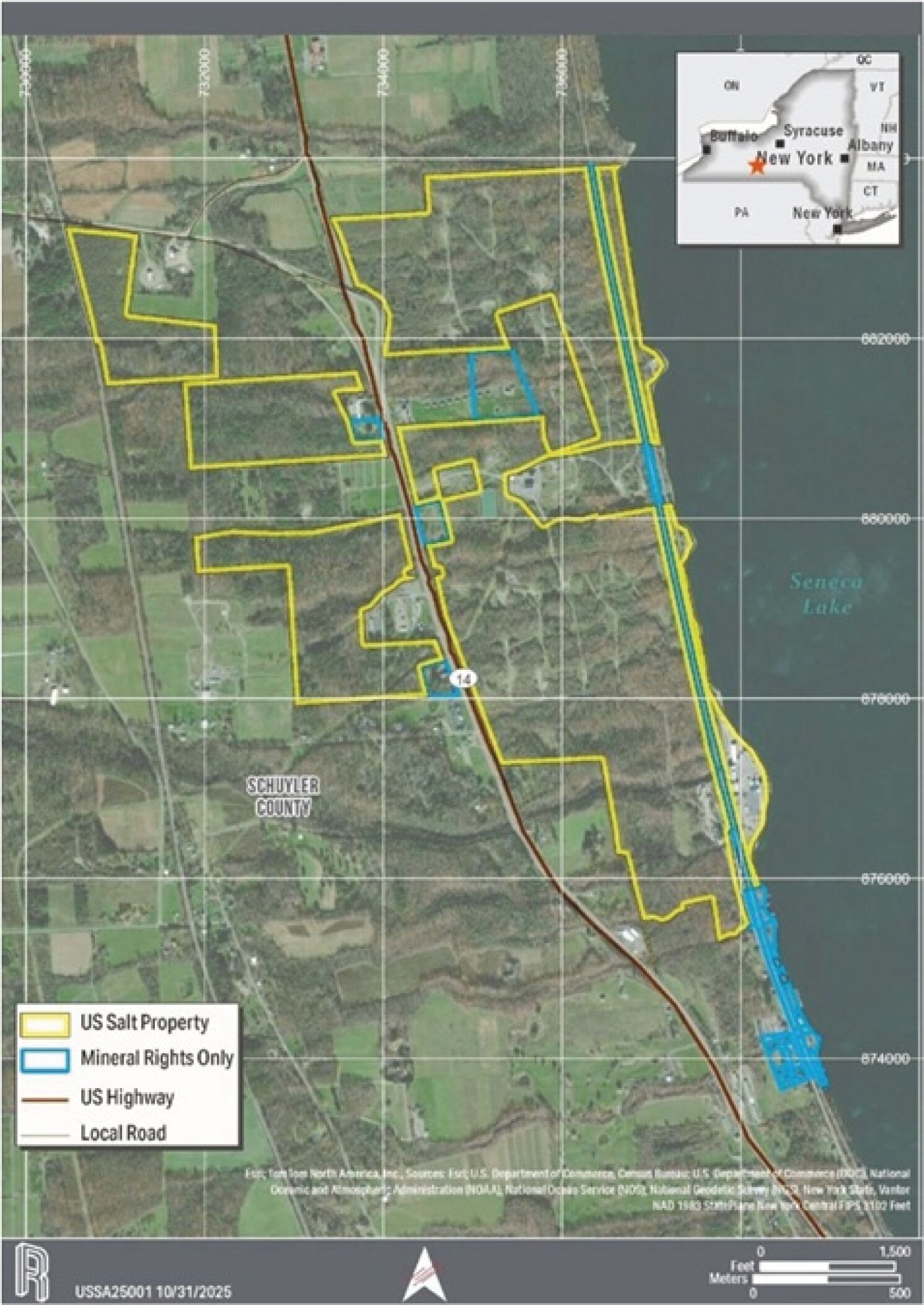
Electrical power is sourced from on-site generation with multiple natural gas-fired generators, amounting to 3,875 kilowatts (kW) per day. The facility is self-sufficient and does not rely on the surrounding electrical grid for operations. Current nameplate capacity is 70 short tons per hour (stph) with engineering studies completed for expansion to 75.7 stph within the existing footprint.
The equipment used in US Salt’s mining operations has useful lives ranging from six to 100 years with current ages ranging from 0 to 64 years. The facility has had several repair and renovation projects over the years and maintains scheduled preventative maintenance and scheduled non-recurring maintenance-of-business
156
Table of Contents
projects to manage the deterioration rate experienced in the highly corrosive environment. Most recent major renovations and upgrades include a permanent gas-fired backup generator to provide redundancy on electric supply, major generator overhauls, tank replacements, network upgrades, beams and structural steel replacements, and brine field monitoring. Maintaining the solution mining production requires ongoing development in the brinefield which is accomplished by drilling wells, installing pipe networks, and establishing electricity on a schedule of approximately one new well per year.
US Salt’s plant is located in a low- to moderate-risk location for extreme weather and seismic events, which limits the risk of catastrophic losses from natural disasters.
A bond is in place for the well capping liability for plugging and abandoning solution wells. The current well closure bond is approximately $1 million. This bond does not present a risk for performing work on the Property but rather allows the work to be performed as part of maintaining permit compliance.
US Salt believes that US Salt’s present facilities are adequate for US Salt’s current needs.
Overland Park, Kansas Office
US Salt also leases an office in Overland Park, Kansas for sales support and finance team. The current lease expires November 30, 2026. US Salt plans to renew the lease and does not foresee any issues in doing so.
Government Regulations
The Company is not currently subject to material government regulation.
Legal Proceedings
We are currently involved in, and may in the future be involved in, actual and threatened legal proceedings, claims, investigations and government inquiries arising in the ordinary course of our business, including legal proceedings, claims, investigations and government inquiries involving intellectual property, data privacy and data protection, torts, consumer protection, securities, employment, contractual rights or false or misleading advertising.
Although the results of the actual and threatened legal proceedings, claims, investigations and government inquiries in which we currently are involved cannot be predicted with certainty, we do not believe that there is a reasonable possibility that the final outcome of these matters will have a material adverse effect on our business or financial results. Regardless of the final outcome, however, litigation can have an adverse impact on us because of defense and settlement costs, diversion of management resources, harm to our reputation and brand, and other factors.
US Salt is subject to litigation and other claims in the ordinary course of business, some of which could be material. Accruals have been recorded when the outcome is probable and can be reasonably estimated. While the ultimate results of claims and litigation cannot be determined, US Salt expects that the ultimate disposition of these matters will not have a material adverse effect on its operations or financial condition. However, depending on the amount and the timing, an unfavorable resolution of some or all of these matters could materially affect US Salt’s results of operations or cash flows in a particular period.
See “Risk Factors,” for further discussion of risks related to legal proceedings.
Human Capital
We are continually investing in the engagement and retention of our workforce by creating a diverse and inclusive workplace, providing market-competitive benefits to support our employees’ health and well-being, and fostering an environment of learning and growth in support of employee development.
157
Table of Contents
As of December 31, 2025, we had a total of 4 employees, each of which was full-time, located in the U.S and reflective of various cultures, backgrounds and ethnicities.
None of our employees in the U.S. are represented by a labor union or subject to a collective bargaining agreement. We have not experienced any work stoppages, and we consider our relations with our employees to be good.
Employee Development and Training
Our employees are critical to the success of our company and we strive to create a supportive environment where all can contribute, learn, and grow in their careers. We prioritize employee development and training, and seek to foster both formal and informal learning opportunities inside and outside of the Company.
We provide an annual professional development stipend, which employees and managers can use for reimbursement of professional development expenses including seminars, courses, books, and training programs. We believe our investment in employee development has a direct impact on employee growth, engagement, and retention and is critical to our Company’s success.
Employee Benefits and Retention Strategies
We provide employees competitive benefits and additional perks to support the health and well-being of all. We offer an array of healthcare, financial, and wellness benefits, to employees and their dependents at no cost to employees. Employees can choose from three medical plan offerings from two healthcare providers, including supplemental health voluntary coverage that fits the needs of our employees and their families. Our wellness services include access to services from various providers. We provide an annual allotment to employees to access these services and annual education reimbursements for career development. We support our employees in taking time off as they need and offer a competitive leave policy.
Flexibility and Decentralization
In 2024, we made a decision to shift to a remote working environment in which all employees had the option to work from home, which we have continued through 2025.
We believe the above working policy will unlock further opportunities to source, connect, hire, and retain talent in more locations
Consideration
Pursuant to the USS Purchase Agreement, at the USS Closing Date, Holdings and/or the Company delivered the following:
| (a) | immediately available funds to Blocker Seller, representing the cash payments to be made in the Blocker Sale; |
| (b) | immediately available funds to the USS Sellers Representative (on behalf of the Cash Sellers (other than Blocker Seller)), representing the cash payments to be made in the Company Sale; |
| (c) | the Adjustment Escrow Amount (defined below) in an amount of $2.8 million to the Escrow Agent (defined below), consisting of immediately available funds and to be held in accordance with the terms of the Escrow Agreement; |
| (d) | the amount set forth in the payoff letters; |
158
Table of Contents
| (e) | all Transaction Expenses (as defined in the USS Purchase Agreement), in the amounts and to the Persons set forth on the Estimated Closing Statement (as defined in the USS Purchase Agreement) (or, in the case of any Transaction Expenses that constitute wages payable to employees of US Salt and its Subsidiaries, deposit such amounts with US Salt, LLC, a Delaware limited liability company (“Opco”), for further payment to the Persons entitled thereto no later than Opco’s second regularly scheduled payroll date following the Closing Date); and |
| (f) | the Expense Fund, in the amount of $0.3 million, to the Sellers Representative. |
Pursuant to the USS Purchase Agreement, at or prior to the Closing, Holdings or ContextLogic delivered payments, including: immediately available funds to Blocker Seller and immediately available funds to the Sellers Representative (on behalf of the Cash Sellers (other than Blocker Seller)); $2.8 million (the “Adjustment Escrow Amount”) to the Escrow Agent (defined below); the amount set forth in the payoff letters; all expenses of the transactions, in the amounts and to the persons set forth on the estimated closing statement of the USS Purchase Agreement.
The Backstop Agreements
Simultaneously with entering into and as contemplated by the USS Purchase Agreement, Holdings entered into a backstop agreement with BCP (such agreement, the “USS BCP Backstop Agreement”) and ContextLogic entered into backstop agreements with each of ACP I and ACP II (the “USS Abrams Backstop Agreements” and, together with the BCP Backstop Agreement, the “USS Backstop Agreements”). Under the respective Backstop Agreements, in the event the USS Rights Offering (as defined below) was not fully subscribed at the expiration of the USS Rights Offering period, (i) BCP was obligated to purchase the Preferred Units from Holdings at a price of $8.00 per Preferred Unit (the “USS Per Unit Subscription Price”) for an aggregate amount not to exceed $92 million (the “BCP Cap”) and (ii) each of ACP I and ACP II was obligated to purchase shares of ContextLogic common stock from ContextLogic at a price of $8.00 per share (the “Per Share Subscription Price”), for an aggregate amount not to exceed (a) $1.6 million for ACP I (the “ACP I Cap”) and (b) $21.4 million for ACP II (the “ACP II Cap” and, together with the BCP Cap and the ACP I Cap, each a “Cap”).
Following the expiration of the USS Rights Offering period and the terms and conditions of the USS Rights Offering, which were customary and subject to the prior written approval of each of BCP, ACP I and ACP II:
| • | BCP purchased, and Holdings issued and sold to BCP, approximately 11,156 thousand Class A Units equal to the quotient of (A) (i) the product of 80% multiplied by (ii) the difference between (x) the USS Rights Offering Amount, minus (y) the dollar amount of proceeds from the Rights Offering actually received by ContextLogic prior to (and that remained available to ContextLogic at) or immediately prior to the closing of the US Salt Acquisition (such product, the “BCP Purchase Price”) divided by (B) the USS Per Unit Subscription Price, for an amount in cash equal to $89.3 million; |
| • | ACP I purchased, and ContextLogic issued and sold to ACP I, approximately 190 thousand shares of ContextLogic common stock equal to the quotient of (A) (i) the product of 1.366% multiplied by (ii) the difference between (x) the USS Rights Offering Amount, minus (y) the dollar amount of proceeds from the USS Rights Offering actually received by ContextLogic prior to (and that remained available to ContextLogic at) or immediately prior to the closing of the US Salt Acquisition (such product, the “ACP I Purchase Price”) divided by (B) the Per Share Subscription Price, for an amount in cash equal to $1.5 million; and |
| • | ACP II purchased, and ContextLogic issued and sold to ACP II, approximately 2,599 thousand shares of ContextLogic common stock equal to the quotient of (A) (i) the product of 18.634% multiplied by (ii) the difference between (x) the USS Rights Offering Amount, minus (y) the dollar amount of proceeds from the Rights Offering actually received by ContextLogic prior to (and that remained |
159
Table of Contents
| available to ContextLogic at) or immediately prior to the closing of the US Salt Acquisition (such product, the “ACP II Purchase Price”) divided by (B) the Per Share Subscription Price, for an amount in cash equal $20.8 million. |
The Financing Arrangements
As contemplated by the USS Purchase Agreement, on December 8, 2025, Holdings entered into an agreement (the “USS Debt Commitment Letter”) with certain lenders, pursuant to which the lenders committed to fund up to $215.0 million to Holdings in connection with a new senior secured first lien term loan facility (the “USS Term Facility”) and $25.0 million to Holdings in connection with a new senior secured first lien revolving loan facility (the “USS Revolving Facility” and, together with the USS Term Facility, the “USS Facilities” or “USS Financings”) in each case subject to the terms and conditions set forth in the USS Debt Commitment Letter.
On the USS Closing Date, Holdings, as the initial borrower, entered into a Credit Agreement (as amended, restated, amended and restated, extended, supplemented or otherwise modified in writing from time to time, the “USS Credit Agreement”), with US Salt Investors, LLC, a Delaware limited liability company (the “USS Borrower”), as the borrower, US Salt Holdings, LLC, a Delaware limited liability company (“US Salt Holdings”), as holdings, the guarantors from time to time party thereto, Wilmington Trust, National Association, as administrative agent and collateral agent (the “Agent”), and each lender from time to time party thereto (the “Lenders”). Immediately after the consummation of the USS Credit Agreement, the Borrower succeeded to the rights and obligations of Holdings under the Credit Agreement and other Loan Documents (as defined in the USS Credit Agreement) and Holdings was released from its obligations under the USS Credit Agreement and other Loan Documents. The obligations under the USS Credit Agreement are guaranteed by US Salt Holdings and certain of the Borrower’s subsidiaries (collectively, the “Guarantors”) and collateralized by substantially all of the assets of the Borrower and the Guarantors.
The USS Credit Agreement provides for (i) an initial term loan facility in an aggregate principal amount of $215.0 million (the “Initial Term Loans”) and (ii) a revolving credit facility in an initial aggregate principal amount of $25.0 million (the “Revolving Loans” and, together with the Initial Term Loans, the “Loans”). The USS Credit Agreement provides that the Borrower has the right at any time and from time to time to incur one or more incremental revolving commitments and/or incremental term loans, subject to certain customary conditions and other requirements. The Lenders under the USS Credit Agreement are not obligated to provide any such incremental loans or commitments. The Initial Term Loans were borrowed on the USS Closing Date. The Loans mature on February 26, 2033.
At the Borrower’s option, and subject to certain conditions, the Loans bear interest at a base rate or a term Secured Overnight Financing Rate (“SOFR”) rate plus, in each case, an applicable margin determined by the Borrower’s Consolidated First Lien Net Leverage Ratio (as defined in the USS Credit Agreement). For borrowings that bear interest at a term SOFR rate, the applicable margin is a per annum amount equal to an amount between 4.00% and 4.50%. The Borrower is also required to pay a commitment fee with respect to unused available commitments under the revolving credit facility in a per annum amount, determined by the Borrower’s Consolidated First Lien Net Leverage Ratio, equal to an amount between 0.375% and 0.50%. The Borrower is also obligated to pay the Agent and Lenders other fees and premiums customary for credit facilities of this size and type.
The USS Credit Agreement contains customary affirmative and negative covenants, conditions to borrowing and events of default.
The Company used the proceeds of the USS Facilities, together with the USS Backstop Agreements and the USS Rights Offering to help (i) fund a portion of the US Salt Acquisition, (ii) repay US Salt’s existing indebtedness under its current credit facility, (iii) pay fees and expenses incurred in connection with the US Salt Acquisition, (iv) cash collateralize, backstop or replace letters of credit of US Salt outstanding on the USS Closing Date, and (v) fund working capital and general corporate purpose needs.
160
Table of Contents
Registration Rights Agreement
Demand Registration
As contemplated by the USS Purchase Agreement, on the USS Closing Date, ContextLogic and certain of the Rollover Sellers entered into a Registration Rights Agreement (the “Registration Rights Agreement”), pursuant to which each signatory to the Registration Rights Agreement listed as Lead Investor (a “Lead Investor”) has the right to make a written request to ContextLogic for registration under the Securities Act of 1933, as amended (the “Securities Act”) of the offer and sale to the public of any Registrable Securities pursuant to a Registration Statement (such request, a “Demand Registration Request”) of all or part of the Registrable Securities held by such Lead Investor which would reasonably be expected to result in gross proceeds of at least $15 million and ContextLogic agrees to file a Registration Statement with the SEC within thirty (30) days of receipt of the Demand Registration Request (or, if such 30-day period falls in a Company Blackout Period (as defined below), within five (5) Business Days from the end of such Company Blackout Period) and use its reasonable best efforts to cause such Registration Statement to be promptly declared effective under the Securities Act. No more than two (2) Business Days after receiving a Demand Registration Request, ContextLogic shall deliver a written notice (a “Demand Notice”) of such Demand Registration Request to all the Lead Investors and each signatory to the Registration Rights Agreement listed as other investors who then hold Registrable Securities under the Registration Rights Agreement (collectively, the “Holders”), offering them the opportunity to include their Registrable Securities in the Demand Registration. Subject to Section 3.1.7 of the Registration Rights Agreement, ContextLogic shall include in the Demand Registration all such Registrable Securities with respect to which ContextLogic has received written requests for inclusion therein within three (3) Business Days after the date that the Demand Notice was delivered. ContextLogic shall use its reasonable best efforts to cause the Demand Registration Statement to become effective and remain effective for not less than one hundred eighty (180) days, subject to certain conditions in the Registration Rights Agreement.
Shelf Registration
Additionally, pursuant to the Registration Rights Agreement, upon the written request of any of the Lead Investors (such request, a “Shelf Registration Request”), ContextLogic will be required to promptly file a shelf Registration Statement (as defined in the Registration Rights Agreement) with the SEC pursuant to Rule 415 under the Securities Act relating to the offer and sale of Registrable Securities by any Holders thereof and shall use reasonable best efforts to cause such Shelf Registration Statement to promptly become effective under the Securities Act (such Registration pursuant to a Shelf Registration Request, a “Shelf Registration”). No more than two (2) Business Days after receiving a Shelf Registration Request, ContextLogic shall deliver a written notice (a “Shelf Registration Notice”) of any such request to all other Holders, which shall specify, if applicable, the amount of Registrable Securities to be registered and shall offer each such Holder the opportunity to include their Registrable Securities in the Shelf Registration. ContextLogic shall include in such Shelf Registration all such Registrable Securities with respect to which ContextLogic has received written requests for inclusion therein within three (3) Business Days (or such shorter period as may be reasonably requested in connection with an underwritten “block trade”) after the date that the Shelf Registration Notice has been delivered. ContextLogic shall use its reasonable best efforts to keep such Shelf Registration Statement continuously effective under the Securities Act in order to permit the Prospectus (as defined below) forming part of the Shelf Registration Statement to be usable by Holders until the earlier of: (i) the date as of which all Registrable Securities have been sold pursuant to the Shelf Registration Statement or another Registration Statement filed under the Securities Act (but in no event prior to the applicable period referred to in Section 4(a)(3) of the Securities Act and Rule 174 thereunder); and (ii) the date as of which no Holder holds Registrable Securities.
Shelf Takedown
At any time ContextLogic has an effective Shelf Registration Statement with respect to a Holder’s Registrable Securities, any of the Lead Investors may make a written request (a “Shelf Takedown Request”) to ContextLogic to effect a Public Offering (as defined in the Registration Rights Agreement), including an
161
Table of Contents
Underwritten Shelf Takedown (as defined in the Registration Rights Agreement), of all or a portion of such Holder’s Registrable Securities that may be registered. No more than two (2) Business Days after receiving a Shelf Takedown Request (or such shorter period as may be reasonably requested in connection with an underwritten “block trade”) for any Underwritten Shelf Takedown, ContextLogic shall deliver a notice (a “Shelf Takedown Notice”) to each other Holder with Registrable Securities covered by the applicable Registration Statement, or to all other Holders if such Registration Statement is undesignated (each a “Potential Takedown Participant”). The Shelf Takedown Notice shall offer each such Potential Takedown Participant the opportunity to include in any Underwritten Shelf Takedown such number of Registrable Securities as each such Potential Takedown Participant may request in writing. ContextLogic shall include in the Underwritten Shelf Takedown all such Registrable Securities with respect to which ContextLogic has received written requests for inclusion therein within three (3) Business Days (or such shorter period as may be reasonably requested in connection with an underwritten “block trade”) after the date that the Shelf Takedown Notice has been delivered.
Piggyback Registration
If ContextLogic at any time proposes to file a Registration Statement under the Securities Act or to conduct a Public Offering (as defined below) with respect to any offering of its equity securities subject to certain exceptions, then, no less than ten (10) Business Days prior to the proposed date of filing of such Registration Statement or, in the case of a Public Offering under a Shelf Registration Statement, the anticipated pricing or trade date, ContextLogic shall give written notice (a “Piggyback Notice”) of such proposed filing or Public Offering to all Holders, and such Piggyback Notice shall offer the Holders the opportunity to register under such Registration Statement, or to sell in such Public Offering, such number of Registrable Securities as each such Holder may request in writing. Subject to Section 3.3.2 of the Registration Rights Agreement, ContextLogic shall include in such Registration Statement or Public Offering all such Registrable Securities that are requested to be included therein within five (5) Business Days after the receipt by such Holder of any such notice, subject to certain exceptions as discussed in more detail in the Registration Rights Agreement.
For purposes of the foregoing description of the Registration Rights Agreement and as defined in the Registration Rights Agreement:
| • | “Business Day” means any day that is not a Saturday, a Sunday or other day on which banks are required or authorized by law to be closed in the City of New York. |
| • | “Company Blackout Period” means the period starting two weeks prior to the end of any fiscal quarter and ending on the second (2nd) Business Day after earnings are publicly reported for such period. |
| • | “Issuer Free Writing Prospectus” means an issuer free writing prospectus, as defined in Rule 433 under the Securities Act, relating to an offer of the Registrable Securities. |
| • | “Prospectus” means (i) the prospectus included in any Registration Statement, all amendments and supplements to such prospectus, including post-effective amendments and supplements, and all other material incorporated by reference in such prospectus, and (ii) any Issuer Free Writing Prospectus. |
| • | “Public Offering” means the offer and sale of Registrable Securities for cash pursuant to an effective Registration Statement under the Securities Act (other than a Registration Statement on Form S-4 or Form S-8 or any successor form). |
| • | “Registrable Securities” means (i) all shares of ContextLogic common stock, (ii) all shares of ContextLogic common stock issuable upon exercise, conversion or exchange of any option, warrant or convertible security of any Person (as defined in the Registration Rights Agreement) that is not then subject to vesting or forfeiture to ContextLogic and (iii) all shares of ContextLogic common stock directly or indirectly issued or then issuable with respect to the securities referred to in clauses (i) or (ii) above by way of a stock dividend or stock split, or in connection with a combination of shares, recapitalization, merger, consolidation or other reorganization, in any such case under clauses (i), (ii) or (iii) above, whether owned on the date of the Registration Rights Agreement or hereafter acquired; |
162
Table of Contents
| provided, however, that shares of ContextLogic common stock that are then subject to forfeiture to ContextLogic shall not be deemed “Registrable Securities” for purposes of Section 3.1, 3.2.4 or 3.3 of the Registration Rights Agreement. As to any particular Registrable Securities, such securities shall cease to be Registrable Securities when (w) a Registration Statement with respect to the sale of such securities shall have become effective under the Securities Act and such securities shall have been disposed of in accordance with such Registration Statement, (x) such securities shall have been Transferred (as defined in the Registration Rights Agreement) pursuant to Rule 144, (y) such Holder is able to immediately sell such securities under Rule 144 without any restrictions on transfer (including without application of paragraphs (c), (d), (e), (f) and (h) of Rule 144), or (z) such securities shall have ceased to be outstanding. |
| • | “Registration Statement” means any registration statement of ContextLogic filed with, or to be filed with, the SEC under the Securities Act, including the related Prospectus, amendments and supplements to such registration statement, including pre- and post-effective amendments, and all exhibits and all material incorporated by reference in such registration statement other than a registration statement (and related Prospectus) filed on Form S-4 or Form S-8, or any successor form to either of the foregoing. |
Voting Agreement
As contemplated by the USS Purchase Agreement, on the USS Closing Date, each of the Abrams Investors and BCP (together, the “Voting Entities”), entered into a voting agreement (the “Voting Agreement”). Pursuant to the Voting Agreement, as subsequently amended by the First Amendment to Voting Agreement, each of the Voting Entities agreed, among other matters, to vote their shares of ContextLogic common stock: (a) to cause the Board to be comprised of not fewer than seven (7) directors at all times; (b) for the election of two (2) individuals designated by the Abrams Investors to serve as directors on the Board (the “Abrams Nominees”), subject to certain conditions; (c) for the election of one (1) individual designated by BCP to serve as directors on the Board (the “BCP Nominee), subject to certain conditions; (d) for the election of any four (4) individuals, as each party may determine in its respective sole discretion, provided, that at least three (3) of such individuals shall qualify as independent directors to serve as directors on the Board; (e) against any action, proposal, transaction or agreement that would or would reasonably be expected to result in the removal of any Abrams Nominee from the Board without the prior written consent of the Abrams Investors or the BCP Nominee from the Board without the prior written consent of BCP; and (f) in favor of any other matter necessary to the election of directors to, or removal of directors from, the Board in accordance with the Voting Agreement Amendment. Under the original Voting Agreement, BCP had the right to designate two (2) of the Company’s seven (7) directors, one of whom was Mr. Ward. The Voting Agreement Amendment, among other things, reduces BCP’s designation right to one (1) director.
Escrow Agreement
As contemplated by the USS Purchase Agreement, on the USS Closing Date, Wilmington Trust, NA, a national banking association (the “Escrow Agent”), the Sellers Representative, and Holdings entered into an Escrow Agreement. Pursuant to the Escrow Agreement, the Escrow Agent will hold the Escrow Funds in an account established with and designated by the parties to the Escrow Agreement by the Escrow Agent, pursuant to which the Escrow Funds shall be held in a segregated, non-commingled deposit account titled in the name of the Escrow Agent for the benefit of the parties and not merely by book-entry identification.
Indemnification Agreement
In connection with the closing of the US Salt Acquisition and pursuant to the USS Purchase Agreement, each Abrams Nominee entered into an Indemnification Agreement with ContextLogic whereby ContextLogic agreed to hold harmless and indemnify each indemnitee to the fullest extent permitted by law, subject to
163
Table of Contents
customary conditions (the “Indemnification Agreement”). The Indemnification Agreement also requires ContextLogic to pay, in the first instance, the entire amount of any judgment or settlement of such action, suit or proceeding without requiring the indemnitee to contribute to such payment and ContextLogic hereby waives and relinquishes any right of contribution it may have against the indemnitee, in addition to other customary provisions.
D. Sugarman Employment Agreement
On December 8, 2025, David Sugarman, current Chief Executive Officer of Opco, a subsidiary of US Salt, entered into an amended and restated employment agreement (the “Sugarman Employment Agreement”) with Opco for the position of Chief Executive Officer of Opco. In connection with the US Salt Acquisition, Opco became a subsidiary of ContextLogic, and as such, ContextLogic’s Compensation Committee and Board approved the assumption of the employment agreement with Mr. Sugarman. Under the terms of the Sugarman Employment Agreement, Mr. Sugarman receives a base salary of $550,000, is eligible for an annual discretionary bonus of between 0% to 150% of his base salary based on achievement of EBITDA growth metrics of Opco, and is eligible to participate in a long-term incentive program that vests over a five-year performance period. Upon a termination of Mr. Sugarman’s employment without “Cause” or by Mr. Sugarman for “Good Reason” (as such terms are defined in the Sugarman Employment Agreement), he is eligible for any earned but unpaid prior year’s bonus, any vested portion of his long-term incentive award, payable at the same time such award would have been paid had he remained employed, 12 months’ base salary continuation, a pro-rated bonus for the year of termination, based on actual performance, and up to 12 months’ COBRA premium payments, in each case conditioned upon his timely execution and non-revocation of a release of claims and compliance with his restrictive covenants.
Rights Offering
On January 22, 2026, the Company commenced a rights offering to distribute to the holders of ContextLogic common stock subscription rights to purchase shares of ContextLogic common stock. Each subscription right entitled the holder to purchase 0.53486 shares of ContextLogic common stock at an exercise price of $8.00 per share (the “USS Rights Offering”). The USS Rights Offering was conducted in connection with the US Salt Acquisition.
On February 25, 2026, the 429,463 aggregate shares of ContextLogic common stock validly subscribed for pursuant to the USS Rights Offering were issued, with a total purchase price of all shares sold of approximately $3.4 million.
164
Table of Contents
MANAGEMENT
ContextLogic Holdings Inc.
Our directors and executive officers, and certain information about each of them as of November 15, 2026 are set forth below.
| Name |
Age | Position(s) at ContextLogic Holdings Inc. | ||
| Mark Ward |
32 | President and Director | ||
| Scott Stewart |
53 | Chief Financial Officer and Chief Operating Officer | ||
| Raja Bobbili |
39 | Director and Board Chairperson | ||
| David Abrams |
65 | Director | ||
| Michael Farlekas |
61 | Director | ||
| Marshall Heinberg |
69 | Director | ||
| Ted Goldthorpe |
50 | Director | ||
| Jennifer Chou |
46 | Director | ||
| Paul S. Levy |
78 | Director |
Executive Officers
Mark Ward has served as our President beginning in December 2025, where he is responsible for execution of the Company’s strategy and oversight of all critical functions. Mr. Ward has served on our Board of Directors since March 2025. Mr. Ward served as a Director at BC Partners until November 2026, having first joined the BC Partners team in November 2020. Prior to that, Mr. Ward worked in the Restructuring Group and as an investment banking analyst at Houlihan Lokey from July 2017 to October 2020. Mr. Ward graduated Summa cum Laude from the University of St. Thomas (Minnesota) with a B.S. in Business Economics. We believe Mr. Ward is qualified to serve as a member of our Board of Directors due to his experience in private equity and corporate restructurings.
Scott Stewart has served as our Chief Financial Officer and Chief Operating Officer since June 2026. Prior to this, Mr. Stewart served as Chief Financial Officer at Cantaloupe, Inc. (“Cantaloupe”) beginning in 2020, where he oversaw Cantaloupe’s finance organization, including financial strategy and operations, accounting and financial reporting, planning and analysis, tax, treasury, and investor relations. Prior to Cantaloupe, Mr. Stewart served in various positions, most recently as Assistant Controller, from 2007 to 2020 at Intercontinental Exchange, Inc. Prior to that, Mr. Stewart spent four years at Ernst & Young LLP in its audit practice. Mr. Stewart graduated from Clemson University with a B.S. in Accounting and Master of Professional Accountancy.
Non-Employee Directors
Michael Farlekas has served on our Board of Directors since April 2024. Mr. Farlekas has served as the Chief Executive Officer of Onit, Inc., a provider of legal workflow software and solutions, since March 2024. Prior to serving in that role, he served as the Chief Executive Officer of E2open, LLC, a provider of cloud-based, on-demand supply chain and execution software, from May 2015 to October 2023. Prior to serving in that role, Mr. Farlekas held positions at Roadnet Technologies, Inc., a provider of fleet management software solutions for private fleets, from 2012 to 2014 and RedPrairie Corporation, a provider of warehouse management solutions from 2001 to 2012. Since, November 2024, Mr. Farlekas has served as the Executive Chairman of accessiBe, an AI-powered web accessibility software company. Mr. Farlekas graduated from Fairleigh Dickinson University with a B.S. in Mechanical Engineering and from Jacksonville University with an M.B.A. in International Business. We believe that Mr. Farlekas is qualified to serve as member of our Board due to his 20 years of experience in executive leadership for enterprise software companies.
Marshall Heinberg has served on our Board of Directors since April 2024. Mr. Heinberg is the founder and has served as the managing director of MAH Associates, LLC, a provider of strategic advisory and consulting services to companies evaluating financing and strategic alternatives, since 2012. He has also served as the chair of the board of directors of Custom Truck One Source, Inc., a leading “one-stop-shop” provider of specialty
165
Table of Contents
equipment serving customers in the growing electric utility transmission and distribution, telecom, rail and infrastructure end-markets in North America, since April 2021 and as a director of Union Carbide Corporation, a subsidiary of Dow Inc, since July 2019. Previously, Mr. Heinberg served as the chair of the board of directors of PAE, Inc., an operational support services company, from February 2020 to February 2022 and on the boards of directors of Galmed Pharmaceuticals Ltd., a clinical-stage life sciences company, from October 2018 to June 2022 and ChannelAdvisor Corporation, an e-commerce company, from December 2019 to November 2022. Mr. Heinberg began his investment banking career in the corporate finance division of Oppenheimer & Co., Inc., an international bank, and served as head of the investment banking department and as a senior managing director of Oppenheimer & Co., Inc. from 2008 until 2012. Mr. Heinberg also served as the head of U.S. investment banking of CIBC World Markets, an international bank, from 2001 until 2008. Mr. Heinberg graduated from The Wharton School at the University of Pennsylvania with a B.S. in Economics and from Fordham University School of Law with a J.D. We believe that Mr. Heinberg is qualified to serve as a member of our Board due to his 35 years of extensive experience in capital markets as well as his business and financial experience in complex and related industries.
Ted Goldthorpe has served on our Board of Directors since March 2025. Mr. Goldthorpe is a Partner at BC Partners, where he leads BC Partners Credit, a platform that he co-founded in 2017. He has served as the Chief Executive Officer and director of BCP Investment Corporation (previously known as Portman Ridge Finance Corporation) and Mount Logan Capital Inc. since 2019 and 2018, respectively. Previously, Mr. Goldthorpe served as Chief Executive Officer and director of Logan Ridge Finance Corporation from 2021 until its merger with Portman Ridge Finance Corporation in July 2025. Previously, Mr. Goldthorpe was President at Apollo Investment Corporation, Chief Investment Officer of Apollo Investment Management, and Senior Portfolio Manager, U.S. Opportunistic Credit from February 2012 to August 2016. At Apollo, he was also a member of the Senior Management Committee and oversaw its US Opportunistic Credit platform. Prior to this, Mr. Goldthorpe was a Managing Director of the Special Situations Group at Goldman Sachs and ran the Bank Loan and Distressed Investing Desk from July 1999 to February 2012. Additionally, Mr. Goldthorpe has served as chair of the board of Runway Growth Finance since March 2025 and has served on the board of TPG RE Finance Trust, Inc. since October 2025. Mr. Goldthorpe previously served on the audit committee of the board of directors of Crescent Point Energy from 2021 to 2023, and on the compensation committee of the board of directors of KITS Eyecare from 2021 to 2024. Mr. Goldthorpe graduated from Queen’s University, Ontario with a B.A. in Commerce. We believe that Mr. Goldthorpe is qualified to serve as a member of our Board of Directors due to his 20 years of experience in private equity, investment management, and complex transactions.
Jennifer Chou has served on our Board of Directors since March 2025. Ms. Chou has over 20 years of experience in private equity, financial services and sales & trading. Ms. Chou is currently Co-Founder, President and Partner at Torch Key Asset Management (TKAM) where she oversees deal origination, capital raising, and operations. Previously, she was Senior Managing Director and Chief Strategy Officer of The Gores Group (“Gores”) where she led firm strategy and the development of new products and partnerships. Prior to joining Gores, Ms. Chou was a Director at Sterling Partners, a private equity firm based in Chicago from 2009 to 2010. Prior to Sterling Partners, Ms. Chou worked in capital markets at Lehman Brothers in New York during the summer of 2008. Ms. Chou began her career at Public Financial Management as an Associate in the Public Utilities Group from 2004 to 2007 and the Vanguard Group as a Trader from 2002 to 2004. Ms. Chou has served as a director of BCP Investment Corporation (previously known as Portman Ridge Finance Corporation) since May 2022 and as a director of Runway Growth Finance since March 2025. Ms. Chou previously served as a director of Logan Ridge Finance Corporation from May 2022 until its merger with Portman Ridge Finance Corporation in July 2025. Ms. Chou graduated from the University of Pennsylvania with a B.A. in Communications in Finance and received an M.B.A. from Northwestern University’s Kellogg School of Management. We believe Ms. Chou is qualified to serve as a member of our Board of Directors due to her 20 years of experience in private equity, financial services, sales and trading.
David Abrams has served on our Board of Directors since February 2026. Mr. Abrams founded Abrams Capital in 1999 and has been its Chief Executive Officer and Portfolio Manager since inception. Previously,
166
Table of Contents
Mr. Abrams was a senior investment professional with The Baupost Group of Boston, Massachusetts, for 10 years. Since March 2014, Mr. Abrams has served as a director of MIT Investment Management Company which oversees the investments of the Massachusetts Institute of Technology’s assets. Since April 2024, Mr. Abrams has served as a director and on the compensation committee of Loar Holdings, Inc., a manufacturer and supplier of specialized components for the aerospace and defense industries. Mr. Abrams graduated from the University of Pennsylvania with a B.A. in History. We believe Mr. Abrams is qualified to serve as a member of our Board of Directors due to his vast experience investing in a wide variety of businesses.
Raja Bobbili has served on our Board of Directors as Chairperson since February 2026. Mr. Bobbili currently serves as a Managing Director at Abrams Capital, which he joined in January 2014. Since April 2024, Mr. Bobbili has served as a director and on the compensation committee of Loar Holdings, Inc., a manufacturer and supplier of specialized components for the aerospace and defense industries. He has extensive experience in financial matters, and a deep understanding of business and corporate strategy. Mr. Bobbili has served on various corporate and non-profit organization boards. Mr. Bobbili received his undergraduate degree from the Massachusetts Institute of Technology, and earned a J.D./M.B.A from Harvard University. Mr. Bobbili is qualified to serve as a member of our Board of Directors due to his extensive experience in corporate strategy and financial matters.
Paul S. Levy has served on our Board of Directors since March 2026. Mr. Levy is a Managing Director of JLL Partners, Inc., which he founded in 1988. Before founding JLL, Mr. Levy was a Managing Director at Drexel Burnham Lambert, where he was responsible for the firm’s restructuring and exchange offer business in New York. Previously, he was an attorney with Stroock & Stroock & Lavan LLP. Mr. Levy currently serves on the board of Loar Holdings Inc. (NYSE: LOAR), an acquisition-driven aerospace platform. He has also served on numerous public and private company boards, including as Chairman of Builders FirstSource, Inc. (NYSE: BLDR), bringing deep experience in scaling companies and overseeing complex acquisitions. Mr. Levy received his B.A. from Lehigh University, where he graduated summa cum laude and Phi Beta Kappa. He earned his J.D. from the University of Pennsylvania Law School, and a certificate from the Institut des Science Politiques in Paris, France. Mr. Levy is qualified to serve as a member of our Board of Directors due to his vast experience overseeing complex acquisitions and years of board service.
Family Relationships
There are no family relationships among any of our directors or executive officers.
Director Independence
Management and outside counsel have reviewed the directors’ responses to a questionnaire asking about their transactions, relationships, and arrangements with us (and those of their immediate family members), and other potential conflicts of interest. Other than as set forth in this prospectus, these questionnaires did not disclose any transactions, relationships, or arrangements that question or compromise the independence of our directors or director nominees. After reviewing this information, our Board of Directors affirmatively determined that each of our current non-employee directors is an independent director. The independent members of our Board of Directors hold separate regularly scheduled executive session meetings at which only independent directors are present.
Conflicts of Interest
Certain of our directors have, and certain of our officers, including Mark Ward, who is our President and was previously employed by BC Partners while also serving as our President, have in the past had, fiduciary and contractual duties to BC Partners and Abrams Capital and their affiliates. As a result, certain of our officers and directors will have or had a duty to communicate or offer business, strategic or investment opportunities to
167
Table of Contents
certain BC Partners or Abrams Capital funds and other entities and will have or had no duty to offer such opportunities to ContextLogic, unless such officers and directors were offered such opportunities in their capacity as officers and/or directors of ContextLogic. As a result, BC Partners and Abrams Capital or any of their affiliates may compete with us for opportunities in the same industries and sectors in which we may operate or pursue strategic initiatives. If any of them decide to pursue any such opportunity, we may be precluded from procuring such opportunities.
In addition, investment ideas and opportunities generated within BC Partners or Abrams Capital or any of their affiliates may be suitable for both us and for BC Partners or Abrams Capital and any of their affiliates, and may be directed initially to BC Partners or Abrams Capital rather than to us. None of our officers and directors, BC Partners or Abrams Capital or any of their affiliates have any obligation to present us with any opportunity of which they become aware unless it is offered to them solely in their capacity as our director or officer and after they have satisfied their contractual and fiduciary obligations to other parties, including BC Partners and Abrams Capital. BC Partners or Abrams Capital may offer investment opportunities that fit within the investment program of a BC Partners or Abrams Capital fund to such fund before offering it to us, and may choose to allocate all or part of any such opportunity to any BC Partners or Abrams Capital affiliate or any business in which a BC Partners or Abrams Capital affiliate has invested instead of offering such opportunity to us.
The potential conflicts described above may limit our ability to enter into a business combination or other transactions or pursue strategic initiatives. BC Partners, Abrams Capital and their affiliates engage, and in the future will engage, in a broad spectrum of activities, including direct investment activities and investment advisory activities, and have extensive investment activities (including principal investments by BC Partners or Abrams Capital affiliates), on behalf of both persons or entities to which they provide investment advice and on a principal basis, that are independent from, and may from time to time conflict or compete with, our activities. These circumstances could give rise to numerous situations where interests may conflict. There can be no assurance that these or other conflicts of interest with the potential for adverse effects on us and our investors will not arise.
The Board approved a renunciation of corporate opportunities for the benefit of the directors and officers affiliated with BC Partners and Abrams Capital, to the fullest extent permitted pursuant to Delaware General Corporation Law Section 122(17).
While we and any other companies or investment vehicles that BC Partners or Abrams Capital may sponsor may share certain information or administrative functions provided by BC Partners or Abrams Capital, our management team that will be involved in sourcing and evaluating potential strategic opportunities for us may differ from the individuals who participate in such activities for BC Partners or Abrams Capital or any of their affiliates. We anticipate that any potential opportunities that are sourced by our management team solely in their capacity as officers or directors of the Company will be first offered to the Company before being offered to BC Partners or Abrams Capital or their affiliates, and that any opportunities sourced within BC Partners or Abrams Capital will be first offered to BC Partners or Abrams Capital or their affiliates before being offered to us; however, our officers and directors do not have such obligation to offer any opportunities first to the Company.
We do not believe that any potential conflicts with BC Partners or Abrams Capital or their affiliates would materially affect our ability to pursue and complete our business strategy. While we expect that BC Partners and Abrams Capital will have priority over us with respect to opportunities that fall within their investment strategies, BC Partners, Abrams Capital and our management team have significant experience in identifying and executing multiple investment opportunities simultaneously, and we are not limited by industry or geography with respect to the investment opportunities we can pursue. It is also possible that we will enter into exclusivity with respect to a transaction that is not ultimately consummated, and that during the applicable exclusivity period attractive opportunities will be offered to and accepted by BC Partners or Abrams Capital or their affiliates.
168
Table of Contents
EXECUTIVE COMPENSATION
This section provides an overview of the compensation awarded to, earned by, or paid to each person who served as our principal executive officer during 2025 and our next two most highly compensated executive officers in respect of their service to us for the fiscal year ended December 31, 2025 (or such shorter period of the named executive officer’s service), whom we refer to collectively as our “named executive officers” or “NEOs.”
Our “named executive officers” for 2025 were:
| • | Mark Ward, our President(1) |
| • | Rishi Bajaj, our former Chief Executive Officer(2); |
| • | Michael Scarola, our former Chief Financial Officer(3); and |
| • | Brett Just, our former Chief Financial Officer(4). |
| (1) | Mr. Ward was appointed as our President effective December 7, 2025. |
| (2) | Mr. Bajaj was appointed as our Chief Executive Officer effective April 19, 2024, and terminated his employment on December 7, 2025. |
| (3) | Mr. Scarola was appointed as our Chief Financial Officer effective June 30, 2025, and terminated his employment on December 7, 2025. |
| (4) | Mr. Just was appointed as our Chief Financial Officer effective April 19, 2024, and terminated his employment on June 30, 2025. |
Summary Compensation Table For 2025
The following table sets forth information concerning the total compensation awarded to, earned by, or paid to our named executive officers for the year ended December 31, 2025.
| Name and Principal Position |
Year | Salary ($) |
Bonus ($) |
Stock Awards ($)(1)(6) |
Option Awards ($) |
All Other Compensation ($) |
Total ($) |
|||||||||||||||||||||
| Mark Ward(2) President |
2025 | — | — | — | — | — | — | |||||||||||||||||||||
| Rishi Bajaj(3) Former Chief Executive Officer |
2025 | 516,667 | 825,000 | 6,395,269 | — | 15,248 | 7,752,184 | |||||||||||||||||||||
| Michael Scarola(4) Former Chief Financial Officer |
2025 | 237,727 | — | 161,669 | — | 108 | 399,504 | |||||||||||||||||||||
| Brett Just(5) Former Chief Financial Officer |
2025 | 275,000 | 112,500 | — | — | 296,760 | 684,260 | |||||||||||||||||||||
| (1) | The amounts reported in this column reflect the grant date accounting value for equity awards granted during 2025 and may not correspond to the actual economic value that may be received by our named executive officers from the equity awards. In accordance with SEC rules, this column reflects the grant date fair value of stock awards, including RSUs, granted to our named executive officers, calculated in accordance with Accounting Standards Codification (“ASC”) Topic 718 for stock-based compensation transactions. See Note 8 to our consolidated financial statements included herein, for a discussion of all assumptions made by us in determining the grant date fair value of such awards. The grant date fair value of RSUs is calculated based on the closing price of a share of our common stock on the date of grant of the award. |
| (2) | Mr. Ward was appointed President on December 7, 2025. Mr. Ward did not receive compensation in respect of his service to us for the year ended December 31, 2025. |
| (3) | Mr. Bajaj is no longer serving as our Chief Executive Officer, effective as of December 7, 2025. Mr. Bajaj’s separation benefits are reflected in the Bonus ($825,000), Stock Awards ($6,395,269, as described in footnote (6) below), and All Other Compensation ($15,000 in legal fees and $248 in Company-paid life insurance premiums) columns. For additional detail, see “Employment Transitions in 2025” below. |
169
Table of Contents
| (4) | Mr. Scarola is no longer serving as our Chief Financial Officer, effective as of December 7, 2025. Mr. Scarola did not receive standard severance under his employment agreement. Instead, he received full acceleration of his 23,740 unvested RSUs and a 22.5% interest in the RB Aggregator (as defined below). All Other Compensation of $108 consists of Company-paid life insurance premiums. For additional detail, see “Employment Transitions in 2025” below. |
| (5) | Mr. Just is no longer serving as our Chief Financial Officer, effective as of June 30, 2025. The Bonus of $112,500 reflects a non-discretionary amount in connection with Mr. Just’s original employment agreement, representing a total of $450,000, paid out in four equal installments over quarterly vesting dates, subject to his continuous services with the Company in good standing at the time of vesting. The amount reported in the “All Other Compensation” column of $296,760 for Mr. Just consists of (i) a lump sum cash severance payment of $275,000, equal to six months of his base salary, and (ii) $21,760 in lump sum benefit premium payments, each pursuant to his severance and change in control agreement, which was payable in connection with a termination of employment not in connection with a change in control. For additional detail, see “Employment Transitions in 2025” below. |
| (6) | Amount reflects the aggregate grant date fair value of awards granted to Mr. Bajaj, computed in accordance with ASC 718, consisting of: (a) Class P Units granted on March 6, 2025, with a grant date fair value of $6,055,269 based on the probable outcome of the performance conditions associated with such awards consisting of two tranches: (i) time-based vesting units with a grant date fair value of $1,521,984, and (ii) performance-based vesting units with a grant date fair value of $4,533,285: and (b) an additional 600,000 Class P Units granted to RB Strategic Holdings LP – Easter Series (the “RB Aggregator”), an entity established and controlled by Mr. Bajaj, on December 7, 2025, in connection with Mr. Bajaj’s separation from the Company, with a grant date fair value of $340,000. The grant date fair value of the March 6, 2025 Class P Units, assuming all performance conditions are satisfied at maximum, is $6,055,269. The Class P Units are structured as profits interests in ContextLogic Holdings, LLC, a subsidiary of ContextLogic Holdings Inc. The ASC 718 fair value reflects the expected economic benefit based on probability-weighted future liquidity scenarios. See Note 8 to our consolidated financial statements included herein, for a discussion of all assumptions made by us in determining the grant date fair value of such awards. |
Narrative Disclosure to Summary Compensation Table
Base Salaries and Annual Incentive Opportunities
To maintain a competitive executive compensation program, we offer cash compensation in the form of annual base salaries to reward individual contributions and to compensate our executives for their day-to-day responsibilities. Our executive officers may also earn a cash bonus during the annual performance review cycle or at an earlier date in an amount determined solely by the Compensation Committee in its discretion.
Our Compensation Committee reviews the base salaries of our executive officers in connection with our annual performance review cycle. The base salaries of Messrs. Bajaj, Scarola, and Just were set by our Compensation Committee upon the appointment of each executive officer, taking into account previous experience, competitive market data and benchmarks, critically needed skills and expected future contributions, and which reflected their individual negotiation with us as part of their employment packages with us.
Our named executive officers’ 2025 base salaries were as follows: $550,000 for Mr. Bajaj; $450,000 for Mr. Scarola; and $550,000 for Mr. Just. Pursuant to Mr. Ward’s appointment letter, his role as President was in addition to his current duties as a member of the Board, and Mr. Ward agreed not to receive any additional compensation or benefits of any kind in respect of such role during the period ended December 31, 2025.
In connection with his separation agreement, Mr. Bajaj also received an incentive bonus of $825,000, equal to 150% of Mr. Bajaj’s annualized year-end base salary, payable no later than March 15, 2026 which is included in the “Bonus” column of the Summary Compensation Table above.
Pursuant to Mr. Just’s original employment agreement, Mr. Just was entitled to a non-discretionary bonus totaling $450,000, paid out in four equal quarterly installments of $112,500 each, subject to his continuous
170
Table of Contents
services with the Company in good standing at the time of vesting. The $112,500 reflected in the “Bonus” column of the Summary Compensation Table above represents the final quarterly installment paid to Mr. Just in February 2025.
Equity Compensation
To focus our named executive officers on the achievement of our business objectives, a significant portion of their compensation may be equity-based. We utilize equity compensation, including RSU awards and profits interests, to motivate our named executive officers to focus on the growth of our overall enterprise value and, correspondingly, to create sustainable long-term value for our stockholders. We believe that having a substantial portion of our named executive officers’ target total direct compensation tied to equity-based awards aligns more closely with our business strategy and the long-term interests of our stockholders. We believe that our named executive officers should share in the risk and rewards of our long-term performance, similar to our stockholders. For our executive officers, we may also grant discretionary performance-based awards, which we believe provide greater incentive and retention objectives for them, as well as further aligning their interests with those of our stockholders.
In 2025, we used RSU awards and Class P Units as the equity compensation components of our executive compensation program. Mr. Scarola received RSUs under our 2020 Plan, and Mr. Bajaj received Class P Units structured as profits interests in ContextLogic Holdings, LLC.
Our RSU awards typically include a service-based vesting requirement, allowing them to serve as an effective retention tool while also motivating our named executive officers to work toward achieving our corporate objectives that we believe provide a meaningful return to our stockholders. Our Class P Units include both time-based and performance-based vesting conditions, as described below under “Class P Units.”
In granting equity awards, our Compensation Committee generally considers, among other things, the named executive officer’s cash compensation, the need to create a meaningful opportunity for reward predicated on the creation of long-term stockholder value, our financial results, our total annual equity budget and any share pool funding constraints, an evaluation of the expected and actual performance of each named executive officer, their individual contributions and responsibilities, the retention hold of their existing outstanding and unvested equity awards and how that hold lapses over time as the awards vest, and the recommendations of our then-current Chief Executive Officer (except with respect to his own equity awards).
During 2025, we granted RSUs to Mr. Scarola under our 2020 Plan.
Mr. Scarola was granted an award of 23,740 RSUs on July 30, 2025, which vested fifty percent (50%) on November 15, 2025. The subsequent fifty percent (50%) of RSUs was accelerated upon Mr. Scarola’s termination on December 7, 2025.
Class P Units
On March 6, 2025 (the “Effective Award Date”), the Compensation Committee awarded Mr. Bajaj 2,372,216.60 Class P units (the “Class P Units”) in ContextLogic Holdings, LLC, consisting of (i) an award of 474,443.55 time-based Class P Units (the “Time Vesting Grant”), which would vest over time, in four (4) equal installments, subject to Mr. Bajaj’s continuous service, with 25% of the Time Vesting Grant vesting on the first anniversary of the Effective Award Date and an additional 25% on each anniversary thereafter; and (ii) an award of performance-based Class P Units (the “Performance Vesting Grant”), which would be earned and would vest based on the achievement of specified performance criteria, with 1,423,329.50 performance-based Class P Units eligible to vest if target performance is met and 1,897,773.05 performance-based Class P Units eligible to vest if maximum performance is met, subject to Mr. Bajaj’s continuous service through the four (4) year anniversary of the Effective Award Date. The treatment of the Class P Units in connection with Mr. Bajaj’s separation from employment is addressed in the Separation Agreement.
171
Table of Contents
Health and Welfare Benefits
Our named executive officers are eligible to participate in the same employee benefit plans, and on the same terms and conditions, as all other full-time, salaried U.S. employees. These benefits include medical, dental, and vision insurance, business travel insurance, an employee assistance program, health and dependent care flexible spending accounts, basic life insurance, accidental death and dismemberment insurance, short-term and long-term disability insurance, and wellness benefits.
We design our employee benefits programs to be competitive in relation to the market as well as compliant with applicable laws and best practices. We adjust our employee benefits programs as needed based upon regular monitoring of applicable laws, practices, and the competitive market.
Retirement Benefits
In 2025, we did not offer a 401(k) plan for our employees. In 2026, we began offering a Section 401(k) plan for our full-time employees, with a 3% company match contribution to participants. The Section 401(k) plan is intended to qualify under Section 401(k) of the Tax Code, so that contributions to the plan by employees or by us, and the investment earnings thereon, are not taxable to the employees until withdrawn, and so that contributions made by us, if any, will be deductible by us when made. Additionally, the 401(k) plan allows for employee contributions to be made on an after-tax basis in the form of Roth contributions. These contributions are intended to qualify under Section 402A of the Tax Code and are designated to grow with tax-free earnings and are distributed at retirement without triggering any future income tax liability.
We do not provide pension or other defined benefit plan arrangements for our named executive officers or other employees, nor do we provide any nonqualified defined contribution or other deferred compensation plans to any of our employees, except where required by local law.
Perquisites and Other Personal Benefits
Currently, we do not view perquisites or other personal benefits as a significant component of our executive compensation program. Accordingly, we do not provide significant perquisites or other personal benefits to our named executive officers except as generally made available to our employees or in situations where we believe it is appropriate to assist an individual in the performance of his or her duties, to make him or her more efficient and effective, and for recruitment and retention purposes. During 2025, none of our named executive officers, except Rishi Bajaj, received perquisites or other personal benefits that were, in the aggregate, $10,000 or more for each individual. During 2025, the Company reimbursed Mr. Bajaj for $15,000 in legal fees incurred in connection with the negotiation of his employment agreement.
172
Table of Contents
Outstanding Equity Awards at 2025 Fiscal Year-End Table
The following table provides information regarding outstanding equity awards held by our named executive officers as of December 31, 2025, including the number of shares subject to each award. The vesting schedule applicable to each outstanding award is described in the footnotes to the table below.
| Option Awards | Stock Awards | |||||||||||||||||||||||||||||||||||
| Name |
Vesting Commencement Date |
Number of Securities Underlying Unexercised Options Exercisable (#) |
Number of Securities Underlying Unexercised Options Unexercisable (#) |
Option Exercise Price ($) |
Option Expiration Date |
Number of Shares or Units of Stock that Have Not Vested (#) |
Market Value of Shares or Units of Stock That Have Not Vested ($) |
Equity Incentive Plan Awards: Number of Unearned Shares, Units or Other Rights That Have Not Vested (#) |
Equity Incentive Plan Awards: Market or Payout Value of Unearned Shares, Units or other Rights that Have Not Vested ($) |
|||||||||||||||||||||||||||
| Rishi Bajaj |
11/29/2023 | — | — | — | — | — | — | — | — | |||||||||||||||||||||||||||
| 5/6/2024 | — | — | — | — | — | — | — | — | ||||||||||||||||||||||||||||
| 3/6/2025 | (1) | — | — | — | — | — | — | 1,897,773 | 4,533,285 | |||||||||||||||||||||||||||
| 12/7/2025 | (2) | — | — | — | — | — | — | 600,000 | 340,000 | |||||||||||||||||||||||||||
| Brett Just |
3/15/2022 | — | — | — | — | — | — | — | — | |||||||||||||||||||||||||||
| 5/10/2023 | — | — | — | — | — | — | — | — | ||||||||||||||||||||||||||||
| 5/6/2024 | — | — | — | — | — | — | — | — | ||||||||||||||||||||||||||||
| (1) | Amount reflects the grant date fair value of the performance-based Class P Units granted on March 6, 2025, computed in accordance with ASC 718 based on the probability-weighted future liquidity scenarios because the Class P Units are structured as profits interests in ContextLogic Holdings, LLC with no established mechanism to convert into shares of the Company’s common stock. Due to the nature of the Class P Units and the Complexity of the valuation methodology, which requires probability-weighting of multiple liquidity scenarios, the grant date fair value represents the value of such Class P Units as of the most recent practicable date, which was the grant date. The Class P Units consist of two tranches: (i) time-based Class P Units with a grant date fair value of $1,521,984, and (ii) performance-based Class P Units with a grant date fair value of $4,533,285. The Class P Units are structured as profits interests in ContextLogic Holdings, LLC, a subsidiary of ContextLogic Holdings Inc. Upon Mr. Bajaj’s termination of employment on December 7, 2025, the time-based Class P Units accelerated in accordance with the original grant terms. Following his termination of employment, Mr. Bajaj transferred all Class P Units (both vested time-based and unvested performance-based) to RB Aggregator. The performance-based Class P Units remain subject to the original performance vesting conditions. |
| (2) | In connection with Mr. Bajaj’s separation from the Company, RB Aggregator was granted an additional 600,000 Class P Units in ContextLogic Holdings, LLC on December 7, 2025. The amount reported in the table reflects the grant date fair value of the Class P Units computed in accordance with ASC 718 based on the probability-weighted future liquidity scenarios because the Class P Units are structured as profits interests in ContextLogic Holdings, LLC with no established mechanism to convert into shares of the Company’s common stock. Due to the nature of the Class P Units and the complexity of the valuation methodology, which requires probability-weighting of multiple liquidity scenarios, the grant date fair value represents the value of such Class P Units as of the most recent practicable date, which was the grant date. These performance-based Class P Units will vest if the fair market value achieves $30 per share at any time between the grant date and December 31, 2030, based on a twenty (20) day average closing price of common stock. All of the units remain unvested. |
173
Table of Contents
Summary Compensation Table For 2024
The following table sets forth information concerning the total compensation awarded to, earned by, or paid to CLI Inc.’s named executive officers for the year ended December 31, 2024. Pursuant to the terms of the Reorganization described herein, CLI Inc. became a wholly owned subsidiary of ContextLogic. On February 26, 2026, CLI Inc. was dissolved pursuant to the US Salt Acquisition.
| Name and Principal Position |
Year | Salary ($) |
Bonus ($) |
Stock Awards ($)(1) |
Option Awards ($)(1) |
All Other Compensation ($) |
Total ($) |
|||||||||||||||||||||
| Rishi Bajaj(2) |
2024 | 693,333 | — | 292,686 | — | — | 986,019 | |||||||||||||||||||||
| Chief Executive Officer |
2023 | — | — | — | — | — | — | |||||||||||||||||||||
| Jun (Joe) Yan(3) |
2024 | 168,878 | — | — | — | 1,119,020 | 1,287,898 | |||||||||||||||||||||
| Former Chief Executive Officer |
2023 | 550,000 | — | 2,504,500 | 3,373,242 | — | 6,427,742 | |||||||||||||||||||||
| Brett Just(4) |
2024 | 513,707 | 390,868 | 180,686 | — | 234,074 | 1,319,336 | |||||||||||||||||||||
| Chief Financial Officer |
2023 | 410,249 | 25,000 | 136,441 | — | — | 571,690 | |||||||||||||||||||||
| Vivian Liu(5) |
2024 | 181,818 | — | — | — | 717,118 | 898,936 | |||||||||||||||||||||
| Former Chief Financial Officer and Chief Operating Officer | 2023 | 587,500 | — | 880,948 | — | — | 1,468,448 | |||||||||||||||||||||
| Joanna Forster(6) |
2024 | 357,646 | 86,764 | 330,450 | — | 496,344 | 1,271,204 | |||||||||||||||||||||
| Former General Counsel and Chief Compliance Officer | 2023 | 337,396 | 20,000 | 448,023 | — | — | 805,419 | |||||||||||||||||||||
| (1) | The amounts reported in this column reflect the accounting value for these equity awards and may not correspond to the actual economic value that may be received by CLI Inc.’s named executive officers from the equity awards. In accordance with SEC rules, this column reflects the grant date fair value of CLI Inc.’s option grants and restricted stock units (“RSUs”) calculated in accordance with Accounting Standards Codification (“ASC”) Topic 718 for stock-based compensation transactions. |
| (2) | Mr. Bajaj was appointed Chief Executive Officer on April 19, 2024. |
| (3) | Mr. Yan was no longer serving as CLI Inc.’s Chief Executive Officer, effective as of April 19, 2024. |
| (4) | Mr. Just was appointed Chief Financial Officer on April 19, 2024. |
| (5) | Ms. Liu was no longer serving as CLI Inc.’s Chief Financial Officer, effective as of April 19, 2024. |
| (6) | Ms. Forster was appointed General Counsel and Chief Compliance Officer on April 19, 2024. Ms. Forster was no longer serving as CLI Inc.’s General Counsel and Chief Compliance Officer, effective August 5, 2024. |
Employment Arrangements with Named Executive Officers
As of December 31, 2025, prior to their terminations of employment, we had entered into written employment offer letters with each of our named executive officers, other than Mr. Ward, who served as President pursuant to an appointment letter and agreed not to receive any compensation or benefits from the Company. We believe that these arrangements were necessary to secure the service of these individuals in a highly competitive job market. Each of these employment offer letters did not have a specific term, provided for “at will” employment (meaning that either we or the named executive officer could have terminated the employment relationship at any time, with or without cause, and with or without notice) and generally set forth the named executive officer’s initial base salary, eligibility to participate in our standard employee health and welfare benefit plans and programs, and included a recommendation for an equity award to be approved by our Compensation Committee or our Board of Directors. In addition, each of these employment offer letters required the named executive officer to execute our standard Proprietary (Confidential) Information and Invention Assignment Agreement.
174
Table of Contents
Severance Arrangements with Named Executive Officers
We entered into severance and change in control agreements with Mr. Just in connection with his appointment to Chief Financial Officer in April 2024 and with Mr. Scarola in connection with his appointment to Chief Financial Officer in June 2025.
The terms of the severance and change in control agreements are described below, as in effect prior to the named executive officer’s termination of employment, as applicable.
Termination Not in Connection with a Change in Control
If the employment of Messrs. Just and Scarola was terminated by the Company without cause or if such officer resigned for good reason, such officer was eligible to receive a lump sum cash payment equal to six months of their base salary, an additional lump sum cash payment equal to six months of their benefit premiums, and 12 months accelerated vesting of their time-based equity awards.
Termination in Connection with a Change in Control
If the employment of Messrs. Just and Scarola was terminated by the Company without cause or if such officer resigned for good reason, in either case within three months prior to or 12 months after a change in control, such officer would be eligible to receive a lump sum cash payment equal to 12 months of the officer’s base salary, an additional lump sum cash payment equal to 12 months of the officer’s benefit premiums, and full acceleration of the officer’s time-based equity awards.
For purposes of the severance and change in control agreements, the terms “cause,” “change in control,” and “good reason” have the following meanings:
“Cause” means an executive officer’s willful and intentional unauthorized use or disclosure of our confidential information or trade secrets which causes material harm, material breach of any agreement with us, material failure to comply with our written policies or rules, conviction of a felony, gross negligence or willful misconduct, continuing failure to perform assigned duties (other than as a result of a disability) or failure to cooperate in good faith with a governmental or internal investigation.
“Good Reason” means a material diminution in the nature or scope of the executive officer’s responsibilities, authority, powers, functions or duties, a material reduction in the executive officer’s base salary, or a requirement that the executive officer relocate more than 50 miles.
“Change in Control” means any person acquires ownership of more than 50% of our voting stock, a sale of all or substantially all of our assets, consummation of a merger of the Company with or into another entity if our capital stock represents less than 50% of the voting power of the surviving entity or its parent, or certain changes in the composition of our Board of Directors.
Employment Transitions in 2025
Effective June 30, 2025, Mr. Just no longer serves as an executive officer and received the severance payments and benefits set forth in his severance and change in control agreement for termination not in connection with a change in control, as described above.
Effective December 7, 2025, Messrs. Bajaj and Scarola no longer serve as our executive officers and received severance payments and benefits set forth in their respective separation agreements. Mr. Scarola did not receive the severance payments and benefits outlined in his original employment agreement and as provided above.
175
Table of Contents
Mr. Bajaj received (i) his incentive bonus with respect to the Company’s 2025 fiscal year at an amount equal to $825,000, payable at the same time annual bonuses are paid to other senior executives of the Company, but in no event later than March 15, 2026; (ii) full vesting of a previously granted award of 474,443.55 time-based Class P Units in ContextLogic Holdings LLC; (iii) continued eligibility for vesting of a previously granted award of 1,897,773.05 performance-based Class P Units in ContextLogic Holdings LLC as if Mr. Bajaj had remained employed with the Company; and (iv) transfer by Mr. Bajaj of all of his Class P Units in ContextLogic Holdings LLC to the RB Aggregator, with immediate subsequent transfer of 50% of Mr. Bajaj’s economic interest in the RB Aggregator to individuals specified in the separation agreement, in the amounts set forth in the separation agreement. Additionally, subject to, and contingent upon, the closing of the US Salt transaction, the RB Aggregator will be granted 600,000 Class P Units in ContextLogic Holdings LLC, which will vest if the fair market value of a share of common stock achieves $30 per share at any time, based on a twenty (20) day average closing price of common stock, between the grant date and December 31, 2030.
The separation agreement provides that in the event Mr. Bajaj breaches any of his continuing obligations under the separation agreement, including obligations regarding confidential information and non-disparagement, or if any of his representations and warranties are false or misleading, the incentive bonus and all Class P Units held by Mr. Bajaj or his permitted transferees (including the RB Aggregator) will be immediately and automatically terminated and forfeited for no consideration. The Company waived the application of the non-competition and non-solicitation restrictions under Section 9(b) of Mr. Bajaj’s employment agreement with respect to the period following the separation date. Mr. Bajaj remains subject to continuing obligations regarding confidential information and non-disparagement, and has agreed to a three-year cooperation obligation to furnish information and assistance as may reasonably be requested by the Company in connection with any claims, charges, or litigation, for which the Company will reimburse reasonable expenses and, for material time commitments, compensate Mr. Bajaj at an hourly rate of $264.42.
Mr. Scarola received (i) any accrued but unpaid base salary through December 7, 2025, (ii) any accrued and vested benefits provided under the Company’s employment benefit plans upon termination of employment, (iii) acceleration of vesting of all outstanding RSUs (23,740 RSUs with a vesting date fair value based on the closing price on the date of termination), and (iv) a 22.5% economic interest in the RB Aggregator.
Current Executive Compensation Arrangements
Following the management transitions described above and the closing of the US Salt Acquisition on February 26, 2026, as of the date of this filing, the Company’s current executive officers are Mark Ward, President, and Scott Stewart, Chief Financial Officer and Chief Operating Officer.
On November 16, 2026, the Company entered into an employment agreement (the “Ward Employment Agreement”) with Mark Ward pursuant to which Mr. Ward will continue to serve as President of the Company, reporting to the Board or its designee, effective as of November 16, 2026. The Ward Employment Agreement has a term of two years from November 16, 2026, unless earlier terminated, and will terminate automatically at the end of the term unless renewed by mutual written agreement of the parties. Under the Ward Employment Agreement, Mr. Ward will relocate his principal place of employment from the New York, New York metropolitan area to the greater Miami, Florida metropolitan area no later than three months following November 16, 2026 or such later date as may be determined by the Company. Mr. Ward will receive a one-time relocation payment of $75,000, subject to his timely relocation and continued employment through the payment date. Pursuant to the Ward Employment Agreement, Mr. Ward will receive a base salary of $350,000 per year, subject to increase by the Board and/or the Compensation Committee. For each of calendar years 2026, 2027 and 2028, Mr. Ward is eligible to receive an annual bonus with a target of $450,000 (the “Annual Bonus”), with the actual amount of the bonus determined by the Board and/or the Compensation Committee in its discretion based on the attainment of performance goals. Mr. Ward’s Annual Bonus for 2026 will be prorated for the period that he is employed by the Company during the year. Any Annual Bonus will be paid in the form of fully vested shares of the Company’s common stock and/or fully vested restricted stock units, as determined by the Board and/or the Compensation Committee, and will be issued in the calendar year following the year to which it
176
Table of Contents
relates, subject to his continued employment through the end of such year (or, for 2028, the end of the term), although the Board and/or the Compensation Committee may change the form of payment in its discretion. Mr. Ward may also be eligible to receive equity awards under the Company’s equity plans as determined by the Board and/or the Compensation Committee. During Mr. Ward’s employment, the Company also pays 100% of his monthly premium costs for health and welfare benefits for Mr. Ward and his eligible family members.
Additionally, in connection with his Employment Agreement, Mr. Ward entered into an Executive Severance and Change in Control Agreement with the Company (the “Ward Severance Agreement”), which has a term of two years from November 16, 2026, providing for the following benefits: Mr. Ward is eligible to receive a lump sum cash payment equal to six months of his base salary and an additional lump sum cash payment equal to six months of his benefit premiums if his employment is terminated by the Company without cause or he resigns for good reason, and such termination is not in connection with a change in control. In addition, unless the terms of an equity grant state otherwise, Mr. Ward would also be entitled to accelerated vesting of any unvested time-based equity grants that would otherwise have vested within 12 months after his termination date. If such termination occurs within three months prior to or 12 months after a change in control, Mr. Ward is eligible to receive a lump sum cash payment equal to 12 months of his base salary, an additional lump sum cash payment equal to 12 months of his benefit premiums, and full acceleration of any unvested time-based equity awards.
On June 1, 2026, the Company appointed Scott Stewart as its Chief Financial Officer and Chief Operating Officer. In connection with Mr. Stewart’s appointment, the Company entered into an employment agreement (the “Stewart Employment Agreement”) approved by the Board. Under the terms of the Stewart Employment Agreement, Mr. Stewart receives a base salary of $400,000 per year. Mr. Stewart is also eligible to receive an annual bonus for each fiscal year completed during his employment, with a target amount of 37.5% of his base salary, with the actual amount of any such bonus ranging from a minimum of 25% to a maximum of 50% of base salary, as determined by the Board and/or Compensation Committee in their sole discretion based on the attainment of performance goals. Mr. Stewart’s annual bonus for 2026 will be prorated for the period that he is employed by the Company during the year.
Pursuant to the terms of the Stewart Employment Agreement, the Board granted Mr. Stewart a new hire award of 50,000 RSUs of the Company’s common stock (the “Stewart Appointment Grant”). The Stewart Appointment Grant vests in equal installments of 20% of the total RSUs subject to the award on each of the first through fifth anniversaries of Mr. Stewart’s start date, generally subject to Mr. Stewart’s continuous service. Mr. Stewart is also eligible to receive an annual award of not less than 25,000 RSUs in conjunction with, and at the same time as, the payment of the annual bonus for up to five consecutive annual bonus cycles following his start date, subject to Mr. Stewart’s continuous service. During Mr. Stewart’s employment, the Company also pays 100% of his monthly premium costs for health and welfare benefits for Mr. Stewart and his eligible family members.
In connection with his appointment, Mr. Stewart also entered into an Executive Severance and Change in Control Agreement with the Company (the “Stewart Severance Agreement”). If Mr. Stewart’s employment is terminated by the Company without cause or he resigns for good reason, and such termination is not in connection with a change in control, he is eligible to receive a lump sum cash payment equal to six months of his base salary, an additional lump sum cash payment equal to six months of his benefit premiums, and, unless the terms of an equity grant state otherwise, accelerated vesting of any unvested time-based equity grants that would otherwise have vested within 12 months after his termination date. If Mr. Stewart’s employment is terminated by the Company without cause or he resigns for good reason, in either case within three months prior to or 12 months after a change in control, he is eligible to receive a lump sum cash payment equal to 12 months of his base salary, an additional lump sum cash payment equal to 12 months of his benefit premiums, and full acceleration of any unvested time-based equity awards. The receipt of severance benefits is subject to Mr. Stewart’s execution of the Company’s then-standard general release of claims.
177
Table of Contents
Corporate Governance Policies
Insider Trading Policy, Derivative Securities and Hedging Transactions
We maintain an insider trading policy governing the purchase, sale and other dispositions of our securities that applies to all employees, directors, officers and other covered persons, as well as the company. Our insider trading policy prohibits transactions by our directors, officers and other employees and their designees in publicly-traded options, such as puts and calls, and other derivative securities with respect to our Company’s securities. This prohibition extends to any hedging or similar transaction designed to decrease the risks associated with holding Company securities. Stock options, restricted stock units, restricted stock, stock appreciation rights, and other securities issued pursuant to our Company benefit plans or other compensatory arrangements with our Company are not subject to this prohibition. Our insider trading policy also prohibits our directors, officers, and other employees and their designees from pledging Company securities as collateral for loans. We believe that our insider trading policy is reasonably designed to promote compliance with insider trading laws, rules and regulations, as well as applicable listing standards.
Stock Ownership Guidelines and Requirements
We do not currently have any stock ownership requirements for our executive officers and the non-employee members of our Board of Directors, however, stock ownership is strongly encouraged.
Clawback Policy
Our named executive officers are subject to our clawback policy which, consistent with SEC rules, requires the reimbursement of certain incentive-based compensation in the event of a restatement of our financial statements due to material noncompliance with any financial reporting requirement under U.S. securities laws.
Equity Award Timing Policies and Practices
We generally do not grant new awards of stock options, stock appreciation rights or similar option like instruments. All outstanding stock options were granted in prior fiscal years, and no new options were granted during the years ended December 31, 2025 or 2024. Accordingly, we have no specific policy or practice on the timing of awards of such options in relation to our disclosure of material nonpublic information. In the event we determine to grant new awards of such options in the future, we will evaluate the appropriate steps to take in relation to the foregoing. The equity awards granted to our named executive officers during fiscal year 2025 consisted of (i) Class P Units (profits interests) in ContextLogic Holdings, LLC, a subsidiary of ContextLogic Holdings Inc., granted to Mr. Bajaj on March 6, 2025 and December 7, 2025, and (ii) restricted stock units granted to Mr. Scarola on July 30, 2025.
178
Table of Contents
DIRECTOR COMPENSATION
2025 Director Compensation Table
The table below shows the total compensation that we paid to our non-employee directors during 2025:
| Name |
Fees Earned or Paid in Cash ($)(1) |
Stock Awards ($)(2) |
Total ($) |
|||||||||
| Ted Goldthorpe(3)(4) |
— | — | — | |||||||||
| Richard Parisi(5)(6) |
81,290 | 303,458 | 384,748 | |||||||||
| Michael Farlekas |
271,290 | 138,985 | 410,275 | |||||||||
| Marshall Heinberg(5) |
81,290 | 296,507 | 377,797 | |||||||||
| Mark Ward(3)(4) |
— | — | — | |||||||||
| Jennifer Chou(3) |
132,293 | 395,773 | 528,066 | |||||||||
| Elizabeth LaPuma(6) |
213,790 | 138,985 | 352,775 | |||||||||
| (1) | The amounts in this column represent the cash compensation each director was paid during fiscal year 2025. In January 2025, Mr. Farlekas and Ms. LaPuma were paid their annual cash retainers for non-employee director service and retainers related to Committee service and Lead Independent Director service, as applicable, in accordance with our Non-Employee Director Compensation Plan. Messrs. Heinberg and Parisi elected to receive their 2025 annual cash retainers in the form of RSU awards (see footnote (5)). The cash compensation shown for Messrs. Heinberg and Parisi reflects only Transaction Committee fees, which were paid monthly in arrears through March 10, 2025 and were not subject to the RSU election. Ms. Chou joined the Board in March 2025, with her cash retainers pro-rated from the date of her appointment in accordance with our Non-Employee Director Compensation Plan. Cash compensation for each of Messrs. Farlekas, Heinberg, and Parisi also includes Transaction Committee fees of approximately $81,290, reflecting monthly fees of $35,000 paid in arrears from January 2025 through the dissolution of the Transaction Committee on March 10, 2025. |
| (2) | In accordance with SEC rules, this column reflects the grant date fair value of RSUs calculated in accordance with ASC Topic 718 for stock-based compensation transactions. See Note 8 to our consolidated financial statements within Item 8, “Financial Statements & Supplementary Data” in the notes to our consolidated financial statements included elsewhere in this prospectus, for a discussion of all assumptions made by us in determining the grant date fair value of such awards. The amounts for Messrs. Farlekas and LaPuma reflect their annual equity award. The amounts for Messrs. Heinberg and Parisi reflect their annual equity award and RSUs received in lieu of cash compensation pursuant to their elections under the Non-Employee Director Compensation Plan. The amount for Ms. Chou reflects her initial equity award granted in connection with her appointment to the Board and a pro-rated annual equity award. As of December 31, 2025, certain of our non-employee directors hold outstanding RSU awards under which the following number of units (convertible into shares of common stock) are issuable upon vesting: Mr. Farlekas – 20,775; Mr. Heinberg – 44,321; Ms. Chou – 56,701. |
| (3) | Messrs. Goldthorpe and Ward were appointed to our Board in March 2025. Ms. Chou was appointed to our Board in March 2025. |
| (4) | Messrs. Goldthorpe and Ward have waived all compensation and benefits of any kind in connection with their service. |
| (5) | Messrs. Heinberg and Parisi elected to receive their 2025 cash compensation in the form of RSU awards. The cash compensation shown reflects Transaction Committee fees, which were not subject to the RSU election. |
| (6) | Mr. Parisi and Ms. LaPuma resigned from our Board in April 2025. |
Non-Employee Director Compensation
The following is a description of the standard compensation arrangements under which our non-employee directors are compensated for their service as directors, including as members of the various committees of our Board.
179
Table of Contents
Equity Compensation
In 2025, each of our non-employee directors was compensated with an initial equity award granted in connection with their entry onto the Board and subsequent annual grants of equity, both of which are granted under our 2020 Plan and are non-discretionary.
Annual Equity Award. Beginning on January 15, 2025, and continuing on each January 15th thereafter for each non-employee director who is not affiliated with Abrams Capital or BC Partners, each non-employee director was granted RSUs having an aggregate value of $150,000. The shares granted were determined based on the closing price of the Company’s common stock on the date of grant.
Initial Equity Award. On the date a non-employee director (who is not affiliated with Abrams Capital or BC Partners) is elected or appointed to our Board of Directors, the director will be granted RSUs having an aggregate target value of $440,000.
The “grant date value” and the number of RSUs subject to each equity award to non-employee directors (other than those affiliated with Abrams Capital or BC Partners) is determined by dividing the aggregate “grant date value” allocated to such RSUs by the volume weighted average price of the Company’s Class A Common Stock for the thirty (30) trading days prior to the date of grant, rounded down to the nearest whole share.
Both grants will vest in full on the one-year anniversary of the date of grant as long as such non-employee director continues to serve on our Board of Directors through such date; provided, however, that vesting will be prorated on a monthly basis in connection with any termination of service prior to an annual vesting date. Notwithstanding the foregoing, upon the resignation or other termination of any non-employee director, the Board may in its discretion provide that all RSUs fully vest if it determines such is in the best interests of the Company.
Cash Compensation
Our non-employee directors received the following annual cash retainers in 2025:
| Position |
Cash Retainer Value |
|||
| Lead Independent Director |
$ | 20,000 | ||
| Audit Committee Chair |
$ | 20,000 | ||
| Compensation Committee Chair |
$ | 15,000 | ||
| Nominating and Corporate Governance Committee Chair |
$ | 10,000 | ||
| Audit Committee Member |
$ | 10,000 | ||
| Compensation Committee Member |
$ | 7,500 | ||
| Nominating and Corporate Governance Committee Member |
$ | 5,000 | ||
| Non-Employee Director Service |
$ | 150,000 | ||
Annual Retainer. In January 2025, non-employee directors who did not elect to receive their cash retainers in RSUs were paid their annual retainers for non-employee director service and retainers related to Committee service and Lead Independent Director service, as applicable. Directors who elected to receive their cash compensation in RSUs were granted RSU awards in lieu of cash retainers (see “Equity Compensation” above). Non-employee directors appointed to the Board after January 1, 2025, received pro-rated retainers upon their appointment.
Our non-employee directors (other than those affiliated with Abrams Capital or BC Partners) may elect to receive RSUs in lieu of any of the above described cash compensation; provided, however, that such an election
180
Table of Contents
is made during an open trading window and prior to December 31st of the year preceding the year in which the fees are earned. If a non-employee director (who is not affiliated with Abrams Capital or BC Partners) elects to receive their annual retainer in RSUs, the grant would be subject to such non-employee director’s continuing service and the RSUs will vest in full on the one-year anniversary of the date of grant; provided, however, that if a non-employee director (who is not affiliated with Abrams Capital or BC Partners) terminates service prior to such vesting date or ceases to provide services in their applicable role (e.g., as Lead Independent Director, Committee Chair or Committee service) but continues to serve as a member of our Board of Directors, as applicable, a pro-rated portion of the RSUs related to such non-employee director’s service and/or role, as applicable, will automatically vest upon the non-employee director’s termination of service or role, as applicable, equal to (i) the total number of RSUs subject to the award multiplied by (ii) a fraction, the numerator of which is the number of whole months since the date of grant and the denominator of which is 12. Notwithstanding the foregoing, upon the resignation or other termination of any non-employee director, the Board may in its discretion provide that all RSUs fully vest if it determines such is in the best interests of the Company.
Non-employee directors (other than those affiliated with Abrams Capital or BC Partners) who are elected or appointed to the Board of Directors following January 1st of the applicable year will automatically be granted a pro-rated annual retainer on the date such non-employee director is elected or appointed to the Board of Directors, with the value of the annual retainers equal to (i) the grant date value of such annual retainers or RSUs, as elected, multiplied by (ii) a fraction, the numerator of which is the number of whole months remaining in the applicable calendar year the denominator of which is 12. If a non-employee director (who is not affiliated with Abrams Capital or BC Partners) elects to convert their annual retainers to RSUs, the grant would be subject to the non-employee director’s continuing service and will vest in full on the one-year anniversary of the date of grant; provided, however, that if a non-employee director terminates service prior to such vesting date, a pro-rated portion of the RSUs will automatically vest in connection with such termination.
Transaction Committee Compensation. Beginning November 15, 2024, our Board of Directors established a special transaction committee (the “Transaction Committee”) and directors serving on the Transaction Committee received a monthly cash fee of $35,000 per month, payable in arrears, until the Transaction Committee was dissolved on March 10, 2025. The Transaction Committee members received a pro-rated portion of the cash fee for their service in March.
We will continue to reimburse our non-employee directors for their reasonable expenses incurred in connection with attending Board of Directors and Committee meetings, as well as reasonable expenses incurred in connection with continuing education programs focused on the Company’s business, industry, legal, and the ethical responsibilities of board members. Additionally, the equity awards described above will vest in full in the event of a “change in control” of the Company (as defined in our 2020 Plan).
181
Table of Contents
SECURITIES AUTHORIZED FOR ISSUANCE UNDER EQUITY COMPENSATION PLANS
The following table provides certain information with respect to each of our equity compensation plans in effect as of December 31, 2025:
| Plan Category |
Number of Securities to be Issued Upon Exercise of Outstanding Options, Warrants and Rights (a) |
Weighted- Average Exercise Price of Outstanding Options, Warrants and Rights ($)(b) |
Number of Securities Remaining Available for Future Issuance Under Equity Compensation Plans (Excluding Securities Reflected in Column (a)) (c) |
|||||||||
| Equity compensation plans approved by stockholders(1) |
468,064 | 15.03 | (2) | 3,584,624 | (3) | |||||||
| Equity compensation plans not approved by stockholders(4) |
64,935 | 25.85 | (2) | 365,181 | ||||||||
| Total |
532,999 | 16.95 | (2) | 3,949,805 | ||||||||
| (1) | Includes the 2020 Stock Plan (the “2020 Plan”). The 2010 Stock Plan (the “2010 Plan”) was terminated following the completion of our initial public offering but continues to govern the terms of outstanding awards. Upon the expiration, forfeiture or cancellation of any stock-based awards granted under the 2010 Plan, an equal number of shares of common stock become available for grant under the 2020 Plan. The 2020 Employee Stock Purchase Plan was terminated on April 10, 2024. In connection with the Reorganization completed on August 6, 2025, ContextLogic Holdings Inc. assumed and continued the Company’s obligations under the 2010 Plan, the 2020 Plan, and the 2022 Inducement Plan, and all outstanding awards thereunder. |
| (2) | Does not take into account outstanding RSUs as these awards have no exercise price. As of December 31, 2025, all 365,181 outstanding stock options were fully vested with a weighted average exercise price of $16.95. There were no options granted during the years ended December 31, 2025 and 2024. |
| (3) | The number of shares reserved for issuance under our 2020 Plan will be increased automatically on the first business day of each of our fiscal years commencing in 2022 and ending in 2030, by a number equal to the lesser of: (a) 5% of the shares of common stock outstanding on the last business day of each prior fiscal year; or (b) the number of shares determined by our Board of Directors. |
| (4) | The ContextLogic Holdings Inc. 2022 Inducement Plan (the “2022 Plan”) is a non-shareholder approved plan which was adopted by our Board of Directors on January 27, 2022, when the Company’s common stock was listed on the Nasdaq Global Select Market. The 2022 Plan was originally adopted pursuant to Rule 5635(c)(4) of the Marketplace Rules of the Nasdaq Stock Market, LLC, which permits the issuance of securities without stockholder approval as an inducement of employment. Following the transfer of the Company’s common stock to the OTCQB Venture Market in June 2025, the 2022 Plan remains in effect and continues to govern its outstanding awards. Nonstatutory stock options, stock appreciation rights, restricted stock, and restricted stock units may be granted under the 2022 Plan to new employees of the Company. Our Board of Directors has authorized 900,000 shares of our common stock for issuance from the 2022 Plan. All option grants made pursuant to the 2022 Plan must have an exercise price per share of no less than 100% of the fair market value per share of our common stock on the grant date. Each option or other equity incentive award granted pursuant to the 2022 Plan will vest in installments over the recipient’s period of service with the Company. |
182
Table of Contents
NO BOARD RECOMMENDATION
Our Board believes the Rights Offering is in the best interests of the Company and its stockholders, and although no Board member or executive officer is contractually committed to do so, we believe that most of our Board members and executive officers will participate in the Rights Offering. The proceeds of this Rights Offering will be used to pay a portion of the purchase price for the gChem Acquisition. See “Use of Proceeds” for a discussion of how we intend to allocate and use the proceeds from this Rights Offering.
The Board is not making any recommendation to our stockholders as to whether any stockholder should exercise subscription rights in this Rights Offering. Each stockholder must make its own decision as to whether to exercise its subscription rights.
No dealer, salesman or other person has been authorized by us to provide you with any information other than the information contained in this prospectus and the other documents delivered herewith. You should rely only on the information provided in this document or other information that we have referred you to. This prospectus and the other documents referred to do not constitute an offer to sell or a solicitation to buy securities in any jurisdiction in which an offer or a solicitation would be unlawful.
The information agent for the Rights Offering, Kroll Restructuring Administration LLC d/b/a Kroll Issuer Services, has agreed to provide services to us in connection with the Rights Offering. If you require assistance, please contact the information agent at contextlogic@is.kroll.com.
183
Table of Contents
PLAN OF DISTRIBUTION
The ContextLogic common stock covered by this prospectus will be issued upon exercise of the subscription rights described above. On or about , 2026, the subscription rights will be distributed to holders of ContextLogic common stock as of the Effective Date. If you wish to exercise your subscription rights, including over-subscription rights, in this Rights Offering, you should timely comply with the procedures described in “The Rights Offering.”
The shares of ContextLogic common stock offered pursuant to this Rights Offering are being offered by us directly to all holders of ContextLogic common stock. We intend to distribute subscription materials to those persons that were holders of ContextLogic common stock on the Effective Date.
We will use the net proceeds from this Rights Offering as partial payment for the purchase price of the gChem Acquisition, related transaction fees and expenses and for general corporate purposes. This Rights Offering is conditioned on the confirmation that the conditions to closing of the gChem Acquisition have been met. In connection with its entry into the Purchase Agreement, Holdings entered into the Backstop Agreements with certain investors for an aggregate of $870 million, pursuant to which each investor committed to purchase Class A Units for cash at a price per Class A Unit equal to $9.00. The Backstop Agreements will be reduced by both (i) the proceeds from the Term Facility and (ii) amounts raised in the Rights Offering used to finance all or a portion of the consideration due under the Purchase Agreement and related fees and expenses, subject to complying with the Backstop Agreements’ guaranteed minimum issuance amounts. In addition to issuances pursuant to the Backstop Agreements, Holdings may issue Class A Units to certain other of Holdings’ existing institutional holders or their affiliates for cash at a price of $9.00 per Class A Unit. If both the Rights Offering is subscribed in full and Holdings makes all contemplated guaranteed minimum issuances under the Backstop Agreements and to other existing investors, it could result in a total equity raise by Holdings of up to $850 million for use in both the gChem transaction and other corporate purposes. See “The gChem Acquisition, Backstop Agreements and Financing Arrangements” for more information.
Although we have filed an application for qualification with the Department of Business Oversight of the State of California in order to permit us to offer and sell the subscription rights and ContextLogic common stock covered by this prospectus in the State of California, the qualification was not effective as of the date of this prospectus. Unless our application becomes effective prior to the Expiration Time, we will not be permitted to offer or sell the subscription rights or ContextLogic common stock in the State of California or communicate to a stockholder located in the State of California that we are accepting their subscription to purchase shares in this Rights Offering.
The Company may choose to qualify its ContextLogic common stock in Arizona, rely on the limited offering exemption which requires a $500,000 cap, or rely on a self-executing exemption. The aggregate amount of ContextLogic common stock we are offering to Arizona residents pursuant to this Rights Offering is limited to $500,000, and we will not issue more than this amount of ContextLogic common stock to holders of subscription rights residing in Arizona upon exercise of their subscription rights. Therefore, unless we choose to qualify the offering in Arizona or can rely on a separate exemption for any subscription, if the rights agent receives exercise documentation that otherwise would require us to issue to Arizona residents more than $500,000 (or approximately 55,556 shares assuming an offering price of $9.00 per share) of ContextLogic common stock, we will issue to all such exercising holders their pro rata portion of such amount of ContextLogic common stock and return the excess payment amount, if any, to such stockholders, without interest, as soon as practicable after the Expiration Time.
Except as set forth below, we have not employed any brokers, dealers or underwriters in connection with the solicitation of exercise of the rights.
Kroll is serving as the rights agent. We have agreed to indemnify Kroll against certain liabilities, including liabilities under the Securities Act, or to contribute to payments it may be required to make in respect of those liabilities.
We have agreed to pay the rights agent and information agent customary fees plus certain expenses in connection with this Rights Offering.
184
Table of Contents
DESCRIPTION OF SECURITIES
The following is a summary of the terms of the securities of ContextLogic. This summary does not purport to be complete nor does it represent all information which you might find to be important for understanding ContextLogic’s capital stock. The following description of ContextLogic’s capital stock is not complete and may not contain all the information you should consider before participating in the Rights Offering. This description is summarized from, and qualified in its entirety by reference to, the Certificate of Incorporation and the Bylaws.
Authorized Capital Stock
Our authorized capital stock consists of 3,100,000,000 shares, including 3,000,000,000 shares of Common Stock, par value $0.0001 per share and 100,000,000 shares of Preferred Stock, par value $0.0001 per share, all of which Preferred Stock are undesignated.
As of October 31, 2026, there were 45,753,716 shares of Common Stock and no Preferred Stock outstanding.
Common Stock
Voting Rights. The holders of Common Stock are entitled to one vote per share on all matters submitted for action by the stockholders.
Distribution Rights. Subject to any preferential rights of any then outstanding Preferred Stock, all shares of Common Stock are entitled to share equally in any dividends the Board may declare from legally available sources.
Liquidation Rights. Upon liquidation, dissolution or winding up of ContextLogic, after payment in full of the amounts required to be paid to holders of any then outstanding Preferred Stock, all shares of Common Stock are entitled to share equally (together with holders of any class or series of stock entitled to participate with the Common Stock in the distribution of assets) in the assets available for distribution to stockholders after payment or provision for payment of all of ContextLogic’s debts and liabilities.
Other Matters. The holders of Common Stock do not have preemptive rights. The rights, preferences and privileges of holders of Common Stock are subject to the terms of any series of Preferred Stock that may be issued in the future.
Subscription Right
Each subscription right will entitle the holder to purchase 1.57849 shares of ContextLogic common stock at an exercise price of $9.00 per share. Holders who exercise their subscription rights in full may over-subscribe for additional shares, to the extent shares are available, subject to certain limitations described herein for a stockholder who would become a 4.9% or greater holder of ContextLogic common stock, as a result of such subscription (or any existing 4.9% or greater stockholder increasing its percentage ownership of ContextLogic common stock).
Preferred Stock
ContextLogic’s authorized capital stock includes 100,000,000 shares of blank-check Preferred Stock. The Board is authorized to divide the Preferred Stock into series and, with respect to each series, to fix the number of shares constituting such series and determine the designations and the powers, preferences and rights, and the qualifications, limitations and restrictions thereof, including the voting rights, dividend rights, redemption rights and terms, liquidation preferences, and conversion or exchange rights. The Board could, without stockholder approval, issue Preferred Stock with voting and other rights that could adversely affect the voting power of the
185
Table of Contents
holders of Common Stock, and which could have certain anti-takeover effects. Subject to the rights of the holders of any series of Preferred Stock, the number of authorized shares of any series of Preferred Stock may be increased (but not above the number of authorized shares) or decreased (but not below the number of shares thereof then outstanding) by resolution adopted by the Board.
Registration Rights
Certain holders possess registration rights pursuant to the terms of our Registration Rights Agreement, which terms are described in additional detail below.
Demand Registration Rights
Pursuant to the Registration Rights Agreement, each signatory to the Registration Rights Agreement listed as a Lead Investor shall have the right to make a written request to the Company for registration under the Securities Act of 1933 as amended (the “Securities Act”) of the offer and sale to the public of any Registrable Securities (as defined below) pursuant to a Registration Statement (such registration, a “Demand Registration”) of all or part of the Registrable Securities held by such Lead Investor which would reasonably be expected to result in gross proceeds of at least $15,000,000, and the Company will agree to file a Registration Statement with the SEC within thirty (30) days of receipt of the Demand Registration Request (or, if such 30-day period falls in a Company Blackout Period (as defined below), within five (5) Business Days (as defined below) from the end of such Company Blackout Period) and use its reasonable best efforts to cause such Registration Statement to be promptly declared effective under the Securities Act. No more than two (2) Business Days after receiving a Demand Registration Request, the Company shall deliver a written notice (a “Demand Notice”) of such Demand Registration Request to all the Lead Investors and each signatory to the Registration Rights Agreement listed as other investors who then hold Registrable Securities under the Registration Rights Agreement (collectively, the “Holders”), offering them the opportunity to include their Registrable Securities in the Demand Registration. Subject to Section 3.1.7 of the Registration Rights Agreement, the Company shall include in the Demand Registration all such Registrable Securities with respect to which the Company has received written requests for inclusion therein within three (3) Business Days after the date that the Demand Notice was delivered. The Company shall use its reasonable best efforts to cause the Demand Registration Statement to become effective and remain effective for not less than one hundred eighty (180) days, subject to certain conditions in the Registration Rights Agreement.
Shelf Registration Rights
Additionally, pursuant to the Registration Rights Agreement, upon the written request of any of the Lead Investors (such request, a “Shelf Registration Request”), the Company will be required to promptly file a shelf Registration Statement (as defined below) with the SEC pursuant to Rule 415 under the Securities Act relating to the offer and sale of Registrable Securities by any Holders thereof and shall use reasonable best efforts to cause such Shelf Registration Statement to promptly become effective under the Securities Act (such registration pursuant to a Shelf Registration Request, a “Shelf Registration”). No more than two (2) Business Days after receiving a Shelf Registration Request, the Company shall deliver a written notice (a “Shelf Registration Notice”) of any such request to all other Holders, which shall specify, if applicable, the amount of Registrable Securities to be registered and shall offer each such Holder the opportunity to include their Registrable Securities in the Shelf Registration. The Company shall include in such Shelf Registration all such Registrable Securities with respect to which the Company has received written requests for inclusion therein within three (3) Business Days (or such shorter period as may be reasonably requested in connection with an underwritten “block trade”) after the date that the Shelf Registration Notice has been delivered. The Company shall use its reasonable best efforts to keep such Shelf Registration Statement continuously effective under the Securities Act in order to permit the Prospectus (as defined below) forming part of the Shelf Registration Statement to be usable by Holders until the earlier of: (a) the date as of which all Registrable Securities have been sold pursuant to the Shelf Registration Statement or another Registration Statement filed under the Securities Act (but in no event prior to
186
Table of Contents
the applicable period referred to in Section 4(a)(3) of the Securities Act and Rule 174 thereunder); and (b) the date as of which no Holder holds Registrable Securities.
Shelf Takedown
At any time the Company has an effective Shelf Registration Statement with respect to a Holder’s Registrable Securities, any of the Lead Investors may make a written request (a “Shelf Takedown Request”) to the Company to effect a Public Offering (as defined below), including an Underwritten Shelf Takedown (as defined in the Registration Rights Agreement), of all or a portion of such Holder’s Registrable Securities that may be registered. No more than two (2) Business Days after receiving a Shelf Takedown Request (or such shorter period as may be reasonably requested in connection with an underwritten “block trade”) for any Underwritten Shelf Takedown, the Company shall deliver a notice (a “Shelf Takedown Notice”) to each other Holder with Registrable Securities covered by the applicable Registration Statement, or to all other Holders if such Registration Statement is undesignated (each a “Potential Takedown Participant”). The Shelf Takedown Notice shall offer each such Potential Takedown Participant the opportunity to include in any Underwritten Shelf Takedown such number of Registrable Securities as each such Potential Takedown Participant may request in writing. The Company shall include in the Underwritten Shelf Takedown all such Registrable Securities with respect to which the Company has received written requests for inclusion therein within three (3) Business Days (or such shorter period as may be reasonably requested in connection with an underwritten “block trade”) after the date that the Shelf Takedown Notice has been delivered.
Piggyback Registration Rights
If the Company at any time proposes to file a Registration Statement under the Securities Act or to conduct a Public Offering (as defined below) with respect to any offering of its equity securities subject to certain exceptions, then, no less than ten (10) Business Days prior to the proposed date of filing of such Registration Statement or, in the case of a Public Offering under a Shelf Registration Statement, the anticipated pricing or trade date, the Company shall give written notice (a “Piggyback Notice”) of such proposed filing or Public Offering to all Holders, and such Piggyback Notice shall offer the Holders the opportunity to register under such Registration Statement, or to sell in such Public Offering, such number of Registrable Securities as each such Holder may request in writing. Subject to Section 3.3.2 of the Registration Rights Agreement, the Company shall include in such Registration Statement or Public Offering all such Registrable Securities that are requested to be included therein within five (5) Business Days after the receipt by such Holder of any such notice, subject to certain exceptions as discussed in more detail in the Registration Rights Agreement.
Voting Agreement
As contemplated by the USS Purchase Agreement, the Voting Entities entered into the Voting Agreement.
Pursuant to the Voting Agreement, as amended by the First Amendment to Voting Agreement, each of the Voting Entities agreed, among other matters, to vote their shares of ContextLogic common stock: (a) to cause the Board to be comprised of not fewer than seven (7) directors at all times; (b) for the election of the Abrams Nominees, subject to certain conditions; (c) for the election of the BCP Nominee, subject to certain conditions; (d) for the election of any four (4) individuals, as each party may determine in its respective sole discretion, provided, that at least three (3) of such individuals shall qualify as independent directors to serve as directors on the Board; (e) against any action, proposal, transaction or agreement that would or would reasonably be expected to result in the removal of any Abrams Nominee from the Board without the prior written consent of the Abrams Investors or the BCP Nominee from the Board without the prior written consent of BCP; and (f) in favor of any other matter necessary to the election of directors to, or removal of directors from, the Board in accordance with the Voting Agreement Amendment. Under the original Voting Agreement, BCP had the right to designate two (2) of the Company’s seven (7) directors, one of whom was Mr. Ward. The Voting Agreement Amendment, among other things, reduces BCP’s designation right to one (1) director.
187
Table of Contents
Anti-Takeover Provisions
Section 203 of the Delaware General Corporation Law
We are governed by the provisions of Section 203 of the Delaware General Corporation Law regulating corporate takeovers. This section prevents some Delaware corporations from engaging, under some circumstances, in a business combination, which includes a merger or sale of at least 10% of the corporation’s assets with any interested stockholder, meaning a stockholder who, together with affiliates and associates, owns or, within three years prior to the determination of interested stockholder status, did own 15% or more of the corporation’s outstanding voting stock, unless:
| • | the transaction is approved by the Board prior to the time that the interested stockholder became an interested stockholder; or |
| • | subsequent to such time that the stockholder became an interested stockholder the business combination is approved by the Board and authorized at an annual or special meeting of stockholders by at least two-thirds of the outstanding voting stock which is not owned by the interested stockholder. |
A Delaware corporation may “opt out” of these provisions with an express provision in its original certificate of incorporation or an express provision in its certificate of incorporation or amended and restated bylaws resulting from a stockholders’ amendment approved by a majority of the outstanding voting shares. We have not opted out of these provisions. As a result, mergers or other takeover or change in control attempts of us may be discouraged or prevented.
Certificate of Incorporation and Bylaw Provisions
The Certificate of Incorporation and Bylaws include a number of provisions that may have the effect of deterring hostile takeovers or delaying or preventing changes in control of our management team, including the following:
| • | Supermajority Approvals. The Certificate of Incorporation and Bylaws provide that certain amendments to the Certificate of Incorporation and Bylaws by stockholders will require the approval of two-thirds of the combined vote of our then-outstanding shares of common stock. This will have the effect of making it more difficult to amend the Certificate of Incorporation and Bylaws to remove or modify certain provisions. |
| • | Board of Directors Vacancies. The Certificate of Incorporation and Bylaws authorize only our Board to fill vacant directorships. In addition, the number of directors constituting our Board is set only by resolution adopted by a majority vote of our entire Board. These provisions restricting the filling of vacancies will prevent a stockholder from increasing the size of our Board and gaining control of our Board by filling the resulting vacancies with its own nominees. |
| • | Classified Board. Our Board is classified into three classes of directors with staggered three-year terms and directors will only be able to be removed from office for cause. The existence of a classified board could delay a successful tender offeror from obtaining majority control of our Board, and the prospect of that delay might deter a potential offeror. |
| • | Stockholder Action; Special Meeting of Stockholders. Our stockholder are unable to take action by written consent, and will only be able to take action at annual or special meetings of our stockholders. Stockholders are not permitted to cumulate their votes for the election of directors. |
| • | Advance Notice Requirements for Stockholder Proposals and Director Nominations. The Bylaws provide for advance notice procedures for stockholders seeking to bring business before our annual meeting of stockholders or to nominate candidates for election as directors at any meeting of stockholders. The Bylaws also specify certain requirements regarding the form and content of a stockholder’s notice. These provisions may preclude our stockholders from bringing matters before our |
188
Table of Contents
| annual meeting of stockholders or from making nominations for directors at our meetings of stockholders. |
| • | Issuance of Undesignated Preferred Stock. Our Board will have the authority, without further action by the holders of common stock, to issue up to 100,000,000 shares of undesignated preferred stock with rights and preferences, including voting rights, designated from time to time by the Board. The existence of authorized but unissued shares of preferred stock will enable our Board to render more difficult or to discourage an attempt to obtain control of us by means of a merger, tender offer, proxy contest or otherwise. |
Choice of Forum
The Certificate of Incorporation provides that the Court of Chancery of the State of Delaware is the exclusive forum for any derivative action or proceeding brought on our behalf, any action asserting a breach of fiduciary duty, any action asserting a claim against us arising pursuant to the Delaware General Corporation Law, the Certificate of Incorporation or Bylaws, any action to interpret, apply, enforce or determine the validity of the Certificate of Incorporation or Bylaws, or any action asserting a claim against us that is governed by the internal affairs doctrine. The Certificate of Incorporation also provides that the U.S. federal district courts are the exclusive forum for resolving any complaint asserting a cause of action arising under the Securities Act.
These choice of forum provisions do not apply to actions brought to enforce a duty or liability created by the Exchange Act. We intend for the choice of forum provision regarding claims arising under the Securities Act to apply despite the fact that Section 22 of the Securities Act creates concurrent jurisdiction for federal and state courts over all actions brought to enforce any duty or liability created by the Securities Act or the rules and regulations thereunder. There is uncertainty as to whether a court would enforce such provision with respect to claims under the Securities Act, and our stockholders will not be deemed to have waived our compliance with the federal securities laws and the rules and regulations thereunder.
189
Table of Contents
MATERIAL U.S. FEDERAL INCOME TAX CONSEQUENCES
The following is a summary of the material U.S. federal income tax considerations relating to the purchase, ownership and disposition of our common stock upon the subscription rights distributed in this Rights Offering by an initial beneficial owner thereof purchasing at the exercise price. This summary is based upon current provisions of the Tax Code, current and proposed Treasury regulations promulgated under the Tax Code, and judicial and administrative decisions and rulings, in each case as of the date hereof. These authorities are subject to differing interpretations, all of which are subject to change, possibly with retroactive effect. We have not sought and do not intend to seek any ruling from the IRS with respect to the matters discussed in the following summary and there can be no assurance that the IRS or a court will not take a contrary position regarding the tax consequences of the purchase, ownership and disposition of our common stock.
This discussion does not address all aspects of U.S. federal income taxation that may be relevant to you in light of your particular circumstances or to persons subject to special treatment under U.S. federal income tax laws. This summary addresses only beneficial owners that hold shares of our common stock as capital assets within the meaning of Section 1221 of the Tax Code. This summary does not address the tax consequences arising under the laws of any state, local or non-U.S. jurisdiction or any other U.S. federal tax consequences, such as estate and gift tax consequences. In addition, this summary does not address all tax considerations that might be applicable to your particular circumstances (such as the alternative minimum tax provisions of the Tax Code or the Medicare contribution tax on certain net investment income), or to certain types of holders subject to special tax rules, including, without limitation, “S corporations,” partnerships or other entities or arrangements classified as partnerships for U.S. federal income tax purposes or other pass-through entities (and investors therein), banks, financial institutions or other “financial services” entities, broker-dealers, insurance companies, tax-exempt organizations or governmental organizations and their controlled entities, regulated investment companies, real estate investment trusts, entities subject to the U.S. anti-inversion rules, “controlled foreign corporations,” “passive foreign investment companies” and corporations that accumulate earnings to avoid U.S. federal income tax, retirement plans, individual retirement accounts or other tax-deferred accounts, persons who use or are required to use mark-to-market accounting for federal income tax purposes, persons that hold shares of our common stock as part of a “straddle,” a “hedge,” a “conversion transaction” or other arrangement involving more than one position, persons deemed to sell their shares of our common stock under the constructive sale provisions of the Tax Code, holders subject to special tax accounting rules as a result of any item of gross income with respect to the shares of our common stock being taken into account in an “applicable financial statement” (as defined in Section 451 of the Tax Code), U.S. Holders (as defined below) that have a functional currency other than the U.S. dollar and certain U.S. expatriates and former citizens or permanent residents of the United States. This discussion may not be applicable to holders who acquired shares of or common stock pursuant to the exercise of options or otherwise as compensation.
THIS SUMMARY IS NOT INTENDED TO CONSTITUTE A COMPLETE DESCRIPTION OF ALL TAX CONSEQUENCES RELATING TO THE OWNERSHIP AND DISPOSITION OF OUR COMMON STOCK AND IS NOT INTENDED TO BE, NOR SHOULD IT BE CONSTRUED TO BE, LEGAL OR TAX ADVICE TO ANY PARTICULAR STOCKHOLDER. IF YOU ARE CONSIDERING THE PURCHASE OF SHARES OF OUR COMMON STOCK, YOU SHOULD CONSULT YOUR OWN TAX ADVISORS CONCERNING THE U.S. FEDERAL INCOME TAX CONSEQUENCES TO YOU IN LIGHT OF YOUR PARTICULAR FACTS AND CIRCUMSTANCES AND ANY CONSEQUENCES ARISING UNDER THE LAWS OF ANY STATE, LOCAL, FOREIGN OR OTHER TAXING JURISDICTION.
As used in this discussion, a “U.S. Holder” is a beneficial owner of our common stock that is:
| • | an individual who is a U.S. citizen or resident alien; |
| • | a corporation or other entity treated as a corporation for U.S. federal income tax purposes created or organized under the laws of the United States or any state thereof or in the District of Columbia; |
190
Table of Contents
| • | an estate that is subject to U.S. federal income tax on its income regardless of its source; or |
| • | a trust if (1) the substantial decisions of the trust are controlled by one or more U.S. persons and which is subject to the primary supervision of a U.S. court, or (2) the trust has validly elected under applicable Treasury Regulations to be treated as a U.S. person for U.S. federal income tax purposes. |
As used in this discussion, a “Non-U.S. Holder” is a beneficial owner of shares of our common stock that is neither a U.S. Holder nor treated as a partnership for U.S. federal tax purposes.
If any entity treated as a partnership for U.S. federal income tax purposes is a beneficial owner of shares of our common stock, the U.S. federal income tax consequences to a partner in the partnership will generally depend on the status of the partner and the activities of the partnership. A holder of shares of our common stock that is a partnership, and the partners in such partnership, are urged to consult their own tax advisors regarding the U.S. federal income tax consequences of the purchase, ownership and disposition of shares of our common stock.
Tax Consequences to U.S. Holders
Taxation of Subscription Rights
Receipt of Subscription Rights
Although the authorities governing transactions such as this Rights Offering are complex and do not speak directly to the consequences of certain aspects of this Rights Offering, we believe that a U.S. Holder’s receipt of subscription rights pursuant to the Rights Offering should not be treated as a taxable distribution with respect to the holder’s existing shares of common stock for U.S. federal income tax purposes and intend to take the position that such receipt will be a non-taxable distribution. Pursuant to Section 305(a) of the Tax Code, in general, the receipt by a stockholder of a right to acquire stock should not be included in the taxable income of the recipient. The general rule of nonrecognition under Section 305(a) of the Tax Code is subject to exceptions under Section 305(b) of the Tax Code, which include a distribution or a series of distributions (including a deemed distribution) that has the effect of the receipt of cash or other property by some stockholders and an increase in the proportionate interest of other stockholders in a corporation’s assets or earnings and profits (such distributions, “Disproportionate Distributions”). We do not believe the receipt of the subscription rights should be treated as a Disproportionate Distribution, but the rules related to Disproportionate Distributions are complex. Our position regarding the tax-free treatment of the subscription rights distribution is not binding on the IRS or the courts. If this position is finally determined by the IRS or a court to be incorrect, whether on the basis that the issuance of the subscription rights is a Disproportionate Distribution or otherwise, the fair market value of the subscription rights upon receipt would be taxable to holders of our common stock to which the subscription right is distributed as a dividend to the extent of the holder’s pro rata share of our current and accumulated earnings and profits, if any, with any excess being treated as a return of capital to the extent thereof and then as capital gain.
The following discussion assumes that the distribution of the subscription rights is a non-taxable distribution to holders of our common stock for U.S. federal income tax purposes.
Tax Basis in the Subscription Rights
If the fair market value of the subscription rights a U.S. Holder receives is less than 15% of the fair market value of the holder’s existing shares of our common stock (with respect to which the subscription rights are distributed) on the date the holder receives the subscription rights, the subscription rights will be allocated a zero-dollar basis for U.S. federal income tax purposes, unless the holder elects to allocate the holder’s basis in the holder’s existing shares of our common stock (with respect to which the subscription rights are distributed) between the holder’s existing shares of our common stock and the subscription rights in proportion to the relative
191
Table of Contents
fair market values of the existing shares of our common stock and the subscription rights, determined on the date of receipt of the subscription rights. If a U.S. Holder chooses to allocate basis between the holder’s existing shares of our common stock and the subscription rights, the holder must make this election on a statement included with the holder’s timely filed tax return (including extensions) for the taxable year in which the holder receives the subscription rights. Such an election is irrevocable.
However, if the fair market value of the subscription rights a holder receives is 15% or more of the fair market value of the holder’s existing shares of our common stock (with respect to which the subscription rights are distributed) on the date the holder receive the subscription rights, then the holder must allocate the holder’s basis in the holder’s existing shares of our common stock (with respect to which the subscription rights are distributed) between those existing shares and the subscription rights the holder receives, in proportion to their fair market values determined on the date the holder receives the subscription rights.
The fair market value of the subscription rights on the date that the subscription rights are distributed is uncertain, and we have not obtained, and do not intend to obtain, an appraisal of the fair market value of the subscription rights. In determining the fair market value of the subscription rights, you are urged to consider all relevant facts and circumstances, including any difference between the exercise price of the subscription rights and the trading price of our shares of our common stock on the date that the subscription rights are distributed, the length of the period during which the subscription rights may be exercised and the fact that the subscription rights are non-transferable.
Exercise of Subscription Rights
Generally, a U.S. Holder will not recognize gain or loss upon the exercise of subscription rights in the Rights Offering. A U.S. Holder’s adjusted tax basis in the shares of our common stock acquired upon exercise of the subscription rights will equal the sum of its adjusted tax basis, if any, in the subscription rights as determined above under “Tax Basis in the Subscription Rights” plus an amount equal to such U.S. Holder’s exercise price. The holding period of shares of our common stock acquired upon exercise of subscription rights in the Rights Offering will begin on the date of exercise.
If a U.S. Holder allows subscription rights received in the Rights Offering to expire without being exercised, the U.S. Holder should not recognize any gain or loss for U.S. federal income tax purposes, and the U.S. Holder should re-allocate any portion of the tax basis in the holder’s existing shares of our common stock previously allocated to the subscription rights that have expired to the existing shares of our common stock with respect to which such subscription rights were received.
Taxation of Common Stock
Distributions
Distributions with respect to shares of our common stock acquired upon exercise of subscription rights will be taxable as dividend income when actually or constructively received to the extent of our current or accumulated earnings and profits as determined for U.S. federal income tax purposes.
Dividend income received by certain non-corporate U.S. Holders with respect to shares of our common stock generally will be “qualified dividends” subject to preferential rates of U.S. federal income tax, under current law, provided that the U.S. Holder meets the applicable holding period and other requirements. Dividend income on shares of our common stock paid to U.S. Holders that are domestic corporations generally will qualify for the dividends-received deduction if the requisite holding period is satisfied.
To the extent that the amount of a distribution exceeds our current and accumulated earnings and profits, such distribution will be treated first as a tax-free return of capital to the extent of the holder’s adjusted tax basis
192
Table of Contents
in such shares of our common stock and thereafter as capital gain. Such capital gain will be long-term capital gain if the holder’s holding period for such shares is more than one year at the time of the applicable distribution. Under current law, long-term capital gain of a non-corporate U.S. Holder is generally taxed at preferential rates of U.S. federal income tax.
Sale, Exchange, Redemption or Other Taxable Disposition of Common Stock
If a U.S. Holder sells or otherwise disposes of shares of our common stock acquired upon exercise of subscription rights in a taxable transaction, the U.S. Holder will generally recognize capital gain or loss equal to the difference between the amount realized and the holder’s adjusted tax basis in the shares. The amount realized is generally the amount of cash received plus the fair market value of any other property received for such shares. Such capital gain or loss will be long-term capital gain or loss if the holder’s holding period for such shares is more than one year at the time of disposition. Under current law, long-term capital gain of a non-corporate U.S. Holder is generally taxed at preferential rates of U.S. federal income tax. The deductibility of capital losses is subject to limitations.
Information Reporting and Backup Withholding
A U.S. Holder may be subject to information reporting and/or backup withholding with respect to dividend payments and the gross proceeds from the disposition of shares of our common stock acquired through the exercise of subscription rights. Backup withholding may apply under certain circumstances if the U.S. Holder (i) fails to furnish the holder’s social security or other taxpayer identification number (a “TIN”), (ii) furnishes an incorrect TIN, (iii) fails to report interest or dividends properly, or (iv) fails to provide a certified statement, signed under penalty of perjury, that the TIN provided is correct, that the holder is not subject to backup withholding and that the U.S. Holder is a “United States person” for U.S. federal income tax purposes on IRS Form W-9. Any amount withheld from a payment under the backup withholding rules is allowable as a credit against (and may entitle the holder to a refund with respect to) the holder’s U.S. federal income tax liability, provided that the required information is timely furnished to the IRS. Certain persons are exempt from information reporting and backup withholding, including corporations and certain financial institutions, provided that they demonstrate their exempt status. U.S. Holders are urged to consult their own tax advisors as to their qualification for exemption from backup withholding and the procedure for obtaining such exemption.
Tax Consequences to Non-U.S. Holders
Taxation of the Subscription Rights
Receipt, Exercise and Expiration of the Subscription Rights
The discussion below assumes that the receipt of subscription rights will be treated as a non-taxable distribution as discussed above. In such case, Non-U.S. Holders will not be subject to U.S. federal income tax (or any withholding thereof) on the receipt, exercise or expiration of the subscription rights. It is possible that the receipt of the subscription rights could be a taxable event and taxable as a distribution on our common stock. Please see “Tax Consequences to U.S. Holders—Taxation of Subscription Rights—Receipt of Subscription Rights” above and “Taxation of Distributions on Common Stock” below.
Taxation of Distributions on Common Stock
Any distributions of cash or property to a Non-U.S. Holder made with respect to our common stock acquired upon exercise of subscription rights generally will be subject to withholding tax to the extent paid out of our current or accumulated earnings and profits as determined for U.S. federal income tax purposes, if any, at a rate of 30% (or a lower rate prescribed by an applicable income tax treaty). To the extent that the amount of a distribution exceeds our current and accumulated earnings and profits, such distribution will be treated first as a tax-free return of capital to the extent of the holder’s adjusted tax basis in such shares of our common stock and thereafter as capital gain, subject to the tax treatment described below under the heading “Sale or Other Disposition of Our Common Stock.”
193
Table of Contents
In order to obtain a reduced withholding tax rate under a tax treaty, if applicable, a Non-U.S. Holder will be required to provide a properly completed and executed IRS Form W-8BEN or IRS Form W-8BEN-E, as applicable, certifying the holder’s entitlement to benefits under a treaty. In addition, a Non-U.S. Holder will not be subject to withholding tax if the Non-U.S. Holder provides an IRS Form W-8ECI certifying that the distributions are effectively connected with the holder’s conduct of a trade or business within the United States (and, if an applicable income tax treaty so provides, are attributable to a permanent establishment or fixed base maintained by such Non-U.S. Holder within the United States); instead, the Non-U.S. Holder generally will be subject to U.S. federal income tax, net of certain deductions, with respect to such income at the same rates applicable to “United States persons.” If a Non-U.S. Holder is a corporation, a “Branch Profits Tax” of 30% (or a lower rate prescribed by an applicable income tax treaty) also may apply to such effectively connected income. Non-U.S. Holders may be required to periodically update their IRS Forms W-8. The U.S. federal income tax treatment of any distribution is also subject to the discussion below under the headings “Information Reporting and Backup Withholding” and “FATCA.”
Sale or Other Disposition of Our Common Stock
Subject to the discussions below regarding backup withholding and FATCA, a Non-U.S. Holder generally will not be subject to U.S. federal income tax on any gain realized on a sale or other disposition of shares of our common stock acquired upon exercise of subscription rights unless:
| • | such gain is effectively connected with the holder’s conduct of a trade or business within the United States (and, if an applicable income tax treaty so provides, is attributable to a permanent establishment or fixed base maintained by such Non-U.S. Holder in the United States); |
| • | such Non-U.S. Holder is an individual who is present in the United States for 183 days or more during the taxable year in which gain is realized and certain other conditions are met; or |
| • | we are or have been a “United States real property holding corporation,” (a “USRPHC”), for U.S. federal income tax purposes during the five-year period preceding such disposition (or the Non-U.S. Holder’s holding period, if shorter) unless our common stock is regularly traded on an established securities market and the Non-U.S. Holder held no more than 5% of our outstanding common stock, directly or indirectly, actually or constructively, during the shorter of the five-year period ending on the date of the disposition or the period that the Non-U.S. Holder held our common stock. |
Gain that is effectively connected with the Non-U.S. Holder’s conduct of a trade or business within the United States (and, if an applicable income tax treaty so provides, is attributable to a permanent establishment or fixed base maintained by such Non-U.S. Holder within the United States) generally will be subject to U.S. federal income tax, net of certain deductions, at the same rates applicable to “United States persons.” If a Non-U.S. Holder is a corporation, a “Branch Profits Tax” of 30% (or a lower rate prescribed in an applicable income tax treaty) also may apply to such effectively connected gain.
A domestic corporation is treated as a USRPHC if the fair market value of its United States real property interests equals or exceeds 50% of the sum of (1) the fair market value of its “United States real property interests,” (2) the fair market value of its non-“United States real property interests,” and (3) the fair market value of any other of its assets which are used or held for use in a trade or business. Although there can be no assurance, we believe that we are not currently, and we do not anticipate becoming, a USRPHC. In addition, no assurance can be provided that our common stock will be regularly traded on an established securities market. Non-U.S. Holders are urged to consult their own tax advisors regarding the U.S. federal income tax considerations that could result if we are, or become, a USRPHC and the exception for 5% or less stockholders.
Information Reporting and Backup Withholding
Generally, distributions on our common stock and the amount of tax, if any, withheld with respect to such distributions will be reported annually to the IRS and to Non-U.S. Holders. Copies of the information returns
194
Table of Contents
reporting such distributions and withholding may also be made available to the tax authorities in the country in which a Non-U.S. Holder resides under the provisions of an applicable income tax treaty.
If a Non-U.S. Holder complies with certification procedures to establish that the holder is not a “United States person,” backup withholding generally should not apply to distributions on our common stock and information reporting and backup withholding generally should not apply to the proceeds from a sale or other disposition of shares of our common stock. Generally, a Non-U.S. Holder will comply with such procedures if it provides a properly completed and executed IRS Form W-8BEN or W-8BEN-E (or other IRS Form W-8), as applicable, or otherwise meets documentary evidence requirements for establishing that it is not a “United States person,” or otherwise establishes an exemption. The amount of any backup withholding will generally be allowed as a refund or credit against the Non-U.S. Holder’s U.S. federal income tax liability, provided that the required information is timely furnished to the IRS.
FATCA
Provisions of the Tax Code commonly referred to as the Foreign Account Tax Compliance Act (“FATCA”), generally impose a 30% withholding tax on dividends on our common stock and gross proceeds from the sale or other disposition of our common stock if paid to a foreign entity unless (1) if the foreign entity is a “foreign financial institution,” the foreign entity undertakes certain due diligence, reporting, withholding, and certification obligations, (2) if the foreign entity is not a “foreign financial institution,” the foreign entity identifies certain of its U.S. investors, or (3) the foreign entity is otherwise exempted under FATCA.
Withholding under FATCA generally applies to payments of dividends on our common stock. While withholding under FATCA may apply to payments of gross proceeds from a sale or other disposition of our common stock, under proposed Treasury Regulations, withholding on payments of gross proceeds is not required. Although such regulations are not final, applicable withholding agents may rely on the proposed regulations until final regulations are issued.
If withholding under FATCA is required on any payment related to our common stock, holders not otherwise subject to withholding (or that otherwise would be entitled to a reduced rate of withholding) on such payment may be able to seek a refund or credit from the IRS. An intergovernmental agreement between the United States and an applicable foreign country may modify the requirements described in this section. Non-U.S. Holders should consult their own tax advisors regarding the possible implications of FATCA on their investment in our common stock and the entities through which they hold our common stock.
THE PRECEDING DISCUSSION OF MATERIAL U.S. FEDERAL INCOME TAX CONSEQUENCES IS NOT TAX ADVICE. HOLDERS OF SUBSCRIPTION RIGHTS AND SHARES OF OUR COMMON STOCK ARE URGED TO CONSULT THEIR OWN TAX ADVISORS REGARDING THE APPLICATION OF THE U.S. FEDERAL INCOME TAX LAWS TO THEIR PARTICULAR SITUATIONS AND THE CONSEQUENCES UNDER FEDERAL ESTATE AND GIFT TAX LAWS, FOREIGN, STATE AND LOCAL LAWS AND TAX TREATIES OF THE RECEIPT, OWNERSHIP, EXERCISE AND EXPIRATION OF SUBSCRIPTION RIGHTS AND THE ACQUISITION, OWNERSHIP AND DISPOSITION OF SHARES OF OUR COMMON STOCK ACQUIRED UPON EXERCISE OF SUBSCRIPTION RIGHTS.
195
Table of Contents
CERTAIN RELATIONSHIPS AND RELATED PARTY TRANSACTIONS
Policies and Procedures for Related Party Transactions
As provided by our Audit Committee charter, our Audit Committee has the primary responsibility for the review, approval, and oversight of any related party transaction. A related party includes our directors, executive officers, beneficial owners of more than 5% of our voting securities, or any member of the immediate family or person sharing the household with the foregoing persons. A related party transaction is any transaction, arrangement, or relationship (or series of similar transactions, arrangements, or relationships) in which we are, were, or will be a participant and the amount involved exceeds $120,000, and in which the related party had, has, or will have a direct or indirect material interest. Under our Related Party Transaction Policy, our management is required to submit any related party transaction not previously approved or ratified by our Audit Committee to our Audit Committee. In approving or rejecting the proposed transactions, our Audit Committee takes into account all of the relevant facts and circumstances available and deemed relevant to the Audit Committee, including, but not limited to, whether the transaction is on terms no less favorable than terms generally available to an unaffiliated third party under the same or similar circumstances and the extent of the related party’s interest in the transaction. Our Audit Committee will approve only those transactions that, as determined by our Audit Committee, are in, or are not inconsistent with, our best interests and the best interests of our stockholders.
Related Party Transactions
Other than the compensation arrangements with directors and current or former executive officers described elsewhere in this prospectus or as described below, since January 1, 2025, we have not entered into any transactions, nor are there any currently proposed transactions, between us and a related party where the amount exceeds, or would exceed, the lower of (i) $120,000 or (ii) 1% of the average of our total assets at year end for the last two completed fiscal years, and in which any related party had or will have a direct or indirect material interest. We believe the terms of the transactions described below were comparable to terms we could have obtained in arm’s-length dealings with unrelated third parties.
Indemnification Agreements
We have entered into an indemnification agreement with each of our directors and executive officers. The indemnification agreements and the Certificate of Incorporation and Bylaws require us to indemnify our directors and executive officers to the fullest extent permitted by Delaware law.
US Salt Acquisition
Purchase Agreement
We entered into the USS Purchase Agreement on December 8, 2025. Mark Ward, our President and a member of our Board of Directors, served as a Director at BC Partners until November 2026. Raja Bobbili, Chairperson of our Board of Directors, serves as a Managing Director and Investment Analyst at Abrams Capital. David Abrams, a member of our Board of Directors, serves as Chief Executive Officer and Portfolio Manager of Abrams Capital. Ted Goldthorpe, a member of our Board of Directors, serves as a Partner at BC Partners. Capitalized terms used in this section discussing the USS Purchase Agreement, but not herein defined shall have the respective meanings set forth in the USS Purchase Agreement.
Holdings acquired US Salt for an aggregate purchase price of approximately $922.3 million subject to customary adjustments, including for cash, debt, and net working capital, which was comprised of approximately $597.1 million in cash consideration (including, among other sources, the use of approximately $211.4 million in net borrowing proceeds from the Initial Term Loans and approximately $115.0 million in proceeds from the USS Rights Offering and USS Backstop Agreements) and approximately $325.2 million in equity rollover consideration. At the closing, $2.8 million in cash was placed into the Escrow Fund to satisfy the escrow obligations set forth under the USS Purchase Agreement and the escrow agreement.
196
Table of Contents
The Backstop Agreements
Simultaneously with entering into and as contemplated by the USS Purchase Agreement, Holdings entered into the USS Backstop Agreements. Under the respective USS Backstop Agreements, in the event the USS Rights Offering was not fully subscribed at the expiration of the USS Rights Offering period, (i) BCP was obligated to purchase the Class A Units from Holdings at the USS Per Unit Subscription Price for an aggregate amount not to exceed the BCP Cap and (ii) each of ACP I and ACP II was obligated to purchase shares of ContextLogic common stock from ContextLogic at a price of $8.00 per share (the “Per Share Subscription Price”), for an aggregate amount not to exceed the ACP I Cap and the ACP II Cap, respectively.
Following the expiration of the USS Rights Offering period and the terms and conditions of the USS Rights Offering, which were customary and subject to the prior written approval of each of BCP, ACP I and ACP II:
| • | BCP purchased, and Holdings issued and sold to BCP, approximately 11,156 thousand Class A Units equal to the quotient of (A) the BCP Purchase Price divided by (B) the USS Per Unit Subscription Price, for an amount in cash equal to $89.3 million; |
| • | ACP I purchased, and ContextLogic issued and sold to ACP I, approximately 190 thousand shares of ContextLogic common stock equal to the quotient of (A) the ACP I Purchase Price divided by (B) the Per Share Subscription Price, for an amount in cash equal to $1.5 million; and |
| • | ACP II purchased, and ContextLogic issued and sold to ACP II, approximately 2,599 thousand shares of ContextLogic common stock equal to the quotient of (A) the ACP II Purchase Price divided by (B) the Per Share Subscription Price, for an amount in cash equal to $20.8 million. |
Registration Rights Agreement
As contemplated by the USS Purchase Agreement, on the USS Closing Date, ContextLogic and certain of the Rollover Sellers entered into the Registration Rights Agreement, pursuant to which each signatory to the Registration Rights Agreement listed as a Lead Investor has the right to make a written request to ContextLogic for registration under the Securities Act of the offer and sale to the public of any Registrable Securities pursuant to a Registration Statement of all or part of the Registrable Securities held by such Lead Investor which would reasonably be expected to result in gross proceeds of at least $15.0 million and ContextLogic agrees to file a Registration Statement with the SEC within thirty (30) days of receipt of the Demand Registration Request (or, if such 30-day period falls in a Company Blackout Period (as defined below), within five (5) Business Days from the end of such Company Blackout Period) and use its reasonable best efforts to cause such Registration Statement to be promptly declared effective under the Securities Act. No more than two (2) Business Days after receiving a Demand Registration Request, ContextLogic shall deliver a Demand Notice of such Demand Registration Request to all the Holders, offering them the opportunity to include their Registrable Securities in the Demand Registration. Subject to Section 3.1.7 of the Registration Rights Agreement, ContextLogic shall include in the Demand Registration all such Registrable Securities with respect to which ContextLogic has received written requests for inclusion therein within three (3) Business Days after the date that the Demand Notice was delivered. ContextLogic shall use its reasonable best efforts to cause the Demand Registration Statement to become effective and remain effective for not less than one hundred eighty (180) days, subject to certain conditions in the Registration Rights Agreement.
Shelf Registration
Additionally, pursuant to the Registration Rights Agreement, upon a Shelf Registration Request, ContextLogic will be required to promptly file a shelf Registration Statement (as defined in the Registration Rights Agreement) with the SEC pursuant to Rule 415 under the Securities Act relating to the offer and sale of Registrable Securities by any Holders thereof and shall use reasonable best efforts to cause such Shelf Registration Statement to promptly become effective under the Securities Act. No more than two (2) Business Days after receiving a Shelf Registration Request, ContextLogic shall deliver a “Shelf Registration Notice” of
197
Table of Contents
any such request to all other Holders, which shall specify, if applicable, the amount of Registrable Securities to be registered and shall offer each such Holder the opportunity to include their Registrable Securities in the Shelf Registration. ContextLogic shall include in such Shelf Registration all such Registrable Securities with respect to which ContextLogic has received written requests for inclusion therein within three (3) Business Days (or such shorter period as may be reasonably requested in connection with an underwritten “block trade”) after the date that the Shelf Registration Notice has been delivered. ContextLogic shall use its reasonable best efforts to keep such Shelf Registration Statement continuously effective under the Securities Act in order to permit the Prospectus (as defined below) forming part of the Shelf Registration Statement to be usable by Holders until the earlier of: (i) the date as of which all Registrable Securities have been sold pursuant to the Shelf Registration Statement or another Registration Statement filed under the Securities Act (but in no event prior to the applicable period referred to in Section 4(a)(3) of the Securities Act and Rule 174 thereunder); and (ii) the date as of which no Holder holds Registrable Securities.
Shelf Takedown
At any time ContextLogic has an effective Shelf Registration Statement with respect to a Holder’s Registrable Securities, any of the Lead Investors may make a Shelf Takedown Request to ContextLogic to effect a Public Offering (as defined in the Registration Rights Agreement), including an Underwritten Shelf Takedown (as defined in the Registration Rights Agreement), of all or a portion of such Holder’s Registrable Securities that may be registered. No more than two (2) Business Days after receiving a Shelf Takedown Request (or such shorter period as may be reasonably requested in connection with an underwritten “block trade”) for any Underwritten Shelf Takedown, ContextLogic shall deliver a Shelf Takedown Notice to each other Holder with Registrable Securities covered by the applicable Registration Statement, or to all other Holders if such Registration Statement is undesignated. The Shelf Takedown Notice shall offer each such Potential Takedown Participant the opportunity to include in any Underwritten Shelf Takedown such number of Registrable Securities as each such Potential Takedown Participant may request in writing. ContextLogic shall include in the Underwritten Shelf Takedown all such Registrable Securities with respect to which ContextLogic has received written requests for inclusion therein within three (3) Business Days (or such shorter period as may be reasonably requested in connection with an underwritten “block trade”) after the date that the Shelf Takedown Notice has been delivered.
Piggyback Registration
If ContextLogic at any time proposes to file a Registration Statement under the Securities Act or to conduct a public offering with respect to any offering of its equity securities subject to certain exceptions, then, no less than ten (10) Business Days prior to the proposed date of filing of such Registration Statement or, in the case of a Public Offering under a Shelf Registration Statement, the anticipated pricing or trade date, ContextLogic shall give a Piggyback Notice of such proposed filing or public offering to all Holders, and such Piggyback Notice shall offer the Holders the opportunity to register under such Registration Statement, or to sell in such public offering, such number of Registrable Securities as each such Holder may request in writing. Subject to Section 3.3.2 of the Registration Rights Agreement, ContextLogic shall include in such Registration Statement or public offering all such Registrable Securities that are requested to be included therein within five (5) Business Days after the receipt by such Holder of any such notice, subject to certain exceptions as discussed in more detail in the Registration Rights Agreement.
Voting Agreement
As contemplated by the USS Purchase Agreement, the Voting Entities entered into the Voting Agreement.
Pursuant to the Voting Agreement, as amended by the First Amendment to Voting Agreement, each of the Voting Entities agreed, among other matters, to vote their shares of ContextLogic common stock: (a) to cause the Board to be comprised of not fewer than seven (7) directors at all times; (b) for the election of the Abrams
198
Table of Contents
Nominees, subject to certain conditions; (c) for the election of the BCP Nominee, subject to certain conditions; (d) for the election of any four (4) individuals, as each party may determine in its respective sole discretion, provided, that at least three (3) of such individuals shall qualify as independent directors to serve as directors on the Board; (e) against any action, proposal, transaction or agreement that would or would reasonably be expected to result in the removal of any Abrams Nominee from the Board without the prior written consent of the Abrams Investors or the BCP Nominee from the Board without the prior written consent of BCP; and (f) in favor of any other matter necessary to the election of directors to, or removal of directors from, the Board in accordance with the Voting Agreement Amendment. Under the original Voting Agreement, BCP had the right to designate two (2) of the Company’s seven (7) directors, one of whom was Mr. Ward. The Voting Agreement Amendment, among other things, reduces BCP’s designation right to one (1) director.
The gChem Acquisition
On August 4, 2026, GCH Buyer, Inc., a Delaware corporation and indirect, wholly owned subsidiary of Holdings entered into the Purchase Agreement, as amended on October 22, 2026, with EagleTree-Gaylord Management Investment, L.P., a Delaware limited partnership, gChem and, solely for limited purposes, Holdings, to acquire all of the issued and outstanding capital stock of gChem (other than certain rollover shares) for $850 million, following satisfaction or waiver of certain conditions and subject to customary purchase price adjustments. gChem manufactures dimethyl sulfide, dimethyl sulfoxide, dinitrogen tetroxide and is the originator and exclusive producer of PROCIPIENT® (Dimethyl Sulfoxide USP, PhEur).
The Backstop Agreements
In connection with its entry into the Purchase Agreement, Holdings entered into the Backstop Agreements with certain investors for an aggregate of $870 million, pursuant to which each investor committed to purchase Class A Units for cash at a price per Class A Unit equal to $9.00. The Backstop Agreements will be reduced by both (i) the proceeds from the Term Facility and (ii) amounts raised in the Rights Offering used to finance all or a portion of the consideration due under the Purchase Agreement and related fees and expenses, subject to complying with the Backstop Agreements’ guaranteed minimum issuance amounts. In addition to issuances pursuant to the Backstop Agreements, Holdings may issue Class A Units to certain other of Holdings’ existing institutional holders or their affiliates for cash at a price of $9.00 per Class A Unit. If both the Rights Offering is subscribed in full and Holdings makes all contemplated guaranteed minimum issuances under the Backstop Agreements and to other existing investors, it could result in a total equity raise by Holdings of up to $850 million for use in both the gChem transaction and other corporate purposes.
199
Table of Contents
SECURITY OWNERSHIP OF CERTAIN BENEFICIAL OWNERS AND MANAGEMENT
The following table sets forth certain information with respect to the beneficial ownership of ContextLogic common stock as of October 31, 2026 for:
| • | each stockholder known by us to be the beneficial owner of more than 5% of our outstanding shares of ContextLogic common stock; |
| • | each of our directors and director nominees; |
| • | each of our named executive officers; and |
| • | all of our directors and executive officers as a group. |
We have determined beneficial ownership in accordance with the rules of the SEC, based on information from Company records and filings with the SEC. Except as indicated by the footnotes below, we believe, based on the information furnished to us and filings with the SEC, that the persons and entities named in the table below have sole voting and investment power with respect to all shares of common stock that they each beneficially own, subject to applicable community property laws.
We have based our calculation of the percentage of beneficial ownership on 45,753,716 shares of our common stock outstanding as of October 31, 2026. In cases of holders who are not directors, director nominees and named executive officers, Schedules 13G or 13D filed with the SEC (and, consequently, ownership reflected here) may reflect holdings as of a date prior to October 31, 2026.
Unless otherwise indicated, the address of each beneficial owner listed in the table below is 2648 International Blvd., Ste 301, Oakland, CA 94601.
| Name of Beneficial Owner |
Shares Beneficially Owned |
Ownership % |
||||||
| >5% Stockholders: |
||||||||
| Abrams Capital Management, L.P. and affiliates(1) |
18,269,534 | 39.9 | ||||||
| Directors and Named Executive Officers: |
||||||||
| Mark Ward(2) |
— | — | ||||||
| Rishi Bajaj(3) |
51,134 | * | ||||||
| Michael Farlekas(4) |
111,260 | * | ||||||
| Marshall Heinberg(5) |
134,806 | * | ||||||
| Ted Goldthorpe(6) |
— | — | ||||||
| Jennifer Chou(7) |
56,701 | * | ||||||
| Paul S. Levy(8) |
638,112 | 1.4 | ||||||
| David Abrams(1)(9) |
18,269,534 | 39.9 | ||||||
| Raja Bobbili(10) |
630,201 | 1.4 | ||||||
| Michael Scarola(11) |
15,145 | * | ||||||
| Brett Just(12) |
29,349 | * | ||||||
| Scott Stewart(13) |
10,000 | * | ||||||
| All current executive officers and directors as a group (9 persons) |
19,850,614 | 43.4 | ||||||
| * | Less than one percent. |
| (1) | Shares reported herein include shares deemed to be beneficially owned by (i) ACP I, ACP II, Riva V and Riva VI; (ii) Abrams Capital, LLC (“AC LLC”) that are held for the account of ACPI and ACPII, for which AC LLC serves as general partner; (iii) Riva Capital Management V, LLC (“RCM V”) that are held for the account of Riva V for which RCM V serves as general partner and (iv) Riva Capital Management VI, LLC (“RCM VI”; together with AC LLC and RCM V, the “GP Entities”) that are held for the account of Riva VI for which RCM VI serves as general partner Furthermore, shares reported herein also include shares deemed |
200
Table of Contents
| to be beneficially owned by Abrams Capital Management, L.P. (the “LP”) and Abrams Capital Management, LLC (the “LLC”). The LP serves as investment manager for ACP I, ACP II, Riva V and Riva VI. The LLC is the general partner of the LP. David Abrams is the managing member of the GP Entities and the LLC and, as such, may be deemed to beneficially own shares that are beneficially owned by the GP Entities and/or the LLC. The principal business address of these entities is 222 Berkeley Street, 21st Floor, Boston, MA 02116. |
| (2) | Mr. Ward does not have any restricted stock units subject to vesting conditions within 60 days of October 31, 2026. |
| (3) | Mr. Bajaj holds 51,134 restricted stock units which have vested as of October 31, 2026. |
| (4) | Mr. Farlekas holds 111,260 restricted stock units which have vested as of October 31, 2026 and 19,206 restricted stock units which are subject to vesting conditions not expected to occur within 60 days of October 31, 2026. |
| (5) | Mr. Heinberg holds 134,806 restricted stock units which have vested as of October 31, 2026 and 19,206 restricted stock units which are subject to vesting conditions not expected to occur within 60 days of October 31, 2026. |
| (6) | Mr. Goldthorpe does not have any restricted stock units subject to vest within 60 days of October 31, 2026. |
| (7) | Ms. Chou holds 56,701 restricted stock units which have vested as of October 31, 2026 and 19,206 restricted stock units which are subject to vesting conditions not expected to occur within 60 days of October 31, 2026. |
| (8) | Mr. Levy indirectly holds 638,112 shares of common stock as of October 31, 2026. |
| (9) | Mr. Abrams does not have any restricted stock units subject to vesting conditions within 60 days of October 31, 2026. See footnote 1. |
| (10) | Mr. Bobbili indirectly holds 630,201 shares in an estate planning vehicle. Mr. Bobbili’s holdings do not include shares held by the Abrams Funds. See footnote 1. |
| (11) | Mr. Scarola holds 15,145 restricted stock units which have vested as of October 31, 2026. |
| (12) | Mr. Just holds 29,349 restricted stock units which have vested as of October 31, 2026. Beneficial ownership information for Mr. Just is based on his last Form 4 filing prior to October 31, 2026. |
| (13) | Mr. Stewart was appointed Chief Financial Officer and Chief Operating Officer on June 1, 2026, and was not an NEO for fiscal year 2025. |
201
Table of Contents
EXPERTS
The financial statements of US Salt Parent Holdings LLC as of December 31, 2025 and 2024, and for each of the two years in the period ended December 31, 2025, included in this prospectus, have been audited by Deloitte & Touche LLP, an independent registered public accounting firm, as stated in their report. Such financial statements are included in reliance upon the report of such firm given their authority as experts in accounting and auditing.
The financial statements of EagleTree-Gaylord Holdings Corp. as of December 31, 2025 and 2024 and for each of the two years in the period ended December 31, 2025, appearing in this prospectus, have been so included in reliance on the report of Bourgeois Bennett, L.L.C., an independent accounting firm, given on the authority of said firm as experts in auditing and accounting.
202
Table of Contents
LEGAL MATTERS
The validity of the rights and shares of common stock offered by this prospectus has been passed upon by Ropes & Gray LLP.
203
Table of Contents
WHERE YOU CAN FIND MORE INFORMATION
Available Information
This prospectus, which is a part of the registration statement does not contain all of the information included in the registration statement and the exhibits to the registration statement, and some parts have been omitted in accordance with the rules and regulations of the SEC. You should rely only on the information contained in this prospectus. We have not authorized anyone else to provide you with different information. You should not assume that the information in this prospectus is accurate as of any date other than the date on the front cover of this prospectus, regardless of the time of delivery of this prospectus or any sale of securities.
We file annual, quarterly and current reports, proxy statements and other information with the Commission. Our Commission filings, including the registration statement and exhibits, are available to the public at the Commission’s website at http://www.sec.gov. As soon as reasonably practicable after such materials are filed with or furnished to the Commission, we make copies available to the public free of charge through our website at https://ir.contextlogic.com or by calling (415) 965-8476. Information on our website is not incorporated by reference into this prospectus, and you should not consider it to be a part of this prospectus.
You should review the information and exhibits in the registration statement for further information on us, our subsidiaries and the securities we are offering. Statements in this prospectus concerning any document we filed as an exhibit to the registration statement or that we otherwise filed with the Commission are not intended to be comprehensive and are qualified by reference to these filings. You should review the complete document to evaluate these statements. You can obtain a copy of the registration statement from the Commission at the address listed above or from the Commission’s website.
204
Table of Contents
| F-2 | ||||
Consolidated Financial Statements |
||||
| F-4 | ||||
| F-5 | ||||
| F-6 | ||||
| F-7 | ||||
| F-9 | ||||
September 30, 2026 and September 30, 2025 |
||||
Consolidated Financial Statements |
||||
| F-22 | ||||
| F-23 | ||||
| F-24 | ||||
| F-25 | ||||
| F-27 | ||||
| • | Exercise professional judgment and maintain professional skepticism throughout the audits. |
| • | Identify and assess the risks of material misstatement of the consolidated financial statements, whether due to fraud or error, and design and perform audit procedures responsive to those risks. Such procedures include examining, on a test basis, evidence regarding the amounts and disclosures in the consolidated financial statements. |
| • | Obtain an understanding of internal control relevant to the audit in order to design audit procedures that are appropriate in the circumstances, but not for the purpose of expressing an opinion on the effectiveness of the Company’s internal control. Accordingly, no such opinion is expressed. |
| • | Evaluate the appropriateness of accounting policies used and the reasonableness of significant accounting estimates made by management, as well as evaluate the overall presentation of the consolidated financial statements. |
| • | Conclude whether, in our judgment, there are conditions or events, considered in the aggregate, that raise substantial doubt about the Company’s ability to continue as a going concern for a reasonable period of time. |
| /s/ Bourgeois Bennett, L.L.C |
| Certified Public Accountants. |
2025 |
2024 |
|||||||
| Assets |
||||||||
| Current assets |
||||||||
| Cash and cash equivalents |
$ | $ | ||||||
| Trade accounts receivable, net |
||||||||
| Inventory |
||||||||
| Prepaid expenses and other current assets |
||||||||
| Prepaid income taxes |
||||||||
| |
|
|
|
|||||
| Total current assets |
||||||||
| |
|
|
|
|||||
| Non-current assets |
||||||||
| Property and equipment, net |
||||||||
| Prepaid expenses |
||||||||
| Operating lease right-of-use |
||||||||
| Deferred tax assets |
||||||||
| Goodwill |
||||||||
| Intangible assets, net of amortization |
||||||||
| |
|
|
|
|||||
| Total non-current assets |
||||||||
| |
|
|
|
|||||
| Total assets |
$ | $ | ||||||
| |
|
|
|
|||||
| Liabilities and stockholders’ equity (deficit) |
||||||||
| Current liabilities |
||||||||
| Current portion of note payable |
$ | $ | ||||||
| Current portion of long-term operating lease liabilities |
||||||||
| Trade accounts payable |
||||||||
| Accrued interest payable |
||||||||
| Accrued payroll liabilities |
||||||||
| Accrued expenses |
||||||||
| Income taxes payable |
||||||||
| |
|
|
|
|||||
| Total current liabilities |
||||||||
| |
|
|
|
|||||
| Long-term liabilities |
||||||||
| Long-term debt, net of current portion and deferred financing costs |
||||||||
| Line of credit |
||||||||
| Deferred tax liabilities |
||||||||
| Long-term operating lease liabilities, net of current portion |
||||||||
| |
|
|
|
|||||
| Total long-term liabilities |
||||||||
| |
|
|
|
|||||
| Total liabilities |
||||||||
| |
|
|
|
|||||
| Commitments (Note 14) |
||||||||
| Stockholders’ Equity (Deficit) |
||||||||
| Common stock, |
||||||||
| Accumulated other comprehensive income (loss) |
( |
) | ||||||
| Retained earnings (deficit) |
( |
) | ( |
) | ||||
| |
|
|
|
|||||
| Total stockholders’ equity (deficit) |
( |
) | ( |
) | ||||
| |
|
|
|
|||||
| Total liabilities and stockholders’ equity (deficit) |
$ | $ | ||||||
| |
|
|
|
|||||
2025 |
2024 |
|||||||
Revenue, net |
$ | $ | ||||||
Cost of sales |
||||||||
Gross profit |
||||||||
Selling, general, and administrative expenses |
||||||||
Amortization of intangibles |
||||||||
Income from operations |
||||||||
Other income (expense) |
||||||||
Interest expense and amortization of debt expense |
( |
) | ( |
) | ||||
Other income (expense) |
||||||||
Total other income (expense) |
( |
) | ( |
) | ||||
Income before income taxes |
||||||||
Income tax expense (benefit) |
( |
) | ||||||
Net income |
$ | $ | ||||||
Comprehensive income, net of income taxes |
||||||||
Net income |
$ | $ | ||||||
Currency translation gain (loss) |
( |
) | ||||||
Comprehensive income |
$ | $ | ||||||
Common Stock |
Accumulated Other Comprehensive Income (Loss) |
Retained Earnings (Deficit) |
Totals |
|||||||||||||
| Balance as of December 31, 2023 |
$ | $ | $ | ( |
) | $ | ( |
) | ||||||||
| Net income |
— | — | ||||||||||||||
| Currency translation gain (loss) |
— | ( |
) | — | ( |
) | ||||||||||
| Equity-based compensation |
— | — | ( |
) | ( |
) | ||||||||||
| Distributions |
— | — | ( |
) | ( |
) | ||||||||||
| |
|
|
|
|
|
|
|
|||||||||
| Balance as of December 31, 2024 |
( |
) | ( |
) | ( |
) | ||||||||||
| Net income |
— | — | ||||||||||||||
| Currency translation gain (loss) |
— | — | ||||||||||||||
| Equity-based compensation |
— | — | ||||||||||||||
| Distributions |
— | — | — | — | ||||||||||||
| |
|
|
|
|
|
|
|
|||||||||
| Balance as of December 31, 2025 |
$ | $ | $ | ( |
) | $ | ( |
) | ||||||||
| |
|
|
|
|
|
|
|
|||||||||
2025 |
2024 |
|||||||
Cash Flows From Operating Activities |
||||||||
Cash received from customers |
$ | $ | ||||||
Cash received from other income |
||||||||
Cash payments to suppliers and employees |
( |
) | ( |
) | ||||
Cash payments for interest expense |
( |
) | ( |
) | ||||
Net cash provided by operating activities |
||||||||
Cash Flows From Investing Activities |
||||||||
Cash payments for property and equipment purchases |
( |
) | ( |
) | ||||
Net cash used in investing activities |
( |
) | ( |
) | ||||
Cash Flows From Financing Activities |
||||||||
New borrowings |
||||||||
Borrowings on line of credit |
||||||||
Payments on line of credit |
( |
) | ( |
) | ||||
Principal payments of long-term debt |
( |
) | ( |
) | ||||
Payments for deferred financing fees |
( |
) | ||||||
Payments to settle equity-based compensation |
( |
) | ||||||
Distributions to members |
( |
) | ||||||
Net cash used in financing activities |
( |
) | ( |
) | ||||
Net Increase (Decrease) In Cash |
( |
) | ||||||
Cash and Cash Equivalents: |
||||||||
Balance, beginning of year |
||||||||
Balance, end of year |
$ | $ | ||||||
Reconciliation of Net Income to Net Cash and Cash Equivalents Provided By Operating Activities |
||||||||
Net income |
$ | $ | ||||||
Adjustments to reconcile net income to net cash provided by operating activities: |
||||||||
Depreciation and amortization expense |
||||||||
Amortization of intangibles |
||||||||
Bad debt expense |
||||||||
Loss on sale and disposals of property and equipment |
||||||||
Amortization of right-of-use |
||||||||
Deferred income taxes |
( |
) | ( |
) | ||||
Amortization of debt issue costs |
||||||||
Equity-based compensation |
||||||||
Changes in assets - decrease (increase) in: |
||||||||
Trade accounts receivable, net |
( |
) | ( |
) | ||||
Inventory |
||||||||
Prepaid expenses and other current assets |
( |
) | ( |
) | ||||
Prepaid income taxes |
||||||||
2025 |
2024 |
|||||||
Changes in liabilities - increase (decrease) in: |
||||||||
Trade accounts payable |
$ | ( |
) | $ | ||||
Accrued interest payable |
( |
) | ||||||
Accrued payroll liabilities |
( |
) | ||||||
Accrued expenses |
( |
) | ||||||
Income taxes payable |
||||||||
Total adjustments |
||||||||
Net cash provided by operating activities |
$ | $ | ||||||
Supplemental Cash Flow Information |
||||||||
Cash paid for interest, net of amounts capitalized |
$ | $ | ||||||
Cash paid for income taxes |
$ | $ | ||||||
Amounts included in the measurement of lease obligations: |
||||||||
Operating cash flows from operating leases |
$ | $ | ||||||
Non-cash investing and financing activities: |
||||||||
Operating lease right-of-use |
$ | $ | ||||||
Construction in-progress purchases included in trade accounts payable |
$ | $ | ||||||
Financing fees funded with long-term debt |
$ | $ | ||||||
| a. | Organization and Nature of Operations |
| b. | Basis of Presentation |
| c. | Basis of Consolidation |
| d. | Use of Estimates |
| e. | Cash and Cash Equivalents |
| f. | Inventory |
| g. | Property and Equipment |
| h. | Leases |
| i. | Intangible Assets |
| j. | Goodwill |
| k. | Impairment of Long-Lived Assets |
| l. | Revenue Recognition |
| • | Identification of the contract, or contracts with a customer |
| • | Identification of the performance obligations in the contract |
| • | Determination of the transaction price |
| • | Allocation of the transaction price to the performance obligations in the contract |
| • | Recognition of revenue as performance obligations are satisfied. |
| 2025 | 2024 | |||||||
Packaged |
$ | $ | ||||||
Non-packaged |
||||||||
Revenue |
$ | $ | ||||||
| m. | Trade Accounts Receivable and Allowance for Credit Losses |
| n. | Shipping and Handling Costs |
| o. | Fair Values of Financial Instruments |
| • | Level 1 - defined as observable inputs such as quoted prices for identical assets or liabilities in active markets; |
| • | Level 2 - defined as observable inputs other than Level 1 inputs such as quoted prices for similar assets or liabilities, quoted prices in markets that are not active, or inputs that are observable or can be corroborated by observable market data for substantially the full term of the assets or liabilities; and |
| • | Level 3 - defined as unobservable inputs in which little or no market data exists, therefore requiring an entity to develop its own assumptions. |
| p. | Income Taxes |
| q. | Subsequent Events |
| r. | Recent Accounting Pronouncements |
| 2025 | 2024 | |||||||
| Trade accounts receivable, gross |
$ | $ | ||||||
| Allowance for credit losses |
( |
) | ( |
) | ||||
| |
|
|
|
|||||
| Trade Accounts Receivable, Net |
$ | $ | ||||||
| |
|
|
|
|||||
| 2025 | 2024 | |||||||
| Beginning allowance for credit losses |
$ | $ | ||||||
| Bad debt expense |
||||||||
| |
|
|
|
|||||
| Ending allowance for credit losses |
$ | $ | ||||||
| |
|
|
|
|||||
| 2025 | 2024 | |||||||
| Raw materials and supplies |
$ | $ | ||||||
| Finished goods |
||||||||
| |
|
|
|
|||||
| Totals |
$ | $ | ||||||
| |
|
|
|
|||||
| 2025 | 2024 | Estimated Useful Life (in years) | ||||||||
| Machinery and equipment |
$ | $ | ||||||||
| Buildings and improvements |
||||||||||
| Office furniture and equipment |
||||||||||
| Construction in process |
N/A | |||||||||
| |
|
|
|
|||||||
| Property and Equipment |
||||||||||
| Less accumulated depreciation |
( |
) | ( |
) | ||||||
| |
|
|
|
|||||||
| Property and Equipment, Net |
$ | $ | ||||||||
| |
|
|
|
|||||||
| 2025 | 2024 | Estimated Useful Life (in years) | ||||||||
| Trademark |
$ | $ | ||||||||
| Technology - unpatented processes |
||||||||||
| Technology - Procipient |
||||||||||
| Customer Relationship |
||||||||||
| |
|
|
|
|||||||
| Total intangible property |
||||||||||
| Less accumulated amortization |
( |
) | ( |
) | ||||||
| |
|
|
|
|||||||
| Intangible Assets, Net |
$ | $ | ||||||||
| |
|
|
|
|||||||
| 2025 | 2024 | |||||||
Cost of Sales |
$ | $ | ||||||
Selling, general, and administrative |
||||||||
Total |
$ | $ | ||||||
| 2025 | 2025 | 2024 | 2024 | |||||||||||||
| Number of Class B Units |
Weighted- Average Grant- Date Fair Value |
Number of Class B Units |
Weighted- Average Grant- Date Fair Value |
|||||||||||||
Unvested as of January 1 |
$ | $ | ||||||||||||||
Granted |
||||||||||||||||
Vested |
( |
) | ( |
) | ||||||||||||
Forfeited |
( |
) | ||||||||||||||
Unvested as of December 31 |
$ | $ | ||||||||||||||
| 2025 | 2024 | |||||||
$582,500 Quarterly Principal Payments |
$ | $ | ||||||
$400,000 Quarterly Principal Payments |
||||||||
$250,000 Quarterly Principal Payments |
||||||||
Total |
||||||||
Less: Unamortized debt discount and issuance costs |
( |
) | ( |
) | ||||
Less: Current portion |
( |
) | ( |
) | ||||
Long-term debt, net of current portion and deferred financing costs |
$ | $ | ||||||
| Amount | ||||
2026 |
$ | |||
2027 |
||||
Less debt issuance costs |
( |
) | ||
Total |
$ | |||
| 2025 | 2024 | |||||||
Lease cost |
||||||||
Operating lease costs |
$ | $ | ||||||
Operating leases |
||||||||
Operating right-of-use assets |
$ | $ | ||||||
Current portion of operating lease liabilities |
||||||||
Long-term operating lease liabilities |
$ | $ | ||||||
Cash paid for amounts included in the measurement of leases- Operating cash flows from operating leases |
||||||||
Weighted-average information |
||||||||
Weighted-average remaining lease in years |
||||||||
Weighted-average discount rate |
% | % | ||||||
| Amount | ||||
2026 |
$ | |||
2027 |
||||
2028 |
||||
Total lease payments |
||||
Less amounts representing interest |
( |
) | ||
Present value of lease liabilities |
$ | |||
| 2025 | 2024 | |||||||
Current: |
||||||||
Federal |
$ | $ | ||||||
State |
||||||||
Foreign |
( |
) | ||||||
Deferred: |
||||||||
Federal |
( |
) | ( |
) | ||||
State |
( |
) | ||||||
Total income tax expense (benefit) |
$ | ( |
) | $ | ||||
United States |
$ | $ | ||||||
Foreign |
( |
) | ||||||
Income before income taxes |
$ | $ | ||||||
| 2025 | 2024 | |||||||
Income before income taxes |
$ | $ | ||||||
Tax at U.S. federal statutory rate (21%) |
||||||||
Increases (decreases) resulting from: |
||||||||
State and local taxes, net of federal benefit |
||||||||
Non-deductible expenses |
||||||||
Share-based compensation |
||||||||
Section 250 Deduction |
( |
) | ( |
) | ||||
Research and development tax credit |
( |
) | ( |
) | ||||
State deferred tax rate change |
||||||||
Deferred and Receivable Prior Year Adjustments |
( |
) | ||||||
Other |
( |
) | ||||||
Total income tax expense (benefit) |
$ | ( |
) | $ | ||||
Effective tax rate |
( |
)% | % | |||||
| 2025 | 2024 | |||||||
Deferred tax assets: |
||||||||
Business interest deduction carryforward |
$ | $ | ||||||
Other |
||||||||
Total deferred tax assets before valuation allowance |
$ | $ | ||||||
Valuation allowance |
$ | $ | ||||||
Deferred tax liabilities: |
||||||||
Intangible assets and goodwill |
$ | ( |
) | $ | ( |
) | ||
Property and equipment |
( |
) | ( |
) | ||||
Other |
( |
) | ( |
) | ||||
Total deferred tax liabilities |
$ | ( |
) | $ | ( |
) | ||
Net deferred tax assets (liabilities) |
$ | $ | ( |
) | ||||
September 30, 2026 |
December 31, 2025 |
|||||||
(Unaudited) |
(Audited) |
|||||||
| Assets |
||||||||
| Current assets |
||||||||
| Cash and cash equivalents |
$ | $ | ||||||
| Trade accounts receivable, net |
||||||||
| Inventory |
||||||||
| Prepaid expenses and other current assets |
||||||||
| Prepaid income taxes |
||||||||
| |
|
|
|
|||||
| Total current assets |
||||||||
| |
|
|
|
|||||
| Non-current assets |
||||||||
| Property and equipment, net |
||||||||
| Prepaid expenses |
||||||||
| Operating lease right-of-use |
||||||||
| Deferred tax assets |
||||||||
| Goodwill |
||||||||
| Intangible assets, net of amortization |
||||||||
| |
|
|
|
|||||
| Total non-current assets |
||||||||
| |
|
|
|
|||||
| Total assets |
$ | $ | ||||||
| |
|
|
|
|||||
| Liabilities and stockholders’ equity (deficit) |
||||||||
| Current liabilities |
||||||||
| Current portion of note payable |
$ | $ | ||||||
| Current portion of long-term operating lease liabilities |
||||||||
| Trade accounts payable |
||||||||
| Accrued interest payable |
||||||||
| Accrued payroll liabilities |
||||||||
| Accrued expenses |
||||||||
| Income taxes payable |
||||||||
| |
|
|
|
|||||
| Total current liabilities |
||||||||
| |
|
|
|
|||||
| Long-term liabilities |
||||||||
| Long-term debt, net of current portion and deferred financing costs |
||||||||
| Line of credit |
||||||||
| Deferred tax liabilities |
||||||||
| Long-term operating lease liabilities, net of current portion |
||||||||
| |
|
|
|
|||||
| Total long-term liabilities |
||||||||
| |
|
|
|
|||||
| Total liabilities |
||||||||
| |
|
|
|
|||||
| Commitments (Note 12) |
||||||||
| Stockholders’ Equity (Deficit) |
||||||||
| Common stock, |
||||||||
| Accumulated other comprehensive income (loss) |
||||||||
| Retained earnings (deficit) |
( |
) | ( |
) | ||||
| |
|
|
|
|||||
| Total stockholders’ equity (deficit) |
( |
) | ( |
) | ||||
| |
|
|
|
|||||
| Total liabilities and stockholders’ equity (deficit) |
$ | $ | ||||||
| |
|
|
|
|||||
Nine Months Ended September 30, |
||||||||
2026 |
2025 |
|||||||
| Revenue, net |
$ |
$ |
||||||
| Cost of sales |
||||||||
| |
|
|
|
|||||
| Gross profit |
||||||||
| Selling, general, and administrative expenses |
||||||||
| Amortization of intangibles |
||||||||
| |
|
|
|
|||||
| Income from operations |
||||||||
| Other income (expense) |
||||||||
| Interest expense and amortization of debt expense |
( |
) |
( |
) | ||||
| Other income (expense) |
||||||||
| |
|
|
|
|||||
| Total other income (expense) |
( |
) |
( |
) | ||||
| Income (loss) before income taxes |
( |
) |
( |
) | ||||
| Income tax expense (benefit) |
( |
) |
( |
) | ||||
| |
|
|
|
|||||
| Net income (loss) |
$ |
( |
) |
$ |
( |
) | ||
| |
|
|
|
|||||
| Comprehensive income (loss), net of income taxes |
||||||||
| Net income (loss) |
$ |
( |
) |
$ |
( |
) | ||
| Currency translation gain (loss) |
||||||||
| |
|
|
|
|||||
| Comprehensive income (loss) |
$ |
( |
) |
$ |
( |
) | ||
| |
|
|
|
|||||
Common Stock |
Accumulated Other Comprehensive Income (Loss) |
Retained Earnings (Deficit) |
Totals |
|||||||||||||
| Balance at December 31, 2024 |
$ |
$ |
( |
) |
$ |
( |
) |
$ |
( |
) | ||||||
| Net income (loss) |
— |
— |
( |
) |
( |
) | ||||||||||
| Currency translation gain (loss) |
— |
— |
||||||||||||||
| Equity-based compensation |
— |
— |
||||||||||||||
| |
|
|
|
|
|
|
|
|||||||||
| Balance at September 30, 2025 |
$ |
$ |
$ |
( |
) |
$ |
( |
) | ||||||||
| |
|
|
|
|
|
|
|
|||||||||
| Balance at December 31, 2025 |
$ |
$ |
$ |
( |
) |
$ |
( |
) | ||||||||
| Net income (loss) |
— |
— |
( |
) |
( |
) | ||||||||||
| Currency translation gain (loss) |
— |
— |
||||||||||||||
| Equity-based compensation |
— |
— |
||||||||||||||
| |
|
|
|
|
|
|
|
|||||||||
| Balance at September 30, 2026 |
$ |
$ |
$ |
( |
) |
$ |
( |
) | ||||||||
| |
|
|
|
|
|
|
|
|||||||||
Nine Months Ended September 30, |
||||||||
2026 |
2025 |
|||||||
| Cash Flows From Operating Activities |
||||||||
| Cash received from customers |
$ |
$ |
||||||
| Cash received from other income |
||||||||
| Cash payments to suppliers and employees |
( |
) |
( |
) | ||||
| Cash payments for interest expense |
( |
) |
( |
) | ||||
| |
|
|
|
|||||
| Net cash provided by (used in) operating activities |
( |
) |
||||||
| Cash Flows From Investing Activities |
||||||||
| Cash payments for property and equipment purchases |
( |
) |
( |
) | ||||
| |
|
|
|
|||||
| Net cash used in investing activities |
( |
) |
( |
) | ||||
| Cash Flows From Financing Activities |
||||||||
| Borrowings on line of credit |
||||||||
| Payments on line of credit |
( |
) |
( |
) | ||||
| Principal payments of long-term debt |
( |
) |
( |
) | ||||
| Payments for deferred financing fees |
( |
) | ||||||
| |
|
|
|
|||||
| Net cash used in financing activities |
( |
) |
( |
) | ||||
| Net Increase (Decrease) In Cash |
( |
) |
||||||
| Cash and Cash Equivalents: |
||||||||
| Balance, beginning of the period |
||||||||
| |
|
|
|
|||||
| Balance, end of the period |
$ |
$ |
||||||
| |
|
|
|
|||||
| Reconciliation of Net Income (Loss) to Net Cash and Cash Equivalents Provided By (Used In) Operating Activities |
||||||||
| Net income (loss) |
$ |
( |
) |
$ |
( |
) | ||
| Adjustments to reconcile net income (loss) to net cash provided by (used in) operating activities: |
||||||||
| Depreciation and amortization expense |
||||||||
| Amortization of intangibles |
||||||||
| Bad debt expense |
( |
) | ||||||
| Loss on sale and disposals of property and equipment |
||||||||
| Accrued operating lease obligations |
( |
) |
||||||
| Deferred income taxes |
( |
) |
( |
) | ||||
| Amortization of debt issue costs |
||||||||
| Equity-based compensation |
||||||||
| Changes in assets - decrease (increase) in: |
||||||||
| Trade accounts receivable, net |
( |
) |
||||||
| Inventory |
( |
) |
||||||
| Prepaid expenses and other current assets |
( |
) |
( |
) | ||||
| Prepaid income taxes |
( |
) |
( |
) | ||||
| Changes in liabilities - increase (decrease) in: |
||||||||
| Trade accounts payable |
||||||||
Nine Months Ended September 30, |
||||||||
2026 |
2025 |
|||||||
| Accrued interest payable |
( |
) |
( |
) | ||||
| Accrued payroll liabilities |
( |
) | ||||||
| Accrued expenses |
||||||||
| Income taxes payable |
( |
) |
||||||
| |
|
|
|
|||||
| Total adjustments |
( |
) |
||||||
| |
|
|
|
|||||
| Net cash provided by (used in) operating activities |
$ |
( |
) |
$ |
||||
| |
|
|
|
|||||
| Supplemental Cash Flow Information |
||||||||
| Cash paid for interest, net of amounts capitalized |
$ |
$ |
||||||
| Cash paid for income taxes |
$ |
$ |
||||||
| Amounts included in the measurement of lease obligations: |
||||||||
| Operating cash flows from operating leases |
$ |
$ |
||||||
| Non-cash investing and financing activities: |
||||||||
| Construction in-progress purchases included in trade accounts payable |
$ |
$ |
||||||
| 2026 | 2025 | |||||||
| Packaged |
$ | $ | ||||||
| Non-packaged |
||||||||
| |
|
|
|
|||||
| Revenue |
$ | $ | ||||||
| |
|
|
|
|||||
| 2026 | 2025 | |||||||
| Trade receivable, gross |
$ | $ | ||||||
| Allowance for credit losses |
( |
) | ( |
) | ||||
| |
|
|
|
|||||
| Trade Accounts Receivables, Net |
$ | $ | ||||||
| |
|
|
|
|||||
| 2026 | ||||
| Balance January 1 |
$ | |||
| Bad debt expense |
||||
| |
|
|||
| Balance September 30 |
$ | |||
| |
|
|||
| 2026 | 2025 | |||||||
| Raw materials and supplies |
$ | $ | ||||||
| Finished goods |
||||||||
| |
|
|
|
|||||
| Totals |
$ | $ | ||||||
| |
|
|
|
|||||
| 2026 | 2025 | |||||||
Cost of Sales |
$ | $ | ||||||
Selling, general, and administrative |
||||||||
Total |
$ | $ | ||||||
| Number of Class B Units | ||||
Unvested as of January 1, 2026 |
||||
Granted |
||||
Vested |
( |
) | ||
Forfeited |
||||
Unvested as of September 30, 2026 |
||||
| 2026 | 2025 | |||||||
$ |
$ | $ | ||||||
$ |
||||||||
$ |
||||||||
Total |
||||||||
Less: Unamortized debt discount and issuance costs |
( |
) | ( |
) | ||||
Less: Current portion |
( |
) | ( |
) | ||||
Long-term debt, net of current portion and deferred financing costs |
$ | $ | ||||||
For the twelve month periods ending September 30, |
Amount | |||
2027 |
$ | |||
2028 |
||||
Less debt issuance costs |
( |
) | ||
Total |
$ | |||
| 2026 | 2025 | |||||||
Lease cost |
||||||||
Operating lease costs |
$ | $ | ||||||
For the twelve-month periods ending September 30, |
Amount | |||
2027 |
$ | |||
2028 |
||||
2029 |
||||
Total lease payments |
$ | |||
Less amounts representing interest |
( |
) | ||
Present value of lease liabilities |
$ | |||
| F-34 | ||||
Consolidated Financial Statements as of and for the years ended December 31, 2025 and 2024 |
||||
| F-36 | ||||
| F-37 | ||||
| F-38 | ||||
| F-39 | ||||
| F-40 | ||||
INDEX TO CONTEXTLOGIC HOLDINGS INC. AND ITS SUBSIDIARIES FINANCIAL STATEMENTS |
| |||
Condensed Consolidated Financial Statements (Unaudited) for the nine and three months ended September 30, 2026 and 2025 |
||||
| F-62 | ||||
| F-63 | ||||
| F-64 | ||||
| F-67 | ||||
| F-68 | ||||
| • | We evaluated the accounting policies established by management against ASC 606, Revenue from Contracts with Customers. |
| • | We sampled revenue transactions and read the terms of the respective master service agreement or purchase order, as well as the applicable proof of delivery or bill of lading to evaluate the correct timing of control transfer and variable consideration, as applicable. |
| • | We selected a sample of revenue transactions recorded near the fiscal year-end, as well as immediately following the year-end, and inspected bills of lading or proof of delivery to evaluate whether revenue was recognized in the correct period based on the specific shipping terms. |
2025 |
2024 |
|||||||
| ASSETS |
||||||||
| Current Assets |
||||||||
| Cash and cash equivalents |
$ | $ | ||||||
| Accounts receivable, net |
||||||||
| Inventories |
||||||||
| Prepaid expenses |
||||||||
| |
|
|
|
|||||
| Total Current Assets |
||||||||
| |
|
|
|
|||||
| Non-current Assets |
||||||||
| Plant, property and equipment, net |
||||||||
| Goodwill |
||||||||
| Intangibles, net |
||||||||
| Operating lease right-of-use |
||||||||
| Finance lease right-of-use |
||||||||
| Other inventories |
||||||||
| |
|
|
|
|||||
| Total Non-current Assets |
||||||||
| |
|
|
|
|||||
| Total Assets |
$ | $ | ||||||
| |
|
|
|
|||||
| LIABILITIES AND MEMBERS’ EQUITY |
||||||||
| Current Liabilities |
||||||||
| Accounts payable |
$ | $ | ||||||
| Accrued liabilities |
||||||||
| Current maturities of long- term debt |
||||||||
| Current portion of operating lease liability |
||||||||
| Current portion of finance lease liability |
||||||||
| |
|
|
|
|||||
| Total Current liabilities |
||||||||
| |
|
|
|
|||||
| Non-current Liabilities |
||||||||
| Long- term debt, net of current maturities |
||||||||
| Long- term portion of operating lease liability |
||||||||
| Long- term portion of finance lease liability |
||||||||
| Asset retirement obligations |
||||||||
| |
|
|
|
|||||
| Total Liabilities |
||||||||
| |
|
|
|
|||||
| Members’ Equity |
||||||||
| Members’ units, Class A |
||||||||
| Members’ units, Class B |
||||||||
| Subscription note receivable |
( |
) | ( |
) | ||||
| Retained earnings (accumulated deficit) |
( |
) | ||||||
| Noncontrolling parent interest |
||||||||
| |
|
|
|
|||||
| Total Members’ Equity |
||||||||
| |
|
|
|
|||||
| Total Liabilities and Members’ Equity |
$ | $ | ||||||
| |
|
|
|
|||||
2025 |
2024 |
|||||||
Revenue |
$ | $ | ||||||
Cost of Revenue |
||||||||
Gross Profit |
||||||||
Selling, general and administrative expenses |
||||||||
Loss on disposal of property, plant and equipment |
||||||||
Operating Income |
||||||||
Other Income (Expenses) |
||||||||
Interest expense |
( |
) | ( |
) | ||||
Foreign currency income (loss) |
( |
) | ||||||
Net Income |
||||||||
Net income attributable to noncontrolling parent interest |
||||||||
Net income attributable to Parent Holdings Class A unitholders |
$ | $ | ||||||
Basic and diluted weighted average Class A units outstanding |
||||||||
Earnings per unit attributable to Class A unit, basic and diluted |
$ | $ | ||||||
Class A Member Units |
Class B Member Units |
Subscription Note Receivable |
Retained Earnings (Accumulated Deficit) |
Noncontrolling Parent Interest |
Total Members’ Equity |
|||||||||||||||||||||||||||
Units |
Amount |
Units |
Amount |
|||||||||||||||||||||||||||||
| Balances, January 1, 2024 |
$ | $ | $ | ( |
) | $ | ( |
) | $ | $ | ||||||||||||||||||||||
| Members’ contributions |
— | — | — | — | — | |||||||||||||||||||||||||||
| Members’ distributions |
— | ( |
) | — | — | — | — | ( |
) | ( |
) | |||||||||||||||||||||
| Collection of subscription note receivable |
— | — | — | — | — | — | ||||||||||||||||||||||||||
| Unit-based compensation expense |
— | — | — | — | — | |||||||||||||||||||||||||||
| Repurchase of units |
( |
) | ( |
) | ( |
) | ( |
) | — | — | — | ( |
) | |||||||||||||||||||
| Cancellation of units purchased and corresponding subscription note receivable |
( |
) | ( |
) | — | — | — | — | — | |||||||||||||||||||||||
| Net income |
— | — | — | — | — | |||||||||||||||||||||||||||
| |
|
|
|
|
|
|
|
|
|
|
|
|
|
|
|
|||||||||||||||||
| Balances, December 31, 2024 |
( |
) | ( |
) | $ | |||||||||||||||||||||||||||
| Members’ contributions |
— | — | — | — | — | — | ||||||||||||||||||||||||||
| Members’ distributions |
— | ( |
) | — | — | — | — | ( |
) | ( |
) | |||||||||||||||||||||
| Collection of subscription note receivable |
— | — | — | — | — | — | ||||||||||||||||||||||||||
| Unit-based compensation expense |
— | — | — | — | — | |||||||||||||||||||||||||||
| Repurchase of units |
( |
) | ( |
) | ( |
) | ( |
) | — | — | — | ( |
) | |||||||||||||||||||
| Net income |
— | — | — | — | — | |||||||||||||||||||||||||||
| |
|
|
|
|
|
|
|
|
|
|
|
|
|
|
|
|||||||||||||||||
| Balances, December 31, 2025 |
$ | $ | $ | ( |
) | $ | $ | $ | ||||||||||||||||||||||||
| |
|
|
|
|
|
|
|
|
|
|
|
|
|
|
|
|||||||||||||||||
2025 |
2024 |
|||||||
Cash Flow from Operating Activities |
||||||||
Net income |
$ | $ | ||||||
Adjustments to reconcile net income to net cash from operating activities: |
||||||||
Depreciation, depletion, and amortization |
||||||||
Loss due to casualty |
||||||||
Gain from insurance recovery |
( |
) | ||||||
Amortization of debt issuance cost |
||||||||
Bad debt expense |
||||||||
Unit-based compensation expense |
||||||||
Loss on disposals |
||||||||
Non-cash lease expense |
||||||||
Amortization of finance right-of-use |
||||||||
Interest on finance leases |
||||||||
Accretion of asset retirement obligation |
||||||||
Changes in operating assets and liabilities: |
||||||||
Accounts receivable |
( |
) | ||||||
Inventory |
( |
) | ( |
) | ||||
Prepaid expenses |
||||||||
Other inventories |
( |
) | ||||||
Accounts payable |
( |
) | ||||||
Operating lease liabilities |
( |
) | ( |
) | ||||
Accrued liabilities |
( |
) | ||||||
Net Cash Provided by Operating Activities |
||||||||
Cash Flow from Investing Activities |
||||||||
Purchases of plant, property, and equipment |
( |
) | ( |
) | ||||
Net cash Used in Investing activities |
( |
) | ( |
) | ||||
Cash Flow from Financing Activities |
||||||||
Repayment of principal on term loan |
( |
) | ( |
) | ||||
Repayment of principal of finance leases obligations |
( |
) | ( |
) | ||||
Members’ contributions |
||||||||
Members’ distributions |
( |
) | ( |
) | ||||
Distribution to noncontrolling parent interest |
( |
) | ( |
) | ||||
Proceeds from collection of subscription note receivable |
||||||||
Repurchase of units |
( |
) | ( |
) | ||||
Net Cash Used in Financing Activities |
( |
) | ( |
) | ||||
Net Change in Cash and Cash Equivalents |
( |
) | ||||||
Cash and Cash Equivalents, Beginning of Year |
||||||||
Cash and Cash Equivalents, End of Year |
$ | $ | ||||||
Supplemental cash flow information |
||||||||
Cash paid for interest |
$ | $ | ||||||
Supplemental non-cash investing and financing information: |
||||||||
Repayment of subscription receivable from proceeds of units repurchase |
$ | $ | ||||||
Property, plant and equipment in accounts payable |
$ | $ | ||||||
Additions and changes in asset retirement obligations |
$ | $ | ( |
) | ||||
| • | Identification of the contract, or contracts, with a customer |
| • | Identification of the performance obligations in the contract |
| • | Determination of the transaction price |
| • | Allocation of the transaction price to the performance obligations in the contract |
| • | Recognition of revenue when, or as, the Company satisfies a performance obligation. |
| Years | ||||
Buildings and improvements |
||||
Machinery and equipment |
||||
| December 31, | ||||||||
| 2025 | 2024 | |||||||
Accounts receivables |
$ | $ | ||||||
Less: allowance for expected credit losses |
( |
) | ( |
) | ||||
Total |
$ | $ | ||||||
| Year ended December 31, | ||||||||
| 2025 | 2024 | |||||||
Beginning balance |
$ | $ | ||||||
Bad debt expense |
||||||||
Write-offs |
( |
) | ||||||
Total |
$ | $ | ||||||
| December 31, | ||||||||
| 2025 | 2024 | |||||||
Finished goods |
$ | $ | ||||||
Packaging and supplies |
||||||||
Maintenance materials |
||||||||
Total |
$ | $ | ||||||
| December 31, | ||||||||
| 2025 | 2024 | |||||||
Prepaid insurance |
$ | $ | ||||||
Prepaid real estate taxes |
||||||||
Prepaid health benefits |
||||||||
Other prepaid expenses |
||||||||
Total |
$ | $ | ||||||
| December 31, | ||||||||
| 2025 | 2024 | |||||||
Land |
$ | $ | ||||||
Buildings and improvements |
||||||||
Machinery and equipment |
||||||||
Salt reserves |
||||||||
Construction in process |
||||||||
Accumulated depreciation and depletion |
( |
) | ( |
) | ||||
| $ | $ | |||||||
| Year ended December 31, | ||||||||
| 2025 | 2024 | |||||||
Cost of revenue |
$ | $ | ||||||
Selling, general and administrative expense |
||||||||
Total |
$ | $ | ||||||
| December 31, 2025 | ||||||||||||
| Gross Carrying Amount |
Accumulated Amortization |
Amount | ||||||||||
Tradename |
$ | $ | ( |
) | $ | |||||||
Customer relationships |
( |
) | ||||||||||
| $ | $ | ( |
) | $ | ||||||||
| December 31, 2024 | ||||||||||||
| Gross Carrying Amount |
Accumulated Amortization |
Amount | ||||||||||
Tradename |
$ | $ | ( |
) | $ | |||||||
Customer relationships |
( |
) | ||||||||||
| $ | $ | ( |
) | $ | ||||||||
| December 31, | ||||||||
| 2025 | 2024 | |||||||
Accrued payroll, bonus and employee benefits |
$ | $ | ||||||
Insurance accruals |
||||||||
Other accruals |
||||||||
Total |
$ | $ | ||||||
| Year ended December 31, | ||||||||
| 2025 | 2024 | |||||||
Asset retirement obligation, beginning of year |
$ | $ | ||||||
Liabilities incurred |
||||||||
Changes in estimated obligations |
( |
) | ||||||
Accretion of expense |
||||||||
Asset retirement obligation, end of year |
$ | $ | ||||||
| December 31, | ||||||||
| 2025 | 2024 | |||||||
Term loan |
$ | $ | ||||||
Unamortized debt issuance |
( |
) | ( |
) | ||||
Current portion |
( |
) | ( |
) | ||||
Long-term portion |
$ | $ | ||||||
2026 |
$ | |||
2027 |
||||
2028 |
||||
| $ | ||||
| • | Level 1 - Observable inputs based on unadjusted quoted prices in active markets for identical assets or liabilities; |
| • | Level 2 - Inputs, other than quoted prices in active markets, that are observable either directly or indirectly; and |
| • | Level 3 - Unobservable inputs for which there is little or no market data, and which require us to develop our own estimates and assumptions reflecting those that a market participant would use. |
| • | Market approach - Uses prices and other relevant information generated by market transactions involving identical or comparable assets or liabilities; |
| • | Income approach - Uses valuation techniques to convert future amounts to a single present amount based on current market expectations about those future amounts; and |
| • | Cost approach - Based on the amount that currently would be required to replace the service capacity of an asset (i.e., replacement cost). |
| December 31, 2025 | ||||||||
| Carrying Value |
Fair Value |
|||||||
Cash |
$ | $ | ||||||
Money Market funds |
||||||||
Total cash and cash equivalents |
$ | $ | ||||||
| December 31, 2024 | ||||||||
| Carrying Value |
Fair Value |
|||||||
Cash |
$ | $ | ||||||
Money Market funds |
||||||||
Total cash and cash equivalents |
||||||||
Year ended December 31, |
||||||||
2025 |
2024 |
|||||||
Net income attributable to Parent Holdings Class A unitholders |
$ | $ | ||||||
Weighted average Class A units outstanding, basic and diluted |
||||||||
Earnings per unit attributable to Class A unitholders, basic and diluted |
$ | $ | ||||||
2024 |
||||
Fair value of Class B unit |
$ | |||
Risk-free interest rate |
% | |||
Volatility |
% | |||
Dividend yield |
% | |||
Expected term |
||||
| Number of Units |
Weighted Average Exercise Price |
Weighted Average Remaining Term (In Years) |
||||||||||
Outstanding, January 1, 2024 |
$ | |||||||||||
Granted |
||||||||||||
Repurchased |
( |
) | ||||||||||
Outstanding, December 31, 2024 |
||||||||||||
Granted |
||||||||||||
Repurchased |
( |
) | ||||||||||
Forfeited |
( |
) | ||||||||||
Outstanding, December 31, 2025 |
$ | |||||||||||
Exercisable, December 31, 2025 |
$ | |||||||||||
2026 |
$ | |||
2027 |
||||
2028 |
||||
2029 |
||||
| $ | ||||
| Class A Units |
Amount | Subscription Receivable |
||||||||||
Outstanding, January 1, 2024 |
$ | $ | ||||||||||
Issuance |
||||||||||||
Repurchase |
( |
) | ( |
) | ||||||||
Cancellation of units purchased and the corresponding subscription notes receivable |
( |
) | ( |
) | ( |
) | ||||||
Repayment |
— | — | ( |
) | ||||||||
Outstanding, December 31, 2024 |
||||||||||||
Issuance |
— | — | ||||||||||
Repurchase |
( |
) | ( |
) | ( |
) | ||||||
Repayment |
— | — | ( |
) | ||||||||
Outstanding, December 31, 2025 |
$ | $ | ||||||||||
| Year ended December 31, | ||||||||
| 2025 | 2024 | |||||||
Operating lease expense: |
||||||||
Operating lease expense |
$ | $ | ||||||
Finance lease expense: |
||||||||
Amortization of lease assets |
$ | $ | ||||||
Interest on lease liabilities |
||||||||
Total finance lease cost |
$ | $ | ||||||
Short term lease expense |
$ | $ | ||||||
Variable lease expense |
||||||||
Total lease expense |
$ | $ | ||||||
| Year ended December 31, | ||||||||
Weighted-average remaining lease term (in years): |
2025 | 2024 | ||||||
Operating leases |
||||||||
Finance leases |
||||||||
Weighted-average discount rate: |
||||||||
Operating leases |
% | % | ||||||
Finance leases |
% | % | ||||||
| Year ended December 31, | ||||||||
| 2025 | 2024 | |||||||
Cash paid for amounts included in the measurement of lease liabilities: |
||||||||
Operating cash flows from finance lease (interest payments) |
$ | $ | ||||||
Operating cash flows from operating leases |
$ | $ | ||||||
Financing cash flows from finance lease |
$ | $ | ||||||
Right-of-use assets obtained in exchange for lease liabilities: |
||||||||
Operating leases |
$ | $ | ||||||
Finance leases |
$ | $ | ||||||
| Operating Leases |
Finance Lease |
|||||||
2026 |
$ | $ | ||||||
2027 |
||||||||
2028 |
||||||||
2029 |
||||||||
2030 |
||||||||
Thereafter |
||||||||
Total future undiscounted lease payments |
||||||||
Imputed interest |
( |
) | ( |
) | ||||
Present value of lease payments |
||||||||
Current portion |
||||||||
Long-term portion of lease payments |
$ | $ | ||||||
| Year ended December 31, | ||||||||
| 2025 | 2024 | |||||||
Revenue |
$ | $ | ||||||
Cost of revenue |
||||||||
Depreciation, amortization and depletion |
||||||||
Selling expense |
||||||||
Administrative expense |
||||||||
Interest expense |
||||||||
Other segment items |
||||||||
Net income (loss) |
$ | $ | ||||||
Capital expenditures - purchases of plant, property and equipment |
$ | ( |
) | $ | ( |
) | ||
Successor |
Predecessor |
|||||||||||
As of September 30, 2026 |
As of December 31, 2025 |
|||||||||||
Assets |
||||||||||||
Current assets: |
||||||||||||
Cash and cash equivalents |
$ |
$ |
||||||||||
Accounts receivable, net |
||||||||||||
Inventories |
||||||||||||
Prepaid expenses and other current assets |
||||||||||||
Total current assets |
||||||||||||
Property, plant and equipment, net |
||||||||||||
Goodwill |
||||||||||||
Intangibles, net |
||||||||||||
Operating lease right-of-use |
||||||||||||
Finance lease right-of-use |
||||||||||||
Other inventories |
||||||||||||
Total assets |
$ |
$ |
||||||||||
Liabilities, Members’ Equity and Stockholders’ Equity |
||||||||||||
Current liabilities: |
||||||||||||
Accounts payable |
$ |
$ |
||||||||||
Accrued liabilities |
||||||||||||
Current maturities of long- term debt |
||||||||||||
Current portion of operating lease liability |
||||||||||||
Current portion of finance lease liability |
||||||||||||
Total current liabilities |
||||||||||||
Long-term debt, net of current maturities |
||||||||||||
Long-term portion of operating lease liability |
||||||||||||
Long-term portion of finance lease liability |
||||||||||||
Asset retirement obligations |
||||||||||||
Other noncurrent liabilities |
||||||||||||
Total liabilities |
||||||||||||
Commitments and contingencies (Note 14) |
||||||||||||
Members’ equity (Predecessor): |
||||||||||||
Members’ units, Class A: |
||||||||||||
Members’ units, Class B: |
||||||||||||
Subscription note receivable |
( |
) | ||||||||||
Retained earnings |
||||||||||||
Noncontrolling parent interest |
||||||||||||
Total members’ equity |
||||||||||||
Stockholders’ equity (Successor): |
||||||||||||
Preferred stock, $ |
||||||||||||
Common stock, $ |
||||||||||||
Additional paid-in capital |
||||||||||||
Accumulated deficit |
( |
) |
||||||||||
Total stockholders’ equity |
||||||||||||
Noncontrolling interest (Note 15) |
||||||||||||
Total members’ equity and stockholders’ equity |
||||||||||||
Total liabilities, members’ equity and stockholders’ equity |
$ |
$ |
||||||||||
Successor |
Predecessor |
|||||||||||||||||||||||
Three Months Ended September 30, 2026 |
Period from February 27, 2026 to September 30, 2026 |
Period from January 1, 2026 to February 26, 2026 |
Three Months Ended September 30, 2025 |
Nine Months Ended September 30, 2025 |
||||||||||||||||||||
Net sales |
$ |
$ |
$ |
$ |
$ |
|||||||||||||||||||
Cost of sales |
||||||||||||||||||||||||
Gross profit |
||||||||||||||||||||||||
Operating expenses: |
||||||||||||||||||||||||
Selling expense |
||||||||||||||||||||||||
General and administrative |
||||||||||||||||||||||||
Transaction expenses |
||||||||||||||||||||||||
Total operating expenses |
||||||||||||||||||||||||
(Loss) income from operations |
( |
) |
( |
) |
||||||||||||||||||||
Other income (expenses): |
||||||||||||||||||||||||
Interest and other income |
||||||||||||||||||||||||
Interest and other expense, net |
( |
) |
( |
) |
( |
) |
( |
) |
( |
) | ||||||||||||||
(Loss) income before income tax expense (benefit) |
( |
) |
( |
) |
||||||||||||||||||||
Income tax expense (benefit) |
( |
) |
||||||||||||||||||||||
Net (loss) income |
( |
) |
( |
) |
||||||||||||||||||||
Net income attributable to noncontrolling interest (Note 15) |
||||||||||||||||||||||||
Net income attributable to Parent Holdings Class A unitholders (Predecessor) |
$ |
$ |
$ |
|||||||||||||||||||||
Net loss attributable to common stockholders (Successor) |
$ |
( |
) |
$ |
( |
) |
||||||||||||||||||
Net income per unit attributable to Class A units, basic and diluted (Predecessor) |
$ |
$ |
$ |
|||||||||||||||||||||
Basic and diluted weighted average Class A units outstanding (Predecessor) |
||||||||||||||||||||||||
Net loss per share attributable to common stockholders, basic (Successor) |
$ |
( |
) |
$ |
( |
) |
||||||||||||||||||
Net loss per share attributable to common stockholders, diluted (Successor) |
$ |
( |
) |
$ |
( |
) |
||||||||||||||||||
Weighted-average shares used in computing net loss per share attributable to common stockholders, basic (Successor) |
||||||||||||||||||||||||
Weighted-average shares used in computing net loss per share attributable to common stockholders, diluted (Successor) |
||||||||||||||||||||||||
Successor |
||||||||||||||||||||||||||||
Three Months Ended September 30, 2026 |
||||||||||||||||||||||||||||
Common Stock |
Additional Paid-in Capital |
Accumulated Other Comprehensive Loss |
Accumulated Deficit |
Noncontrolling Interest |
Total Stockholders’ Equity |
|||||||||||||||||||||||
Shares |
Amount |
|||||||||||||||||||||||||||
Balances as of June 30, 2026 |
$ |
— |
$ |
$ |
— |
$ |
( |
) |
$ |
$ |
||||||||||||||||||
Issuance of common stock upon settlement of restricted stock units |
— |
— |
— |
— |
— |
— |
||||||||||||||||||||||
Stock-based compensation |
— |
— |
— |
— |
— |
|||||||||||||||||||||||
Net loss |
— |
— |
— |
— |
( |
) |
— |
( |
) | |||||||||||||||||||
Balances as of September 30, 2026 |
$ |
— |
$ |
$ |
— |
$ |
( |
) |
$ |
$ |
||||||||||||||||||
Predecessor |
||||||||||||||||||||||||||||||||
Three Months Ended September 30, 2025 |
||||||||||||||||||||||||||||||||
Class A Member Units |
Class B Member Units |
Subscription Note Receivable |
Accumulated Deficit |
Noncontrolling Parent Interest |
Total Members’ Equity |
|||||||||||||||||||||||||||
Units |
Amount |
Units |
Amount |
|||||||||||||||||||||||||||||
Balances as of June 30, 2025 |
$ |
$ |
$ |
( |
) |
$ |
( |
) |
$ |
$ |
||||||||||||||||||||||
Unit-based compensation expense |
— |
— |
— |
— |
— |
|||||||||||||||||||||||||||
Net income |
— |
— |
— |
— |
— |
|||||||||||||||||||||||||||
Balances as of September 30, 2025 |
$ |
$ |
$ |
( |
) |
$ |
$ |
$ |
||||||||||||||||||||||||
Predecessor |
||||||||||||||||||||||||||||||||
Period from January 1, 2026 to February 26, 2026 |
||||||||||||||||||||||||||||||||
Class A Member Units |
Class B Member Units |
Subscription Note Receivable |
Retained Earnings |
Noncontrolling Parent Interest |
Total Members’ Equity |
|||||||||||||||||||||||||||
Units |
Amount |
Units |
Amount |
|||||||||||||||||||||||||||||
| Balances as of January 1, 2026 |
$ |
$ |
$ |
( |
) |
$ |
$ |
$ |
||||||||||||||||||||||||
| Collection of subscription note receivable |
— |
— |
— |
— |
— |
— |
||||||||||||||||||||||||||
| Unit-based compensation expense |
— |
— |
— |
— |
— |
|||||||||||||||||||||||||||
| Net income |
— |
— |
— |
— |
— |
— |
||||||||||||||||||||||||||
| |
|
|
|
|
|
|
|
|
|
|
|
|
|
|
|
|||||||||||||||||
| Balances as of February 26, 2026 |
$ |
$ |
$ |
— |
$ |
$ |
$ |
|||||||||||||||||||||||||
| |
|
|
|
|
|
|
|
|
|
|
|
|
|
|
|
|||||||||||||||||
Successor |
||||||||||||||||||||||||||||
Period from February 27, 2026 to September 30, 2026 |
||||||||||||||||||||||||||||
Common Stock |
Additional Paid-in Capital |
Accumulated Other Comprehensive Loss |
Accumulated Deficit |
Noncontrolling Interest |
Total Stockholders’ Equity |
|||||||||||||||||||||||
Shares |
Amount |
|||||||||||||||||||||||||||
| Balances as of February 27, 2026 |
$ |
— |
$ |
$ |
— |
$ |
( |
) |
$ |
— |
$ |
|||||||||||||||||
| Issuance of common stock upon settlement of restricted stock units |
— |
— |
— |
— |
— |
— |
||||||||||||||||||||||
| Stock-based compensation |
— |
— |
— |
— |
— |
|||||||||||||||||||||||
| Net loss |
— |
— |
— |
— |
( |
) |
— |
( |
) | |||||||||||||||||||
| Issuance of common stock - US Salt Acquisition |
— |
— |
— |
— |
||||||||||||||||||||||||
| Issuance of Noncontrolling interest - US Salt Acquisition |
— |
— |
— |
— |
— |
|||||||||||||||||||||||
| Issuance of common stock - Rights Offering |
— |
— |
— |
— |
||||||||||||||||||||||||
| Issuance of subsidiary membership units - Rights Offering backstop |
— |
— |
— |
— |
— |
|||||||||||||||||||||||
| Conversion of redeemable noncontrolling interest to noncontrolling interest |
— |
— |
— |
— |
— |
|||||||||||||||||||||||
| Deferred taxes arising from changes in ownership |
— |
— |
— |
— |
— |
|||||||||||||||||||||||
| |
|
|
|
|
|
|
|
|
|
|
|
|
|
|||||||||||||||
| Balances as of September 30, 2026 |
$ |
— |
$ |
$ |
— |
$ |
( |
) |
$ |
$ |
||||||||||||||||||
| |
|
|
|
|
|
|
|
|
|
|
|
|
|
|||||||||||||||
Predecessor |
||||||||||||||||||||||||||||||||
Nine Months Ended September 30, 2025 |
||||||||||||||||||||||||||||||||
Class A Member Units |
Class B Member Units |
Subscription Note Receivable |
Accumulated Deficit |
Noncontrolling Parent Interest |
Total Members’ Equity |
|||||||||||||||||||||||||||
Units |
Amount |
Units |
Amount |
|||||||||||||||||||||||||||||
| Balances as of January 1, 2025 |
$ |
$ |
$ |
( |
) |
$ |
( |
) |
$ |
$ |
||||||||||||||||||||||
| Members’ distributions |
— |
( |
) |
— |
— |
— |
— |
— |
( |
) | ||||||||||||||||||||||
| Collection of subscription note receivable |
— |
— |
— |
— |
— |
— |
||||||||||||||||||||||||||
| Unit-based compensation expense |
— |
— |
— |
— |
— |
|||||||||||||||||||||||||||
| Repurchase of units |
— |
— |
( |
) |
( |
) |
— |
— |
— |
( |
) | |||||||||||||||||||||
| Net income |
— |
— |
— |
— |
— |
|||||||||||||||||||||||||||
| |
|
|
|
|
|
|
|
|
|
|
|
|
|
|
|
|||||||||||||||||
| Balances as of September 30, 2025 |
$ |
$ |
$ |
( |
) |
$ |
$ |
$ |
||||||||||||||||||||||||
| |
|
|
|
|
|
|
|
|
|
|
|
|
|
|
|
|||||||||||||||||
Successor |
Predecessor |
|||||||||||||||
Period from February 27, 2026 to September 30, 2026 |
Period from January 1, 2026 to February 26, 2026 |
Nine Months Ended September 30, 2025 |
||||||||||||||
Cash flows from operating activities: |
||||||||||||||||
Net (loss) income |
$ |
( |
) |
$ |
$ |
|||||||||||
Adjustments to reconcile net (loss) income to net cash (used in) provided by operating activities: |
||||||||||||||||
Depreciation, depletion and amortization |
||||||||||||||||
Deferred income tax |
( |
) |
||||||||||||||
Unit/Stock-based compensation |
||||||||||||||||
Long-term incentive plan expense |
||||||||||||||||
Other |
||||||||||||||||
Changes in operating assets and liabilities: |
||||||||||||||||
Accounts receivable, net |
( |
) |
( |
) |
||||||||||||
Inventories |
( |
) |
( |
) |
( |
) | ||||||||||
Prepaid expenses and other current assets |
( |
) |
( |
) | ||||||||||||
Other inventories |
( |
) |
( |
) | ||||||||||||
Accounts payable |
( |
) |
( |
) |
( |
) | ||||||||||
Operating lease liability |
( |
) |
( |
) |
( |
) | ||||||||||
Accrued liabilities |
||||||||||||||||
Net cash (used in) provided by operating activities |
( |
) |
||||||||||||||
Cash flows from investing activities: |
||||||||||||||||
Purchases of property, plant and equipment |
( |
) |
( |
) |
( |
) | ||||||||||
Acquisition of businesses, net of cash acquired |
( |
) |
||||||||||||||
Net cash used in investing activities |
( |
) |
( |
) |
( |
) | ||||||||||
Cash flows from financing activities: |
||||||||||||||||
Proceeds from issuance of common stock from the backstopped rights offering, net of cost |
||||||||||||||||
Proceeds from issuance of subsidiary membership units from the backstopped rights offering |
||||||||||||||||
Proceeds from issuance of subsidiary membership units, prior to conversion (Note 15) |
||||||||||||||||
Proceeds from issuance of long-term debt |
||||||||||||||||
Payment of debt issuance costs |
( |
) |
||||||||||||||
Repayment of principal on term loan |
( |
) |
( |
) | ||||||||||||
Repayment of principal of finance lease obligations |
( |
) |
( |
) | ||||||||||||
Members’ distributions |
( |
) | ||||||||||||||
Proceeds from collection of unit subscription receivable |
||||||||||||||||
Repurchase of units |
( |
) | ||||||||||||||
Other |
( |
) |
||||||||||||||
Net cash provided by (used in) financing activities |
( |
) | ||||||||||||||
Net (decrease) increase in cash, cash equivalents, and restricted cash |
( |
) |
( |
) | ||||||||||||
Cash, cash equivalents, and restricted cash at beginning of period |
||||||||||||||||
Cash, cash equivalents, and restricted cash at end of period |
$ |
$ |
$ |
|||||||||||||
Reconciliation of cash, cash equivalents and restricted cash to the consolidated balance sheets: |
||||||||||||||||
Cash and cash equivalents |
$ |
$ |
$ |
|||||||||||||
Restricted cash included within prepaid expenses and other current assets in the consolidated balance sheets |
||||||||||||||||
Total cash, cash equivalents and restricted cash |
$ |
$ |
$ |
|||||||||||||
Supplemental cash flow disclosures: |
||||||||||||||||
Cash paid for income taxes, net of refunds |
$ |
$ |
$ |
|||||||||||||
Cash paid for interest |
$ |
$ |
$ |
|||||||||||||
Supplemental noncash investing and financing activities: |
||||||||||||||||
Property, plant and equipment in accounts payable |
$ |
$ |
$ |
|||||||||||||
Equity exchanged for ownership in US Salt (Note 3) |
$ |
$ |
$ |
|||||||||||||
Conversion of redeemable noncontrolling interest to noncontrolling interest (Note 15) |
$ |
$ |
$ |
|||||||||||||
Right-of-use |
||||||||||||||||
Operating leases |
$ |
$ |
$ |
|||||||||||||
Finance leases |
$ |
$ |
$ |
|||||||||||||
| Years | ||||
Buildings and improvements |
||||
Machinery and equipment |
||||
| Fair Value Consideration Transferred | ||||
| (in millions) | ||||
| Payments made to the Seller Parties |
||||
| Cash consideration |
$ | |||
| Repayment of US Salt debt |
||||
| Total cash consideration |
||||
| |
|
|||
| Rollover equity |
||||
| |
|
|||
| Total equity consideration |
||||
| |
|
|||
| Total consideration |
$ | |
||
| |
|
|||
| Fair Value Equity Consideration | ||||
| ($ in millions, shares in thousands) | ||||
| ContextLogic common shares issued to consummate the US Salt Acquisition |
||||
| Holdings preferred units issued to consummate the US Salt Acquisition |
||||
| |
|
|||
| Total shares issued |
||||
| |
|
|||
| Price per share issued |
$ | |||
| |
|
|||
| Fair value of the equity consideration |
$ | |||
| |
|
|||
| Fair Value | ||||
| (in millions) | ||||
| Cash and cash equivalents |
$ | |||
| Prepaid expenses and other current assets |
||||
| Accounts receivable |
||||
| Inventory |
||||
| Property, plant and equipment |
||||
| Intangible assets |
||||
| Right-of-use asset |
||||
| Other noncurrent assets |
||||
| |
|
|||
| Total assets |
||||
| |
|
|||
| Accrued liabilities |
||||
| Accounts payable |
||||
| Current portion of lease liability |
||||
| Current maturities of long-term debt |
||||
| Deferred tax liability |
||||
| Lease liabilities, non-current |
||||
| |
|
|||
| Net assets acquired |
||||
| |
|
|||
| Goodwill |
||||
| |
|
|||
| Total net assets acquired |
$ | |||
| |
|
|||
Estimated Useful Life |
Estimated Asset Fair Value |
|||||||
(in years) |
(in millions) |
|||||||
Trade names and trademark |
$ |
|||||||
Permits |
||||||||
Customer relationships |
||||||||
Identifiable intangible assets, net |
$ |
|||||||
| Three Months Ended September 30, |
Nine Months Ended September 30, |
|||||||||||||||
| 2025 | 2026 | 2025 | 2026 | |||||||||||||
| (in millions) | (in millions) | (in millions) | (in millions) | |||||||||||||
Pro forma net sales |
$ | $ | $ | $ | ||||||||||||
Pro forma net loss |
||||||||||||||||
Pro forma net loss attributable to controlling interest |
||||||||||||||||
Pro forma net loss attributable to noncontrolling interest |
||||||||||||||||
| • | Identification of the contract, or contracts, with a customer |
| • | Identification of the performance obligations in the contract |
| • | Determination of the transaction price |
| • | Allocation of the transaction price to the performance obligations in the contract |
| • | Recognition of revenue when, or as, the Company satisfies a performance obligation |
Successor |
Predecessor |
|||||||||||||||||||||||
Three Months Ended September 30, 2026 |
Period from February 27, 2026 to September 30, 2026 |
Period from January 1, 2026 to February 26, 2026 |
Three Months Ended September 30, 2025 |
Nine Months Ended September 30, 2025 |
||||||||||||||||||||
(in millions) |
(in millions) |
(in millions) |
(in millions) |
(in millions) |
||||||||||||||||||||
Packaged |
$ | $ | $ | $ | $ | |||||||||||||||||||
Non-packaged |
||||||||||||||||||||||||
Total net sales |
$ | $ | $ | $ | $ | |||||||||||||||||||
| • | Market approach - Uses prices and other relevant information generated by market transactions involving identical or comparable assets or liabilities; |
| • | Income approach - Uses valuation techniques to convert future amounts to a single present amount based on current market expectations about those future amounts; and |
| • | Cost approach - Based on the amount that currently would be required to replace the service capacity of an asset (i.e., replacement cost). |
| Successor | Predecessor | |||||||||||||||||||
| September 30, 2026 | December 31, 2025 | |||||||||||||||||||
| Carrying Value | Fair Value | Carrying Value | Fair Value | |||||||||||||||||
| (in millions) | (in millions) | |||||||||||||||||||
Cash |
$ | $ | $ | $ | ||||||||||||||||
Money market funds |
||||||||||||||||||||
Total cash and cash equivalents |
$ | $ | $ | $ | ||||||||||||||||
| Successor | Predecessor | |||||||||||
| September 30, 2026 | December 31, 2025 | |||||||||||
| (in millions) | (in millions) | |||||||||||
Accounts receivable |
$ | $ | ||||||||||
Less: allowance for expected credit losses |
( |
) | ( |
) | ||||||||
Total |
$ | $ | ||||||||||
| Predecessor | ||||
| Nine Months Ended September 30, 2025 |
||||
| (in millions) | ||||
Balance as of December 31, 2024 (Predecessor) |
$ | |||
Add: bad debt expenses |
||||
Less: write-offs |
||||
Balance as of September 30, 2025 (Predecessor) |
$ | |||
| Predecessor | ||||
| Period from January 1, 2026 to February 26, 2026 |
||||
| (in millions) | ||||
Balance as of December 31, 2025 (Predecessor) |
$ | |||
Add: bad debt expenses |
||||
Less: write-offs |
||||
Balance as of February 26, 2026 (Predecessor) |
$ | |||
| Successor | ||||
| Period from February 27, 2026 to September 30, 2026 |
||||
Balance as of February 27, 2026 (Successor) |
$ | |||
Add: bad debt expenses |
||||
Less: write-offs |
||||
Balance as of September 30, 2026 (Successor) |
$ | |||
| Successor | Predecessor | |||||||
| September 30, 2026 |
December 31, 2025 |
|||||||
| (in millions) | (in millions) | |||||||
Finished Goods |
$ | $ | ||||||
Packaging and supplies |
||||||||
Maintenance materials |
||||||||
Total |
$ | $ | ||||||
| Successor | Predecessor | |||||||
| September 30, 2026 |
December 31, 2025 |
|||||||
| (in millions) | (in millions) | |||||||
Land |
$ | $ | ||||||
Buildings and improvements |
||||||||
Machinery and equipment |
||||||||
Salt reserves |
||||||||
Construction in process |
||||||||
Accumulated depreciation and depletion |
( |
) | ( |
) | ||||
Total |
$ | $ | ||||||
| Successor | Predecessor | |||||||||||||||||||
| Three Months Ended September 30, 2026 |
Period from February 27, 2026 to September 30, 2026 |
Period from January 1, 2026 to February 26, 2026 |
Three Months Ended September 30, 2025 |
Nine Months Ended September 30, 2025 |
||||||||||||||||
| (in millions) | (in millions) | (in millions) | (in millions) | (in millions) | ||||||||||||||||
Cost of sales |
$ | $ | $ | $ | $ | |||||||||||||||
Selling expense |
||||||||||||||||||||
General and administrative expense |
||||||||||||||||||||
Total |
$ | $ | $ | $ | $ | |||||||||||||||
| Successor | ||||||||||||
| September 30, 2026 | ||||||||||||
| Gross Carrying Amount |
Accumulated Amortization |
Amount | ||||||||||
| (in millions) | ||||||||||||
Tradename |
$ | $ | ( |
) | $ | |||||||
Customer relationships |
( |
) | ||||||||||
Permits |
( |
) | ||||||||||
Total |
$ | $ | ( |
) | $ | |||||||
| Predecessor | ||||||||||||
| December 31, 2025 | ||||||||||||
| Gross Carrying Amount |
Accumulated Amortization |
Amount | ||||||||||
| (in millions) | ||||||||||||
Tradename |
$ | $ | ( |
) | $ | |||||||
Customer relationships |
( |
) | ||||||||||
Total |
$ | $ | ( |
) | $ | |||||||
| Successor | Predecessor | |||||||
| September 30, 2026 |
December 31, 2025 |
|||||||
| (in millions) | (in millions) | |||||||
Prepaid insurance |
$ | $ | ||||||
Other prepaid expenses |
||||||||
Other current assets(1) |
||||||||
Total |
$ | $ | ||||||
| (1) | Includes $ |
| Successor | Predecessor | |||||||
| September 30, 2026 |
December 31, 2025 |
|||||||
| (in millions) | (in millions) | |||||||
Accrued payroll, bonus, and employee benefits |
$ | $ | ||||||
Contingent loss accrual(1) |
||||||||
Accrued services(2) |
||||||||
Rail car repair accrual(3) |
||||||||
Well capping accrual |
||||||||
Accrued insurance services |
||||||||
Other accruals |
||||||||
Total |
$ | $ | ||||||
| (1) | Estimated contingent loss related to a legal case settlement. Refer to Note 14, Commitments and Contingencies, for further information. |
| (2) | Accrued services primarily consist of professional services related to pursuing and executing potential acquisitions and other routine services. |
| (3) | Rail car accrual represents the expected cost of disposing of or repairing leased railcars. |
| Successor | Successor | Predecessor | ||||||||||||||||||
| Three Months Ended September 30, 2026 |
Period from February 27, 2026 to September 30, 2026 |
Period from January 1, 2026 to February 26, 2026 |
Three Months Ended September 30, 2025 |
Nine Months Ended September 30, 2025 |
||||||||||||||||
| (in millions) | (in millions) | (in millions) | (in millions) | (in millions) | ||||||||||||||||
Operating lease expense: |
||||||||||||||||||||
Operating lease expense |
$ | $ | $ | $ | $ | |||||||||||||||
Short term lease expense |
$ | $ | $ | $ | $ | |||||||||||||||
Variable lease expense |
||||||||||||||||||||
Total lease expense |
$ | $ | $ | $ | $ | |||||||||||||||
| Successor | Predecessor | |||||||
| September 30, 2026 |
December 31, 2025 |
|||||||
| Weighted-average remaining lease term (in years) |
||||||||
| Operating leases |
||||||||
| Finance leases |
||||||||
| Weighted-average discount rate |
||||||||
| Operating leases |
% | % | ||||||
| Finance leases |
% | % | ||||||
| Successor | Predecessor | |||||||||||
| Period from February 27, 2026 to September 30, 2026 |
Period from January 1, 2026 to February 26, 2026 |
Nine Months Ended September 30, 2025 |
||||||||||
| (in millions) | (in millions) | (in millions) | ||||||||||
| Cash paid for amounts included in the measurement of lease liabilities |
||||||||||||
| Operating cash flows from finance lease (interest payments) |
$ | $ | $ | |||||||||
| Operating cash flows from operating leases |
||||||||||||
| Financing cash flows from finance lease |
||||||||||||
| Right-of-use assets obtained in exchange for lease liabilities |
||||||||||||
| Operating leases |
$ | $ | $ | |||||||||
| Finance leases |
||||||||||||
| Successor | ||||||||
| September 30, 2026 | ||||||||
| Operating Leases | Finance Leases | |||||||
| Year ending December 31, | (in millions) | |||||||
| 2026 |
$ | $ | ||||||
| 2027 |
||||||||
| 2028 |
||||||||
| 2029 |
||||||||
| 2030 |
||||||||
| Thereafter |
||||||||
| |
|
|
|
|||||
| Total future undiscounted lease payments |
||||||||
| Imputed interest |
( |
) | ( |
) | ||||
| |
|
|
|
|||||
| Present value of lease payments |
||||||||
| Current portion |
( |
) | ( |
) | ||||
| |
|
|
|
|||||
| Long-term portion of lease payments |
$ | $ | ||||||
| |
|
|
|
|||||
| Successor | Predecessor | |||||||
| September 30, 2026 |
December 31, 2025 |
|||||||
| (in millions) | (in millions) | |||||||
| Term loan |
$ | $ | ||||||
| Unamortized debt discount and issuance |
( |
) | ( |
) | ||||
| Current portion |
( |
) | ( |
) | ||||
| |
|
|
|
|||||
| Long-term portion |
$ | $ | ||||||
| |
|
|
|
|||||
| Successor | ||||
| September 30, 2026 | ||||
| Year ending December 31, | (in millions) | |||
| Remaining 2026 |
$ | |||
| 2027 |
||||
| 2028 |
||||
| 2029 |
||||
| 2030 |
||||
| Thereafter |
||||
| |
|
|||
| Total maturities |
$ | |||
| |
|
|||
| Balance as of December 31, 2024 (Predecessor) |
$ | |||
| Liabilities incurred |
||||
| Changes in estimated obligations |
||||
| Accretion of expense |
||||
| |
|
|||
| Balance as of September 30, 2025 (Predecessor) |
$ | |||
| |
|
|||
| Balance as of December 31, 2025 (Predecessor) |
$ | |||
| Liabilities incurred |
||||
| Changes in estimated obligations |
||||
| Accretion of expense |
||||
| |
|
|||
| Balance as of February 26, 2026 (Predecessor) |
$ | |||
| |
|
|||
| Balance as of February 27, 2026 (Successor) |
$ | |||
| Liabilities incurred |
||||
| Changes in estimated obligations |
||||
| Accretion of expense |
||||
| |
|
|||
| Balance as of September 30, 2026 (Successor) |
$ | |||
| |
|
|||
| Predecessor | ||||||||||||
| Period from January 1, 2026 to February 26, 2026 | ||||||||||||
| Number of Units |
Weighted Average Exercise Price |
Weighted Average Remaining Term |
||||||||||
| (in thousands) | (In Years) | |||||||||||
Balance as of December 31, 2025 |
$ | |||||||||||
Granted |
||||||||||||
Repurchased |
||||||||||||
Forfeited |
||||||||||||
Balance as of February 26, 2026 |
$ | |||||||||||
| Predecessor | ||||||||||||
| Nine Months Ended September 30, 2025 | ||||||||||||
| Number of Units |
Weighted Average Exercise Price |
Weighted Average Remaining Term |
||||||||||
| (in thousands) | (In Years) | |||||||||||
Balance as of December 31, 2024 |
$ | |||||||||||
Granted |
||||||||||||
Repurchased |
( |
) | ||||||||||
Forfeited |
( |
) | ||||||||||
Balance as of September 30, 2025 |
$ | |||||||||||
Successor |
||||||||||||||||
Period from February 27, 2026 to September 30, 2026 |
||||||||||||||||
Options Outstanding |
RSUs Outstanding |
|||||||||||||||
Number of Options |
Weighted- Average Exercise Price |
Weighted- Average Remaining Contractual Term (In Years) |
Number of RSUs |
|||||||||||||
(in thousands) |
(in thousands) |
|||||||||||||||
| Balance as of February 27, 2026 (Successor) |
$ | |||||||||||||||
| Granted |
||||||||||||||||
| Vested |
— | ( |
) | |||||||||||||
| Forfeited or cancelled |
( |
) | $ | — | ||||||||||||
| |
|
|
|
|
|
|
|
|||||||||
| Balance as of September 30, 2026 (Successor) |
$ | |||||||||||||||
| |
|
|
|
|
|
|
|
|||||||||
| Successor | Successor | Predecessor | Predecessor | Predecessor | ||||||||||||||||
| Three Months Ended September 30, 2026 |
Period from February 27, 2026 to September 30, 2026(1) |
Period from January 1, 2026 to February 26, 2026(2) |
Three Months Ended September 30, 2025(2) |
Nine Months Ended September 30, 2025(2) |
||||||||||||||||
| (in millions) | (in millions) | (in millions) | (in millions) | (in millions) | ||||||||||||||||
| Cost of sales |
$ | $ | $ | $ | $ | |||||||||||||||
| Selling expense |
||||||||||||||||||||
| General and administrative |
||||||||||||||||||||
| Transaction expenses |
||||||||||||||||||||
| |
|
|
|
|
|
|
|
|
|
|||||||||||
| Total equity-based compensation |
$ | $ | $ | $ | $ | |||||||||||||||
| |
|
|
|
|
|
|
|
|
|
|||||||||||
| (1) | Successor information is stock-based compensation. |
| (2) | Predecessor information is member-unit based compensation. |
| • | Performance Condition - The US Salt Acquisition must close for the award to become eligible to vest. The award is forfeited in its entirety if the transaction does not close. |
| • | Market Condition - Vesting requires the Company’s common stock to reach $ 20-day average closing price) at any point through December 31, 2030. This condition is incorporated into the fair value measurement under the Monte Carlo simulation model. |
| • | Service Condition - The Company determined that the Separation Agreement’s cooperation and restrictive covenants do not constitute a substantive service requirement. Therefore, no service-based vesting condition exists. |
Expected time to a liquidity event (1) |
||||
Expected volatility (2) |
% | |||
Risk-free interest rate (3) |
% | |||
Equity value (4) |
$ | |||
Discount for lack of marketability |
% |
| (1) | Represents the expected time to a liquidity event as of the measurement date. |
| (2) | Given the fundamental change in the Company’s business expected to result from the closing of the US Salt deal, the Company’s historical stock price volatility is not a reasonable proxy for expected volatility. Accordingly, the Company estimated expected volatility using a selected group of guideline public companies, considering industry alignment, size, and stage of development, with adjustments to reflect differences in financial leverage. |
| (3) | The risk-free rate equals the continuously compounded yield from the US Treasury’s published Daily Treasury Par Yield Curve Rates as of the Transaction Grant Date for a period equal to the time from the Transaction Grant Date until the expected liquidity event, assuming linear interpolation between terms. |
| (4) | Holdings’ underlying equity value on the Transaction Grant Date was estimated to be equal to the capital contributions for the Class A Units and Class B Units on a pro forma basis assuming closing of the US Salt Acquisition. |
| Initial Grant | Transaction Grant | |||||||||||||||
| Number of Units |
Weighted Average Grant Date Fair Value |
Number of Units |
Weighted Average Grant Date Fair Value |
|||||||||||||
Nonvested at February 27, 2026 (Successor) |
$ | $ | ||||||||||||||
Vested |
( |
) | ||||||||||||||
Forfeited |
||||||||||||||||
Nonvested at September 30, 2026 (Successor) |
$ | $ | ||||||||||||||
| Successor | Predecessor | |||||||||||||||||||
| Three Months Ended September 30, 2026 |
Period from February 27, 2026 to September 30, 2026 |
Period from January 1, 2026 to February 26, 2026 |
Three Months Ended September 30, 2025 |
Nine Months Ended September 30, 2025 |
||||||||||||||||
| ($ in millions, shares in thousands, except per share data) |
($ in millions, shares in thousands, except per share data) |
|||||||||||||||||||
| Numerator: |
||||||||||||||||||||
| Net income attributable to Parent Holdings Class A unitholders (Predecessor) |
$ | $ | $ | |||||||||||||||||
| |
|
|
|
|
|
|||||||||||||||
| Net (loss) income attributable to common stockholders (Successor) |
$ | ( |
) | $ | ( |
) | ||||||||||||||
| |
|
|
|
|||||||||||||||||
| Denominator: |
||||||||||||||||||||
| Basic and diluted weighted average USPH Class A units outstanding (Predecessor) |
||||||||||||||||||||
| Weighted-average shares used in computing net loss per share attributable to common stockholders, basic (Successor) |
||||||||||||||||||||
| Weighted-average shares used in computing net loss per share attributable to common stockholders, diluted (Successor) |
||||||||||||||||||||
| |
|
|
|
|
|
|||||||||||||||
| Net income per unit attributable to USPH Class A unit, basic and diluted (Predecessor) |
$ | $ | $ | |||||||||||||||||
| |
|
|
|
|
|
|
|
|
|
|||||||||||
| Net (loss) income per share attributable to common stockholders, basic (Successor) |
$ | ( |
) | $ | ( |
) | ||||||||||||||
| |
|
|
|
|||||||||||||||||
| Net (loss) income per share attributable to common stockholders, diluted (Successor) |
$ | ( |
) | $ | ( |
) | ||||||||||||||
| |
|
|
|
|||||||||||||||||
| Successor | ||||||||
| Three Months Ended September 30, 2026 |
Period from February 27, 2026 to September 30, 2026 |
|||||||
| (in thousands) | (in thousands) | |||||||
| Restricted stock units outstanding |
||||||||
| |
|
|
|
|||||
| Total |
||||||||
| |
|
|
|
|||||
| Predecessor | ||||||||||||
| Period from January 1, 2026 to February 26, 2026 |
||||||||||||
| USPH Class A Units |
Amount | Subscription Receivable |
||||||||||
| (in thousands) | (in millions) | (in millions) | ||||||||||
| Outstanding, December 31, 2025 (Predecessor) |
$ | $ | ||||||||||
| Repayment |
— | — | ( |
) | ||||||||
| |
|
|
|
|
|
|||||||
| Balance as of February 26, 2026 (Predecessor) |
$ | $ | ||||||||||
| |
|
|
|
|
|
|||||||
| Predecessor | ||||||||||||
| Three Months Ended September 30, 2025 | ||||||||||||
| USPH Class A Units |
Amount | Subscription Receivable |
||||||||||
| (in thousands) | (in millions) | (in millions) | ||||||||||
| Balance as of June 30, 2025 (Predecessor) |
$ | $ | ||||||||||
| Repayment |
— | — | ||||||||||
| |
|
|
|
|
|
|||||||
| Balance as of September 30, 2025 (Predecessor) |
$ | $ | ||||||||||
| |
|
|
|
|
|
|||||||
| Predecessor | ||||||||||||
| Nine Months Ended September 30, 2025 | ||||||||||||
| USPH Class A Units |
Amount | Subscription Receivable |
||||||||||
| (in thousands) | (in millions) | (in millions) | ||||||||||
| Outstanding, December 31, 2024 (Predecessor) |
$ | $ | ||||||||||
| Repayment |
— | — | ( |
) | ||||||||
| |
|
|
|
|
|
|||||||
| Balance as of September 30, 2025 (Predecessor) |
$ | $ | ||||||||||
| |
|
|
|
|
|
|||||||
| Successor | Predecessor | |||||||||||||||||||
| Three Months Ended September 30, 2026 |
Period from February 27 - September 30, 2026 |
Period from January 1 - February 26, 2026 |
Three Months Ended September 30, 2025 |
Nine Months Ended September 30, 2025 |
||||||||||||||||
| (in millions) | (in millions) | (in millions) | (in millions) | (in millions) | ||||||||||||||||
| Net sales |
$ | $ | $ | $ | $ | |||||||||||||||
| Cost of sales |
||||||||||||||||||||
| Depreciation, amortization and depletion |
||||||||||||||||||||
| Selling expense |
||||||||||||||||||||
| Administrative expense |
||||||||||||||||||||
| Transaction expense |
||||||||||||||||||||
| Interest expense |
||||||||||||||||||||
| Other segment items |
||||||||||||||||||||
| Benefit from income taxes |
( |
) | ||||||||||||||||||
| |
|
|
|
|
|
|
|
|
|
|||||||||||
| Net (loss) income |
$ | ( |
) | $ | ( |
) | $ | $ | $ | |||||||||||
| |
|
|
|
|
|
|
|
|
|
|||||||||||
| Capital expenditures - purchases of property, plant and equipment |
$ | ( |
) | $ | ( |
) | $ | ( |
) | $ | ( |
) | $ | ( |
) | |||||
| |
|
|
|
|
|
|
|
|
|
|||||||||||
Table of Contents
Up to 72,222,222 Shares of
ContextLogic
Common Stock
PROSPECTUS

, 2026
Table of Contents
PART II
INFORMATION NOT REQUIRED IN PROSPECTUS
Item 13. Other Expenses of Issuance and Distribution
The expenses, other than underwriting commissions, expected to be incurred by ContextLogic in connection with the issuance and distribution of the securities being registered under this registration statement are estimated to be as follows:
| SEC Registration Fee |
$ | 56,500 | ||
| Transfer Agent’s Fees |
2,000 | |||
| Printing and Engraving Expenses |
15,000 | |||
| Legal Fees and Expenses |
1,300,000 | |||
| Accounting Fees and Expenses |
200,000 | |||
| Rights Agent and Information Agent Fees |
50,000 | |||
| Miscellaneous |
1,000 | |||
| Total | $1,624,500 |
Item 14. Indemnification of Directors and Officers
We are incorporated under the laws of the State of Delaware. Section 145 of the General Corporation Law of the State of Delaware, or DGCL, provides that a Delaware corporation may indemnify any persons who were, are, or are threatened to be made, parties to any threatened, pending or completed action, suit or proceeding, whether civil, criminal, administrative or investigative (other than an action by or in the right of such corporation), by reason of the fact that such person is or was an officer, director, employee or agent of such corporation, or is or was serving at the request of such corporation as a director, officer, employee or agent of another corporation, partnership, joint venture, trust or other enterprise. The indemnity may include expenses (including attorneys’ fees), judgments, fines and amounts paid in settlement actually and reasonably incurred by such person in connection with such action, suit or proceeding, provided that such person acted in good faith and in a manner he or she reasonably believed to be in or not opposed to the corporation’s best interests and, for any criminal action or proceeding, had no reasonable cause to believe his or her conduct was unlawful.
A Delaware corporation may indemnify officers and directors against expenses (including attorneys’ fees) in connection with the defense or settlement of an action by or in the right of the corporation under the same conditions, except that no indemnification is permitted without judicial approval if the officer or director is adjudged to be liable to the corporation. Where an officer or director is successful on the merits or otherwise in the defense of any action referred to above, the corporation must indemnify him or her against the expenses which such officer or director actually and reasonably incurred.
In accordance with Section 102 of the DGCL, ContextLogic’s second amended and restated certificate of incorporation contains a provision to limit the personal liability of our director’s violations of their fiduciary duty. This provision eliminates each director’s liability to us and our stockholders for monetary damages except (i) for any breach of the director’s duty of loyalty to us or to our stockholders, (ii) for acts or omissions not in good faith or which involve intentional misconduct or a knowing violation of law, (iii) under Section 174 of the DGCL providing for liability of directors for unlawful payment of dividends or unlawful stock purchases or redemptions, or (iv) for any transaction from which a director derived an improper personal benefit.
Item 15. Recent Sales of Unregistered Securities.
On February 26, 2026, the Company completed its previously announced rights offering (the “February Rights Offering”) to distribute to the holders of ContextLogic common stock subscription rights to purchase up to an aggregate of 14,375,000 shares of ContextLogic common stock. The subscription rights expired at 5:00 p.m. in New York City on February 20, 2026.
II-1
Table of Contents
Holdings entered into a backstop agreement with BCP on December 8, 2025 (the “BCP Backstop Agreement”), and the Company entered into backstop agreements with each of ACP I and ACP II on December 8, 2025 (the “Abrams Backstop Agreements” and, together with the BCP Backstop Agreement, the “Backstop Agreements”).
Under the respective Backstop Agreements, (i) BCP purchased 11,156,429.60 Class A Convertible Preferred Units (the “Preferred Units”) from Holdings at a price of $8.00 per Preferred Unit for an aggregate amount of approximately $89.3 million and (ii) each of ACP I and ACP II purchased approximately 190 thousand and 2,599 thousand shares of ContextLogic common stock, respectively, from the Company at a price of $8.00 per share of ContextLogic common stock, for aggregate amounts of approximately (a) $1.5 million for ACP I and (b) $20.8 million for ACP II.
The gross proceeds received by the Company from the Backstop Agreements were approximately $111.6 million. The total proceeds from the February Rights Offering and the Backstop Agreements were approximately $115.0 million. All securities issued in satisfaction of the Backstop Agreements were issued in a transaction pursuant to Section 4(a)(2) of the Securities Act.
Item 16. Exhibits and Financial Statement Schedules.
(a) Exhibits
A list of exhibits required to be filed under this item is set forth on the Exhibit Index of this registration statement and is incorporated in this Item 16(a) by reference.
(b) Financial Statement Schedules
All schedules have been omitted because either they are not required, are not applicable or the information is otherwise set forth in the financial statements and related notes thereto.
Item 17. Undertakings
(a)
| (1) | To file, during any period in which offers or sales are being made, a post-effective amendment to this registration statement: |
| (i) | To include any prospectus required by Section 10(a)(3) of the Securities Act; |
| (ii) | To reflect in the prospectus any facts or events arising after the effective date of the registration statement (or the most recent post-effective amendment thereof) which, individually or in the aggregate, represent a fundamental change in the information set forth in the registration statement. Notwithstanding the foregoing, any increase or decrease in volume of securities offered (if the total dollar value of securities offered would not exceed that which was registered) and any deviation from the low or high end of the estimated maximum offering range may be reflected in the form of prospectus filed with the SEC pursuant to Rule 424(b) (§ 230.424(b) of this chapter) if, in the aggregate, the changes in volume and price represent no more than 20% change in the maximum aggregate offering price set forth in the “Calculation of Filing Fee Tables” or “Calculation of Registration Fee” table, as applicable, in the effective registration statement; and |
| (iii) | To include any material information with respect to the plan of distribution not previously disclosed in the registration statement or any material change to such information in the registration statement; |
provided, however, that: paragraphs (a)(1)(i), (ii), and (iii) of this section do not apply if the registration statement is on Form S-1 and the information required to be included in a post-effective amendment by those paragraphs is contained in reports filed with or furnished to the SEC by the registrant pursuant to Section 13 or Section 15(d) of the Exchange Act, that are incorporated by reference in the registration statement.
II-2
Table of Contents
| (2) | That, for the purpose of determining any liability under the Securities Act, each such post-effective amendment shall be deemed to be a new registration statement relating to the securities offered therein, and the offering of such securities at that time shall be deemed to be the initial bona fide offering thereof. |
| (3) | To remove from registration by means of a post-effective amendment any of the securities being registered which remain unsold at the termination of the offering. |
| (4) | That, for the purpose of determining liability under the Securities Act to any purchaser: each prospectus filed pursuant to Rule 424(b) as part of a registration statement relating to an offering, other than registration statements relying on Rule 430B or other than prospectuses filed in reliance on Rule 430A (§ 230.430A of this chapter), shall be deemed to be part of and included in the registration statement as of the date it is first used after effectiveness. Provided, however, that no statement made in a registration statement or prospectus that is part of the registration statement or made in a document incorporated or deemed incorporated by reference into the registration statement or prospectus that is part of the registration statement will, as to a purchaser with a time of contract of sale prior to such first use, supersede or modify any statement that was made in the registration statement or prospectus that was part of the registration statement or made in any such document immediately prior to such date of first use. |
| (5) | That, for the purpose of determining liability of the registrant under the Securities Act to any purchaser in the initial distribution of the securities, the undersigned registrant undertakes that in a primary offering of securities of the undersigned registrant pursuant to this registration statement, regardless of the underwriting method used to sell the securities to the purchaser, if the securities are offered or sold to such purchaser by means of any of the following communications, the undersigned registrant will be a seller to the purchaser and will be considered to offer or sell such securities to such purchaser: |
| (i) | Any preliminary prospectus or prospectus of the undersigned registrant relating to the offering required to be filed pursuant to Rule 424; |
| (ii) | Any free writing prospectus relating to the offering prepared by or on behalf of the undersigned registrant or used or referred to by the undersigned registrant; |
| (iii) | The portion of any other free writing prospectus relating to the offering containing material information about the undersigned registrant or its securities provided by or on behalf of the undersigned registrant; and |
| (iv) | Any other communication that is an offer in the offering made by the undersigned registrant to the purchaser.` |
| (6) | Insofar as indemnification for liabilities arising under the Securities Act, may be permitted to directors, officers and controlling persons of the registrant pursuant to the foregoing provisions, or otherwise, the registrant has been advised that in the opinion of the SEC such indemnification is against public policy as expressed in the Securities Act and is, therefore, unenforceable. In the event that a claim for indemnification against such liabilities (other than the payment by the registrant of expenses incurred or paid by a director, officer or controlling person of the registrant in the successful defense of any action, suit or proceeding) is asserted by such director, officer or controlling person in connection with the securities being registered, the registrant will, unless in the opinion of its counsel the matter has been settled by controlling precedent, submit to a court of appropriate jurisdiction the question whether such indemnification by it is against public policy as expressed in the Securities Act and will be governed by the final adjudication of such issue. |
| (7) | The undersigned registrant hereby undertakes that: |
| (1) | For purposes of determining any liability under the Securities Act, the information omitted from the form of prospectus filed as part of this registration statement in reliance upon Rule 430A and contained in a form of prospectus filed by the registrant pursuant to Rule 424(b)(1) or (4) or 497(h) under the Securities Act shall be deemed to be part of this registration statement as of the time it was declared effective. |
II-3
Table of Contents
| (2) | For the purpose of determining any liability under the Securities Act, each post-effective amendment that contains a form of prospectus shall be deemed to be a new registration statement relating to the securities offered therein, and the offering of such securities at that time shall be deemed to be the initial bona fide offering thereof. |
II-4
Table of Contents
II-5
Table of Contents
| Exhibit No. | Description |
Form | Date | Number | Filed Herewith(1) |
To be Filed by Amendment | ||||||||||
| 23.3 | Consent of Ropes & Gray LLP (included in Exhibit 5.1) | X | ||||||||||||||
| 99.1 | Form of Rights Offering Exercise Instructions | X | ||||||||||||||
| 99.2 | Form of Registered Shareholder Election Form | X | ||||||||||||||
| 107 | Filing Fee Table. | X | ||||||||||||||
| ** | Indicates a management contract or compensatory plan. |
| (1) | If not filed herewith, filed as an exhibit to the document referred to in the columns for Form, Date, and Numbers, all of which are filings of ContextLogic Inc. or ContextLogic Holdings Inc. (CIK: #0001822250; #0002064307). |
| + | Certain schedules, exhibits and similar attachments have been omitted pursuant to Item 601(a)(5) of Regulation S-K. The Company will provide a copy of such omitted materials to the Securities and Exchange Commission or its staff upon request. |
II-6
Table of Contents
SIGNATURES
Pursuant to the requirements of the Securities Act of 1933, as amended, the registrant has duly caused this registration statement to be signed on its behalf by the undersigned, thereunto duly authorized, in the City of Oakland, State of California, on the 20th day of November, 2026.
| CONTEXTLOGIC HOLDINGS INC. | ||
| By: | /s/ Mark Ward | |
| Mark Ward | ||
| President | ||
| (Principal Executive Officer) | ||
POWER OF ATTORNEY
Each person whose signature appears below constitutes and appoints Mr. Mark Ward and Mr. Scott Stewart as his or her true and lawful attorneys-in-fact and agents, with full power of substitution and resubstitution, for him or her and in his or her name, place and stead, in any and all capacities, to sign any and all amendments (including post-effective amendments) to this registration statement, as amended and any registration statement (including any amendment thereto) for this offering that is to be effective upon filing pursuant to Rule 462 under the Securities Act and to file the same, with all exhibits thereto, and all other documents in connection therewith, with the U.S. Securities and Exchange Commission, granting unto said attorneys-in-fact and agents full power and authority to do and perform each and every act and thing requisite and necessary to be done, as fully to all intents and purposes as he or she might or would do in person, and hereby ratifying and confirming all that said attorneys-in-fact and agents, or their substitute or substitutes, may lawfully do or cause to be done by virtue hereof.
****
Pursuant to the requirements of the Securities Act of 1933, this registration statement has been signed by the following persons in the capacities and on the dates indicated.
| Signature |
Title |
Date | ||
| /s/ Mark Ward Mark Ward |
President and Director (Principal Executive Officer) |
November 20, 2026 | ||
| /s/ Scott Stewart Scott Stewart |
Chief Financial Officer and Chief Operating Officer (Principal Financial and Accounting Officer) |
November 20, 2026 | ||
| /s/ Raja Bobbili Raja Bobbili |
Chairperson | November 20, 2026 | ||
| /s/ David Abrams David Abrams |
Director | November 20, 2026 | ||
| /s/ Jennifer Chou Jennifer Chou |
Director | November 20, 2026 | ||
| /s/ Michael Farlekas Michael Farlekas |
Director | November 20, 2026 | ||
II-7
Table of Contents
| Signature |
Title |
Date | ||
| /s/ Ted Goldthorpe Ted Goldthorpe |
Director | November 20, 2026 | ||
| /s/ Marshall Heinberg Marshall Heinberg |
Director | November 20, 2026 | ||
| /s/ Paul S. Levy Paul S. Levy |
Director | November 20, 2026 | ||
II-8
Exhibit 5.1

|
ROPES & GRAY LLP 1211 AVENUE OF THE AMERICAS NEW YORK, NY 10036-8704 WWW.ROPESGRAY.COM |
November 20, 2026
ContextLogic Holdings Inc.
2648 International Blvd., Ste 301
Oakland, CA 94601
| Re: | Registration Statement on Form S-1 |
Ladies and Gentlemen:
We have acted as counsel to ContextLogic Holdings Inc., a Delaware corporation (the “Company”), in connection with the Registration Statement on Form S-1 (the “Registration Statement”), filed by the Company with the Securities and Exchange Commission (the “Commission”) under the Securities Act of 1933, as amended (the “Securities Act”), for the registration of subscription rights to purchase up to 72,222,222 shares of common stock, $0.0001 par value per share, of the Company (the “Securities”).
In connection with this opinion letter, we have examined such certificates, documents and records and have made such investigation of fact and such examination of law as we have deemed appropriate in order to enable us to render the opinions set forth herein. In conducting such investigation, we have relied, without independent verification, upon certificates of officers of the Company, public officials and other appropriate persons.
The opinions expressed below are limited to the Delaware General Corporation Law.
Based upon and subject to the foregoing, we are of the opinion that the Securities have been duly authorized and, when issued and delivered pursuant to the Registration Statement and against payment of the consideration set forth therein, will be, validly issued, fully paid and non-assessable.
We hereby consent to your filing this opinion as an exhibit to the Registration Statement and to the use of our name therein and in the related prospectus under the caption “Legal Matters.” In giving such consent, we do not thereby admit that we are in the category of persons whose consent is required under Section 7 of the Securities Act or the rules and regulations of the Commission thereunder.
| Very truly yours, |
| /s/ Ropes & Gray LLP |
| Ropes & Gray LLP |
Exhibit 23.1
CONSENT OF INDEPENDENT REGISTERED PUBLIC ACCOUNTING FIRM
We consent to the use in this Registration Statement on Form S-1 of our report dated July 21, 2026, relating to the financial statements of US Salt Parent Holdings, LLC. We also consent to the reference to us under the heading “Experts” in such Registration Statement.
/s/ Deloitte & Touche LLP
New York, New York
November 20, 2026
Exhibit 23.2

CONSENT OF INDEPENDENT AUDITORS
We consent to the use in this Registration Statement on Form S-1 of ContextLogic Holdings Inc. of our report dated August 28, 2026 on our audits of the consolidated financial statements of EagleTree-Gaylord Holdings Corp. and Subsidiaries as of December 31, 2025 and 2024 and for the two years ending December 31, 2025. We also consent to the reference to us under the heading “EXPERTS” in such Registration Statement.
| /s/ Bourgeois Bennett, L.L.C. |
| Bourgeois Bennett, L.L.C., an independent accounting firm New Orleans, Louisiana November 20, 2026 |
P.O. BOX 60600 • NEW ORLEANS, LA 70160-0600 • 504•831•4949 •BOURGEOISBENNETT.COM
P.O. BOX 2168 • HOUMA, LA 70361-2168 • 985•868•0139
34 LOUIS PRIMA, SUITE B • COVINGTON, LA 70433-5903 • 985•246•3022
Exhibit 99.1
CONTEXTLOGIC HOLDINGS INC.
RIGHTS OFFERING EXERCISE INSTRUCTIONS
Transaction Overview
ContextLogic Holdings Inc. (OTCQB: LOGC) (“ContextLogic,” the “Company,” “we” or “our”) is conducting a $650 million rights offering to holders of its common stock, par value $0.0001 per share (“ContextLogic common stock”) at $9.00 per share (the “Rights Offering”). Proceeds will be used to fund a portion of the previously announced $850 million acquisition of EagleTree-Gaylord Holdings Corp. and its subsidiaries (collectively, “gChem”) (the “Transaction”), the Company’s second platform acquisition following its acquisition of US Salt Parent Holdings, LLC in February 2026.
The Rights Offering is being made only by means of a prospectus, a copy of which has been filed with the Securities and Exchange Commission (the “SEC”) and is available on its website, www.sec.gov, and on the Company’s website, www.contextlogic.com or by contacting the Information Agent, Kroll Issuer Services US, at (844) 408-3269 or contextlogic@is.kroll.com.
Rights Offering Details
| Total Offering: | Up to 72,222,222 shares ($650 million at $9.00 per share). | |
| Ticker Symbol: | The Company’s ticker symbol will be modified to LOGCD to indicate that Rights are attached for the duration of the Subscription Period as defined below. | |
| Exercise Price: | $9.00 per share | |
| Subscription Ratio: | Each Right entitles you to purchase 1.57849 shares of ContextLogic common stock at an exercise price of $9.00 per share. This means you need a minimum of 0.63351 rights to purchase one (1) full share of ContextLogic common stock. | |
| Basic Subscription Right: | Each basic subscription right entitles you to purchase 1.57849 shares of ContextLogic common stock at an exercise price of $9.00 per share (the “Basic Subscription Right”). You may exercise all or a portion of your Basic Subscription Rights, or you may choose not to exercise any. | |
| Over-Subscription Right: | If you fully exercise your Basic Subscription Right, are a less-than 4.9% holder and other less-than 4.9% holders do not fully exercise their Basic Subscription Right, you may also exercise an oversubscription right (the “Over-Subscription Right”) to purchase additional shares of ContextLogic common stock that remain unsubscribed by such holders at the Expiration Time, subject to availability, pro rata allocation among persons exercising this Over-Subscription Right based on the number of shares subscribed for under their respective Basic Subscription Rights, and the 4.9% ownership limitation described below. You may not exercise the Over-Subscription Right unless you have fully exercised your Basic Subscription Right. | |
| Effective Date (Earliest date to exercise rights): | [•], 2026 | |
| Expiration Time: | [•], 2026, at 5:00 PM in New York City Period between Effective Date and Expiration Time is the “Subscription Period” | |
| Rights Tradability: | Rights trade WITH ContextLogic common stock; NOT separately transferable or tradable | |
Important Terms and Conditions
| • | Shareholders can continue to acquire ContextLogic common stock during the Subscription Period: During the Subscription Period, you may continue to purchase additional shares of ContextLogic common stock in the open market, those shares will continue to have Rights attached to them and you may exercise the Rights attached to those shares. However, once you exercise any Rights, those specific shares of ContextLogic common stock (along with their associated Rights) will be held in a suspense account at DTC and are non-transferable and non-tradeable until the Rights Offering closes. |
| • | Shareholders cannot transfer ContextLogic common stock following exercise of Rights: In order to exercise your Rights, you must submit the associated shares of ContextLogic common stock which will be held in a DTC suspense account and will be non-transferable and non-tradeable until the consummation or termination of the Rights Offering. For example, if you hold 100 shares of ContextLogic common stock (with 100 Rights attached) and exercise 50 of such shares of ContextLogic common stock (with their 50 Rights), those 50 shares of ContextLogic common stock (with their 50 Rights) will not be able to be traded or transferred until the Rights Offering is completed or terminated. Your remaining 50 unexercised shares of ContextLogic common stock (with their 50 Rights) can continue to be traded normally. |
| • | Exercise is irrevocable: Once you exercise your Rights, including any exercise of your Over-Subscription Rights, you cannot cancel or revoke your exercise. If we amend this Rights Offering to allow for an extension of this Rights Offering for a period of more than 30 days or make a fundamental change to terms set forth in the Prospectus, holders may cancel their subscription and receive a refund on any money previously advanced. Holders should not exercise their Rights unless they are certain that they wish to purchase additional shares of ContextLogic common stock at an exercise price of $9.00 per full share. |
| • | 4.9% ownership threshold: No stockholder, without approval of the ContextLogic Board of Directors (the “Board”), may exercise Rights to the extent its holdings will equal or exceed 4.9% of the ContextLogic common stock after completion of the Rights Offering. The Company reserves the right to reduce or reject any subscription to the extent that the exercise of some or all of a holder’s subscription may result in a holder becoming a 4.9% or greater stockholder, any existing 4.9% stockholder increasing its ownership of ContextLogic common stock, or certain transfers of any shares by any stockholder owning 4.9% or more of ContextLogic common stock. If your exercise would result in 4.9%+ ownership, you must contact the Information Agent immediately at the email below. The Rights Agent will request disclosure of beneficial owner detail for purposes of determining percent ownership via spreadsheet. |
| • | Payment is due when you exercise Rights: You must pay in full at the time you exercise your Rights, for all shares you subscribe for under both your Basic Subscription Right and your Over-Subscription Right. If you are allocated fewer shares than you paid for – through a pro rata cutback of over-subscriptions or a reduction under the 4.9% ownership limitation – the Rights Agent will return the excess, without interest or deduction, as soon as practicable after the Expiration Time. |
| • | No fractional shares: Fractional shares will be rounded down to the nearest whole share, with the subscription price (the money tendered upon exercise of Rights) adjusted accordingly. |
| • | Unexercised rights expire: Rights not exercised by the Expiration Time (as may be extended by the Company at its option) will expire and have no value. |
How to Exercise Your Rights
The exercise process depends on how you hold your shares of ContextLogic common stock. The diagram below sets out both routes side by side – what you will receive, what you must provide, and the deadline that applies to you. If you receive account statements from a broker, bank or other financial institution, you are a street name holder.
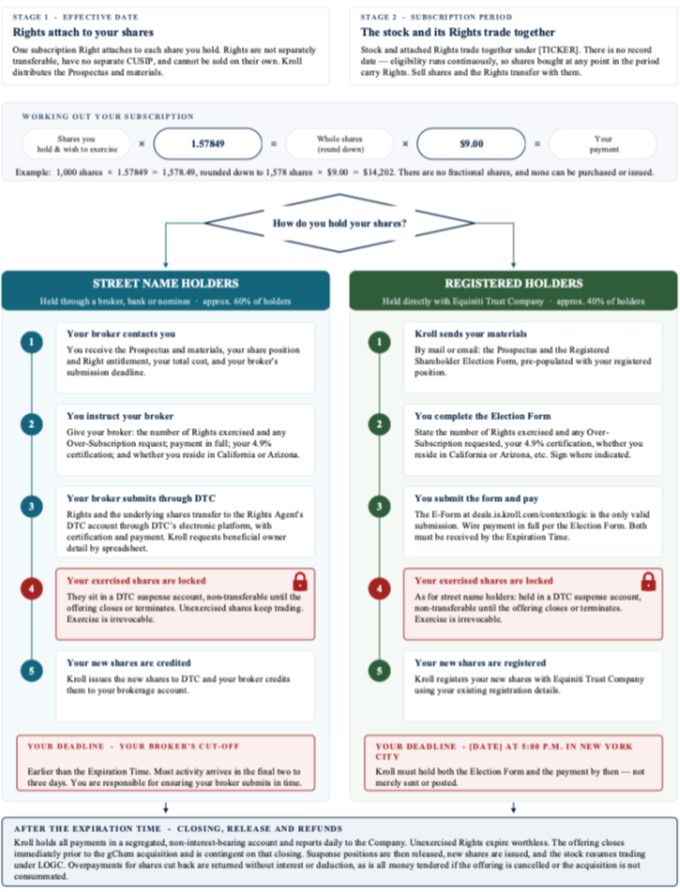
Payment Details
Payment is due in full, in U.S. dollars by wire transfer, at the time you exercise your Rights, and must be received by the Rights Agent by the Expiration Time. The Rights Agent holds all subscription payments in a segregated, non-interest-bearing account until the Rights Offering closes or is terminated. Overpayments in respect to shares cut back will be returned without interest or deduction.
Calculating Your Subscription & Payment:
Basic Subscription Example: If you own 1,000 shares of ContextLogic common stock, you will receive 1,000 Rights and can purchase 1,578 new shares of ContextLogic common stock (1,000 / 0.63351 = 1,578 shares, rounded down to the nearest whole share) for a total payment of $14,202 (1,578 x $9.00).
Over-Subscription Example: Continuing the example above, if you fully exercise your Basic Subscription Right to purchase 1,578 shares and wish to
exercise your Over-Subscription Right, you would indicate the additional number of shares you wish to purchase on your election form and submit the corresponding payment at $9.00 per share. If you request 500 additional shares, you would submit an
additional payment of $4,500 (500 × $9.00). If, after the Expiration Time, only 300 additional shares are allocated to you based on the pro rata allocation, you would receive a refund of
$1,800
((500 – 300) × $9.00), without interest or deduction.
To calculate your payment: Divide your Rights by 0.63351, round down to the nearest whole share, and multiply by $9.00.
Contact Information
Rights Agent (Subscription Processing) / Information Agent (Questions, Assistance):
Kroll Issuer Services US.
285 Fulton Street, 31st Floor, New York, NY 10007
Email: contextlogic@is.kroll.com
Toll-Free: (844) 408-3269
International: (646) 706-7496
This document is for informational purposes only and does not constitute an offer to sell or a solicitation of an offer to buy any securities. Please refer to the Prospectus for complete terms and conditions of the Rights Offering. All information is subject to the final terms set forth in the Registration Statement on Form S-1 filed with the Securities and Exchange Commission.
Exhibit 99.2
CONTEXTLOGIC HOLDINGS INC.
REGISTERED SHAREHOLDER ELECTION FORM
TO BE USED BY HOLDERS OF COMMON STOCK WHO ARE HELD IN REGISTERED FORM ON THE BOOKS OF THE TRANSFER AGENT. HOLDERS OF COMMON STOCK THROUGH DTC ARE NOT REQUIRED TO SUBMIT AN ELECTION FORM, AND SHOULD COORDINATE DIRECTLY WITH THEIR CUSTODIAN/NOMINEE TO EXERCISE THEIR RIGHTS, IF APPLICABLE.
The undersigned acknowledge(s) receipt of the rights offering materials relating to the rights offering (the “Rights Offering”) by ContextLogic Holdings Inc., a Delaware corporation (the “Company”), of non-transferable subscription rights to holders to subscribe for and purchase shares of the Company’s common stock, par value $0.0001 per share (“ContextLogic common stock”). Each subscription right will entitle the holder to purchase 1.57849 shares of ContextLogic common stock at an exercise price of $9.00 per share. Your basic subscription right is calculated by multiplying the number of subscription rights you hold by 1.57849 and rounding down to the nearest whole share.
By completing and submitting this Election Form to the rights agent, you agree to exercise subscription rights to purchase shares of ContextLogic common stock held by you, pursuant to the terms and subject to the conditions set forth in the prospectus, dated [•] (the “Prospectus”). (Check the applicable box and provide all required information.). This Election Form must be received by the rights agent by the Expiration Time (as defined in the Prospectus) via the E-Form available at the following address: https://deals.is.kroll.com/contextlogic. Delivery of this Election Form via the E-Form is the only valid form of submission. By submitting the E-Form to the rights agent, the undersigned has agreed to surrender the applicable stock certificates. By delivering the E-Form, the undersigned agrees that the Company’s transfer agent will place a stop-transfer instruction on the undersigned’s ContextLogic common stock until the expiration of the Rights Offering Period (as defined in the Prospectus). The registered shareholder is not required to submit physical copies of such certificates to the rights agent or company.
Name of Registered Shareholder:
Number of Shares of ContextLogic common stock Held:
| ☐ | Please EXERCISE SUBSCRIPTION RIGHTS as set forth below: |
Complete Line (A) below for your basic subscription right. Complete Line (B) only if you have subscribed in full for all shares available to you under your basic subscription right; if you have not, your over-subscription election will be disregarded.
| No. of Shares |
Per Right Subscription Price |
Payment | ||||||||||||||||
| (A) Basic Subscription Right |
X | $ | 9.00 | = | $ | |||||||||||||
|
|
|
|
|
|
|
|||||||||||||
| (B) Over-Subscription Right |
X | $ | 9.00 | = | $ | |||||||||||||
|
|
|
|
|
|
|
|||||||||||||
| Total Payment Required (A+B) |
|
$ | ||||||||||||||||
|
|
|
|||||||||||||||||
Basic Subscription Right. Each basic subscription right entitles you to purchase 1.57849 shares of ContextLogic common stock at an exercise price of $9.00 per share (the “Basic Subscription Right”). You may exercise all or a portion of your Basic Subscription Rights, or you may choose not to exercise any.
Over-Subscription Right. If you fully exercise your Basic Subscription Right, are a less-than 4.9% holder and other less-than 4.9% holders do not fully exercise their Basic Subscription Right, you may also exercise an oversubscription right (the “Over-Subscription Right”) to purchase additional shares of ContextLogic common stock that remain unsubscribed by such holders at the Expiration Time, subject to availability, pro rata allocation among persons exercising this Over-Subscription Right based on the number of shares subscribed for under their respective Basic Subscription Rights, and the 4.9% ownership described below. You may not exercise the Over-Subscription Right unless you have fully exercised your Basic Subscription Right.
Payment is due in full when you exercise. Because the number of unsubscribed shares is not known until after the Expiration Time, you must remit payment for all shares requested on Lines (A) and (B) at the time you submit this Election Form. If you are allocated fewer shares than you paid for, whether because your Over-Subscription request is reduced pro rata or because your subscription is reduced as a result of the 4.9% ownership limitation described below, the rights agent will return the excess to you, without interest or deduction, as soon as practicable after the Expiration Time, using the refund wire details you provide below.
In order to validly exercise your rights, you must send payment for each share of ContextLogic common stock subscribed for based upon your subscription rights, which is to be remitted to the rights agent via wire.
Wires should be remitted to the below account:
Account Name:
Bank Account No:
ABA/Routing:
SWIFT:
Bank Name:
Bank Address:
Reference: (Name of Registered Holder)
In the event that a refund is required to be sent to you, please provide your wire details:
Domestic Account:
Account Name :
Beneficiary Address:
Bank Account No.:
ABA/Routing No.:
Bank Name:
Bank Address:
Reference:
International Account:
Intermediary Account Name:
Intermediary Beneficiary Address:
Intermediary Bank SWIFT Code/BIC:|
Beneficiary Bank Name:
Beneficiary Bank Address:
Beneficiary Bank SWIFT Code/BIC:
Beneficiary Bank IBAN/Account Number:
Reference:
REQUIRED CERTIFICATIONS
Each item below must be completed. This Election Form will not be accepted unless each item is completed.
| 1. | Total Ownership. Total number of shares of ContextLogic common stock beneficially owned by the undersigned, including the shares registered in this account, any shares held in another registered account, and any shares held through a bank, broker or other nominee: _______________________ shares. |
| 2. | 4.9% ownership certification. In accordance with the restrictions described in the Prospectus, no stockholder, without approval of the ContextLogic Board of Directors (the “Board”), may exercise subscription rights to the extent its pro forma ownership will equal or exceed 4.9% of the outstanding ContextLogic common stock after completion of the Rights Offering. By signing and submitting this Election Form, the undersigned represents that it does not own, and upon completion of the Rights Offering will not own, 4.9% or more of the outstanding ContextLogic common stock, directly or indirectly (as described in the Prospectus), unless previously granted a waiver by the Board. The Company reserves the right to reduce or reject any subscription, under the Basic Subscription Right, the Over-Subscription Right, or both, to the extent that the exercise of some or all of a holder’s subscription may result in a holder becoming a 4.9% or greater stockholder, any existing 4.9% stockholder increasing its ownership of ContextLogic, or certain transfers of any shares by any stockholder owning 4.9% or more of ContextLogic common stock. If your exercise, including any Over-Subscription shares requested on Line (B), would result in ownership of 4.9% or more, you must contact the information agent immediately at contextlogic@is.kroll.com before submitting this Election Form. The rights agent may request disclosure of additional beneficial ownership details for purposes of determining percentage ownership. |
| 3. | State of residence. Check all that apply: |
| ☐ | The undersigned is a resident of the State of California. |
| ☐ | The undersigned is a resident of the State of Arizona. |
| ☐ | Neither of the above. |
| 4. | Ownership of the shares exercised. The undersigned (or the person for whom this election is made, if the undersigned is signing in a representative capacity disclosed in the signature block below) is the beneficial owner of the shares to which the exercised subscription rights attach and will remain the beneficial owner through the delivery of any shares received pursuant to the Basic Subscription Right or Over-Subscription Right. Those shares are not subject to any securities lending, repurchase, pledge, short sale or similar arrangement under which another person holds, or is entitled to receive, the shares or the economic benefit of them, and the shares issued upon exercise will be held for the same beneficial owner. The undersigned in not exercising for an undisclosed principal. |
I (we) on my (our) own behalf, or on behalf of any person(s) on whose behalf, or under whose directions, I am (we are) signing this form:
| • | Irrevocably elect to purchase the number of shares indicated above upon the terms and conditions specified in the Prospectus; and |
| • | Agree that if I (we) fail to pay for the shares I (we) have elected to purchase, the exercise will be invalid. |
| • | Agree that if such shares are transferred following submission of the Registered Shareholder Election Form and/or the applicable purchase, such subscriptions will be deemed invalid. |
| • | Agree that the rights agent and transfer agent will increase your registered holder position in accordance with any validly purchased shares and will register such shares using the same contact details as your current registered shares. |
| • | Represent that the certifications set forth under “Required Certifications” above are true and complete as of the date of this Election Form, and agree to notify the information agent immediately if any of them ceases to be true. |
| Signature: |
| |
| Name: |
| |
| Title: |
| |
| Address: |
| |
| Telephone: |
| |
| Date: |
[•], 2026 |
| Calculation of Filing Fee Tables | |||
| | |||
| | |||
| Table 1: Newly Registered and Carry Forward Securities |
|---|
| Security Type |
Security Class Title |
Fee Calculation or Carry Forward Rule |
Amount Registered |
Proposed Maximum Offering Price Per Unit |
Maximum Aggregate Offering Price |
Fee Rate |
Amount of Registration Fee |
Carry Forward Form Type |
Carry Forward File Number |
Carry Forward Initial Effective Date |
Filing Fee Previously Paid in Connection with Unsold Securities to be Carried Forward | ||
|---|---|---|---|---|---|---|---|---|---|---|---|---|---|
| Newly Registered Securities | |||||||||||||
| |
1 | |
|
|
$ |
|
$ |
||||||
| Fees Previously Paid | |||||||||||||
| Carry Forward Securities | |||||||||||||
| Carry Forward Securities | |||||||||||||
| Total Offering Amounts: |
$ |
$ |
|||||||||||
| Total Fees Previously Paid: |
$ |
||||||||||||
| Total Fee Offsets: |
$ |
||||||||||||
| Net Fee Due: |
$ |
||||||||||||
| Offering Note |
| 1 |
| ||||||
| | |||||||
| Table 2: Fee Offset Claims and Sources |
|---|
| Registrant or Filer Name | Form or Filing Type | File Number | Initial Filing Date | Filing Date | Fee Offset Claimed | Security Type Associated with Fee Offset Claimed | Security Title Associated with Fee Offset Claimed | Unsold Securities Associated with Fee Offset Claimed | Unsold Aggregate Offering Amount Associated with Fee Offset Claimed | Fee Paid with Fee Offset Source | |||
|---|---|---|---|---|---|---|---|---|---|---|---|---|---|
| Rules 457(b) and 0-11(a)(2) | |||||||||||||
| Fee Offset Claims | |||||||||||||
| Fee Offset Sources | |||||||||||||
| Rule 457(p) | |||||||||||||
| Fee Offset Claims | |||||||||||||
| Fee Offset Sources | |||||||||||||
| Table 3: Combined Prospectuses |
|---|
| Security Type |
Security Class Title |
Amount of Securities Previously Registered |
Maximum Aggregate Offering Price of Securities Previously Registered |
Form Type |
File Number |
Initial Effective Date | |
|---|---|---|---|---|---|---|---|